
I spend most of my working week inside AI writing tools. I have used them to outline, to summarize transcripts, and to draft articles I then tore down and rebuilt by hand because the first pass was not fit to publish. So this is not a piece arguing that AI content is poison. It is about what happens when nobody stands between the tool and the publish button, written by someone who has watched that mistake play out in real dashboards more than once.
Between late 2022 and 2024, some very large names ran that experiment in public. The results were brutal and unusually well documented, because reporters at Futurism, The Verge and The Washington Post kept receipts, and because Google eventually started swinging back.
Below are six sites that paid a real price. Not vague traffic dips: counted corrections, a fired CEO, a terminated brand license, deindexed domains, and a company that sold for a fifth of its purchase price. For each one: what they published, what broke, and the number that stung.
The short version CNET, Sports Illustrated, Causal, Gizmodo's io9, Men's Journal and Reviewed all took public, documented damage tied to AI-generated content between 2022 and 2024. The common failure was never the technology. It was publishing at a scale no editor checked, hiding machine output behind fake or vague bylines, and treating Google's quality systems as a loophole instead of a wall. |
The damage, at a glance
| Site | The AI play | What broke first | The number that hurt |
|---|---|---|---|
| CNET | 77 finance explainers from an in-house AI tool, byline "CNET Money Staff" | Accuracy and originality | 41 of 77 corrected; sold for $100M after a $500M purchase |
| Sports Illustrated | Product reviews under invented authors with AI-generated headshots | Reader trust, then the license | Stock down 20%+ in a day; license gone within 8 weeks |
| Causal | 1,800 AI articles cloned from a rival's sitemap | Google's patience | 600K+ weekly visits at peak, wiped within months |
| Gizmodo (io9) | "Gizmodo Bot" Star Wars listicle, no editor involved | Basic facts, staff trust | A chronological list that was not chronological |
| Men's Journal | AI health explainer labeled reviewed and fact-checked | Medical accuracy | 18 errors in roughly 700 words |
| Reviewed | Outsourced shopping content from contractor AdVon | Authorship transparency | Site shut down in 2024; 73 jobs cut |
How this list was built: every claim traces to on-the-record reporting, from Futurism, The Verge, CBS, NBC, Fortune, Business Insider and Originality.ai's deindexing dataset. Where a figure is an estimate, I say so. Rumored-but-unproven cases did not make the cut.
1. CNET: 41 corrections and a $400 million haircut
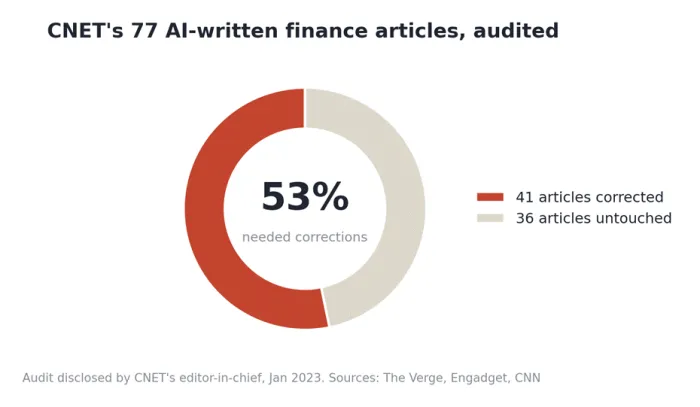
Starting in November 2022, CNET quietly published 77 finance explainers under the byline "CNET Money Staff." The pieces came from an internally built AI engine, and the only disclosure lived in a hover-over note. Futurism noticed in January 2023, then found factual errors and passages suspiciously similar to earlier articles published elsewhere.
| The play | 77 SEO finance explainers generated by an in-house AI tool, with disclosure buried in a byline dropdown |
| Who caught it | Futurism, January 2023, with follow-up reporting from The Verge |
| What broke | Accuracy and originality. An internal audit forced corrections on 41 of 77 articles, some "substantial" per the editor-in-chief, and several notes admitted phrases were not entirely original |
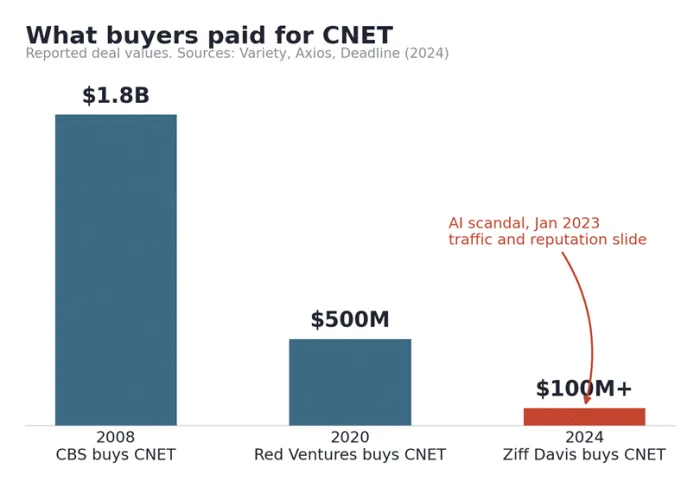
| The damage | AI publishing paused. Wikipedia editors downgraded CNET's reliability in 2024. Red Ventures, which paid $500 million in 2020, sold CNET to Ziff Davis in 2024 for just over $100 million |
| Status in 2026 | Publishing under Ziff Davis and rebuilding trust the slow way |
A 53 percent correction rate is not an editing miss. It is proof the review step existed on paper only. The scandal came first; the traffic slide and fire-sale price came after. The AI mess alone did not erase $400 million of value, the ad market was rough everywhere, but nobody negotiating that sale was helped by a results page full of correction stories.
2. Sports Illustrated: fake writers, real layoffs
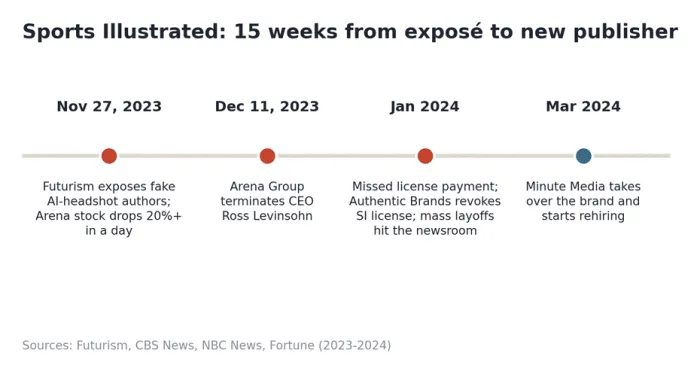
On November 27, 2023, Futurism reported that SI product reviews carried bylines like "Drew Ortiz" and "Sora Tanaka," writers who did not exist, with headshots traced to a marketplace selling AI-generated faces. Once Futurism started asking questions, the profiles quietly vanished.
| The play | Shopping content supplied by contractor AdVon Commerce under invented bylines |
| Who caught it | Futurism, November 27, 2023 |
| What broke | Trust, instantly. Arena Group's stock fell more than 20 percent the next day. The company blamed AdVon pen names, pulled the content and ended the partnership. The SI union said it was "horrified" |
| The damage | CEO Ross Levinsohn was out two weeks later. In January 2024 Arena missed a quarterly license payment, Authentic Brands revoked the SI license, and mass layoffs hit the newsroom |
| Status in 2026 | The brand survives under Minute Media, which took over in March 2024 and began rehiring laid-off staff |
SI's journalists never wrote a word of it. The commerce content ran in a corner of the site most readers ignored. It did not matter. The brand absorbed the hit, and within fifteen weeks the company running the magazine had lost it.
3. Causal: the SEO heist Google unwound
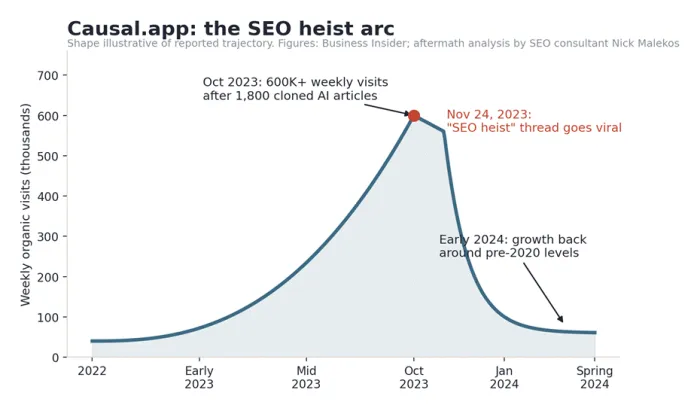
This was not a legacy publisher stumbling. It was a growth stunt. A consultant working for Causal, a business planning startup, exported the sitemap of Exceljet, a well-loved Excel tutorial site, turned its roughly 1,800 URLs into article titles, and generated 1,800 posts on the same topics. On November 24, 2023, he bragged about it on X, opening with "We pulled off an SEO heist" and claiming 3.6 million in stolen traffic.
| The play | 1,800 AI articles cloned topic-for-topic from a competitor's sitemap |
| Who caught it | The consultant outed himself; Business Insider then investigated in depth |
| What broke | Quality first. Exceljet's founder found factual errors in the clones, including an Excel feature that does not exist, one surfaced by Google as a featured snippet. Then rankings broke |
| The damage | Causal had climbed past 600,000 weekly visits by October 2023. After the thread went viral, the spike collapsed. One post-mortem put the whole run at about four months, ending with organic growth worse than before the stunt, near pre-2020 levels |
| Collateral | Exceljet slid from about 2 million monthly visits in 2022 to just over 1 million in 2023, though Business Insider noted other factors may have contributed to that decline |
The part SEO Twitter skipped: 1,800 thin pages act like a sitewide anchor. Google weighs quality at the domain level, so when the junk got reweighed, the legitimate pages sank with it. The stunt torched roughly two years of real growth for a company that needed leads, not pageviews.
4. Gizmodo's io9: a chronological list that wasn't
On July 5, 2023, days after G/O Media announced a "modest test" of AI content, a byline called Gizmodo Bot published "A Chronological List of Star Wars Movies & TV Shows" on io9. The list was not in chronological order. It skipped Andor, Obi-Wan Kenobi and The Book of Boba Fett entirely, and placed The Clone Wars after The Rise of Skywalker.
| The play | A corporate-mandated AI listicle pushed live with zero involvement from the desk it appeared on |
| Who caught it | io9's own staff, within minutes of publication |
| What broke | The facts, and the newsroom. Deputy editor James Whitbrook said he got about ten minutes of notice, sent management a list of corrections, and publicly called the piece "embarrassing, unpublishable, disrespectful." The union condemned the test |
| The damage | A week later the piece still sat on page one of Google for Star Wars movies, errors included, a second news cycle in itself. G/O Media sold Gizmodo to Swiss publisher Keleops in June 2024 |
| Status in 2026 | io9's credibility largely survived, because its humans revolted loudly and fast |
The uncomfortable lesson here: bad AI content can rank, for a while. The penalty arrives on trust first and traffic later, which is exactly why teams keep convincing themselves the strategy is working right up until it is not.
5. Men's Journal: 18 errors in roughly 700 words
In February 2023, Arena Group's Men's Journal published its first AI-generated story, "What All Men Should Know About Low Testosterone," under the byline "Men's Fitness Editors" and labeled as reviewed and fact-checked by the editorial team.
| The play | AI health explainers assembled from archival content, presented as vetted |
| Who caught it | Futurism, which handed the piece to Dr. Bradley Anawalt, chief of medicine at the University of Washington Medical Center |
| What broke | Medical accuracy. Anawalt flagged 18 errors in roughly 700 words, including conflating low testosterone with hypogonadism, and said it carried "the ring of truth" alongside many false and misleading notes |
| The damage | The article was corrected so heavily it became nearly unrecognizable. That same month, the print magazine ceased publication and subscribers were shifted over to Sports Illustrated |
| Status in 2026 | The episode is now a stock citation in research on medical misinformation |
That works out to one error every 39 words, in a health article, wearing a fact-checked label. This is where sloppy AI output stops being embarrassing and starts being dangerous, and it is exactly the content Google's raters are told to hold to the highest bar.
6. Reviewed: the testing site that lost the benefit of the doubt
Reviewed was Gannett's product-testing operation, the USA Today network's answer to Wirecutter, with journalists running actual labs. In October 2023, its own unionized staff flagged a batch of oddly stiff shopping articles credited to writers nobody could find on LinkedIn or anywhere else.
| The play | Outsourced commerce content from AdVon, the same contractor at the center of the Sports Illustrated scandal |
| Who caught it | Reviewed's union staff, October 2023 |
| What broke | Authorship transparency. Gannett denied AI was involved and blamed missing disclosures on the vendor. A later Verge investigation reported former AdVon employees saying some of the company's content was AI-generated |
| The damage | Gannett shut Reviewed down on November 1, 2024, cutting 73 jobs. A spokesperson pointed to heavy reliance on search traffic and Google's algorithm changes degrading the business model |
| Status in 2026 | Gone. The testing lab is history and the archive redirects |
To be fair about causation: the AdVon mess did not shut Reviewed by itself. Google's commerce updates were grinding down every reviews site by 2024. But a product-testing brand runs entirely on the belief that a human touched the product. Once that belief cracked in public, there was nothing left to defend when the traffic went.
The bigger purge nobody wrote obituaries for
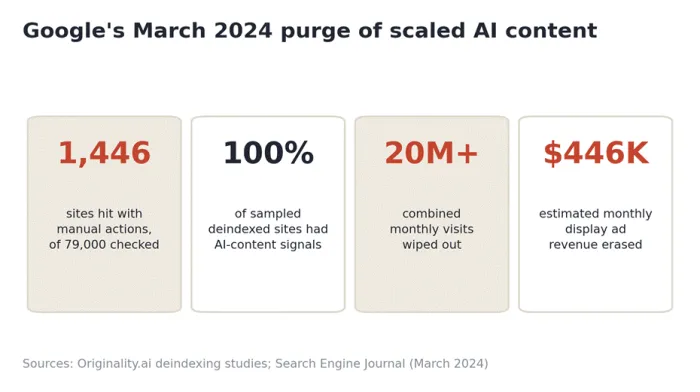
The six names above got coverage because they are famous. The wider damage landed on sites you have never heard of. On March 5, 2024, Google announced a core update and a spam update targeting what it now calls scaled content abuse, with a stated goal of cutting unhelpful content in search by 40 percent. Manual actions started landing within days.
Originality.ai checked 79,000 sites and found 1,446 hit with manual actions, roughly 2 percent, together losing more than 20 million monthly visits. Every deindexed site in its sample showed signs of AI-generated content, and half ran 90 to 100 percent AI posts. The firm estimated about $446,000 in monthly display ad revenue evaporated. Some were businesses doing over a million visits a month. They went to zero overnight.
What actually broke, in every single case
Line the six cases up and the pattern is almost boring. Not one of them failed because a model wrote a clumsy sentence. They failed at the system level, in four repeating ways.
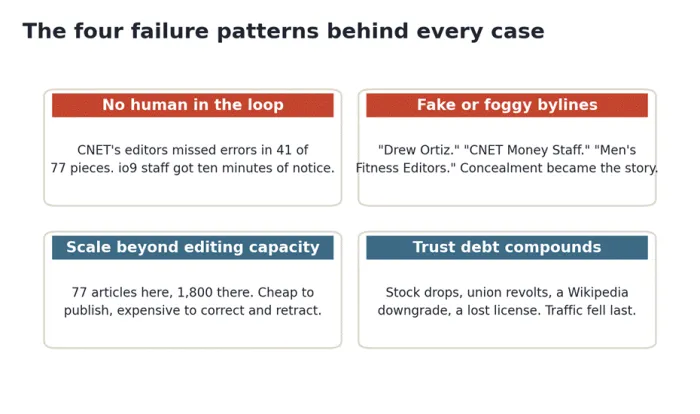
That graphic is the audit. Miss one box and you carry the same risk these sites did, minus the headlines so far.
What the people closest to it said
Do not take my framing for it. Here is how the people closest to each collapse put it, on the record.
He got roughly ten minutes of notice, sent G/O Media a list of corrections, and called the piece "embarrassing, unpublishable, disrespectful." James Whitbrook, deputy editor, io9 (public statement, July 2023) |
Counted 18 errors in the Men's Journal AI article and warned it mixed "the ring of truth" with false and misleading claims about basic male health. Dr. Bradley Anawalt, chief of medicine, UW Medical Center (to Futurism, February 2023) |
Said members were "horrified" by the report and that the content did not represent its working journalists. The Sports Illustrated Union (statement, November 2023) |
Reported that every site in its sample hit with a Google manual action showed signs of AI-generated content, and that half were publishing almost nothing else. Originality.ai research team (deindexing studies, March 2024) |
My verdict after three years inside these tools
Here is where I land, after three years of daily use and a week spent re-reading every correction note and layoff memo above. AI did not sink any of these sites. Unsupervised AI at scale did. Every case traces back to the same decision: someone removed the person whose job was to say, this is wrong and we are not publishing it. CNET had editors assigned to its AI pieces and still corrected more than half of them. That is not a tooling gap. That is a process that existed only in a slide deck.
The rules I work by now, learned partly from my own near-misses: the model drafts, a named human owns every fact. Never publish faster than you can verify. Put a real byline on it or do not ship it, because in every case above the concealment did more damage than the errors. And treat Google's spam policy as a wall, not a puzzle. The heist crowd picked puzzle and paid with two years of growth.
The part that stays with me is not the famous names. They can eat a bad quarter. It is the 1,446 anonymous sites in the March 2024 wave, some doing a million visits a month, gone overnight with no obituary. The cost of bad AI content is not the traffic you lose. It is the trust you cannot buy back at any price. Ask whoever signed the $100 million check for a $500 million website.