
The first content calendar I built for a client had forty-odd post ideas on it, and I was proud of it for about a month. Then I pulled the site's search data and saw what the calendar had produced: three posts competing for the same query, a dozen posts nothing linked to, and a "complete guide" ranking below two of its own follow-ups. The posts were fine. The strategy was a list.
Content pillars fixed that, and they have fixed it on every site I've worked on since, but only once I stopped treating them as a diagram and started treating them as decisions. Which topics you commit to. What the main page for each one has to do. Which articles support it, how they link, and what gets cut when it stops earning its place.
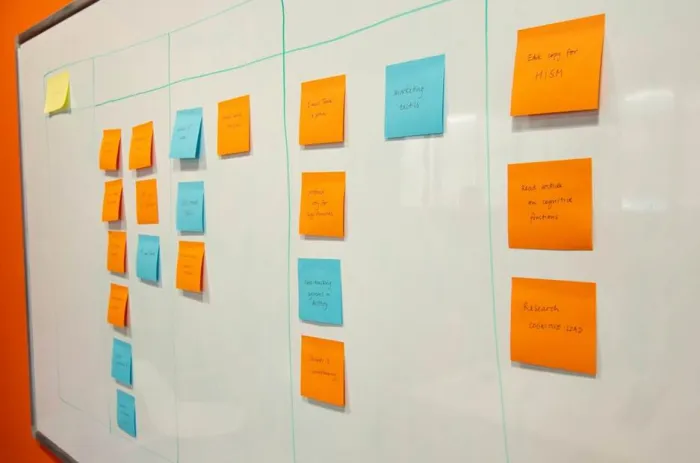
This guide is the process I use, followed by a real blog mapped into pillars so you can see the structure on a live site instead of a whiteboard. For the definition itself, start with what a content pillar is. This article is about turning the concept into a strategy.

THE SHORT VERSION • A pillar is a topic you commit to owning: one hub page plus cluster articles that link to it and to each other. • Pick three to five from the overlap between what you sell and what readers search for. • Write the linking rules down, then review quarterly: update what has demand, merge what overlaps, cut what never earned a click. |
What a content pillar is, and what it is not
Four things look alike inside a CMS and do different jobs. A pillar is a commitment: a topic your site intends to be the best answer for. The pillar page is the hub article for that topic. Cluster articles answer one question each and point back to the hub. Categories and tags are storage. They help a reader browse and prove authority on nothing.
| ELEMENT | WHAT IT IS | HOW MANY | ITS JOB |
|---|---|---|---|
| Pillar (topic) | A subject you commit to covering completely | 3 to 5 for most sites | Decides what you publish and decline |
| Pillar page | The hub article for that topic | One per pillar | Ranks for the broad term, routes readers onward |
| Cluster article | A focused post answering one question | 8 to 20 per pillar | Ranks for long-tail queries, feeds the hub |
| Category or tag | A CMS label | As many as you like | Helps browsing. No strategy on its own |
HubSpot's team popularized the model after experiments that began in 2016: the more deliberately they interlinked related posts, the higher the pillar placed in search results, and impressions rose with the number of links. It stuck because it organizes a site around topics, the way search engines already read the web.
Why pillars beat a calendar full of one-offs
The case for structure has only grown stronger. Three numbers I reach for when someone asks why they can't simply publish more:
96.55% of pages get no Google traffic at all, in Ahrefs' study of around 14 billion pages. Most had no links pointing in or covered topics nobody searches. Pillars fix both up front. Source: Ahrefs, search traffic study | 97% of B2B marketers say they have a content strategy, yet only 12% rate their marketing as highly effective. Where strategy improved, 74% credited refining it, ahead of new technology at 51%. Source: CMI B2B trends survey, 1,015 marketers, 2025 | Fan-out Google says AI Overviews and AI Mode may issue several related searches across subtopics to build one answer. A hub plus a dozen linked subtopic pages is a dozen chances to be pulled in. Google also warns against thin pages for every sub-query; a real cluster list prevents that. Source: Google Search Central, AI features documentation |
How to build the strategy, step by step
Seven steps. The first two hold most of the thinking. The last two are where most teams stop too early.
Step 1. Pull pillar candidates from three places
• What you sell, phrased as the problem it solves. An AI writing tool sells faster drafts, so "writing with AI without sounding like it" qualifies. "AI" on its own does not. • What people ask you. Sales calls, support tickets, the question in every onboarding. • What already ranks. Export your top pages and look for accidental clusters nobody planned. |
Expect ten to fifteen candidates. You will keep three to five.

Step 2. Run each candidate through four questions
| QUESTION | PASS LOOKS LIKE | FAIL LOOKS LIKE |
|---|---|---|
| Is there demand across the whole topic? | Dozens of related queries | One head term and a few variants |
| Can you say something a competitor can't? | First-hand use, data, customers or a firm opinion | You'd be summarizing other guides |
| Does ranking for it bring readers who might buy? | The topic sits next to the purchase decision | Near your brand, far from your product |
| Can you sustain 8 to 20 articles on it? | Subtopics keep coming | You run dry at five |
Step 3. Give the pillar page a job before you write it
| DECISION | WHAT I SETTLE BEFORE DRAFTING |
|---|---|
| Target term | The broad query to own, plus the three or four questions it must answer in full |
| Length | Every subtopic at overview depth. 2,000 to 4,000 words is typical |
| Structure | A table of contents, one section per subtopic, each ending with a link to the deeper cluster post |
| Freshness | An owner, a review date, and a list of the statistics that will age |
| Conversion | One call to action matched to the reader's stage, placed after they've had value |
A written brief for the hub saves more rewrites than anything else here. This breakdown of what a content brief is shows the fields worth filling.
Step 4. Map the cluster by intent, not by keyword list
| INTENT | TITLE PATTERN | WHAT IT DOES FOR THE PILLAR |
|---|---|---|
| Definition | What is X | Catches the query the hub only summarizes |
| How-to | How to do X, step by step | Earns links from sibling posts and shows real process |
| Comparison | X vs Y, or X alternatives | Reaches readers close to a decision |
| Problem | Why X goes wrong and how to fix it | Builds trust. These get shared |
| Proof | I tested X, or a case study | Supplies the first-hand experience search engines reward |
Aim for a mix; eight how-tos and nothing else reads like a manual. Plan eight to twelve articles and mark which already exist. An audit usually shows a third of the cluster is half-written; this is how I run a content audit before planning anything new.
Step 5. Write the linking rules down
1. Every cluster links to its hub in the first third of the body, with anchor text that names the topic. Never "click here". 2. The hub links to every cluster from the section that summarizes it. 3. Clusters link to two or three siblings where a reader would need them. Not a footer block of ten. 4. Anchor text varies. One phrase repeated on every link reads as mechanical. 5. No two posts in a cluster target the same query. If they do, merge them (Step 7). |
These five lines sit in my brief template. For how the link graph shapes what search engines think you know, read building topical authority cluster by cluster.
Step 6. Sequence the publishing
| PHASE | WHAT SHIPS | WHY THIS ORDER |
|---|---|---|
| Weeks 1 to 4 | Hub for pillar one, plus its three clearest-demand clusters | The hub exists before anything points at it |
| Months 2 to 3 | Remaining clusters for pillar one; hub for pillar two | One pillar reaches critical mass first |
| Months 4 to 6 | Clusters for pillar two; refresh pillar one with new links and numbers | Early pages get updated while young |
| Month 6 onward | Pillars three to five, same pattern | The process is proven before it scales |
Set expectations in writing. Ahrefs puts the share of new pages reaching the top ten within a year at 1.74%, and 72.9% of top-ten pages are over three years old. The first quarter builds the base.
Step 7. Review every quarter and prune
| SIGNAL | ACTION |
|---|---|
| Impressions, poor click rate | Rewrite the title and meta description; check the intent match |
| Two posts rank for the same queries | Merge into the stronger URL, redirect the other |
| No clicks for two quarters, no links | Cut it, or fold the usable parts into a sibling |
| Hub ranks below one of its clusters | The cluster answers the head term better. Expand the hub or swap roles |
| New questions keep appearing | Add them as clusters. The pillar is working |
The update-or-rewrite call is its own skill, and this rule of thumb for when to update an old post versus writing a new one is the one I use.
A real example: the pillars hiding in an AI writing tool's blog
Here is the exercise on a live site: the blog of WriteNexa, an AI writing tool for SEO content. It holds about 220 posts across five categories, and 167 of them sit in one called AI Tools; the content pillar guide itself is filed there. That isn't a criticism. Categories are storage. Read as a pillar map, the archive shows four pillars, each with a plausible hub and clusters already live.
Example 1. The archive, read as four pillars
| PILLAR | HUB PAGE | CLUSTER POSTS ALREADY LIVE | GAP TO FILL |
|---|---|---|---|
| 1. Content strategy and topical authority | HUB PAGE What Is a Content Pillar? A Complete Guide | Topical authority, cluster by cluster Content pillars for Instagram, LinkedIn and YouTube Content audit: update, merge or cut Update an old post or write a new one? This article, the how-to the hub only summarizes | A calendar-from-pillars how-to and an examples-by-industry post. Both have demand. |
| 2. Writing with AI without sounding like it | HUB CANDIDATE | Editing AI writing so it sounds like you AI habits that make content sound generic Giving an AI writer enough context Adding first-hand experience for E-E-A-T | Deepest cluster on the site, but the hub reads as a practical guide, not the definitive overview. Expand it and point every post here at it. |
| 3. AI writing tools, tested | HUB PAGE | Best budget AI writing tools, tested Wordtune tested with 45 planted errors | Plenty of single-tool reviews. A "how we test" methodology post would anchor the proof intent and attract links. |
| 4. Getting found, in Google and in AI answers | HUB PAGE | Optimizing a post for one target keyword Getting cited by ChatGPT and Perplexity | Two posts circle the same ChatGPT and Perplexity question. Check Search Console for split impressions; merge if needed. |
WHERE I'D TIGHTEN IT • The related posts block under the pillar guide shows the six newest posts, not the six closest. Swap in the cluster list and the hub starts working. • Make categories match pillars, or hide the counts. "AI Tools (167)" tells a reader nothing about structure. |
Mistakes that quietly sink pillar strategies
Picking pillars from the org chart "Product updates" is a department, not a reader problem. Pillars come from what readers ask. | Writing the hub last Clusters go live with nowhere to link, and by the time the hub arrives each has settled for a related query. |
Treating the hub like a landing page A hub that sells in the first screen earns neither links nor the time on page that keeps it ranking. Teach first. | Outsourcing the first-hand parts A cluster of summaries ranks like a summary. Tested, measured and opinionated posts are what make a pillar worth linking to. |
A one-page template you can copy
Everything above fits on one sheet per pillar, kept where anyone writing for the site can see it.
| FIELD | FILL IN |
|---|---|
| Pillar name | The topic in the reader's words |
| Hub URL and target term | One page, one broad query, the must-answer questions |
| Cluster list | Title, intent, status: published, planned, or merge |
| Linking rules | The five from Step 5, copied in full |
| Owner and review date | One name, one quarter |
| Success metrics | Hub ranking, cluster impressions, assisted conversions |

Final verdictAfter running this on my own sites and on the archive in the example above, my advice to anyone starting out is that the pillar model is mostly an editing discipline. The writing is the smallest part. The hard part is saying no to the thirtieth post that belongs nowhere, writing the linking rules down so they survive a staff change, and reading the quarterly numbers frankly enough to merge a post you happen to like. What surprised me in the example was how much structure already existed. Three of the four hubs were there. The proof-style reviews, where someone plants 45 grammar errors or hits a paywall on purpose, are the first-hand cluster content most sites never manage. The gaps were all about connection, and a week of fixing them changes how the whole archive reads. Using an AI writer for cluster drafts has been fine: title and keyword in, a draft with sensible headings out, then the editing pass every AI draft needs. What it can't do, and what no tool should be asked to do, is choose the pillars. That decision is the strategy. Everything else is execution. |