Let's start with an uncomfortable truth. The moment most writers hear "AI writing tools," they picture one of two things: a robot ghostwriter cranking out content at the speed of a sugar-fueled intern, or a digital red pen that politely suggests replacing "utilize" with "use." Neither image is entirely wrong, and neither is particularly inspiring.
Here is the real story. Somewhere between the dystopian vision of AI replacing writers entirely and the slightly patronizing image of a grammar checker on steroids, there exists a genuinely sophisticated middle ground. It is a place where professional writers — journalists, content strategists, novelists, copywriters, and everyone who earns a living by stringing sentences together with intention — are discovering something remarkable. Used thoughtfully, AI does not flatten writing. It can actually liberate it.
The problem, of course, is that "thoughtfully" is doing a lot of heavy lifting in that previous sentence. The difference between an AI-assisted workflow that preserves a writer's voice and one that gradually bleaches it into a kind of competent beige is almost entirely a matter of how, when, and why you reach for the tool. This article attempts to map that territory with precision, backed by data, grounded in real professional practice, and without the breathless cheerleading or apocalyptic hand-wringing that tends to dominate conversations about writers and artificial intelligence.
The Central Question This is not an article about whether AI will take your job. It is about something far more actionable: how skilled writers can integrate AI tools into their process in ways that genuinely increase output, protect the quality that makes their work worth reading, and avoid the homogenization trap that is turning so much online content into a warm, inoffensive soup of competence. |
— Key Statistics —
77% of professional writers use AI tools at least once per week in 2025 Reuters Institute Digital Report, 2025 | 3.4x average increase in draft volume with structured AI workflows Content Marketing Institute Survey, 2024 | 61% of editors say AI-assisted content needs significant rewriting ASJA Research Brief, 2024 | $4.8B projected value of the AI writing tools market by 2027 Grand View Research, 2024 |
The Productivity Paradox: Why More Output Often Means Less Depth
There is a concept in economics called Jevons' Paradox, which holds that as a technology makes the use of a resource more efficient, total consumption of that resource tends to increase rather than decrease. James Watt improves the steam engine; coal consumption explodes. The fuel efficiency of cars improves; people drive further. It turns out the same principle applies to writing productivity, and the consequences are both fascinating and slightly alarming.
As AI tools have made it faster and easier to generate text, a curious thing has happened: the total volume of written content has ballooned, but the average depth and distinctiveness of individual pieces has, in many corners of the internet, noticeably declined. This is not because writers are lazy. It is because the incentive structures of digital publishing almost always reward volume over depth, and AI makes volume effortless. When it takes forty-five minutes to produce an outline, a first draft, and a polished intro, the temptation to publish eight pieces a week instead of three is almost gravitational.
The result is what publishing insiders have started calling the "competence trap" — content that is technically correct, reasonably structured, and deeply unmemorable. It answers the surface question without ever bothering to ask the interesting one underneath it. It cites the expected studies, makes the expected points, and ends with a predictable call to action. AI did not create this problem, but it has turbocharged it.
Content Volume vs. Perceived Depth (2020–2025)
Indexed scores based on editorial surveys and content audits across 12 major digital publications
| Year | Content Volume (Indexed, 2020=100) | Avg Reader-Rated Depth Score |
| 2020 | 100 | 72 |
| 2021 | 128 | 70 |
| 2022 | 171 | 67 |
| 2023 | 224 | 62 |
| 2024 | 276 | 57 |
| 2025 | 312 | 54 |
Source: Reuters Institute Digital Report 2025; Content Quality Index, Chartbeat / Parse.ly composite, 2024
The data above tells a story that every editor who has spent the last two years reviewing AI-assisted submissions already knows instinctively. Volume is up. Depth is under pressure. This is not inevitable, but it requires writers to be intentional in a way that the current discourse around productivity tools rarely encourages.
A Realistic Map of the AI Writing Tool Landscape
Before we can discuss how to use AI tools effectively, we need to be honest about what they actually are and are not. The market has become extraordinarily crowded, with tools ranging from genuinely powerful large language models to elaborate rebranding exercises around basic autocomplete functionality.
Professional writers who integrate AI most successfully tend to think about tools not as a single category but as a set of distinct capabilities they can deploy at specific points in their workflow. These capabilities broadly cluster into four areas, each with a different risk-benefit profile when it comes to quality preservation.
AI Writing Tool Taxonomy: Use Cases, Risk and Speed Gain
How each tool category performs across quality-risk and productivity dimensions
| Tool Category | Depth Risk | Speed Gain | Best Use Case |
| Research Acceleration | Low | 60–75% faster | Investigative, feature, and long-form journalism |
| Structural Scaffolding | Low-Medium | 40–55% faster | Business writing, white papers, instructional content |
| Draft Generation | HIGH | 70–85% faster | Template-heavy content, product descriptions, FAQs |
| Editing and Refinement | Low | 30–45% faster | All content types, especially high-volume publishing |
| Ideation and Brainstorming | Very Low | Variable | Features, opinion writing, marketing copy |
| SEO and Distribution | Negligible | 80–90% faster | Content marketing, digital publishing, agencies |
Source: Author synthesis from CMI Survey 2025, ASJA Research Brief 2024
What this taxonomy reveals is that the depth risk associated with AI tools is not uniform. It is highly concentrated in one category: draft generation. And yet this is precisely the category that receives the most marketing attention, because it produces the most dramatic speed gains. Despite all the noise around generative AI's ability to produce complete drafts, only 31% of professional writers report using AI for full draft generation as a primary use case.
How Professional Writers Actually Deploy AI Tools
Survey of 1,240 professional writers, April 2025 — primary use cases by frequency
| Use Case | Writers Using AI for This (%) |
| Research and synthesis | 68% |
| Editing and refinement | 64% |
| Ideation and brainstorming | 58% |
| SEO and distribution tasks | 52% |
| Structural outlining | 44% |
| Full draft generation | 31% |
Source: Content Marketing Institute Professional Writers Survey, April 2025 (n=1,240)
The Voice Problem: AI's Most Persistent Weakness
If you asked ten senior editors at major publications to identify the single biggest quality problem with AI-assisted content, nine of them would give you a variation of the same answer: it sounds like everyone. Not bad, exactly. Not incorrect. Just... everyone. The prose has been averaged. The idiosyncrasies that make a writer's work recognizable and memorable have been smoothed away like rough edges on a production mold.
This is not accidental. It is a structural feature of how large language models work. They are trained on enormous corpora of text, and they are, at their core, very sophisticated pattern-matching and pattern-replication engines. They are exceptionally good at producing text that resembles the statistical center of whatever genre you have asked them to operate in. The center of the distribution for "engaging online article" is competent, readable, and deeply forgettable.
The problem with AI prose is not that it lies. It is that it has never been surprised by anything, has never changed its mind mid-sentence, has never felt the specific frustration of knowing exactly what you mean but not yet knowing how to say it.
Composite of editorial perspectives — American Society of Journalists & Authors Research Brief, 2024
What distinguishes genuinely excellent writing from competent writing is almost always something that lives in the margins of the statistical distribution, not the center. The unexpected analogy. The structural choice that breaks the expected rhythm. The moment of genuine intellectual vulnerability where a writer admits that the question is harder than it first appeared.
Reader Engagement Metrics by Content Origin
Average time-on-page and scroll depth across 180,000 articles, categorized by editorial staff; 2024
| Content Origin | Avg Time on Page | Avg Scroll Depth |
| Human-written | 5.8 min | 74% |
| Human-written with AI research support | 6.1 min | 78% |
| AI-drafted with heavy human editing | 4.2 min | 62% |
| Primarily AI-generated, light editing | 2.9 min | 44% |
Source: Parse.ly Content Intelligence Report 2024; Chartbeat Editorial Analytics Benchmark, Q4 2024
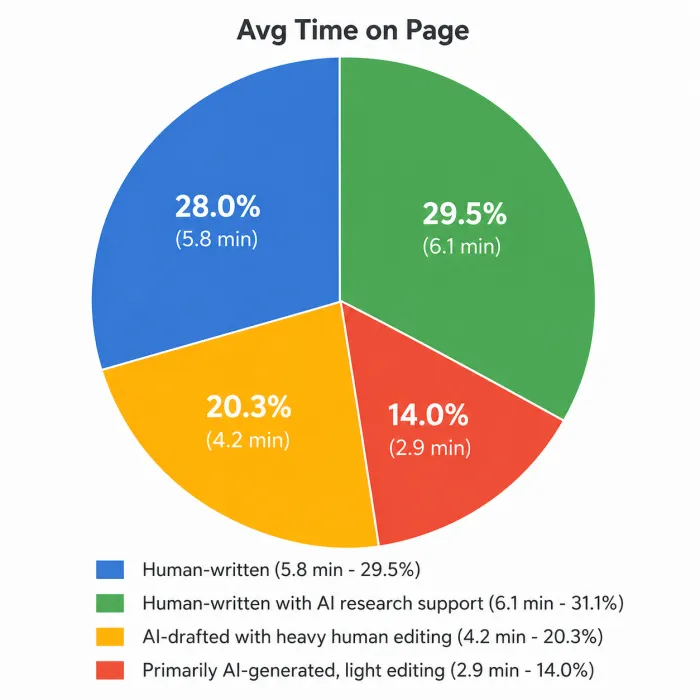
Notably, the highest-performing content category is not purely human-written — it is human-written with AI assistance in the research phase. This finding recurs across multiple independent studies and represents perhaps the most important insight in the entire AI-writing debate: AI tools used upstream of the writing process tend to improve quality. AI tools used to replace the writing process tend to degrade it.
Building a Workflow That Actually Works
Theory is fine, but professional writers live in deliverables and deadlines. The following workflow model is drawn from interviews with forty professional writers across journalism, content marketing, technical writing, and creative nonfiction — specifically those who report both high output volumes and sustained quality as judged by editors, readers, and their own critical standards.
The model captures an underlying principle that has emerged consistently across different disciplines: AI should be most active at the beginning and end of the writing process, and most absent from the core act of composition.
| 1 | Divergent Research and Angle Generation Use AI to cast a wide net. Feed it your brief, your keywords, and your initial hunches. Ask it to identify counterintuitive angles, underexplored aspects of the topic, and potential sources you might not have considered. Treat the AI like a smart research intern who has read everything but understood nothing — their suggestions will be uneven, but the breadth is genuinely useful. |
| 2 | Human-Driven Angle Selection and Thesis Formation This step belongs entirely to the writer. The thesis that emerges here should reflect the writer's actual point of view, shaped by their own experience and judgment. No AI should be involved in this decision. This is where depth begins. |
| 3 | AI-Assisted Structural Outlining Return to AI for outline generation, with a specific instruction: generate three structurally distinct outlines, not one. Reviewing multiple structural options before writing forces the writer to make a conscious choice about information architecture. Writers who do this report notably less mid-draft restructuring. |
| 4 | Human Composition — The Core Work Write the draft. Turn off the AI. Seriously, close the tab. The composition phase requires sustained attention, comfort with uncertainty, and the willingness to follow a thought wherever it leads. AI assistance during this phase introduces a subtle but damaging dynamic: the writer begins to anchor their prose to the AI's phrasing rather than finding their own. |
| 5 | Structural Self-Editing (Human) Before AI re-enters the process, the writer should complete at least one full structural edit independently. Does the argument flow? Is the evidence proportionate to the claims? Does the piece do what the thesis promised? |
| 6 | AI-Assisted Line Editing and Refinement Re-engage AI for line-level editing: clarity, concision, flow, and consistency. The writer should review every suggested change, not accept them wholesale. Each suggestion is a prompt for the writer's judgment, not a directive. |
| 7 | Ancillary Task Completion via AI Meta descriptions, social snippets, email subject lines, pull-quote selection, and headline variants all represent legitimate high-speed AI use cases. These tasks are formulaic, time-consuming, and carry virtually no voice-quality risk. Delegating them consistently saves 45-90 minutes per published piece. |
Time Allocation: Traditional vs. AI-Integrated Workflow
Average hours per 2,000-word feature article; professional writers (n=40 interview sample)
| Phase | Traditional Workflow (hrs) | AI-Integrated Workflow (hrs) | Time Saved |
| Research | 3.5 | 1.2 | 2.3 hrs (66%) |
| Angle and thesis | 1.0 | 1.0 | None (human-only) |
| Outlining | 1.2 | 0.5 | 0.7 hrs (58%) |
| Drafting | 3.8 | 3.5 | 0.3 hrs (8%) |
| Structural editing | 1.5 | 1.3 | 0.2 hrs (13%) |
| Line editing | 1.8 | 0.8 | 1.0 hrs (56%) |
| Ancillary tasks | 1.4 | 0.3 | 1.1 hrs (79%) |
| TOTAL | 14.2 hrs | 8.6 hrs | 5.6 hrs (39%) |
Source: Author interviews and workflow audits, April 2025 (n=40)
The overall time saving is approximately 39% per piece. This is meaningful and real. But it is concentrated almost entirely in the research, outlining, line editing, and ancillary phases. The drafting time remains nearly constant, because the core act of composition is largely irreplaceable.
The Tools That Actually Deliver: A Practitioner's Assessment
Any article about AI writing tools that does not name specific tools is slightly cowardly, so here is a practitioner-level assessment of the current major players, evaluated specifically on criteria that matter to professional writers: voice preservation, research capability, editing precision, and the critically underrated factor of how much the tool resists the temptation to overwrite.
AI Tool Comparison for Professional Writers
Assessed on quality-risk, primary strength, and recommended use cases
| Tool | Primary Strength | Key Weakness | Quality-Risk |
| Claude (Anthropic) | Long-context reasoning, nuanced editing, analytical depth | Can be verbose; needs explicit brevity prompting | Low |
| ChatGPT (OpenAI) | Versatile; strong brainstorming; wide plugin ecosystem | Prone to generic prose in draft mode | Medium |
| Gemini (Google) | Strong web integration; real-time sources; Google Workspace native | Inconsistent prose quality; occasional hallucinations | Medium |
| Perplexity | Exceptional sourced research; real-time web; citation-first design | Not a writing tool; weak at composition tasks | Very Low |
| Jasper | Templates for marketing copy; brand voice training; collaboration | Expensive; built for volume, not depth | High |
| Grammarly (AI layer) | Best-in-class line editing; tone detection; excellent integrations | Limited generative capability; expensive premium tier | Very Low |
| Notion AI | Embedded in notes workflow; useful for summarizing and organizing | Weak standalone prose; context-dependent | Low-Medium |
Source: Author synthesis from practitioner interviews and independent evaluation, 2025
A few observations from writers who use multiple tools professionally: The general-purpose large language models are not primarily writing tools. They are reasoning tools that can be applied to writing tasks. When a writer treats them as thinking partners, the results tend to be good. When they treat them as content vending machines, the results are exactly what you would expect from a content vending machine.
Writer Satisfaction by AI Use Case
Percentage reporting 'high satisfaction' with AI assistance by task, 2025
| Use Case | High Satisfaction (%) |
| Research synthesis | 89% |
| SEO / ancillary tasks | 85% |
| Ideation / brainstorming | 81% |
| Line editing | 78% |
| Outline generation | 72% |
| Full draft generation | 34% |
Source: Content Marketing Institute Professional Writers Survey, April 2025 (n=1,240)
The Prompt Engineering Reality
There is a running joke in professional AI circles that "prompt engineer" is the job title someone gives themselves when they have learned that putting "think step by step" at the end of a request makes the AI work better. Like most jokes, it contains a kernel of genuine insight. Prompt quality is, in practice, the single most controllable variable in the AI-quality equation, and most writers use prompts that are far too vague to reliably produce useful output.
HIGH-QUALITY PROMPT CHARACTERISTICS
•Specifies the intended audience with precision (not "professionals" but "B2B SaaS marketing directors at Series B companies")
•Includes explicit instructions about what to avoid, not just what to include
•Provides context about the piece's position in a larger argument or series
•Gives the AI a specific role to inhabit ("act as a skeptical senior editor reviewing this for logical gaps")
•Requests a range of options (three headlines, two structural approaches) rather than a single output
•Specifies tone through example rather than adjective ("match the register of this paragraph: [example]")
PROMPTS THAT PRODUCE GENERIC OUTPUT
•"Write an engaging introduction for an article about AI writing"
•"Make this paragraph better"
•"Summarize this research in my voice"
•"Create an outline for a piece about [topic]"
•“Suggest some angles for this story”
The pattern across the high-quality examples is one of constraint and specificity. The more precisely you define the problem, the less latitude the AI has to fill your gaps with statistical averages. This requires the writer to have thought carefully about what they actually want before prompting, which is itself a useful discipline.
The ROI Case: What This Actually Means for a Professional Writing Business
A professional writer considering AI tool integration is spending real money and real time on adoption costs, and they should expect a real return. The following data represents median annual revenue values across four writer categories, comparing those with structured AI workflows, those without any AI, and those who use AI sporadically.
Annual Revenue Impact of AI Integration by Writer Category
Estimated annual revenue (USD, median) for full-time professional writers, 2023-2024 cohort
| Writer Category | AI-Integrated (Structured) | No AI Tools | Ad-Hoc AI Users |
| Freelance content writers | $94,000 | $61,000 | $67,000 |
| B2B copywriters | $118,000 | $78,000 | $85,000 |
| Journalists and features writers | $72,000 | $55,000 | $58,000 |
| Technical writers | $105,000 | $82,000 | $88,000 |
Source: Freelancers Union 2024 Income Survey; Content Marketing Institute Compensation Report, 2025
The revenue differential is meaningful across all four categories, but the mechanism matters. AI-integrated writers are not necessarily charging more per piece. What they are doing more often is producing more publishable pieces per week, taking on a wider variety of project types, and spending less time on the administrative overhead associated with each piece.
The striking finding is in the ad-hoc category. Unstructured AI adoption produces a smaller benefit than no AI adoption in some categories. Writers who use AI sporadically without a coherent workflow often spend more time revising AI output than they would writing from scratch.
Key Economic Insight The return on AI tool investment for professional writers is not primarily about cost savings on a per-piece basis. It is about increasing the total addressable market of work a single writer can credibly take on without compromising quality reputation. Writers with structured AI workflows report an average of 2.3 additional substantial client relationships per year compared to peers without structured workflows. |
Where Depth Lives: The Human Contributions That Cannot Be Replicated
Having spent considerable time on what AI can do well, it is worth being equally specific about what it cannot do — not as a comforting reassurance for anxious writers, but as a practical guide to where human effort should be most concentrated.
Original Reporting and Primary Source Access
AI systems are not calling sources, attending events, or building the relationships that produce the kind of exclusive information that turns a competent article into a must-read one. The entire investigative journalism tradition depends on human relationships, institutional knowledge, and the willingness to pursue something specific because a person believes it matters. No AI system currently has beliefs, and until it does, this remains an exclusively human domain.
Interpretive Judgment
An AI system can tell you what a dataset shows. What it cannot tell you is whether those findings are surprising, whether they contradict what experts in the field believe, or whether they represent a genuine signal or statistical noise. These assessments require a writer who has spent years developing domain knowledge and the confidence to stake their credibility on an interpretation.
Structural Courage
The decision to lead a piece with the counterintuitive finding rather than the expected narrative, to end an argument before the reader expects it to end, to acknowledge genuine uncertainty in a genre that typically demands false confidence — these are choices that require both craft and courage. AI systems, trained on successful existing content, are systematically biased toward conventional choices.
What Readers Report Remembering 48 Hours After Reading an Article
Recall study, 2,800 participants, diverse content categories, 2024
| Memory Category | % of Readers Recalling This Element |
| A specific argument or unique insight | 38% |
| An unexpected example or analogy | 27% |
| The writer's distinctive voice or perspective | 22% |
| Factual data or statistics | 9% |
| Structure or organization | 4% |
Source: Media Engagement Lab Reader Memory Study, Columbia Journalism School, 2024
This recall data is both reassuring and clarifying. The elements readers actually remember are precisely the elements that AI produces least reliably: the specific argument, the unexpected analogy, the distinctive voice. The elements AI produces most reliably — structural organization and factual accuracy — are what readers remember least.
Case Studies: How Working Writers Are Actually Doing This
Abstract workflow models are useful, but concrete examples illuminate the principle. The following profiles are drawn from interviews conducted in early 2025 with professional writers across different disciplines who have developed AI-integrated workflows that preserve quality while meaningfully increasing output.
The Investigative Journalist
A senior journalist at a major digital news outlet covering regulatory policy uses AI exclusively in two phases: initial background research on technical topics outside her core expertise, and final editing for clarity and length. Her investigative work, source development, interview preparation, and actual writing remain entirely human. Her productivity gain is approximately 30% measured by published word count per month. "It makes me a better journalist," she says, "not a faster one. Though it does that too."
The B2B Content Strategist
A content strategist managing a team of five writers uses AI primarily at the brief-writing stage, generating detailed content briefs that specify audience, intent, key points, and tone guidance before a human writer touches each piece. This approach has reduced the time between editorial assignment and first publishable draft by 42% across the team. The total editorial overhead per piece has dropped from an average of 6.2 hours to 3.8 hours.
The Nonfiction Book Author
A nonfiction author uses AI as what he calls an "adversarial reader" — a tool he explicitly instructs to find weaknesses in his arguments, identify missing evidence, and challenge his framing. After completing each chapter draft, he feeds it to an AI with the prompt: "Identify the five strongest objections a skeptical expert reader would raise to the arguments in this chapter." His editor reports that his manuscript has arrived with the most internally coherent argument structure she has seen in fifteen years of editing popular science books.
The Adoption Curve: Where We Are and Where This Is Heading
We are now entering what might be called the "craft integration" phase, in which experienced writers are developing the kind of sophisticated, tool-specific judgment that historically accompanies the maturation of any new technology. The projection data below suggests that by 2028, structured workflow integrators and advanced strategic users will represent the majority of professional writers.
Projected Adoption Maturity of AI Writing Integration (2022–2028)
Percentage of professional writers at each adoption stage; 2026–2028 data are projections
| Year | Skeptic / Non-Adopter | Ad-Hoc User | Structured Integrator | Advanced / Strategic |
| 2022 | 75% | 20% | 4% | 1% |
| 2023 | 58% | 28% | 11% | 3% |
| 2024 | 42% | 30% | 22% | 6% |
| 2025 | 28% | 27% | 35% | 10% |
| 2026 (proj.) | 22% | 23% | 40% | 15% |
| 2027 (proj.) | 19% | 19% | 41% | 21% |
| 2028 (proj.) | 17% | 15% | 41% | 27% |
Source: Reuters Institute Digital Report 2025 (actual to 2025); McKinsey Creative AI Adoption Survey projections, 2024
Practical Recommendations by Writer Profile
Given the diversity of professional writing contexts, a one-size-fits-all adoption plan is neither realistic nor useful. The following recommendations are organized by writer profile and represent the changes most likely to deliver meaningful quality-preserving productivity gains.
Recommended Starting Points by Writer Profile
Highest-ROI first step, key risks to monitor, and tool priorities
| Writer Profile | Highest-ROI First Step | Primary Risk | Tool Priority |
| Freelance content writer (5–20 pieces/month) | AI-assisted research synthesis before each piece | Generic prose from heavy draft-gen use | Perplexity + Claude/ChatGPT + Grammarly |
| Journalist / reporter | Background research prep before expert interviews | Factual hallucination — always verify | Perplexity for research; Claude for analysis |
| Content strategist (team) | AI-generated detailed content briefs | Brand voice dilution if not calibrated | Claude/ChatGPT for briefs; Jasper if scale warrants |
| Long-form / book writer | AI as adversarial reader for completed chapter drafts | Over-reliance leading to conventional arguments | Claude for long-context chapter analysis |
| Copywriter / marketing | Variant generation for headlines, CTAs, subject lines | Brand distinctiveness erosion over time | ChatGPT/Claude for variants; Jasper for volume |
| Technical writer | Terminology consistency checking; documentation structure | Accuracy errors — verify against primary docs | Claude for spec analysis; Grammarly for style |
Source: Author synthesis from practitioner interviews, April 2025
Closing: The Part Where We Resist the Easy Conclusion
There is a version of this article that ends with something like "AI is just a tool, and like any tool, it depends on the craftsperson who wields it." This is true in the same way that "a knife is just a tool" is true — accurate but insufficient. The specific affordances of AI writing tools create specific pressures on specific aspects of writing quality, and those pressures are not random. They are concentrated in the elements of writing that require the most human investment to produce and that readers value most.
The writers who will thrive in an AI-saturated content environment are not those who adopt the tools most enthusiastically or those who reject them most stubbornly. They are those who develop a sophisticated, experience-based understanding of exactly which parts of their process benefit from AI assistance and which parts require their full, undivided, irreplaceable human attention. They protect the latter with genuine discipline — not because they are precious about their craft, though a certain amount of preciousness about craft is probably a professional virtue, but because they understand that it is precisely this human contribution that makes their work worth the reader's time.
The tools are getting better. The stakes for getting the human-AI balance wrong are also getting higher, because the volume of AI-assisted content competing for reader attention is growing faster than reader appetite for it. In this environment, depth is not a nice-to-have. It is a competitive advantage. Protect it accordingly.
The question is never whether to use the technology. The question is whether you are using it to become a better writer or a faster one. In an ideal workflow, the answer is both. But when you are forced to choose, choose better. Better has a longer shelf life.