There is a specific moment that sends people looking for a tool like this. A draft is finished, it is good, and then a detector returns a number that makes it feel radioactive. What follows is a frantic hour of pasting paragraphs into free checkers and wondering whether the problem is the writing or the machine reading it.
WriteHuman and Undetectable AI both promise to end that hour, from opposite directions. Undetectable AI is a wide platform with a dozen tools bolted around a rewriter. WriteHuman is a narrow one that does two things and sells an API for both. Spend time with each and the pricing pages start to look less like price lists and more like two different theories of what the customer is buying.
The short verdict
| Category | Winner | Why |
|---|---|---|
| Best rewrite fidelity | WriteHuman | Second highest bypass rate in July's benchmark, with almost no distortion to the source text. |
| Best raw bypass rate | Undetectable AI | 95.7 percent of detector tests returned a human verdict, achieved largely by padding. |
| Best value per word | WriteHuman | Roughly 8 cents per 1,000 words at the Pro ceiling, against 45 to 100 cents opposite. |
| Best all in one suite | Undetectable AI | Detector, SEO writer, translator, essay writer, job applier and Chrome extension in one login. |
What each tool actually is
WriteHuman : narrow, rewriter first, developer friendly
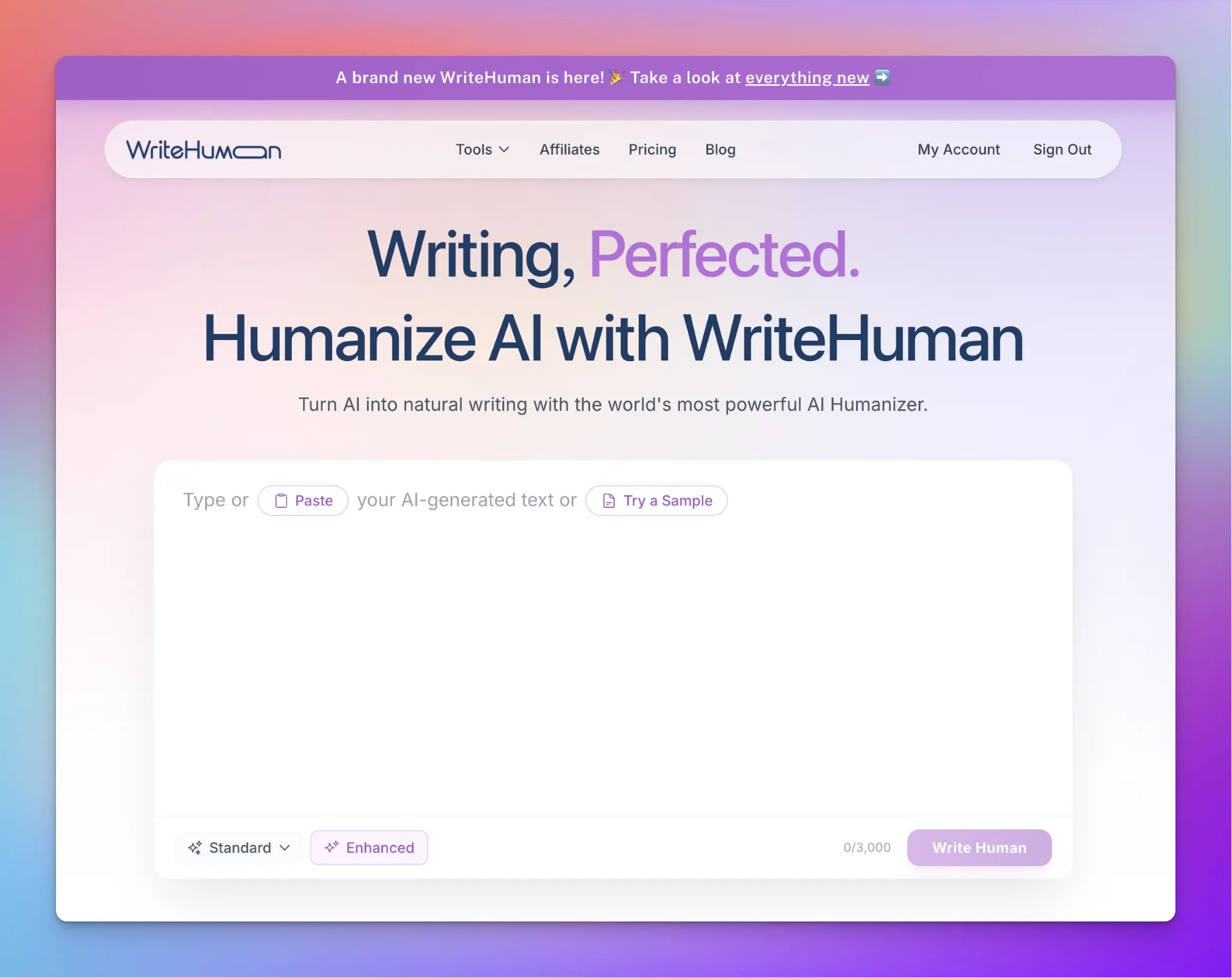
• AI humanizer with an Enhanced model on every paid tier
• Built in AI detector and AI image detector
• REST API with humanize, detect and usage endpoints
• MCP server for connecting the humanizer to AI agents
• iOS and Android apps, 40+ languages, 7 writing tones
• Multiple scored output variations per request
Undetectable AI: broad, platform first, consumer facing

• AI humanizer with readability and purpose presets
• AI detector that reports scores from several engines at once
• Human Auto Typer that retypes text into Google Docs
• SEO writer, essay writer, translator, chatbot, job applier
• Chrome extension that works across 50+ sites
• 50+ languages, and a refund promise if output is flagged
The Human Auto Typer deserves a note, because nothing on WriteHuman's side answers it. It simulates keystrokes, pauses and typos included, so a pasted passage produces a plausible revision history in Google Docs. That is not a rewriting feature. It is an artefact feature, for people whose work gets inspected for how it was written.
Feature comparison
TABLE 1 · CAPABILITIES AS LISTED ON EACH VENDOR'S SITE, JULY 2026
| Capability | WriteHuman | Undetectable AI |
|---|---|---|
| Core rewriter | Enhanced model on all paid plans | Standard rewriter with readability presets |
| Output variations | 2 to 5, depending on tier | 1 |
| Built in AI detector | Yes, metered by tier | Yes, unlimited on all plans |
| Image detector | Yes | Yes |
| Public API | Yes, dedicated plans from $29/mo | Yes, included with subscription |
| MCP server for AI agents | Yes, on Pro and Ultra | Not offered |
| Browser extension | Not offered | Chrome, 50+ supported sites |
| Mobile apps | iOS and Android | Web and extension only |
| Typing simulator | Not offered | Human Auto Typer, unlimited |
| Adjacent writing tools | Word counter only | SEO writer, essay writer, translator, chatbot, job applier |
| Languages | 40+ | 50+ |
| Free tier | 3 requests, 250 words each | 250 words total |
| Refund guarantee | No output guarantee | Refund if output is flagged as AI |
Undetectable AI's trial is capped at 250 words in total, not per request. Neither free tier is large enough to evaluate a full article.
On paper this looks lopsided. Undetectable AI wins nine categories of surface area, but surface area is a strange thing to pay for in a humanizer. The essay writer, translator and chatbot wrap models most people can already reach elsewhere. Only the multi engine detector and the Auto Typer are hard to replicate. The rest is convenience.
WriteHuman goes the other way. Two products exist, both exposed as endpoints. The /v1/humanize and /v1/detect calls share a key, so a pipeline can rewrite a draft and verify it before anything ships. For a solo blogger this is irrelevant. For an agency pushing a hundred articles a month, it is the whole reason to pick one.
One WriteHuman key covers rewriting, detection and usage checks. Photo: Rahul Mishra / Unsplash
Pricing, and the metering trick nobody mentions
Both companies quote a monthly number and hope nobody reads the unit attached to it. Undetectable AI sells words. WriteHuman sells requests. Those are not the same product, and comparing headline prices without adjusting for that produces a badly wrong answer.
TABLE 2 · CONSUMER PLANS, VERIFIED ON VENDOR PRICING PAGES, 10 JULY 2026
| Plan | Monthly | Billed annually | What the allowance buys |
|---|---|---|---|
| WriteHuman Free | $0 | $0 | 3 requests, 250 words each, basic model |
| WriteHuman Basic | $18 | $12 ($144/yr) | 80 requests, up to 600 words each, 2 variations |
| WriteHuman Pro | $27 | $18 ($216/yr) | 200 requests, up to 1,200 words each, 3 variations, MCP |
| WriteHuman Ultra | $48 | $36 ($432/yr) | Unlimited requests, up to 3,000 words each, 5 variations |
| Undetectable 10K | $9.99 | $5.00 ($60/yr) | 10,000 words per month, all features |
| Undetectable 20K | $19.00 | $9.50 ($114/yr) | 20,000 words per month, all features |
| Undetectable 35K | $31.00 | $15.75 ($189/yr) | 35,000 words per month, all features |
Annual figures are the vendors' own monthly equivalents. Undetectable AI scales past 35K words on request. Both offer custom business terms.
Run the arithmetic and the gap opens
WriteHuman Pro allows 200 requests of up to 1,200 words, a ceiling of 240,000 words for $27, or roughly 11 cents per 1,000 words. Undetectable AI's 20K plan costs $19 for 20,000 words, or 95 cents per 1,000 words. Annual billing narrows the spread but does not close it: about 8 cents against 48.
That ceiling carries a catch. A request is consumed whether it holds 1,200 words or twelve, so anyone rewriting a paragraph at a time burns the request budget long before the word budget. The cheap per word figure is real, but only for people who paste in long blocks.
THE PRACTICAL READ Undetectable AI is cheaper to try and cheaper to leave. WriteHuman is dramatically cheaper at volume, provided the work arrives in large chunks. |
Developers get a cleaner comparison. WriteHuman's API runs $29 a month for 125,000 words, or $69 for 400,000 with best of three scored outputs, about 17 cents per 1,000 words. Top up packs of 125,000 words cost $25 and never expire. Undetectable AI folds API access into the standard subscription, which sounds generous until the word allowance does double duty across the web app and the pipeline.
Performance: what the only open benchmark shows
Independent testing in this category is a mess of affiliate links. HumanizerBench is the exception, and it carries an unusual disclosure: it is operated by WriteHuman, one of the tools it ranks. That conflict is real. It remains useful anyway because the raw data is public and the rankings can be recomputed by anyone.
TABLE 3 · HOW THE BENCHMARK IS BUILT
| Parameter | Detail |
|---|---|
| Operator | WriteHuman, which is scored under the same rules as every other entrant |
| Cycle | July 2026, run monthly, each cycle archived at its own URL |
| Field | 13 humanizers |
| Prompts per tool | 33 |
| Detectors used | GPTZero, ZeroGPT, Copyleaks, Winston AI, Originality.ai |
| Source passages from | Claude Sonnet 5, Gemini 3.5 Flash, GPT-5.5 |
| Score weighting | Bypass 42% · Meaning 32% · Readability 16% · Consistency 10% |
| Penalties applied | Length inflation, over trimming, meaning drift |
| Reproducibility | Every prompt, output, detector verdict and the scoring script are published |
Turnitin is not among the five detectors tested, which matters for anyone submitting academic work.
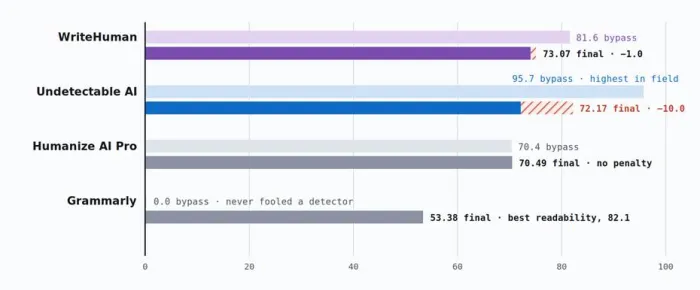
THE PADDING TAX · HumanizerBench, July 2026 cycle · 33 prompts · 5 detectors · scores out of 100
TABLE 4 · SCORECARD, JULY 2026 CYCLE
| Tool | Bypass | Meaning | Readability | Penalty | Final |
|---|---|---|---|---|---|
| WriteHuman | 81.6 | 72.9 | 56.2 | −1.0 | 73.07 |
| Undetectable AI | 95.7 | 73.0 | 55.9 | −10.0 | 72.17 |
| Humanize AI Pro | 70.4 | 74.3 | 60.3 | 0 | 70.49 |
| Grammarly | 0.0 | 94.5 | 82.1 | 0 | 53.38 |
Bold marks the field leader on that measure. Grammarly is included as a control: an editor that never attempts evasion.
Undetectable AI won the metric it advertises and lost the one that matters
• It cleared detectors 95.7 percent of the time, the highest figure in the field by a wide margin.
• It then surrendered the full ten point penalty maximum, all of it for length inflation, triggered on 26 of its 33 outputs.
• Add those points back and it wins. Its pre penalty composite reaches roughly 82, ahead of WriteHuman's 74. The ranking flips entirely on how padding is treated.
• WriteHuman led no single sub score. It finished first by taking one penalty point across the whole cycle, for a single instance of meaning drift.
• Grammarly is the control that explains the market. Zero bypass, best meaning, best readability. It edits prose and makes no attempt to hide where the prose came from.
Padding works because detectors estimate machine authorship from statistical regularities across a passage. Filler dilutes those signals and drags the score down, with almost no real rewriting. It also hands back a longer document, thinned with redundancy, which has to be cut back to length before anyone can use it.
READ THIS BEFORE TRUSTING ANY BYPASS RATE A humanizer that inflates a 900 word article to 1,300 words has not solved the problem. It has moved the work from rewriting to trimming, and charged for the privilege. |
What the benchmark cannot settle
• Turnitin is absent. The five detectors tested exclude the one most universities actually run.
• The operator is a competitor. WriteHuman wrote the penalty rules and finished first because of them. The rules are defensible and the data is open, but the incentive is real.
• Detectors move. GPTZero has added paraphrase detection aimed at bypass tools. WriteHuman shipped an Enhanced model update on 9 July 2026 tuned for GPTZero. Any score is a snapshot.
• Readability is mediocre on both sides. The best readability score in the cycle belongs to the tool that never fooled anything.
Both rewriters score in the mid fifties for readability. Neither removes the editing pass. Photo: Standsome Worklifestyle / Unsplash
Output quality and the editing tax
Reviewers converge on a pattern the benchmark scores only partly capture. Both tools handle short marketing copy well. Both degrade as passages grow longer and more formal, and they degrade in opposite directions.
TABLE 5 · HOW EACH TOOL FAILS
| Behaviour | WriteHuman | Undetectable AI |
|---|---|---|
| Output length | Holds close to the input | Inflated on 26 of 33 benchmark outputs |
| Where quality drops | Technical vocabulary, specialist terms | Passages beyond roughly 800 words |
| Most cited complaint | Needs two or three passes to land | Awkward phrasing on aggressive settings |
| Secondary complaint | Occasional vocabulary drift | Meaning drift on long form |
| Built in mitigation | 2 to 5 scored variations per request | Readability and purpose presets |
| Work left for the editor | Re run, then light cleanup | Cut the text back to length |
WriteHuman's three to five variations exist for a reason: one pass is frequently not enough. Undetectable AI's presets answer the same problem from the other end, offering a dial between readable and undetectable that cannot be turned to both at once.
The editing tax
• Neither removes the edit. Both sit in the mid fifties for readability, roughly 26 points behind Grammarly.
• Padding converts rewriting into trimming. A longer document is not a finished one, and the time saved reappears as time spent cutting.
• Count the real hourly cost. A tool that saves fifteen minutes of rewriting and costs twenty minutes of trimming has saved nothing.
Trust, billing and marketing claims
This is where the comparison gets uncomfortable, and where an honest review has to spend words.
TABLE 6 · TRUST SIGNALS AND RECURRING COMPLAINTS
| Signal | WriteHuman | Undetectable AI |
|---|---|---|
| Trustpilot volume | ~260 reviews | ~930 reviews |
| Reported score | Around 4 stars historically, with a recent run of sharply negative reviews | Reported at 2.1 out of 5 across 762 reviews in April 2026 |
| Top complaint | Annual plan charged when a monthly price was displayed | Charges after cancellation, and a 250 word trial that activates a full year |
| Second complaint | Output still flagged, repeated runs needed | Inconsistent bypass, meaning drift on longer text |
| Consistent praise | Clean interface, founder responds publicly to complaints | Support team responsiveness and refund handling |
| On site rating | Testimonial wall | 4.8 stars from its own review system |
Two things stand out. The first is that both companies attract the same billing grievance in different clothing. WriteHuman's pricing cards headline the annual equivalent, so a customer who reads $18 and clicks through can be charged $216. Undetectable AI advertises a free trial, caps it at 250 words, and places an activation button that charges the card. Both mechanics are disclosed somewhere, and a meaningful number of buyers did not see them.
The second is the gap between claimed and observed reputation. Undetectable AI displays 4.8 stars from its own review system while its Trustpilot score sits far lower, and its homepage claims a Forbes ranking as the best AI detector. GPTZero, a detector vendor and therefore not a neutral party, has publicly noted that Undetectable AI did not appear in Forbes' November 2024 ranking at all. That claim deserves independent verification before it carries weight in a purchase decision.
BEFORE SUBSCRIBING TO EITHER Read the checkout screen, not the pricing card. Confirm the billing period and exact amount before entering payment details. This is the most common regret in the review data for both products. |
Which tool fits which workflow
Choose WriteHuman if
• Work arrives in long blocks at volume, where the per word economics are five to ten times better
• The output length has to match the input length, for word counts, briefs or client specs
• An API or an MCP connection into an existing content pipeline matters
• Fidelity to the original argument beats a maximal detector score
Choose Undetectable AI if
• The absolute highest bypass rate is the goal and a longer output is acceptable
• The multi engine detector is worth the subscription on its own
• Browser based editing across Gmail, Docs and LinkedIn is the daily habit
• The adjacent tools, especially the SEO writer, would otherwise be separate subscriptions
Neither is a sensible choice for high stakes academic submission. The detector most universities run was not in the benchmark, 2026 testing puts humanized text near common flag thresholds, and the penalty for being wrong is not a refund.
The tool that scored best on meaning and readability is the one that never tried to hide anything. Photo: Clay Banks / Unsplash
Final verdict
After a week of feeding the same drafts into both, the choice stopped feeling like a contest between two rewriters and started feeling like a question about what a good outcome even looks like. Undetectable AI is extraordinarily good at the thing it is named after. It gets text past a detector more reliably than almost anything on the market, partly by making that text longer and blander, and charges roughly nine times as much per word for it.
WriteHuman is the better tool for anyone who still cares what the paragraph says when it comes back. It preserves length and meaning, costs a fraction as much at volume, and plugs into a pipeline. It is also slower to satisfy, often needing a second pass, and its billing interface has caught out enough customers to warrant real caution at checkout.
The uncomfortable conclusion sits in the Grammarly row. The tool with the best readability and the best meaning preservation in the entire cycle was flagged as machine written every single time. Nothing here has solved the underlying problem. These two products manage a symptom, at different prices, with different side effects. Anyone treating either as a substitute for a careful edit is buying the wrong thing.