AI writing tools have crossed the line from novelty to standard equipment for content teams. The latest Siege Media and Wynter survey of content marketers found that 97 percent now plan to use AI in 2026, up from 90 percent a year earlier. The question is no longer whether to use AI for content, but which tool fits the specific job, and where each one will quietly let a writer down.
This roundup compares eight of the most-used AI content writing tools in 2026, based on verified vendor pricing, real G2 and Capterra ratings, and the specific strengths and weaknesses that show up when content professionals actually deploy them. Every tool here was selected for one reason: it does something measurably useful that a generic alternative cannot match.
The state of AI content writing in 2026
Before naming tools, a few numbers explain why this category has reshaped how content gets made, and why picking the wrong tool now costs more than it did a year ago.
| Global AI writing assistant software market (2026) | USD 4.2 billion |
| Projected market size by 2033 | USD 9.09 billion (12.1% CAGR) |
| Content marketers planning to use AI in 2026 | 97 percent |
| Marketers using AI specifically for content creation | 85 percent |
| Average time saved per week by AI-using teams | 11 hours |
| Content marketers using AI for editing (2026 vs 2025) | 38% vs 19%, a 2x jump |
| Most trusted AI tool by marketers, 2026 | ChatGPT (80%), Claude (55%) |
| Share of new web pages containing AI-generated text | 74 percent |
Two numbers stand out. First, 74 percent of new web pages now contain AI-generated text, which means search engines and readers have learned to filter the obvious patterns. Second, only 1 percent of content marketers report that 100 percent of their work is AI-generated. The teams winning in 2026 are the ones that use AI for the right step of the workflow, then add real human judgment on top.
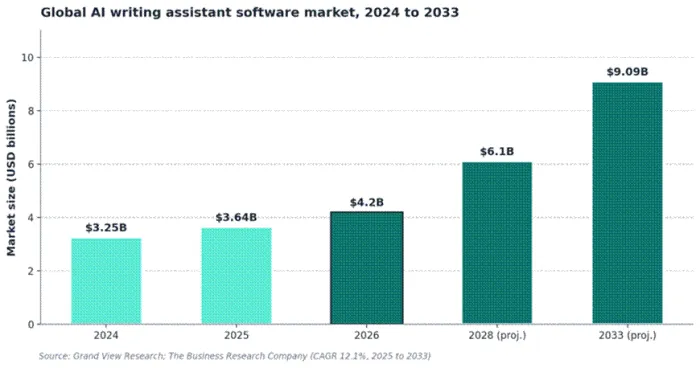
Figure: Market growth of AI writing assistants, 2024 to 2033 projection
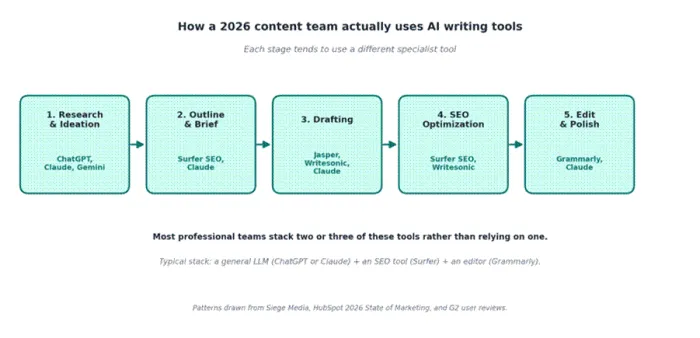
Figure: The five stages of an AI-assisted content workflow, and the tools that fit each one
Comparison snapshot: all 8 tools at a glance
The table below summarizes the eight tools reviewed in this guide. Pricing reflects entry-level paid plans verified against each vendor's public pricing page as of May 2026. Ratings combine the most recent G2 and Capterra aggregates.
| Tool | Best for | Starts at (monthly) | G2 / Capterra |
|---|---|---|---|
| ChatGPT | All-purpose writing and ideation | Free / $20 | 4.7 / 4.6 |
| Claude | Long-form prose and voice matching | Free / $20 | 4.6 / 4.7 |
| Jasper AI | Brand-voice marketing at scale | $49 per seat | 4.4 / 4.4 |
| Copy.ai | Sales and GTM workflows | Free / $49 | 4.7 / 4.5 |
| Writesonic | SEO blog volume on a budget | Free / $16 | 4.7 / 4.5 |
| Grammarly | Editing and polishing | Free / $12 | 4.7 / 4.6 |
| Surfer SEO | SERP-driven optimization | $79 annual | 4.8 / 4.7 |
| Rytr | Affordable short-form writing | Free / $9 | 4.7 / 4.6 |
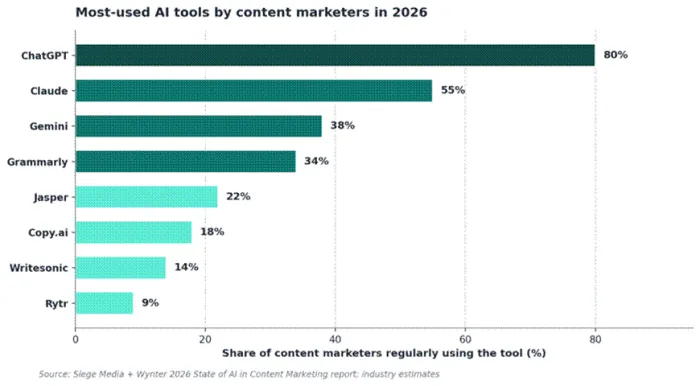
Figure: Most-used AI tools among content marketers in 2026
Tool-by-tool reviews
Each tool below is reviewed on its actual 2026 capabilities, with a quick-look spec table, a few pointers on strengths and gaps, and a final line on who it suits. Tools appear in order of overall versatility for content writing, not alphabetical.
ChatGPT (OpenAI)
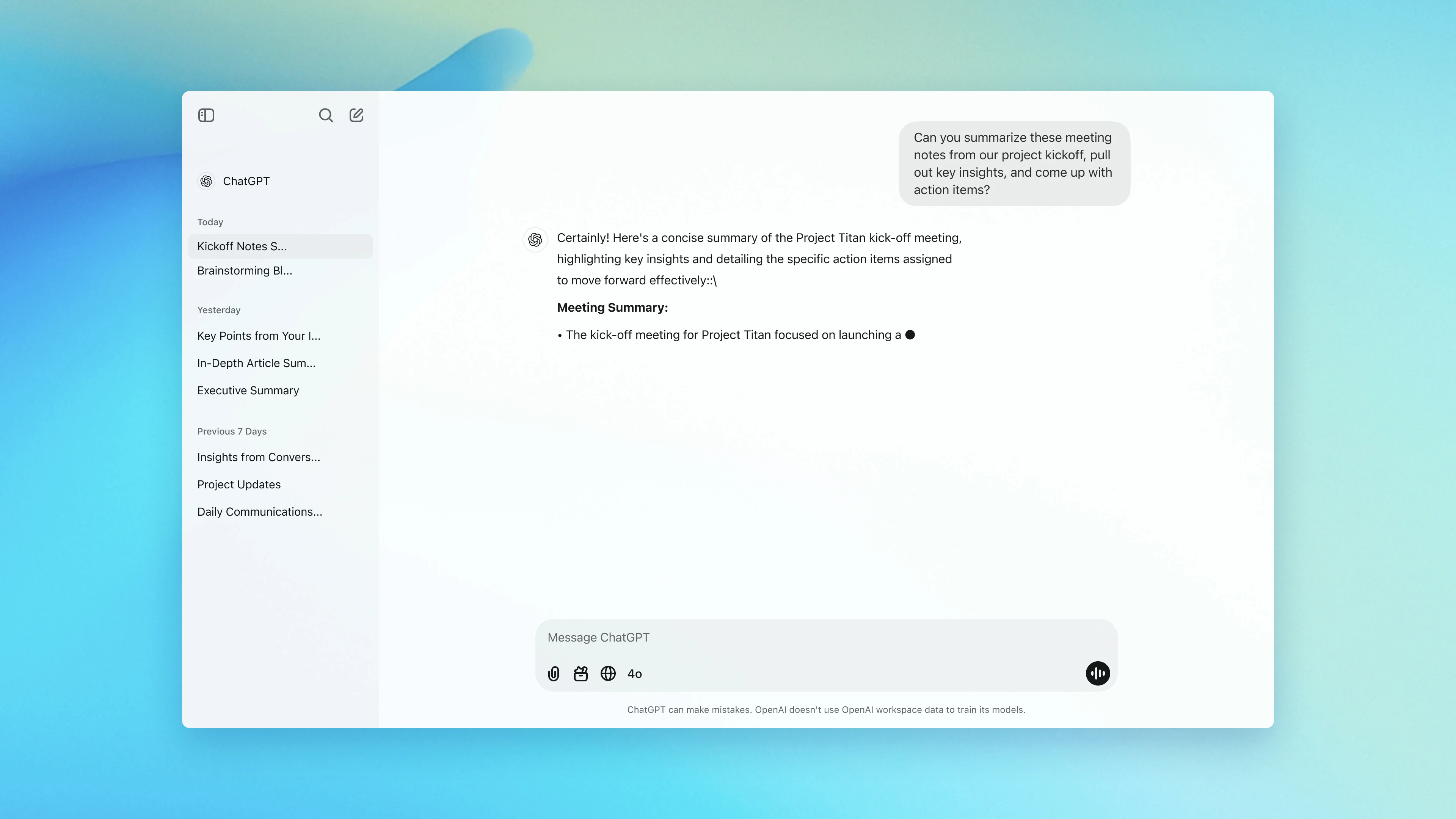
ChatGPT entered 2026 as the default AI writing tool for 80 percent of content marketers surveyed by Siege Media, and the reason is no longer just brand recognition. GPT-5.2 added persistent Memory across chats, the Canvas side-panel for targeted rewrites of long documents, and the Projects feature for keeping context organized across a campaign. For a writer who needs to bounce between a tagline, a product description, a research summary, and a newsletter draft inside one session, no tool moves between formats as smoothly.
The trade-off is stylistic uniformity. ChatGPT defaults to a recognizable rhythm and certain tic-phrases that readers and editors have learned to spot, so brand voice work still requires prompting discipline or a style file pasted into Memory.
| Pricing | Free (GPT-5.2 Instant), Plus $20/mo, Go $8/mo, Pro $200/mo for power users |
| G2 rating | 4.7 / 5 |
| Standout feature | Canvas editor plus Memory and Custom GPTs for repeatable workflows |
| Main limitation | Default voice is recognizable; brand work needs heavy prompt tuning |
| Best for | Solo writers and small teams who need one flexible tool across many tasks |
•Strengths: broad model capability, strong ideation, real-time web search, image generation, and the deepest third-party ecosystem of any tool here.
•Watch-outs: outputs can sound formulaic on long-form pieces; verify any cited facts before publishing.
Claude (Anthropic)

Claude has built a reputation among professional writers as the model that produces the most human-sounding prose, and 2026 blind tests across multiple independent reviewers confirmed the gap. The Opus 4 family handles 10 to 15 page drafts with consistent voice and structural coherence, and the Artifacts feature renders documents live as Claude writes them. Where it stands apart is voice matching: paste in two or three samples of an existing writer's work, and the next draft picks up rhythm, sentence length variety, and vocabulary with notable accuracy.
Where it falls short is the ecosystem around it. Claude has no built-in SEO scoring, fewer integrations than ChatGPT, and occasionally refuses prompts on borderline topics that competitors will write.
| Pricing | Free tier, Pro $20/mo ($17/mo annual), Max plans $100 and $200/mo for heavy use |
| G2 rating | 4.6 / 5 |
| Standout feature | Voice matching from style samples; Projects for persistent context |
| Main limitation | Smaller ecosystem; no native SEO tools; occasional cautious refusals |
| Best for | Long-form writers, ghostwriters, content strategists who care about prose quality |
•Strengths: highest prose quality in the category, strong reasoning on nuanced topics, lower hallucination rate on long documents.
•Watch-outs: slower than ChatGPT for quick punchy drafts; no integrated SEO scoring.
Jasper AI
![Jasper.ai vs. Scalenut: In-depth Comparison [2026]](https://driebipxfld1t.cloudfront.net/ai-tools-screenshots/jasper-ui.jpg)
Jasper is the most marketing-specific tool in this guide. Its 2026 platform runs on a multi-model architecture that quietly routes prompts to Claude, OpenAI, or Jasper's own fine-tuned models depending on the task, and offers more than 100 specialized agents and templates built around marketing workflows. Brand Voice training is its real differentiator: upload existing content, and Jasper learns the tone, then enforces it across every team member's drafts. Boeing, L'Oreal, and Wayfair use it for exactly that reason.
Jasper costs more per seat than any general LLM, and on simple tasks the output is often only marginally better than what ChatGPT produces with a good prompt. The price makes sense only when brand consistency across multiple writers genuinely matters.
| Pricing | Creator $49/seat/mo, Pro $69/seat/mo, Business custom |
| G2 rating | 4.4 / 5 across 1,200+ reviews |
| Standout feature | Brand Voice training and 100+ marketing-specific agents and templates |
| Main limitation | Per-seat pricing adds up fast; output can feel generic without prompt tuning |
| Best for | Mid-market and agency marketing teams that need brand voice consistency |
•Strengths: best-in-class brand voice consistency, Surfer SEO integration, enterprise security with SOC 2 compliance.
•Watch-outs: no permanent free plan; learning curve is real; not a great fit for solo creators.
Copy.ai
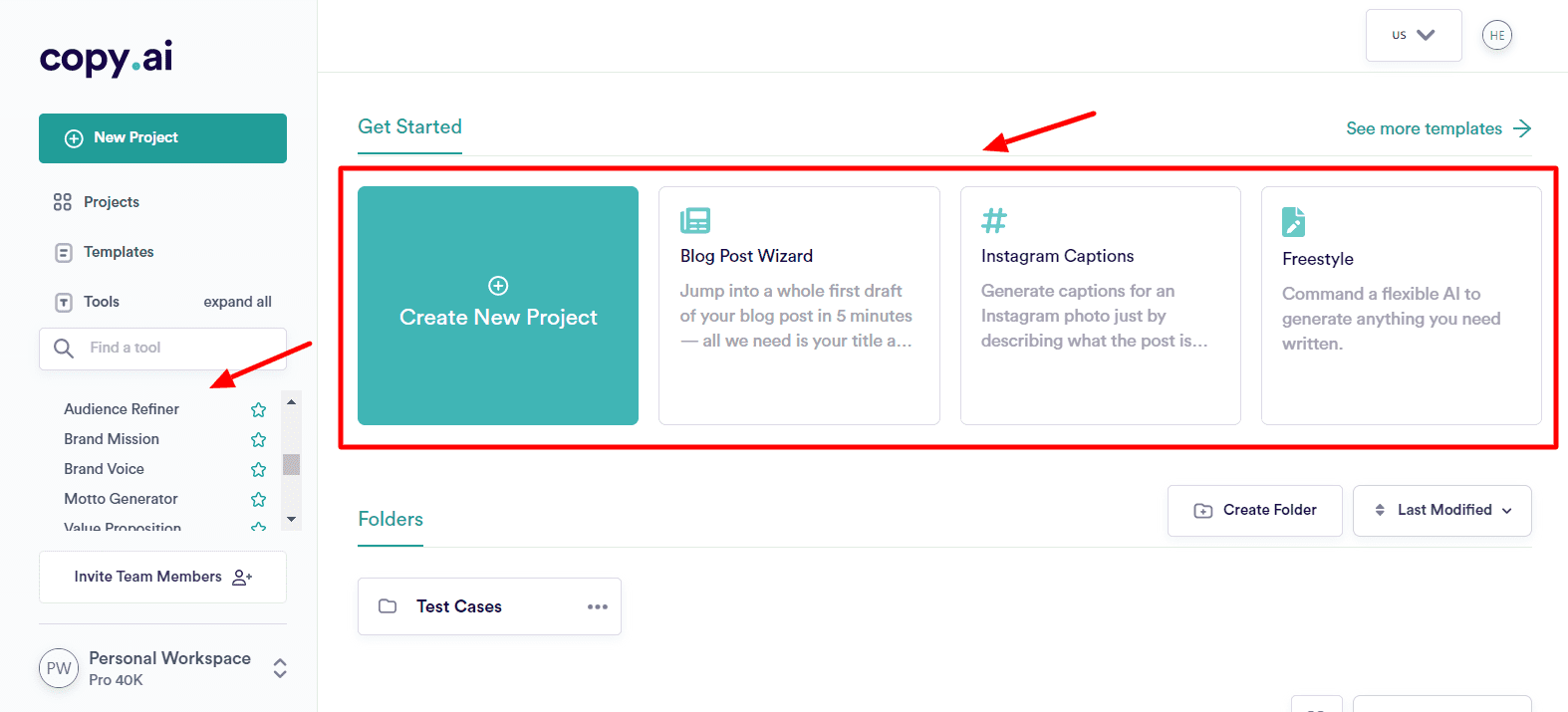
Copy.ai pivoted in 2024 from a pure copywriting tool to what it now calls a GTM AI platform, and the repositioning shows in the product. It still has the 90-plus content templates that built its early reputation, but the heavier lift now is workflow automation: chaining prompts together so that a single input becomes a research brief, a draft, a social variation pack, and an outreach sequence. Sales and marketing teams who already work in HubSpot or Salesforce get the most out of this design.
For a writer who only wants to draft a blog post, the workflow scaffolding can feel like overkill, and the Starter plan at $49 per month is steep for what is essentially template-driven generation.
| Pricing | Free plan available, Starter $49/mo, Advanced $249/mo, Enterprise custom |
| G2 rating | 4.7 / 5 |
| Standout feature | Multi-step workflow automation chaining prompts across content and outreach |
| Main limitation | Workflow design is overkill for pure short-form drafting |
| Best for | Sales and revenue operations teams embedding AI in their pipeline |
•Strengths: generous free tier, 90+ templates, native HubSpot and Salesforce hooks.
•Watch-outs: long-form output usually needs heavier editing than Jasper or Claude.
Writesonic

Writesonic has held its position as the budget alternative to Jasper, and in 2026 it earns that label more clearly than ever. The platform bundles ArticleGPT for long-form SEO drafts, Chatsonic for conversational generation with real-time web access, Photosonic for image generation, and Botsonic for custom chatbots, all behind one subscription. Eighty-plus templates and support for 24 languages make it a practical pick for high-volume SEO content shops and freelancers serving multiple clients.
Independent reviewers consistently note that Writesonic output reaches 80 to 90 percent of Jasper quality at roughly 30 percent of the cost. The gap shows up on technical and brand-specific content, where outputs need more editing than what Jasper or Claude produce on the same brief.
| Pricing | Free 10,000 words, Standard $16/mo, Professional $79/mo |
| G2 rating | 4.7 / 5 |
| Standout feature | ArticleGPT for long-form SEO drafts; bundled image and chatbot tools |
| Main limitation | Brand voice memory is weaker than Jasper; pricing tiers have changed often |
| Best for | Bloggers, freelancers, and SMBs producing high-volume SEO content |
•Strengths: best price-to-feature ratio in the category, multilingual, all-in-one suite.
•Watch-outs: outputs need extra editing on niche topics; word-count metering can be confusing.
Grammarly

Grammarly is the only tool in this guide that earns its place by polishing what other AI tools produce. Its browser extension and desktop app catch grammar, tone, clarity, and consistency issues across more than 500,000 websites and apps, which makes it the de facto last pass for any content workflow. The 2024 launch of GrammarlyGO added generative AI for rewriting and tone adjustment directly inline.
Grammarly is not built for generating long-form drafts from scratch, and pretending it is leads to flat output. Its real value is sitting on top of whatever generator is being used and quietly cleaning up the result.
| Pricing | Free, Pro $12/mo, Business $15/user/mo |
| G2 rating | 4.7 / 5 (700,000+ reviews across review sites) |
| Standout feature | Real-time editing across every app via browser extension and desktop client |
| Main limitation | Not a primary content generator; weaker for original creative writing |
| Best for | Any writer or team that wants AI-polished output regardless of which tool drafted it |
•Strengths: works everywhere a writer types, catches tonal and style issues most generators miss.
•Watch-outs: rewrites can flatten distinctive voice; always read its suggestions before accepting them.
Surfer SEO
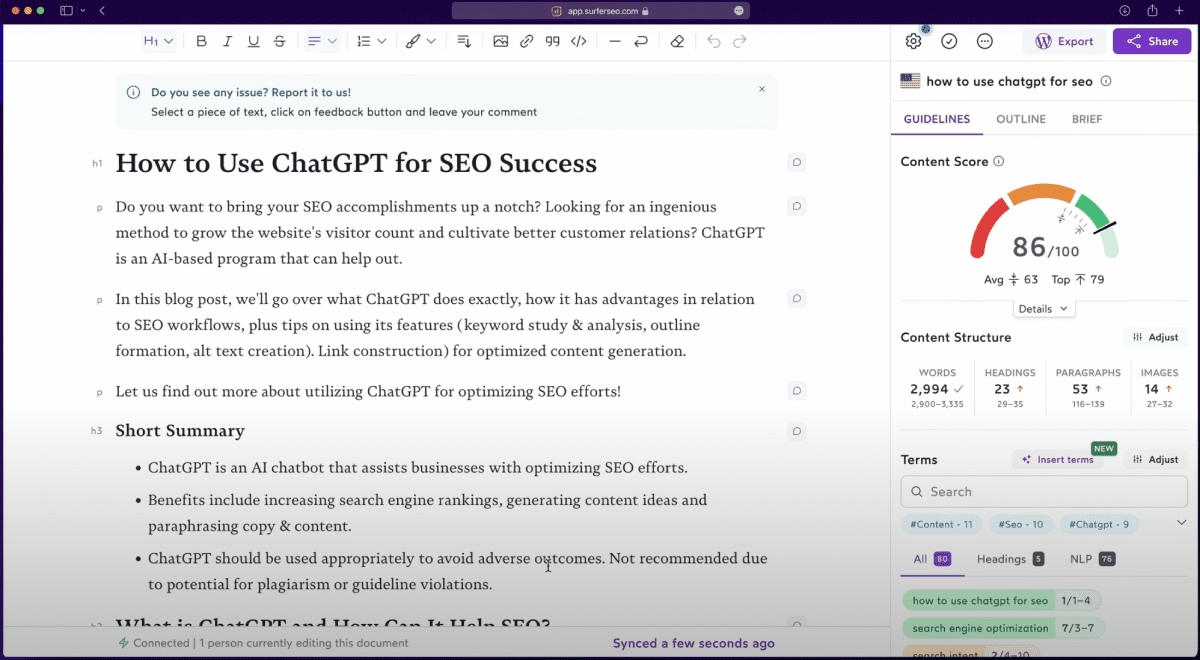
Surfer is the SEO specialist that pairs with whichever generator a content team already uses. Its Content Editor scores drafts against the top 20 to 50 SERP results in real time, with a documented 0.28 correlation between Content Score and Google ranking. The platform analyzes more than 500 ranking signals, including NLP terms, heading structure, and SERP patterns, and now extends visibility tracking across ChatGPT, Perplexity, Gemini, and Google AI Overviews.
Surfer's Essential plan at $99 per month ($79 annual) is the highest entry price in this roundup. The investment pays back only for teams publishing enough SEO content to recover the cost through traffic gains.
| Pricing | Essential $79/mo annual ($99 monthly), Scale $219/mo, Enterprise custom |
| G2 rating | 4.8 / 5 |
| Standout feature | Real-time Content Score linked to SERP analysis; new AI Tracker for LLM visibility |
| Main limitation | Premium pricing; AI-drafted articles still require manual editing |
| Best for | SEO professionals and agencies producing optimized content at volume |
•Strengths: data-driven optimization grounded in actual SERP results, Google Docs integration, strong topical mapping.
•Watch-outs: credit limits on lower plans; not a substitute for a strong primary writer.
Rytr
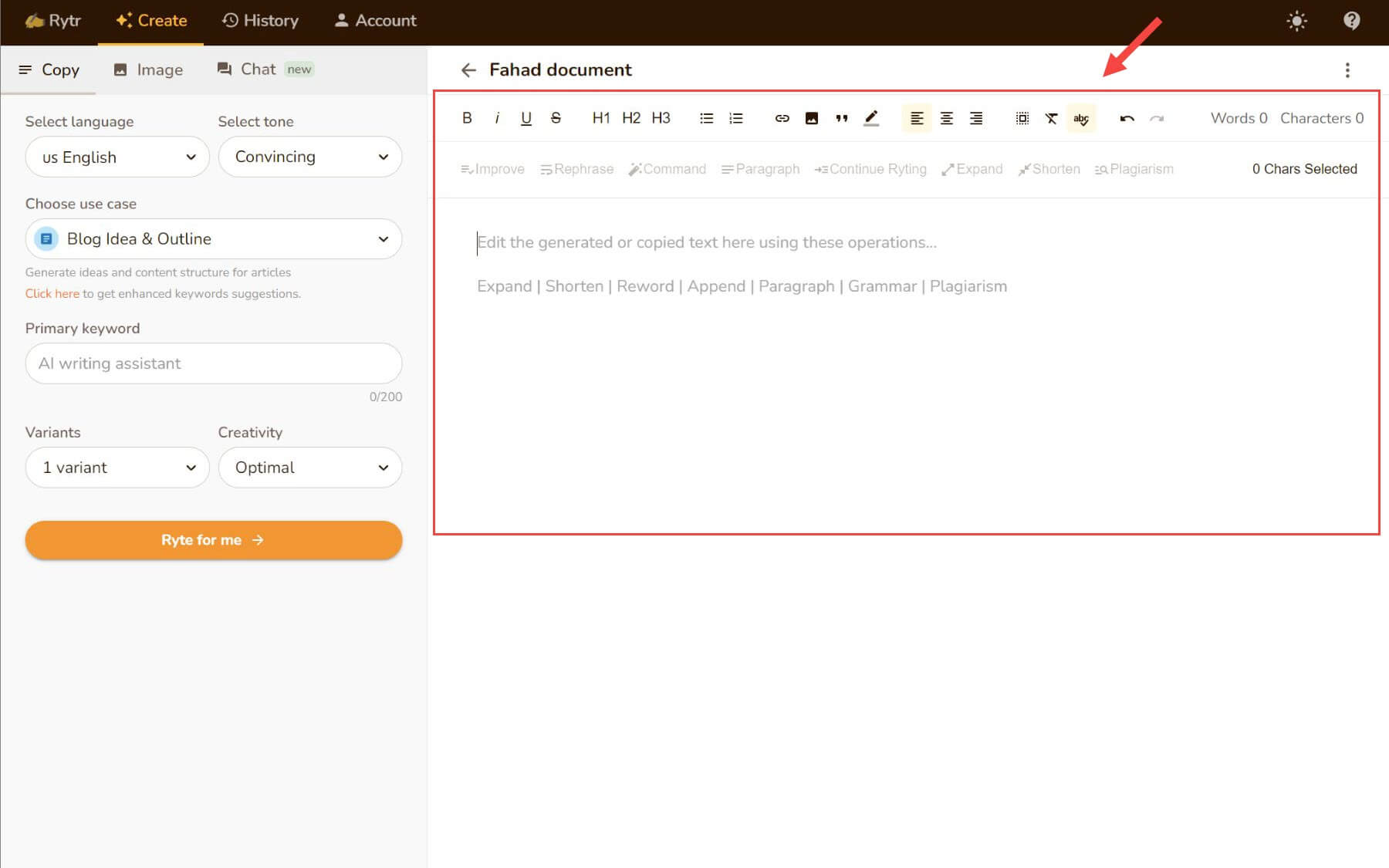
Rytr is the budget-friendly option for writers who need quick output across many short formats and refuse to pay premium prices for it. Its 40-plus use case templates cover everything from Facebook ads and product descriptions to blog outlines and email subject lines, and the MyVoice feature lets users save tone samples to mimic later. The Saver plan at $9 per month remains one of the cheapest paid AI writing subscriptions on the market.
Output quality sits a clear step below ChatGPT and Claude on complex or nuanced content. For long-form pieces that need to rank or convert, Rytr makes a fine first-draft engine but not a final one.
| Pricing | Free 10,000 characters, Saver $9/mo, Unlimited $29/mo |
| G2 rating | 4.7 / 5 |
| Standout feature | 40+ use case templates, MyVoice for tone matching, built-in Copyscape check |
| Main limitation | Quality gap on long-form and technical topics; weaker than premium alternatives |
| Best for | Freelancers and solo creators who write short-form copy on a tight budget |
•Strengths: cheapest paid plan in the category, easy interface, 40+ languages and tones.
•Watch-outs: outputs can become repetitive on volume use; not built for long-form polish.
Pricing and plan comparison
Tools in this category price by very different units: words, characters, seats, credits, or AI articles. The table below normalizes the entry points so that comparing real cost is straightforward.
| Tool | Free plan | Entry paid plan | Mid tier | Premium tier |
|---|---|---|---|---|
| ChatGPT | Yes, GPT-5.2 Instant | Plus $20/mo | Team $25/user/mo | Pro $200/mo |
| Claude | Yes, limited use | Pro $20/mo | Max 5x $100/mo | Max 20x $200/mo |
| Jasper AI | 7-day trial only | Creator $49/seat | Pro $69/seat | Business custom |
| Copy.ai | Yes, 2,000 words | Starter $49/mo | Advanced $249/mo | Enterprise custom |
| Writesonic | 10,000 words | Standard $16/mo | Professional $79/mo | Enterprise custom |
| Grammarly | Yes, full free tier | Pro $12/mo | Business $15/user | Enterprise custom |
| Surfer SEO | No, 7-day refund | Essential $79 annual | Scale $219/mo | Enterprise custom |
| Rytr | 10,000 characters | Saver $9/mo | Unlimited $29/mo | Not applicable |
One pattern stands out across the table. The base productivity tier for an individual writer settles at roughly $20 per month, whether through ChatGPT Plus, Claude Pro, or Grammarly Pro stacked with Rytr or the Writesonic free plan. Tools that charge significantly more, like Jasper, Copy.ai Advanced, and Surfer SEO, justify the difference only when they solve a real team-level problem.
Best tool for each use case
The right tool depends almost entirely on what is being written. The matrix below maps common content jobs to the tool most likely to deliver, along with a credible alternative.
| Content use case | First-choice tool | Strong alternative |
|---|---|---|
| Long-form thought leadership blog | Claude | ChatGPT |
| High-volume SEO blog posts | Writesonic with Surfer SEO | Jasper with Surfer SEO |
| Brand voice across a marketing team | Jasper AI | Claude with style samples |
| Sales emails and outreach sequences | Copy.ai | ChatGPT |
| Product descriptions at scale | Rytr | Writesonic |
| Social media captions and ad copy | ChatGPT | Copy.ai |
| Editing and final polish | Grammarly | Claude |
| Content that needs to rank on Google | Surfer SEO with Claude | Surfer SEO with ChatGPT |
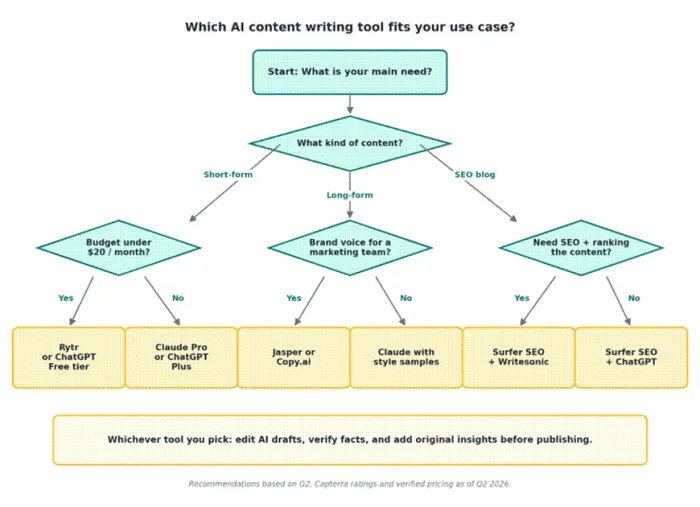
Figure: A simple decision path for picking the right AI content writing tool
How to choose, and how to use it well
Picking the right AI tool is only half the work. The other half is using it in a way that produces content readers and search engines actually trust. A few practical guardrails apply regardless of which tool ends up in the stack.
•Match the tool to the stage. Use a strong generator (Claude or ChatGPT) for drafting, an SEO tool (Surfer) for optimization, and an editor (Grammarly) for polish. One tool rarely does all three well.
•Always edit AI drafts before publishing. Only 1 percent of content marketers publish AI output unchanged, and Google rewards original insight and accuracy, not raw word count.
•Verify every fact and statistic. All major LLMs still hallucinate, particularly on dates, citations, and named entities. A short fact-check pass takes minutes and prevents real damage.
•Train the tool on a real voice. Whether through Jasper Brand Voice, Claude Projects, or ChatGPT Custom Instructions, feeding the tool actual writing samples improves output more than any prompt trick.
•Track what works. Compare engagement and ranking data on AI-assisted versus fully human pieces over three months. The gap usually narrows once the workflow tightens.
| The teams getting real value from AI writing tools in 2026 are not the ones generating the most content. They are the ones who picked a tool that solves a specific bottleneck, trained it on real samples, and built a clear editing pass into the workflow. |
A final word
There is no single best AI writing tool. There is the best fit for a specific writer, a specific budget, and a specific kind of content. For most professional writers, the combination of a strong general model (Claude or ChatGPT Plus at $20 per month), a polishing layer (Grammarly Pro at $12 per month), and a specialist tool added when needed (Surfer SEO for ranking content, Jasper for brand-voice work) covers nearly every use case.
Start with the free tiers, test each tool on a real project for a week, and compare the editing time required to reach publishable quality. The tool that disappears into the workflow, rather than demanding constant attention, is the right one.