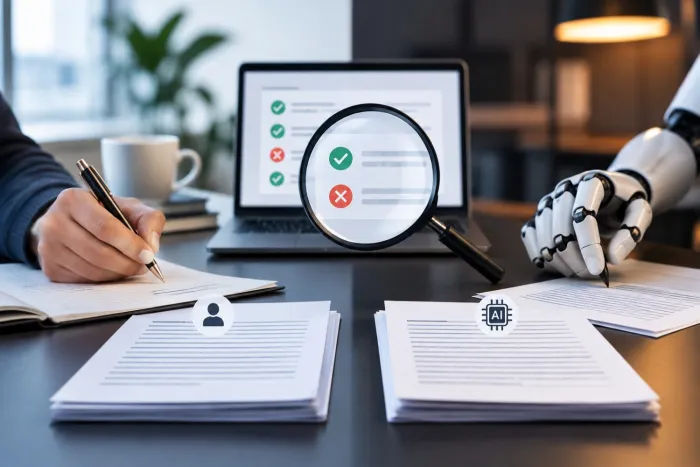
Most "best AI tools" lists feel like vendor brochures. This one is different. The eight tools below were vetted against the work researchers actually do: tracing whether a claim holds up, screening hundreds of abstracts, untangling methodology written in equation form, and producing literature reviews that survive peer review.
A 2025 Wiley survey of 2,400 researchers found 84% now use AI in their workflow, with 62% reporting publication-task improvements. The tools delivering that lift aren't general chatbots: they index peer-reviewed corpora, expose sources, and refuse to invent citations. Picks listed alphabetically.
How These Eight Were Chosen
Three criteria drove selection: source transparency (can the tool show its receipts?), corpus size and quality (peer-reviewed, open web, or both?), and price-to-output ratio (does the free tier reveal anything?). Tools that hallucinate citations were disqualified. Tools locking essential features behind opaque enterprise pricing were flagged or excluded.
Quick Comparison
Tool
Free Tier
Cheapest Paid
Corpus
Standout
Consensus
10 Pro Analyses/mo
$8.99/mo annual
200M+ papers
Consensus Meter
Elicit
5,000 one-time credits
$10/mo annual
138M papers
PRISMA workflow
NotebookLM
100 notebooks free
$19.99/mo
User uploads
Audio Overviews
Perplexity
3 Pro searches/day
$16.67/mo annual
Web + 200M papers
Deep Research
ResearchRabbit
Full features
Free forever
Semantic Scholar
Visual graphs
Scite
7-day trial
$12/mo annual
1.2B citations
Smart Citations
SciSpace
Limited daily
$12/mo annual
270M+ papers
Paragraph explainer
Semantic Scholar
Full features
Free forever
200M+ papers
Open API
The 8 Tools
Consensus
Editorial rating ★★★★½ 4.5/5
Evidence-backed Q&A across 200M papers with an agreement meter showing where the literature leans.
Ask a research question and Consensus returns an answer with a meter showing how many studies agree, disagree, or remain neutral. The 2026 version runs on GPT-5 across 200M+ peer-reviewed papers. It shines on yes/no questions and falters on open-ended exploration where Elicit's structured workflow goes deeper.
Meter ranks 10 studies in <15s for treatment-decision support
Policy yes/no questions
Strong
Output maps cleanly to policy brief structure
Science journalism fact-checks
Top pick
Cited synthesis under 20s with verifiable DOIs
Formal systematic reviews
Skip
No PRISMA workflow; switch to Elicit
Elicit
Editorial rating ★★★★½ 4.6/5
Purpose-built systematic-review workflow with structured extraction across 138M papers.
Elicit treats reviews as a workflow, not a chat. It pulls papers from 138M indexed publications, extracts methodologies, sample sizes, and findings into a PRISMA-aligned table. The workflow justifies the subscription for systematic reviewers. Plus tier's 4-report monthly cap pushes serious users into Pro quickly.
Sample size, methodology, intervention, outcome, study design, country
Citation grain
Sentence-level citations linking every claim to source paragraph
Latency & export
30-90s/paper extraction; 5-15 min full report; CSV/BibTeX/RIS
Pricing
Plan
Monthly
Annual
Free Tier Use
Paid Use
Notes
Basic
Free
Free
5,000 one-time credits
n/a
Credits do not refresh
Plus
$12
$120 ($10/mo)
n/a
4 reports/mo
Annual unlocks 48 workflows upfront
Pro
$49
$499 ($41.58/mo)
n/a
12 reports/mo
Paper monitoring alerts included
Team
$79/user
$780/user ($65/mo)
n/a
12 reports/user
2-seat min, admin panel
Enterprise
Custom
Custom
n/a
Custom
SSO/SAML, custom templates
Pros and Cons
Pros
Cons
PRISMA workflow saves 10+ hours per systematic review
Plus tier caps at 4 reports/month
Sentence-level citations to source paragraphs
Free credits are 5,000 one-time; no refresh
Custom columns extract sample size, method, outcome together
English-only; non-English needs manual workflow
Use Cases
Use Case
Fit
Why
Systematic and scoping reviews
Top pick
Only tool with native PRISMA workflow
Meta-analyses with structured data
Top pick
Custom columns capture effect sizes in one export
Quick fact checks
Overkill
Depth-oriented; use Consensus for speed
Citation-network exploration
Wrong tool
Use ResearchRabbit for visual mapping
NotebookLM
Editorial rating ★★★★½ 4.7/5
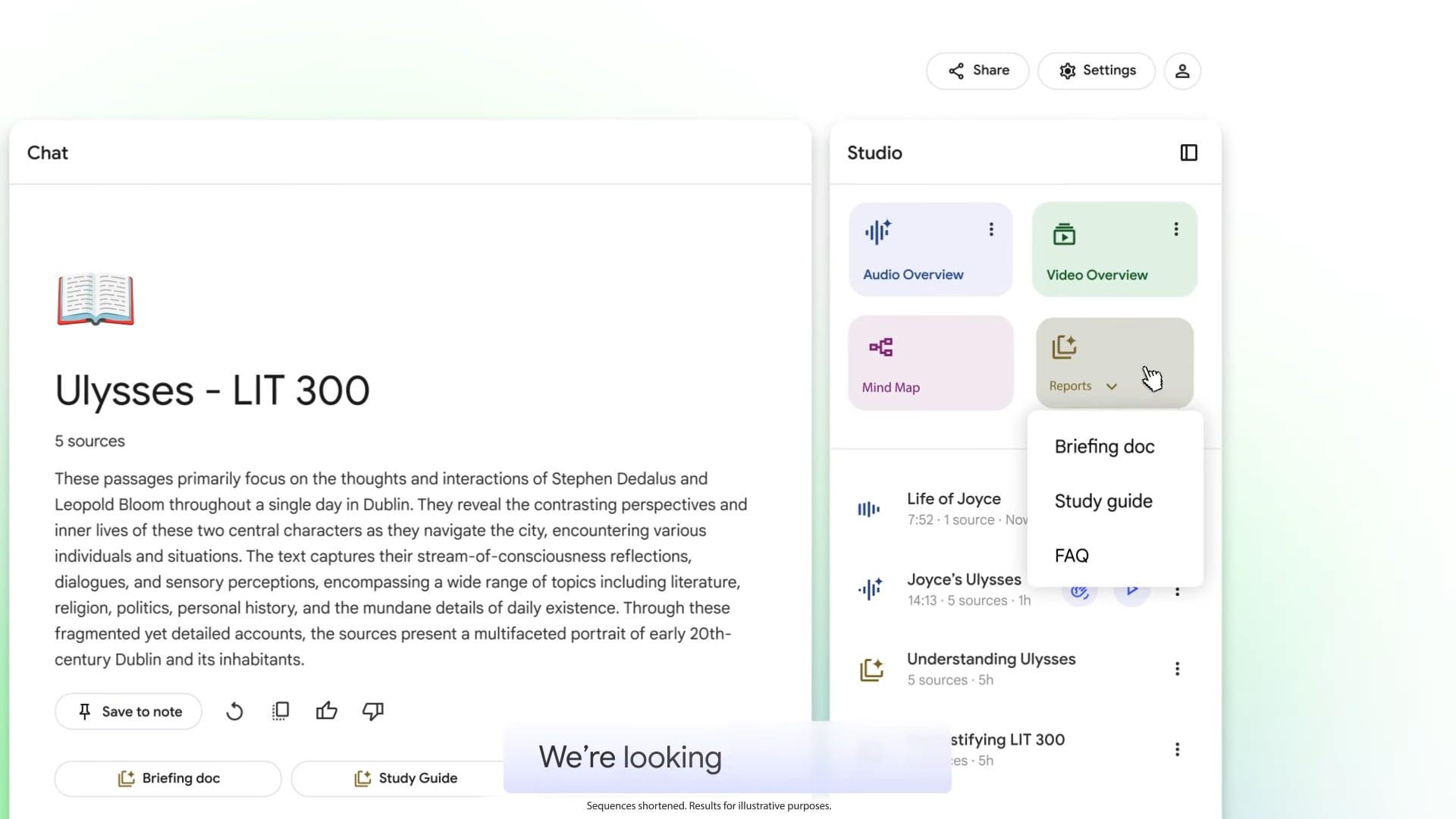
Google's source-grounded notebook with Gemini 3, a 1M-token context window, and surprisingly addictive Audio Overviews.
NotebookLM doesn't search anything: that's the strength. Upload up to 50 sources per notebook and Gemini 3 answers only from what was uploaded. No external scraping, no fabricated citations. Audio Overviews (two-host podcast discussions) became the surprise hit, now used to digest dense PDFs while commuting.
Specifications
Spec
Detail
Notebooks & sources (Free)
100 notebooks; 50 sources each; up to 500,000 words or 200 MB
LLM backend
Gemini 3 (Standard); Gemini 3 Pro (Plus+); 1M+ token context
Upload formats
PDF, DOCX, Google Docs, YouTube transcripts, audio (20+ formats)
Free tier limits
3 Audio Overviews/day; 10 Deep Research sessions/month
Pricing
Plan
Monthly
Annual
Free Tier Use
Paid Use
Notes
Standard (Free)
$0
$0
100 notebooks, 50 sources each
n/a
No card required
AI Plus
$7.99
~$84/yr
n/a
Elevated limits
Higher Audio quota
Google AI Pro
$19.99
$239.88 ($9.99 students)
n/a
Unlimited
Gemini 3 Pro, 2 TB storage
Google AI Ultra
$249.99
$3,000
n/a
Unlimited + Cinematic
Watermark-free outputs
Workspace Enterprise
~$9/license
~$108/license
n/a
Custom
15-license min, SSO, VPC
Pros and Cons
Pros
Cons
Zero hallucinated citations; every answer cites uploaded source
Cannot search outside uploaded materials
Free tier (100 notebooks, 50 sources each) covers 90% of casual use
Locked into Gemini model family
1M-token context absorbs full books and dissertations
Generator outputs structured outlines and timelines
Audio summaries for commute
Top pick
Two-host podcast format engages better than text
Discovering new papers
Wrong tool
No search corpus; use Semantic Scholar
Perplexity AI
Editorial rating ★★★★ 4.2/5
The generalist on this list, with credible Academic Focus and Deep Research reports spanning dozens of citations.
Perplexity searches the open web with inline citations. Academic Focus restricts queries to Semantic Scholar's peer-reviewed index, and Deep Research runs 5-30 minute investigations producing reports with 50+ citations. It is a web search engine first; for peer-reviewed depth, Elicit and Consensus go deeper. Perplexity wins on breadth.
Specifications
Spec
Detail
Search scope & corpus
Open web + Semantic Scholar (Academic Focus); 200M+ papers
LLM backends
GPT-5.2, Claude Sonnet 4.5, Gemini 3 Pro, Sonar (proprietary)
Free across iOS/Android/Win/Mac (March 2026); Sonar API $1-$15/1M tokens
Pricing (May 2026)
Plan
Monthly
Annual
Free Tier Use
Paid Use
Notes
Free
$0
$0
3 Pro/day + 5 Deep Research/day
n/a
Sonar auto-selected
Education Pro
$10
Monthly only
n/a
Unlimited
SheerID verified students
Pro
$20
$200 ($16.67/mo)
n/a
Unlimited
$5 API credits/mo included
Max
$200
$2,000
n/a
Unlimited + Model Council
Computer agent, 10K credits
Enterprise Pro/Max
$40-$325/user
$400-$3,250/user
n/a
Per tier
SSO, SCIM, audit logs
Pros and Cons
Pros
Cons
Real-time web search plus inline citations and Deep Research
Open-web sources need verification
Academic Focus pipes into Semantic Scholar's 200M+ index
Peer-reviewed depth weaker than Elicit
Comet browser free across all four platforms (March 2026)
Max tier $200/mo steep for solo researchers
Use Cases
Use Case
Fit
Why
Scoping a new topic broadly
Top pick
Academic Focus + open web exposes both contexts
Policy and tech research
Top pick
Real-time search captures current developments
Grey literature and reports
Strong
Open web catches what academic-only tools miss
Formal systematic reviews
Wrong tool
No PRISMA workflow; use Elicit
ResearchRabbit
Editorial rating ★★★★ 4.4/5
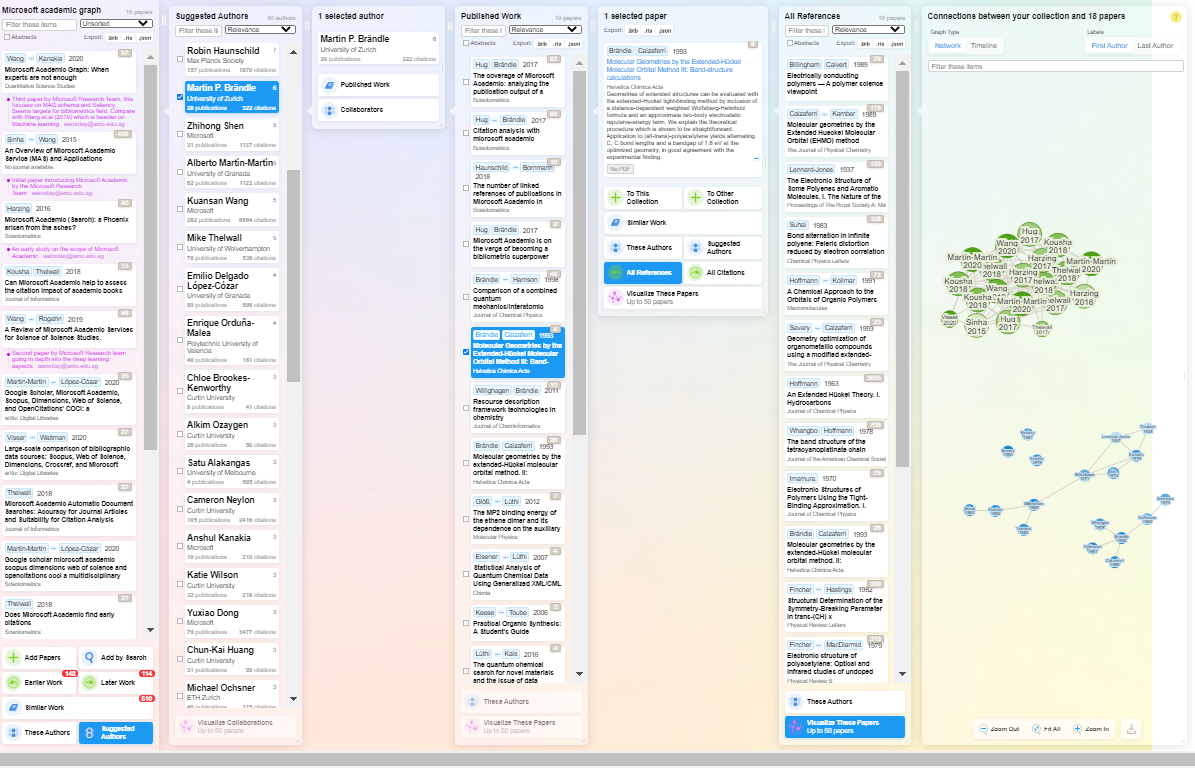
Free, visual citation mapping that turns one good seed paper into a map of an entire conversation.
Free, with no usage caps. ResearchRabbit gives every user a visual citation map for any seed paper: what it cites, what cites it, what clusters around it. It won't extract data or write summaries. For discovery, nothing maps the conversation faster.
Specifications
Spec
Detail
Cost & data
Free for all users; Semantic Scholar corpus (200M+ papers)
Core visualization
Similar Work, Earlier Work, Later Work per seed paper
Citation map shows conversation structure at a glance
Identifying seminal works
Top pick
Earlier Work traces influences backward to foundations
Literature review citation chasing
Top pick
Combines forward/backward with semantic similarity
Reading individual papers
Wrong tool
Use SciSpace for paragraph-level explanation
Scite
Editorial rating ★★★★ 4.3/5
Smart Citations classify 1.2 billion references as supporting, contrasting, or mentioning.
Citation counts lie. Scite classifies every citation as supporting, contrasting, or mentioning, drawn from 1.2B citation statements across 30M full-text articles. For systematic reviewers and pharmaceutical evidence teams, this changes credibility math entirely.
Specifications
Spec
Detail
Citation database
1.2B+ classified statements across 30M+ full-text articles
Smart Citation categories
Supporting, Contrasting, Mentioning (each linked to source paragraph)
Reference Check
Audits manuscript reference lists for retractions and disputed claims
Integrations
Word plugin, Zotero/Mendeley/EndNote browser extensions
Strongest coverage
Medicine, biology, life sciences; 460,000+ active users
Pricing (May 2026)
Plan
Monthly
Annual
Free Tier Use
Paid Use
Notes
Free Trial
$0 (7 days)
n/a
Personal features
n/a
Auto-converts to Personal monthly
Personal
$20
$144 ($12/mo)
n/a
Unlimited Smart Citations
Reference Check included
API Access
$250/mo+
Negotiable
n/a
Programmatic
Institutional integration
Organization
Custom
$5K-$25K/yr
n/a
Unlimited
SSO, admin controls, volume pricing
Pros and Cons
Pros
Cons
1.2B citations classified as supporting/contrasting/mentioning
An AI Copilot that explains dense methodology paragraph by paragraph and unpacks unfamiliar equations.
SciSpace lives at the reading layer. Upload a PDF and Copilot explains dense passages paragraph by paragraph, breaks down equations, defines jargon, and produces structured summaries. For researchers reading outside their primary subfield, that explainer is the killer feature. The 270M-paper search is decent but not the strength.
PubMed, Google Scholar, arXiv, journal sites in-context
Languages
Multilingual paper support; English UI
Pricing
Plan
Monthly
Annual
Free Tier Use
Paid Use
Notes
Basic
Free
Free
Limited daily Copilot
n/a
Free Chrome extension
Premium
$20
$144 ($12/mo)
n/a
Unlimited Copilot
SCI30 code: 30% off first month
Teams
$18/seat
$96/seat ($8/mo)
n/a
Unlimited
SAML SSO, admin controls
Advanced
$70
n/a
n/a
Deep Review model
100-col export, meta-analysis tooling
Enterprise
Custom
Custom
n/a
Unlimited + API
On-prem options, bespoke onboarding
Pros and Cons
Pros
Cons
Copilot explains dense methodology and equations paragraph by paragraph
Credit consumption opacity flagged in user reviews
40,000+ journal templates plus 10,000+ citation styles
Search corpus weaker than Elicit or Semantic Scholar
Chrome extension works in-context on PubMed, arXiv, Scholar
Strict 24-hour refund window on Premium
Use Cases
Use Case
Fit
Why
Reading methodology-dense papers
Top pick
Copilot explains equations and dense passages line by line
Working in a new subdiscipline
Top pick
Jargon definitions flatten the learning curve
Journal manuscript formatting
Strong
40,000+ templates handle most target journals
Paper discovery
Wrong tool
Use Elicit or Semantic Scholar instead
Semantic Scholar
Editorial rating ★★★★½ 4.5/5
The free, open-corpus backbone quietly powering half the tools above.
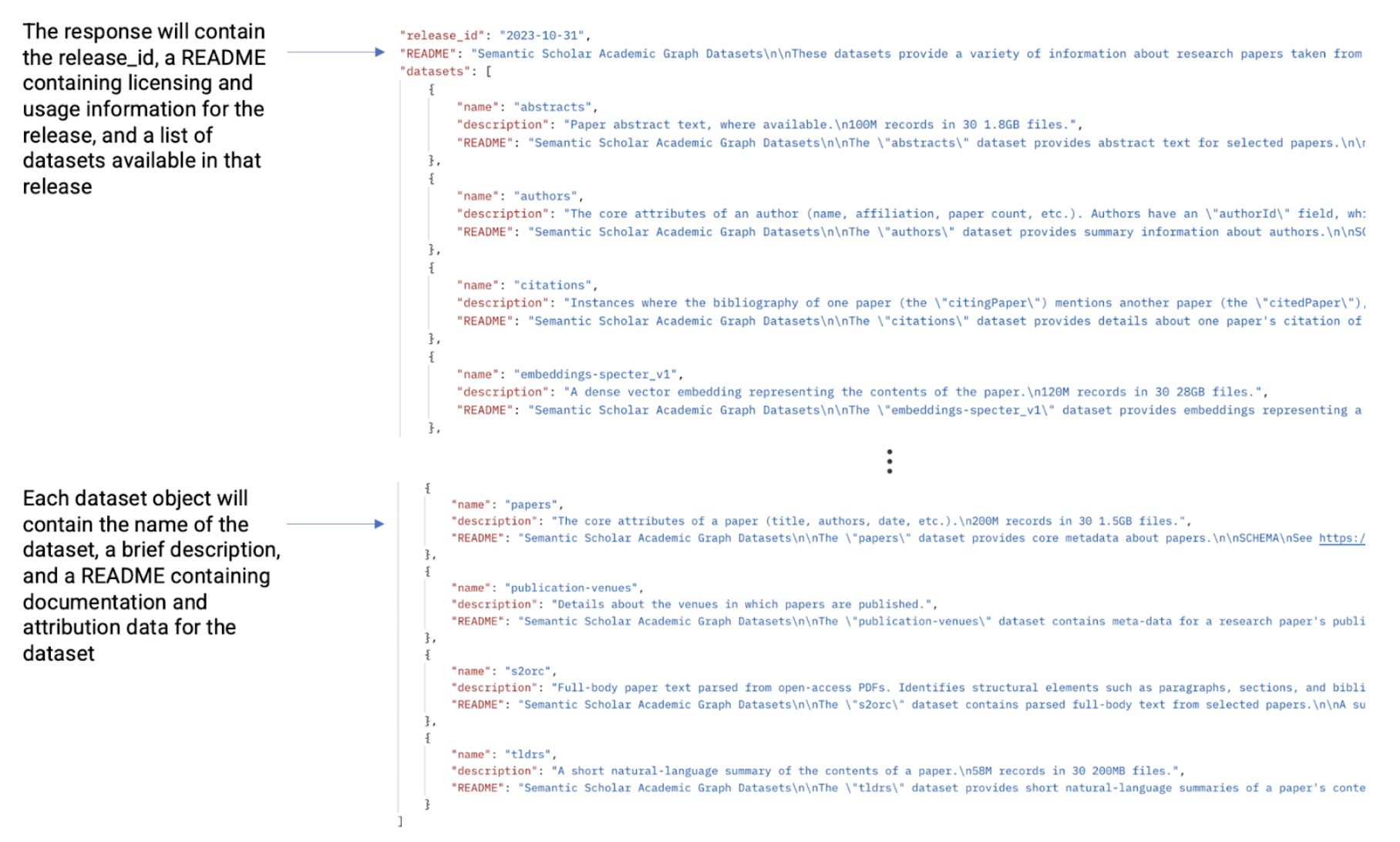
The unsung backbone of half this list. Built by the Allen Institute for AI, Semantic Scholar indexes 200M+ papers with rich metadata, citation graphs, and AI-generated TL;DR summaries. It powers ResearchRabbit, feeds Elicit, and serves Perplexity's Academic Focus. The right no-subscription baseline.
Specifications
Spec
Detail
Corpus & summaries
200M+ papers across all disciplines; AI-generated TL;DRs (not universal)
Citation graph
Influential Citation Count separates high-impact from passing mentions
Open API
Free at api.semanticscholar.org; ~100 req/5 min unauthenticated
Operator
Allen Institute for AI (nonprofit, Paul G. Allen Foundation)
Powers
ResearchRabbit, Elicit, Perplexity Academic Focus, dozens more
Pricing (May 2026)
Plan
Monthly
Annual
Free Tier Use
Paid Use
Notes
Free (only tier)
$0
$0
Unrestricted web; rate-limited API
n/a
Nonprofit public good; no paid tier
Pros and Cons
Pros
Cons
200M+ corpus comparable to commercial alternatives at zero cost
TL;DRs don't exist for every paper
Open API enables custom pipelines and powers many tools
No structured extraction; build with API
Influential Citation Count separates high-impact from filler
No single tool wins. The strongest workflows pair a discovery tool with a synthesis tool, plus one specialist for whatever niche need keeps surfacing. A baseline configuration:
Research Stage
Primary Tool
Backup
Approx. Cost
Initial discovery
Semantic Scholar
ResearchRabbit
Free
Evidence-backed Q&A
Consensus Premium
Perplexity Pro
$0-$9/mo
Systematic reviews
Elicit Plus
n/a
$10/mo annual
Reading dense PDFs
SciSpace Premium
NotebookLM
$12/mo annual
Citation context
Scite Personal
Semantic Scholar
$12/mo annual
Source-bound synthesis
NotebookLM
n/a
$0-$20/mo
That stack covers most workflows for roughly $25-$35/month total, with the option to drop down to free tiers (Semantic Scholar, ResearchRabbit, NotebookLM Standard, Consensus Free, Elicit Basic) without losing core capability.
Limitations Worth Naming
Three issues deserve a clear-eyed look. Coverage bias: nearly every tool here leans English-language, STEM-dominated, and post-2000; humanities and non-English scholarship are systematically underrepresented. Hallucinated citations: even peer-reviewed tools occasionally invent references, and every AI-pulled citation must be verified before publication. Query logging: most platforms log queries to improve models, so for sensitive clinical or human-subjects work, vendor data-handling agreements should precede deployment.
Final Thought
The 2026 generation of AI research tools didn't replace researchers. It freed them from work that never required intellectual contribution: screening abstracts, extracting sample sizes, hunting reference lists for retractions, decoding methodology written to obscure. Framing the question, judging the evidence, building the argument: still the human's job.