Every content team eventually discovers the same uncomfortable truth: blog posts age slightly worse than gym memberships in February. One quarter the post is on page one, pulling steady leads. A year later it sits buried under three competitors who quietly published better versions while the team was busy producing something new.
This is content decay, and the math now sits squarely on the side of refreshing old posts rather than ignoring them. Ahrefs research found roughly 66 percent of pages older than two years experience declining organic traffic. A Conductor study put the annual loss from neglected content at up to 20 percent. HubSpot, on the opposite side, reported a 106 percent average increase in organic search views from systematic refreshes. The opportunity is real; the only question is which tools to use.
Six AI platforms compete seriously for refresh workflows in 2026. Each section below includes a pricing table, a feature breakdown, a strengths and trade-offs table, and a rating snapshot built from current G2 and Capterra data.
Why Old Content Loses Rankings
Content decay is rarely caused by one factor. Competitors publish fresher work, statistics age out, search intent drifts, algorithm updates redefine ranking signals, and AI engines now pull citations from a different set of sources than the classic blue links. The implication is that refreshing content is no longer a tidying exercise. It is a recovery operation that must address the topical gaps pulling a page down in classic SERPs and the entity coverage that determines whether large language models surface the content at all.
The Numbers Behind Content Refresh ROI
| Data Point | Reported Figure | Source |
|---|---|---|
| Pages older than two years with declining traffic | Approximately 66 percent | Ahrefs research |
| Indexed pages receiving zero Google traffic | Approximately 96.55 percent | Ahrefs study |
| Average traffic increase from systematic refreshes | Approximately 106 percent | HubSpot internal data |
| Annual organic traffic loss from neglected content | Up to 20 percent | Conductor |
| AI-sourced traffic growth, early 2025 to early 2026 | 527 percent year over year | Previsible AI Traffic Report |
| Companies stating refresh outperforms net-new content | 51 percent | Knowledge Enthusiast 2025 survey |
The 6 Best SEO Tools for High-Impact Content Refreshes
Surfer SEO
Surfer SEO is the practical middle ground for content refresh work. Its Audit feature ingests an existing URL, benchmarks it against the live SERP for the target keyword, and returns a prioritized list of changes covering missing entities, header structure, internal linking, content length, and keyword density. The Content Editor scores edits in real time, with NLP-driven term suggestions surfaced from the top fifty ranking pages.

Surfer's own correlation data places its Content Score at a 0.28 correlation with Google rankings, a meaningful signal for a directly controllable on-page factor. The Audit tool unlocks at the Scale tier, which is where most refresh-focused buyers will land.
Pricing Plans
| Plan | Monthly | Annual (per month) | Audit Pages | Best For |
|---|---|---|---|---|
| Essential | 99 USD | 79 USD | Limited | Solo bloggers, freelancers |
| Scale | 219 USD | 175 USD | 100 per month | Agencies, content teams |
| Enterprise | Custom | Custom | Custom | Large content operations |
Feature Breakdown
| Feature | What It Does | Why It Matters for Refresh Work |
|---|---|---|
| Audit Tool | Compares a URL to current SERP leaders and returns prioritized fixes | Direct workflow for diagnosing exactly what changed since the page first ranked |
| Content Editor | Real-time scoring with NLP term suggestions while editing | Refreshes can be applied and re-scored in the same workspace |
| Topical Map | Maps cluster gaps for site-wide topical authority | Identifies adjacent pages that should be refreshed in tandem |
| AI Tracker (Add-on) | Monitors brand visibility in ChatGPT, Perplexity, and AI Overviews | Catches AI citation decay invisible to classic rank tracking |
| Google Docs and WordPress integrations | Editor recommendations appear inside the writing tool | Reduces context switching during high-volume refresh runs |
Strengths and Trade-offs
| Strengths | Trade-offs |
|---|---|
| Audit feature is purpose-built for the refresh use case | Refresh workflow effectively requires the 219 USD Scale tier |
| Documented SERP correlation gives Content Score defensible weight | AI search visibility costs an extra 95 USD per month |
| Native Google Docs and WordPress integrations keep writers in flow | No backlink data, so link-driven decay needs a paired tool |
| Topical Map supports cluster-level refresh planning | Monthly credits do not roll over on monthly billing |
Rating Snapshot
| G2 Rating | Capterra Rating | Most-Cited Strength | Most-Cited Concern |
|---|---|---|---|
| 4.8 / 5 | 4.8 / 5 | Real-time scoring tied to live SERP data | AI Tracker add-on at 95 USD per month |
Best fit: in-house content teams and agencies producing twenty to one hundred refreshes per month who want unified audit, optimization, and AI assistance without enterprise pricing. Particularly strong for affiliate sites and SaaS blogs recovering pages from positions five to fifteen, where on-page changes drive the highest leverage.
Clearscope
Clearscope sits at the premium end of the optimization category and is built around grading accuracy. Its content reports analyze top-ranking pages for a target query and produce an A through F grade alongside semantic keyword recommendations. Unlike rivals that emphasize raw frequency, Clearscope's NLP weights terms by topical relevance, producing a smaller but more defensible recommendation set.
For refresh workflows the value lies in Content Inventory, which monitors every tracked URL, identifies pages where grades have slipped against current SERP leaders, and flags decay candidates with concrete update recommendations. Customers include IBM, Cisco, and Shopify.
Pricing Plans
| Plan | Starting Price | Reports per Month | Inventory Pages | Best For |
|---|---|---|---|---|
| Essentials | From 129 USD per month | 20 AI Drafts | 50 | Solo creators, small teams |
| Business | Higher tier (custom) | Increased | Expanded | Mid-market content teams |
| Enterprise | Custom | Unlimited | Unlimited | Large enterprises with SSO |
Feature Breakdown
| Feature | What It Does | Why It Matters for Refresh Work |
|---|---|---|
| A through F Grading | Scores content against top-ranking pages for the target query | Defensible target metric for each refreshed article |
| Content Inventory | Monitors tracked URLs and flags grade decline over time | Surfaces decay candidates without manual SERP checking |
| Topic Explorations | Maps topical authority across the site | Identifies adjacent topics that need refresh or expansion |
| Google Docs Add-on | Recommendations live inside the editor | Writers and editors stay in the document during refresh |
| Unlimited Seats | Every plan supports unlimited users | Per-user cost falls as the team grows, valuable for agencies |
Strengths and Trade-offs
| Strengths | Trade-offs |
|---|---|
| Highest content grading accuracy in independent comparisons | Most expensive entry point in the optimization category |
| Unlimited user seats on every plan | No free trial; demo-only evaluation |
| Content Inventory built specifically for decay detection | Narrower feature set than full SEO suites |
| Used by IBM, Cisco, and Shopify | No technical audits or backlink analysis |
Rating Snapshot
| G2 Rating | Capterra Rating | Most-Cited Strength | Most-Cited Concern |
|---|---|---|---|
| 4.9 / 5 | 4.7 / 5 | Highest grading accuracy in the category | No free trial and no annual discount |
Best fit: enterprise content teams publishing fifteen or more articles monthly where grading precision and writer onboarding speed matter more than feature breadth. Agencies with multiple client teams benefit disproportionately from unlimited seats.
Frase
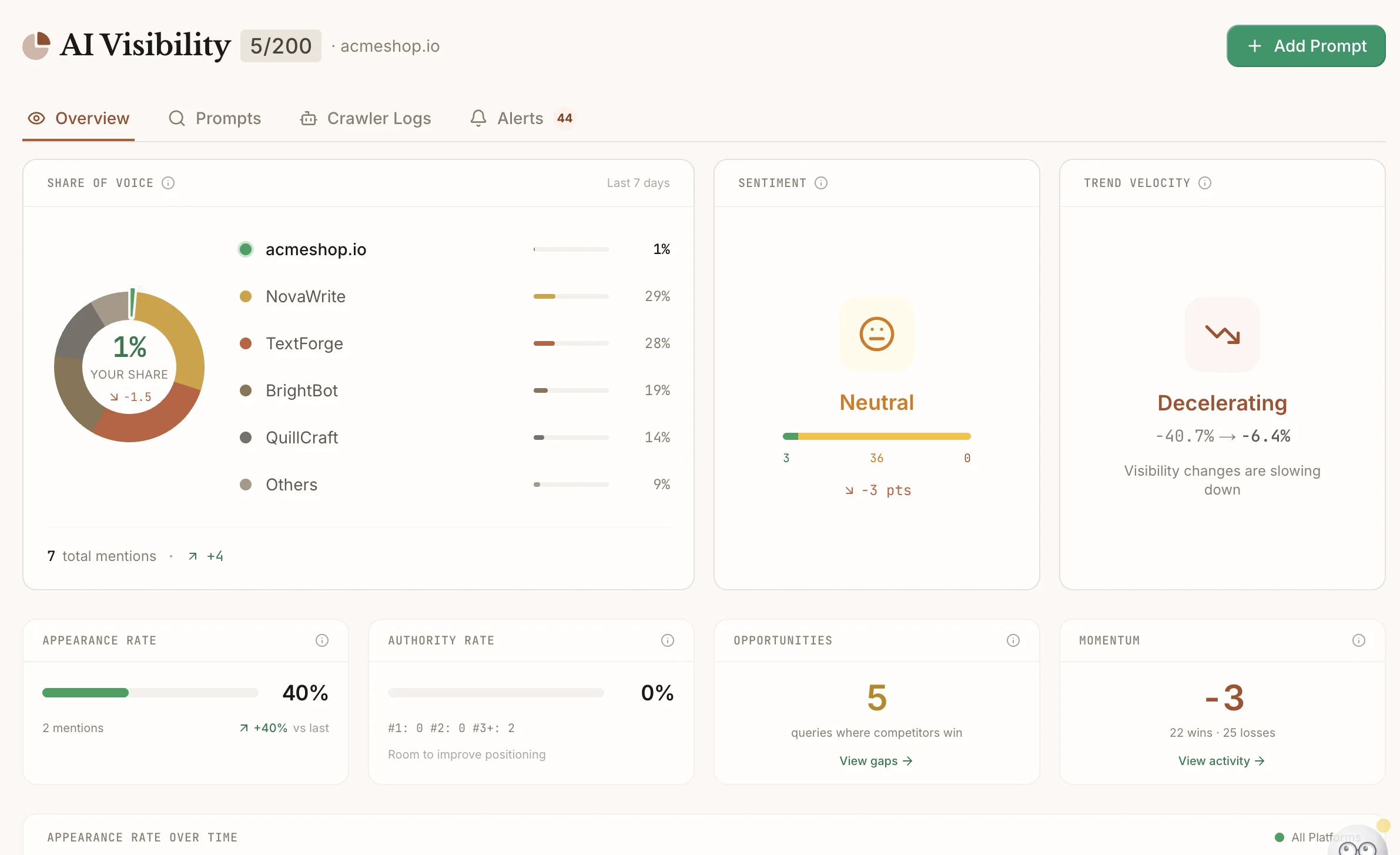
Frase has emerged as one of the most aggressive innovators in autonomous content recovery. Content Watchdog monitors a publisher's content library, detects ranking declines, classifies the root cause across competitor displacement, freshness decay, intent shift, algorithm impact, and AI citation loss, and generates specific fixes prioritized by revenue impact.
The dual SEO and GEO scoring system grades content for both classic Google rankings and Generative Engine Optimization, addressing citation eligibility in ChatGPT, Perplexity, Claude, and Google AI Overviews. AI visibility tracking is bundled on every plan.
Pricing Plans
| Plan | Annual (per month) | Monthly | Articles | AI Platforms Tracked |
|---|---|---|---|---|
| Starter | 39 USD | 49 USD | 10 per month | 2 |
| Growth | 79 USD | 99 USD | Higher allotment | 3 |
| Team | 129 USD | 159 USD | 40 per month | 3 to 5 |
| Enterprise | Custom | Custom | Custom | 5+ with white label |
Feature Breakdown
| Feature | What It Does | Why It Matters for Refresh Work |
|---|---|---|
| Content Watchdog | Autonomous monitoring with diagnosis and fix generation | Replaces manual quarterly content audits |
| Dual SEO and GEO Scoring | Real-time grades for Google and AI search citations | Single workflow covers ranking recovery and AI visibility |
| AI Agent (80+ skills) | Natural language commands across the workflow | Automates multi-step refresh tasks like brief, draft, optimize |
| MCP Server | Read-write access for external AI agents | Integrates Frase into custom agentic content stacks |
| Site Auditing | Cannibalization detection, internal linking, crawler analytics | Identifies multi-page issues that contribute to decay |
Strengths and Trade-offs
| Strengths | Trade-offs |
|---|---|
| Lowest entry price in the category at 39 USD per month annual | AI writing quality requires editorial review on output |
| AI search visibility included on every plan | Seat counts capped on lower tiers (1 to 5 by plan) |
| Content Watchdog automates decay detection and recovery | No backlink analysis or deep technical SEO |
| MCP server supports modern agentic workflows | Interface can feel cluttered as features have multiplied |
Rating Snapshot
| G2 Rating | Capterra Rating | Most-Cited Strength | Most-Cited Concern |
|---|---|---|---|
| 4.8 / 5 | 4.5 / 5 | Bundled AI visibility tracking from the entry plan | AI writing output benefits from human editing |
Best fit: content marketers, SEO managers, and digital agencies that need creation, optimization, and AI visibility tracking in one subscription. Particularly strong for teams trying to recover classic SERP rankings and earn AI citations without operating two separate tooling stacks.
MarketMuse

MarketMuse is the most strategically focused tool in this guide. Rather than optimizing individual pages, it analyzes an entire content library through patented topic modeling and produces a domain-level authority map. For each cluster it generates an Authority Score reflecting how comprehensively the site covers a subject relative to ranking competitors, then identifies coverage gaps, content decay, and cannibalization across the inventory.
Content Inventory automatically audits every URL, scores it for personalized difficulty, competitive advantage, and intent alignment, and surfaces pages where ranking has slipped or competitor coverage has expanded. Customers include IBM, Deloitte, and MongoDB.
Pricing Plans
| Plan | Approximate Price | Queries | Inventory Access | Best For |
|---|---|---|---|---|
| Free | 0 USD | 10 per month | Limited | Trial users |
| Standard | 149 USD per month | Limited | Single site | Solo strategists |
| Team | 399 USD per month | Unlimited | Multi-site | Content teams, agencies |
| Premium and Enterprise | Custom | Unlimited | Multi-site advanced | Large enterprises |
Feature Breakdown
| Feature | What It Does | Why It Matters for Refresh Work |
|---|---|---|
| Topic Authority Score | Maps domain-level authority across topic clusters | Shows where to invest refresh effort for maximum ranking impact |
| Content Inventory | Auto-audits every URL with decay and cannibalization flags | Replaces manual spreadsheet-based content audits |
| Personalized Difficulty | Scores keywords by site-specific likelihood of ranking | Prioritizes refresh candidates with realistic recovery odds |
| AI Content Briefs | Generates structured outlines with topics and questions | Standardizes refresh briefs across multiple writers |
| MarketMuse Connect | Internal linking analysis and orphan content detection | Restores topical connectivity often lost during decay |
Strengths and Trade-offs
| Strengths | Trade-offs |
|---|---|
| Domain-level authority mapping is unmatched in the category | Authority Score requires 50+ articles to be meaningful |
| Decay and cannibalization detection built into Content Inventory | Standard plan query limits force frequent upgrades |
| Personalized difficulty scoring grounds prioritization decisions | Steepest learning curve in the category |
| Free tier sufficient for evaluation | Optimization scoring less actionable than Surfer or Clearscope |
Rating Snapshot
| G2 Rating | Capterra Rating | Most-Cited Strength | Most-Cited Concern |
|---|---|---|---|
| 4.5 / 5 | 4.6 / 5 | Best site-wide topical authority modeling | Steep learning curve and aggressive higher-tier pricing |
Best fit: enterprise teams and agencies managing libraries of one hundred or more articles where the strategic question is which pages to refresh, consolidate, or prune. Most enterprise users pair it with Surfer or Clearscope for writing-time scoring.
Semrush Content Toolkit
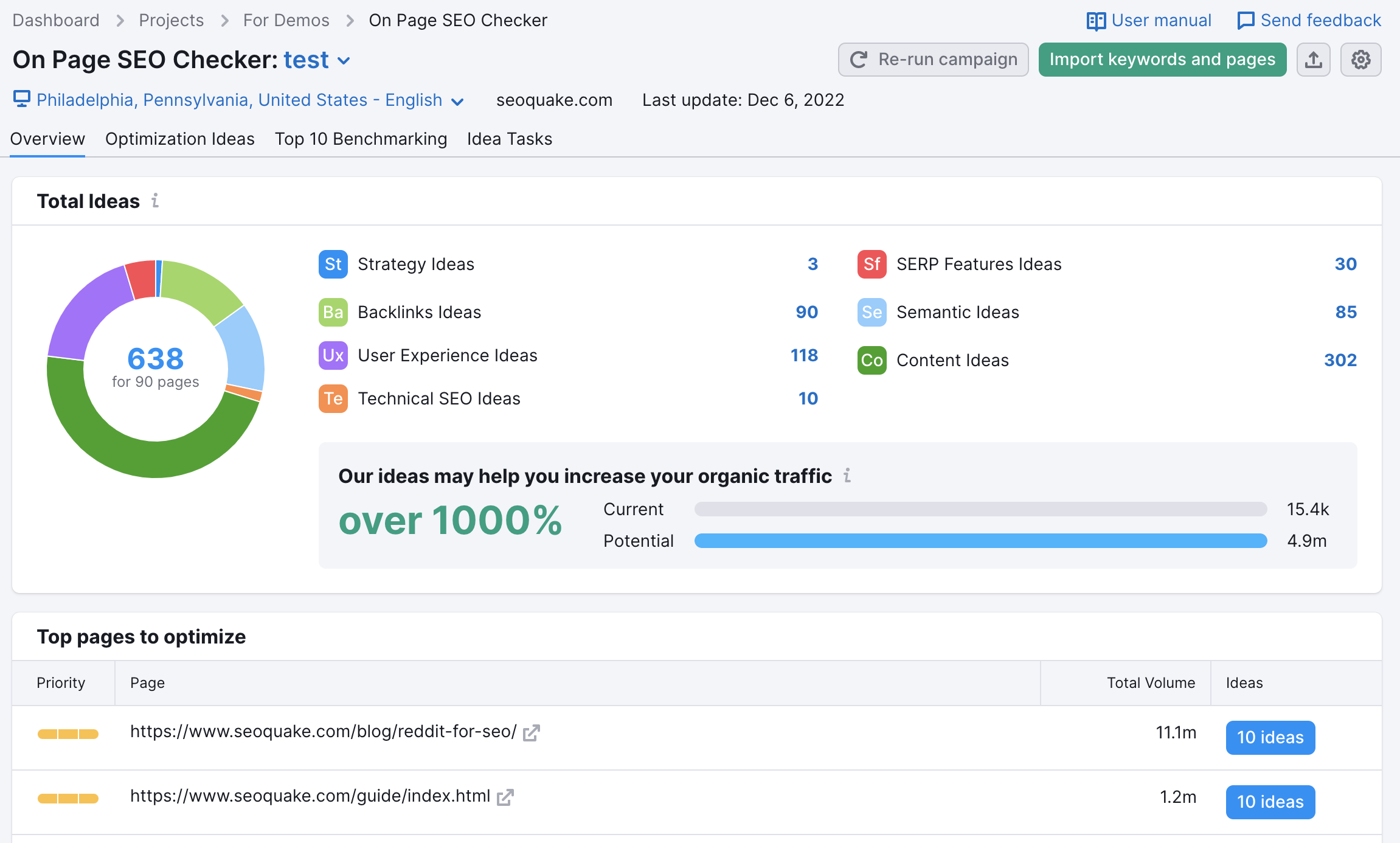
Semrush approaches content refresh as one workflow inside a broader marketing platform consolidating more than fifty-five tools. The Content Audit module pulls page-level data from Google Search Console and Google Analytics, scores articles on traffic, backlinks, and engagement, then categorizes each URL as rewrite, remove, update, or maintain. This addresses the often-overlooked first step in refresh work: deciding which articles deserve the investment.
The Content Toolkit, formerly branded ContentShake AI, sits alongside the SEO Writing Assistant and generates optimized first drafts using Semrush's SERP and keyword data rather than generic language model output. The 2026 Semrush One tier adds AI Visibility Toolkit functionality for ChatGPT, Gemini, Perplexity, and Google AI Overviews.
Pricing Plans
| Plan | Monthly | Annual (per month) | Content Toolkit | Best For |
|---|---|---|---|---|
| Pro | 139.95 USD | 117.33 USD | Add-on at 60 USD | Solo SEOs, small teams |
| Guru | 249.95 USD | 208.33 USD | Included | Content-focused teams |
| Business | 499.95 USD | Custom | Included | Agencies at scale |
| Semrush One | From 199 USD | Custom | Included with AI Visibility | AI search era teams |
Feature Breakdown
| Feature | What It Does | Why It Matters for Refresh Work |
|---|---|---|
| Content Audit | Categorizes URLs as rewrite, update, remove, or maintain | Provides decision framework before refresh investment |
| SEO Writing Assistant | Real-time optimization scoring inside Google Docs and WordPress | Refreshes are scored against live SERP data while edited |
| ContentShake AI | Generates SEO-optimized first drafts from SERP data | Speeds up rewrite-heavy refresh work on outdated articles |
| AI Visibility Toolkit | Tracks brand presence across major AI engines | Catches AI citation decay alongside classic ranking decay |
| Position Tracking | Monitors keyword rankings including AI Overview citations | Validates whether refresh work has actually recovered traffic |
Strengths and Trade-offs
| Strengths | Trade-offs |
|---|---|
| Single subscription covers diagnosis, refresh, and rank tracking | ContentShake quality is competent but trails dedicated AI writing tools |
| Content Audit provides decision logic missing from optimization-only tools | Content Toolkit gating between Pro and Guru creates upgrade friction |
| AI Visibility Toolkit competitively priced versus Ahrefs Brand Radar | Most users report engaging less than 20 percent of features |
| Largest keyword database in the category at 26 billion keywords | No free plan; only a 14-day trial |
Rating Snapshot
| G2 Rating | Capterra Rating | Most-Cited Strength | Most-Cited Concern |
|---|---|---|---|
| 4.5 / 5 | 4.6 / 5 | Most comprehensive all-in-one digital marketing suite | Feature breadth produces a steep learning curve |
Best fit: SEO teams and agencies needing content refresh capabilities alongside backlinks, technical audits, and rank tracking in a single subscription. Less appealing for teams whose only requirement is content optimization, where Clearscope, Surfer, or Frase deliver more focused functionality at a lower cost.
Ahrefs
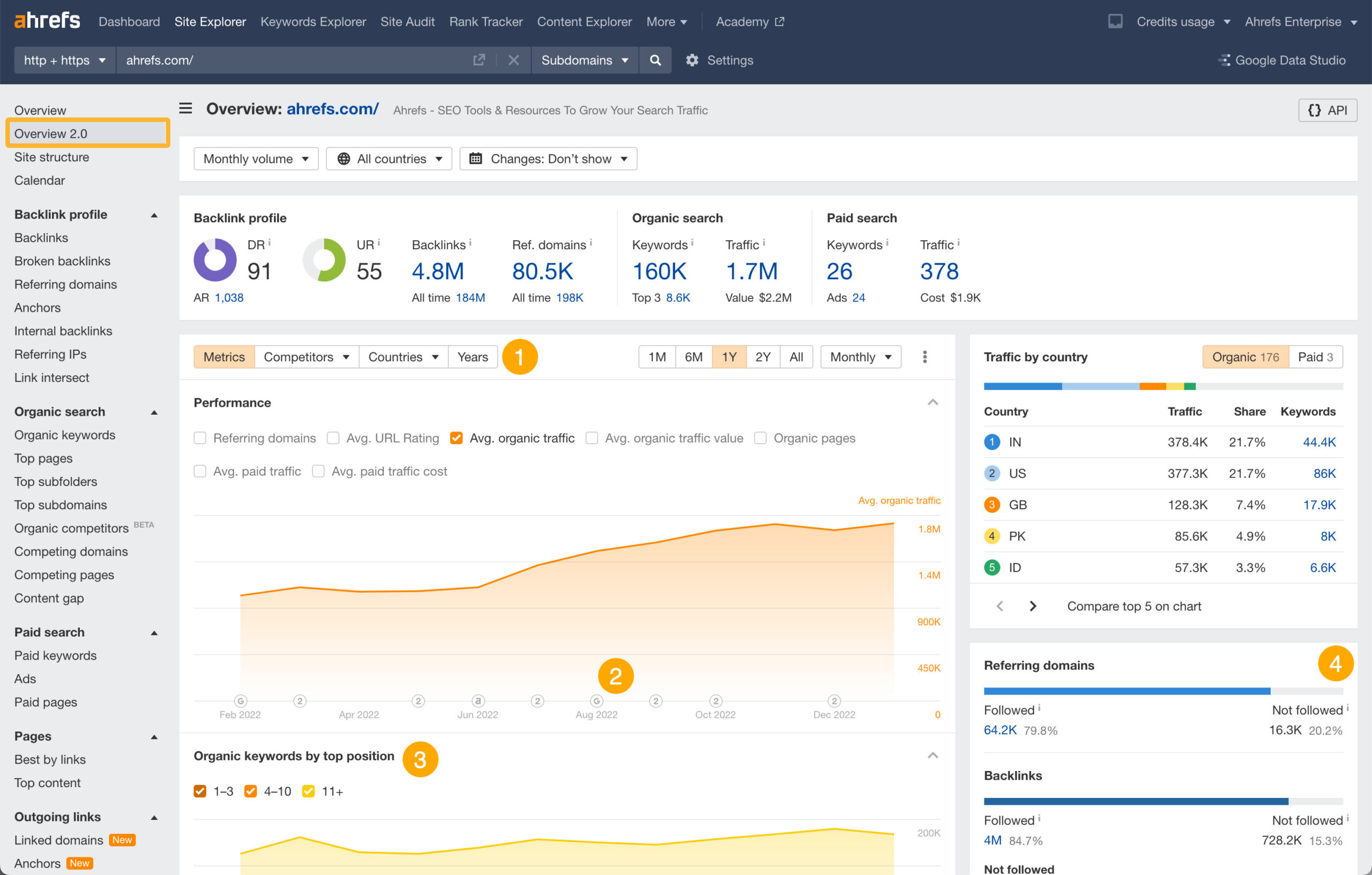
Ahrefs is the diagnostic engine of the refresh stack. Its Top Pages report inside Site Explorer surfaces every URL on a domain with twelve-month traffic trends, filterable to show declining pages sorted by largest negative change. Layering a Keyword Difficulty filter of forty or below isolates pages where content quality is the constraint rather than backlink scarcity.
The 2026 AI Content Helper grades a target URL against top-ranking pages and highlights specific topical gaps and missing entities. Ahrefs maintains the largest backlink index in the industry, refreshed every fifteen to thirty minutes, which lets refresh workflows account for whether a ranking decline correlates with lost backlinks rather than content drift.
Pricing Plans
| Plan | Monthly | Annual (per month) | Projects | Best For |
|---|---|---|---|---|
| Starter | 29 USD | Monthly only | Limited | Site owners exploring the platform |
| Lite | 129 USD | 108 USD | 5 | Solo SEOs, small sites |
| Standard | 249 USD | 199 USD | 20 | Agencies, content marketers |
| Advanced | 449 USD | 374 USD | 50 | In-house SEO teams |
| Enterprise | From 1,499 USD | Annual only | 100+ | Large operations |
Feature Breakdown
| Feature | What It Does | Why It Matters for Refresh Work |
|---|---|---|
| Top Pages Report | Lists every URL with twelve-month traffic direction | Identifies decay candidates and ranks them by traffic loss |
| AI Content Helper | Grades a URL against top-ranking pages with topical gap analysis | Replaces manual SERP comparison during refresh planning |
| Site Audit | Crawls 100 technical and on-page issue types | Surfaces thin content, indexation issues, and orphan pages |
| Backlink Index | Industry-largest live link database, refreshed every 15 to 30 minutes | Confirms whether decay is content-driven or link-driven |
| Brand Radar (Add-on) | AI search visibility monitoring | Adds AI citation tracking to traditional rank monitoring |
Strengths and Trade-offs
| Strengths | Trade-offs |
|---|---|
| Most accurate decay diagnostics through Top Pages report | Lite credit system constrains heavy refresh diagnostic workflows |
| Largest backlink index, refreshed every 15 to 30 minutes | Brand Radar AI search tracking adds 199 USD per month |
| AI Content Helper grades content against current SERP leaders | No free trial; only the 29 USD Starter plan as evaluation |
| Standard tier 5,000 keywords often outpaces direct competitors at the price | Optimization tooling less developed than Surfer or Clearscope |
Rating Snapshot
| G2 Rating | Capterra Rating | Most-Cited Strength | Most-Cited Concern |
|---|---|---|---|
| 4.5 / 5 | 4.6 / 5 | Industry-leading backlink data accuracy | Brand Radar costs 199 USD per month extra |
Best fit: technically sophisticated SEO teams, growth marketers, and agencies that need diagnostic precision before committing optimization effort. Most refresh workflows that reach scale pair Ahrefs for identification with a dedicated optimization tool such as Surfer, Clearscope, or Frase.
Side by Side Comparison
The six platforms above solve different parts of the same problem. The summary below normalizes pricing entry points, refresh strengths, and current G2 ratings for a faster decision.
Six Tools at a Glance
| Tool | Entry Price | Primary Refresh Strength | AI Search Tracking | G2 Rating | Trial |
|---|---|---|---|---|---|
| Surfer SEO | From 79 USD | Audit feature for SERP-aligned page recovery | Add-on at 95 USD | 4.8 / 5 | 7-day refund |
| Clearscope | From 129 USD | Highest grading accuracy, content inventory | Included via Expand | 4.9 / 5 | Demo only |
| Frase | From 39 USD | Autonomous decay recovery, dual SEO and GEO | Included on every plan | 4.8 / 5 | 7-day free |
| MarketMuse | Free; from 149 USD | Site-wide topical authority and inventory | Limited | 4.5 / 5 | Free tier |
| Semrush | From 117.33 USD | All-in-one suite with Content Audit | Semrush One tier | 4.5 / 5 | 14-day trial |
| Ahrefs | From 29 USD | Decay diagnostics and AI Content Helper | Brand Radar 199 USD | 4.5 / 5 | Starter at 29 USD |
How to Choose the Right Tool
Tool selection should follow from the bottleneck in the current refresh process rather than from feature counts. Most teams have one of four constraints.
Match Your Bottleneck to the Right Tool
| Primary Bottleneck | Best Tool | Why |
|---|---|---|
| Identifying which pages have decayed | Ahrefs or MarketMuse | Top Pages report and Content Inventory surface decay candidates with traffic and difficulty data |
| Closing topical gaps on individual pages | Surfer SEO or Clearscope | Real-time scoring against current SERP leaders during the edit |
| AI search visibility decay | Frase or Semrush One | Bundled tracking for ChatGPT, Perplexity, and Google AI Overviews |
| End-to-end automation | Frase Content Watchdog | Detects, diagnoses, and generates fixes without manual triggers |
| Single-platform consolidation | Semrush | Diagnosis, refresh, and rank tracking in one subscription |
A practical 2026 stack for a growing content team typically combines two tools rather than relying on one platform. A representative configuration: Ahrefs Standard or Semrush Pro for diagnostics, plus Surfer Scale or Frase Growth for refresh execution. Total cost lands between 220 USD and 380 USD per month, which compares favorably with the cost of a single decayed flagship article in lost traffic over a year.
Enterprise teams with one hundred or more articles often replace the diagnostics layer with MarketMuse for inventory analysis depth and pair it with Clearscope for grading precision. Boutique agencies and freelance operators tend to consolidate around Frase for the lower entry price and bundled AI visibility.
Conclusion
Refreshing old blog posts is the highest leverage activity available to most content teams in 2026. A 106 percent average traffic uplift from systematic refreshes, up to 20 percent annual loss from neglecting aging content, and a 527 percent year over year surge in AI sourced traffic all point in the same direction. The infrastructure to capture that opportunity now exists at a price point accessible to almost any serious publisher.
The six tools profiled solve different parts of the problem. Surfer SEO and Clearscope handle per page optimization with proven correlation to ranking improvements. Frase consolidates the workflow and addresses AI visibility natively. MarketMuse provides strategic inventory intelligence at the domain level. Semrush integrates refresh into a complete digital marketing operation. Ahrefs supplies the diagnostic foundation that makes prioritization defensible, while specialist partners such as Writenexa give teams the option to outsource research heavy, SEO aligned rewrites when capacity is tight.
The actionable next step is straightforward. Identify the twenty pages that have lost the most organic traffic over the last twelve months. Filter for manageable keyword difficulty. Apply a per page optimization tool to close topical gaps against current SERP leaders. Add an AI visibility check for any article in a query class triggering AI Overviews. Re measure at thirty, sixty, and ninety days. Teams that operationalize this loop typically recover meaningful traffic on roughly half of their refresh candidates, which usually exceeds the ROI of equivalent investment in net new content.