The invoice folder tells the story better than any spec sheet. Over the past few months I ran the same set of jobs, a 2,400 word affiliate roundup, a client blog post that had to sit in someone else's voice, a batch of forty meta descriptions, and a plain evergreen guide, through more AI writing tools than I want to admit paying for. Some got cancelled inside a week. A handful stayed. What became obvious fast is that the question “which AI writer is best” has no honest answer until you finish the sentence: best for whom, and best on whose money.
A solo blogger publishing twice a week with their own name on the byline needs something cheap, fast, and forgiving. An agency billing clients for that same word count needs voice control that survives 3,000 words, seats for a team, and a paper trail when a client asks how the piece was made. Those are not the same tool, and pretending they are is how people end up paying agency prices for a hobby, or handing a client work that reads like a template.
So I split the field. Below are five tools I actually used, sorted by who they genuinely serve. Each one gets a review table, an honest pros and cons, real user feedback pulled from the review sites, and a note on where it fits. The pricing is what the vendors published as of September 2026; several of these companies reprice mid-year, so confirm the live figure before you hand over a card.
IF YOU ARE A SOLO BLOGGER Try WriteNexa, or Claude Pro WriteNexa turns a title or keyword into a structured, SEO-aware draft with a free trial to test it, and Claude Pro at $20 is the stronger prose engine when your own voice carries the byline. Between them you cover most of a blogger's week without an agency bill. | IF YOU RUN AN AGENCY OR TEAM Look at Jasper, backed by Blaze Jasper's Brand Voice held a client's register across a full guide with the lightest edit of anything I tested. Blaze covers the multi-channel repurposing a small team lives on. The per-seat bill is the trade. |
The five tools, and who they are really for
Here is the whole field on one screen before the detail. I have marked each tool by the side of the fence it lands on, based on price, feature depth, and how it behaved when I pushed real client work through it.
Five AI writing tools, sorted by who they serve. Prices verified September 2026.
| Tool | Best for | Entry price | The feature that matters | Tested score |
|---|---|---|---|---|
| WriteNexa Solo | SEO blog drafts that read human | Free trial, Pro $49/mo | Title or keyword to structured draft, no prompts | House tool |
| Claude Pro Solo | Writers whose own voice is the product | $20/mo | Projects that hold a client's voice and files | 8.4 / 10 |
| ChatGPT Plus Both | The everyday workhorse draft | $20/mo | Best first-pass structure of any chatbot | 8.3 / 10 |
| Blaze AI Team | Solo marketers and small teams, many channels | $39/mo | One asset repurposed across a dozen channels | 4.2 / 5 |
| Jasper Agency | Brand and client content at scale | $59/mo | Brand Voice that survives 3,000 words | Team pick |
Notice the split runs on cost and workflow more than raw quality. Every tool here needed a human editing pass; not one produced a page I would publish untouched. The difference between the sides is what you are buying around the writing: low-friction SEO drafting for the solo, or voice control, seats, and repeatability for the team.
WriteNexa: low-friction SEO drafts that read human
Full disclosure before anything else, since it matters for how you read this section: WriteNexa is the tool this blog is published on, so treat the following as the house team describing its own product rather than a blind test. I have tried to keep it as level as the other four, flaws included.
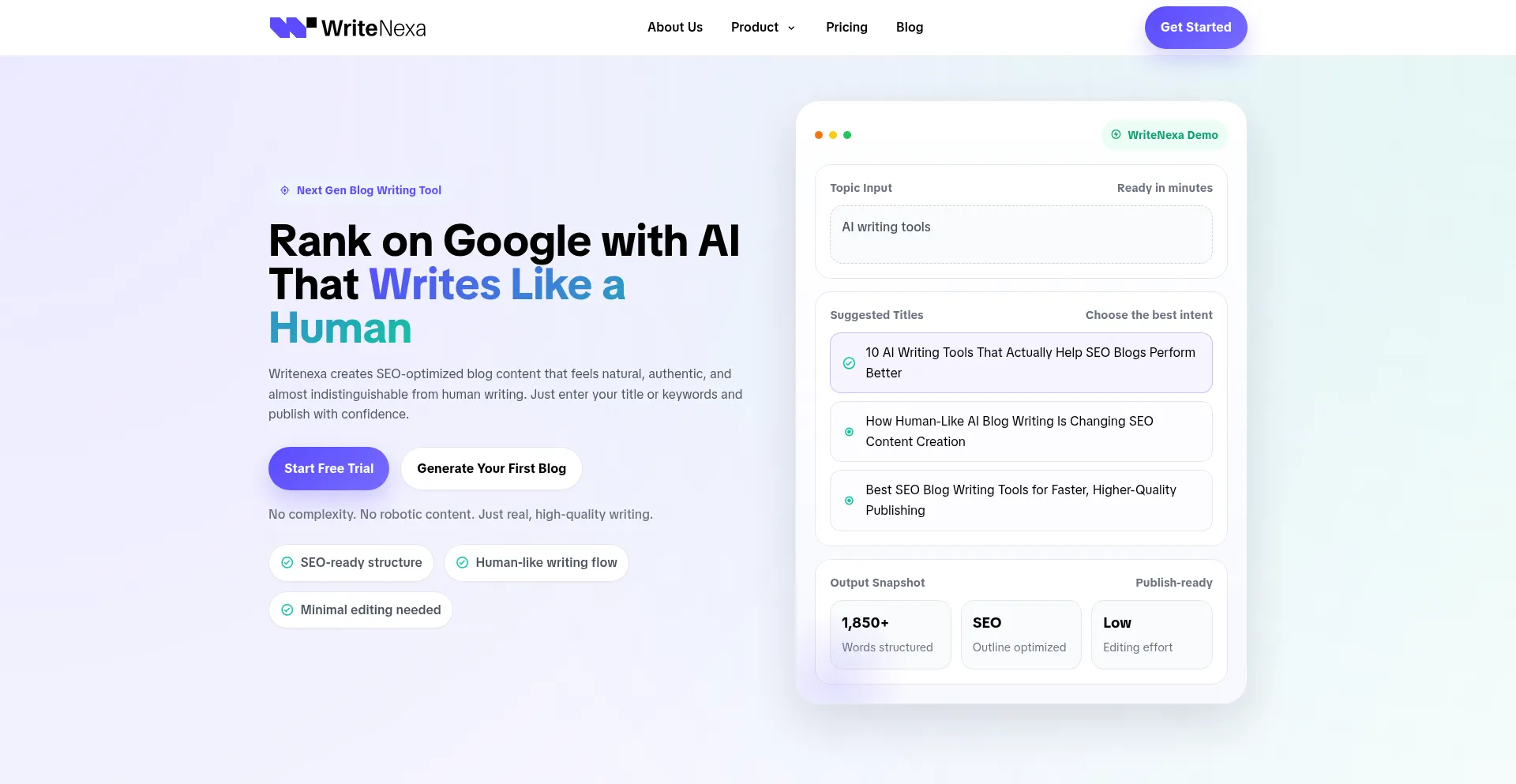
WriteNexa is deliberately narrow. There is no sprawling toolbox and no prompt to engineer. You enter a title, a keyword, or even a rough idea, it suggests a few search-intent titles to pick from, and it returns a structured blog draft built to read naturally and rank. For a solo blogger, the appeal is the low friction: the gap between “I should write about this” and “I have a draft to edit” is short, which is usually the hardest part of publishing consistently.
Where it lands honestly is as a starting-draft engine, not a finished page. The output reads cleaner than a lot of raw AI and needs less structural cleanup, but it is still a draft: your examples, your opinion and your voice are what turn it into something worth your byline. On voice-led personal essays it is less at home than a pure prose model like Claude, and it does not chase live product data the way a dedicated affiliate tool would. It is aimed squarely at the informational SEO blog post, and it is honest about that being the job.
| Best for | Informational SEO blog posts that need to rank and read human |
| Entry price | Free trial (no card); Pro $49/mo, Growth $99/mo |
| Free way in | Starter trial, cancel anytime, no hidden fees |
| Draft came back as | Structured, readable draft that needs your voice added |
| Weak spot | Narrow by design; not a fiction or live-data tool |
WHAT WORKS ● No prompt engineering: a title or keyword is enough to start ● Suggests several search-intent titles so you pick the angle ● Drafts arrive structured for readability and search visibility ● Free trial with no card, and you can cancel anytime | WHAT HOLDS IT BACK ● Narrow scope: built for blog posts, not fiction or ad campaigns ● Still a draft; you supply the voice, examples and opinion ● No live product or SERP-scraping data inside the draft ● Pro sits at $49, above the cheapest solo picks |
WHERE WRITENEXA FITS
The pitch is a shorter path from idea to publishable draft: stronger structure and readability so you spend less time fixing the basics later. WriteNexa product positioning Solo pick | By its own account the workflow also suits SEO teams and agencies that want consistent draft quality across multiple deliverables, not just solo creators. WriteNexa, stated use cases Scales up |
BLOGGER REALITY CHECK WriteNexa is a first-draft engine, same as every other tool on this page. It gets you a structured, on-topic starting point fast, and then the part that carries your name, the specifics and the point of view, is still yours to write. For a solo blogger trying to publish on a schedule, that trade is the whole point of using one at all. |
Claude Pro: when your own voice is the product
The free plan handles the odd rewrite and a batch of subject lines. Then a client sends over a seventy-page brand book and asks for a refresh across their whole range, and it taps out before the second batch of pages is done. That is the situation this stretch of testing ran from. Over a full quarter, Claude Pro at $20 a month handled the unglamorous middle of a writing life: blog drafts that need a particular voice, landing pages with non-negotiable word counts, editing other people's copy, and turning a rambling interview transcript into something a reader would finish.

Two habits stood out and neither shows up on a feature list. It pushes back: ask for a claim it cannot support and it says so rather than writing it anyway, which is the right instinct for client work. And it writes in paragraphs by default. Ask for an article and you get prose, with structure arriving only when you ask for it, which is a small mercy after years of bullet soup from other tools.
| Prose quality | 9.0 / 10, varied rhythm, few filler phrases |
| Voice matching | 9.0 / 10, holds a client's tone across 2,000 words |
| Editing and rewriting | 8.5 / 10, fast revision loops in Artifacts |
| Usage limits | 6.5 / 10, heavy PDFs hit the five-hour window |
| Overall for writers | 8.4 / 10 |
WHAT WORKS ● Prose that reads like a person wrote it, with real sentence variety ● Projects hold a client's voice and samples so you stop re-pasting the brief ● Respects hard constraints like word counts and banned terms ● Three models on one plan, so the allowance goes where it is needed | WHAT HOLDS IT BACK ● The heaviest model plus large files exhausts the five-hour session on a busy afternoon ● Research mode is useful but expensive in allowance terms ● No image generation, so featured images come from elsewhere ● No project sharing on Pro; a shared brief needs the Team plan |
WHAT PEOPLE ARE SAYING ABOUT CLAUDE PRO
It caught my writing style down to short sentences and leading with the punchline, and the side panel finally killed the copy-and-paste loop. G2 verified reviewer ★★★★★ | Praise centres on thorough, step-by-step responses and instruction following; the common complaint is running into usage limits. Capterra, 4.5 from 31 reviews ★★★★☆ |
For a solo writer who lives in text, the case is simple. One client blog post a month pays for the plan several times over, and the editing time saved on everything else is the real return. The honest test is to build one proper Project around a single client's voice and judge it on that. Read the full Claude Pro review for writers for the model-by-model breakdown.
ChatGPT Plus: the workhorse neither camp cancels
I kept Grok and ChatGPT open side by side for two months, and for straight writing work ChatGPT Plus at $20 is the one that stayed. It writes like an editor who wants the piece to ship: consistent tone across 1,500 words, a sensible heading hierarchy, and fewer detours into side topics. Feed it a 600-word voice guide and three sample posts and the first draft lands close enough to the house voice that the edit is mostly cutting.

For years the complaint ran the other way, that it turned every answer into bullet soup. The August update went after exactly that. Ask for one subject line now and you get one subject line; ask for a blog section and it still arrives structured. That single change removed the rewrite-every-intro tax that used to make it a chore for client work. It sits on both sides of my fence because a solo blogger and an agency writer use it for the same thing: the reliable first draft that needs the least structural surgery.
| Prose quality on a first draft | 8.5 / 10 |
| Holding a supplied style guide | 9.0 / 10 |
| Formatting and structure | 9.0 / 10 |
| Facts, citations and live data | 7.5 / 10 |
| Overall for writers | 8.3 / 10 |
WHAT WORKS ● Best first-pass structure of any chatbot I tested ● Strongest at absorbing style guides and samples ● Writing blocks, memory and projects built for the revision loop ● The flagship model is included at the $20 tier | WHAT HOLDS IT BACK ● Free and Go tiers carry ads and run on the weakest writing model ● Web research trails rivals and dated facts can slip in ● The default voice is safe; edge has to be requested ● Two separate plans share the “Pro” name, so it is easy to buy the wrong one |
WHAT PEOPLE ARE SAYING ABOUT CHATGPT FOR WRITING
Across a brand-kit test, its tagline, values and tone-of-voice examples were the ones the reviewer preferred over the rival on the same brief. tl;dv comparison ★★★★☆ | Rated stronger than rival models at using style guides and samples, with speed and willingness to take direction ideal for collaborative writing. Every.to, Vibe Check ★★★★☆ |
If you write about things that happened this morning, the picture shifts, and that is a separate contest. The full Grok vs ChatGPT writing head-to-head lays out the ten-job scorecard, but for voice-guided client work and clean structure, Plus is the safer keyboard.
Blaze AI: the bridge from solo to small team
Blaze is where the fence gets blurry, and deliberately so. It is an all-in-one marketing platform built for solopreneurs, small teams and agencies alike. It connects to your social accounts and your site, builds a strategy, plans content weeks ahead, then writes and schedules across more than ten channels. For this test I treated the scheduling and analytics as background and pointed everything at the writing.
The feature I would actually miss is repurposing. Take one blog and turn it into social posts, an email, a press release, a video script, a landing page or an FAQ in a couple of clicks. For anyone stretching a single idea across channels, that is where the real time saving lives, and it is exactly the workflow a lean content team runs on. Short-form was the standout: captions and ad variations came back on tone with almost no steering. Long-form held on a single draft, then started reusing the same sentence shapes across a run of posts, which is a habit to plan an edit around rather than ignore.
| Short-form writing | 4.5 / 5, captions and ad copy land on tone |
| Long-form / blogs | 3.8 / 5, solid structure, repetitive on long runs |
| Brand voice | 4.4 / 5, strong once fed real samples |
| Speed and volume | 4.7 / 5, a month of content in an afternoon |
| Overall | 4.2 / 5 |
WHAT WORKS ● Repurposing is the killer feature: one blog spins out into a dozen assets ● Brand voice is convincing once trained on real samples ● Speed and volume are real; a month of social content in one sitting ● Strategy, writing, images, scheduling and publishing live in one place | WHAT HOLDS IT BACK ● Credits cap output on lower tiers and do not roll over ● Long drafts get repetitive, reusing patterns across a run ● Thin voice training reads generic; depth is limited on competitive SEO ● Brand kit applies inconsistently, fonts especially, per repeated reports |
WHAT PEOPLE ARE SAYING ABOUT BLAZE AI
Writing blogs with it is very easy and the results are almost perfect, with one post spinning out into many. Capterra, 4.8 rating ★★★★★ | The posts do not sound like AI, and the drafts carried the brand's usual tone and humour across channels. Trustpilot, 4.6 rating ★★★★☆ |
Priced from around $39 a month, with managed done-for-you tiers climbing well past $999, Blaze earns its keep for the solo marketer or small team replacing agency work. The full month-long Blaze AI test has the credit-cost breakdown, since credits decide whether the plan feels generous or stingy.
Jasper: voice control that survives the whole guide
Jasper has grown out of being a writing toy and into marketing software, and the price says so. What justified the bill in testing was Brand Voice. I trained it on three published samples and my 3,000 word guide came back needing the lightest tone edit of any draft in the entire long-form test. Knowledge assets let it pull from real product details rather than improvising, and because the long-form editor sits beside the campaign tools, the same guide became emails and social posts without re-explaining anything to the model.
That is an agency feature set, not a blogger one. When several writers have to produce work in one client's register, and a manager has to keep it consistent across a campaign, the per-seat cost stops looking like a tax and starts looking like the point. For a solo blogger it is almost certainly more platform than the job needs.
| Built for | Brand and team content, collaboration |
| Entry price | $69/mo, or $59 on annual billing, per seat |
| Free way in | 7 day trial, no free plan |
| Draft came back as | On-brand guide, lightest tone edit of six tools |
| Weak spot | Hard to justify for solo use; seat pricing multiplies |
WHAT WORKS ● Best voice consistency of every tool tested here ● Knowledge assets ground drafts in real product facts, not guesses ● Built for teams, with genuine collaboration features ● Campaign tools turn one long piece into a matching set of shorter assets | WHAT HOLDS IT BACK ● Highest per-seat cost in the lineup ● More platform than a solo blogger will ever use ● Seat pricing multiplies quickly for a small team ● No free plan, only a 7 day trial to judge it on |
WHAT PEOPLE ARE SAYING ABOUT JASPER
The one I would keep if I ran a content team instead of my own sites. The voice control is real, but so is the per-seat bill. WriteNexa long-form test ★★★★☆ | Required the least tone editing of the six tools, and turned one long-form piece into a full campaign without re-briefing. Hands-on reviewer ★★★★☆ |
WHERE THESE FIT IN THE WIDER FIELD Jasper and Blaze were the team picks, but the same long-form test also weighed Sudowrite for fiction, Surfer for ranking, Writesonic for AI-search visibility and Scalenut on a budget. If your job is narrower than “client content,” the six long-form alternatives breakdown is the one to read next. |
Side by side, on the things that actually differ
Strip out the marketing and the choice comes down to a few axes: what it costs to get in, how much team plumbing you get, and whether the draft needs light or heavy editing before your name goes on it. Here is the field on those terms.
How the five compare on the things that separate a blogger's pick from an agency's.
| Tool | Entry price | Voice training | Team / multi-seat | Editing load |
|---|---|---|---|---|
| WriteNexa | Free trial, $49/mo | Structure over voice | Scales to teams | Light on structure, add voice |
| Claude Pro | $20/mo | Strong (Projects, Styles) | Team plan only | Light |
| ChatGPT Plus | $20/mo | Strong | Team plan available | Light on structure |
| Blaze AI | $39/mo | Good once trained | Yes, unlimited users on Growth | Medium, edit long-form |
| Jasper | $59/mo | Best in test | Yes, seat-based | Lightest tone edit |
The pattern is not subtle. Money buys you the team layer and the voice consistency an agency cannot function without. If you are one person, you are paying for capability you will not use, and the cheaper picks leave more in your pocket for the one thing none of these tools sell: your own editing time.
The things the price tag alone will not tell you
Price, voice and seats are the headline split, but three quieter differences decide how a tool feels day to day: how you try it, how much work it takes to reach a usable draft, and where that draft ends up.
1. How you try it before paying
For a solo blogger this matters more than the sticker price, because a risk-free look tells you in an afternoon whether a tool suits your voice. Every option here has a way in that costs nothing; what differs is how much of the real product you actually get to judge.
The free route into each tool, and what you can judge before a card comes out.
| Tool | Free way in | What you get to test |
|---|---|---|
| WriteNexa Solo | Free trial, no card | Generate real blog drafts and see if the output fits before upgrading |
| Claude Pro Solo | Free plan, always on | Sonnet and Haiku, five Projects, Styles and Artifacts at a smaller allowance |
| ChatGPT Plus Both | Free tier, always on | Unlimited chats on the weaker writing model, ad-supported, fine for ideas |
| Blaze AI Team | Free tier plus 7-day paid trial | Free tier is watermarked and capped at one post a week per channel |
| Jasper Agency | 7-day trial, no free plan | Full Pro features for a week, including Brand Voice, then it stops |
The read here favours the solo side. WriteNexa, Claude and ChatGPT let you keep testing indefinitely at some level, while Jasper gives you one week and then asks for the card.
2. How much effort to reach a usable draft
Two tools can cost the same and still differ in how much setup stands between you and a draft. Some want a trained voice and connected accounts first; others take a keyword and go. Which is better depends on whether you are furnishing a workflow or just want words on a page.
Setup effort and prompt skill needed before each tool earns its keep.
| Tool | Prompt skill needed | Setup before it is useful | Learning curve |
|---|---|---|---|
| WriteNexa | Minimal | A title or keyword, then pick a suggested angle | Gentle |
| Claude Pro | Moderate | Build one Project holding a voice guide and samples | Moderate |
| ChatGPT Plus | Moderate | Paste a voice guide and a few sample posts per client | Moderate |
| Blaze AI | Low | Train a brand voice and connect your accounts | Gentle, clean onboarding |
| Jasper | Moderate | Train Brand Voice on samples, add knowledge assets | More platform to learn |
WriteNexa and Blaze are the fastest from cold start to first draft, which is why one suits a blogger on a schedule and the other a small team pushing volume. Claude, ChatGPT and Jasper reward a little setup with better voice matching, so the effort pays back over many pieces.
3. Where the finished draft ends up
A draft is only useful when it reaches the page, and this is where the blogger tools and the team platforms part ways. Some hand you text to place yourself; others push straight to a CMS or spin one piece into a dozen formats.
Output format, direct publishing, and how far each tool stretches one piece.
| Tool | What comes out | Publishes direct? | Repurposing to other formats |
|---|---|---|---|
| WriteNexa | A structured, publish-ready blog post | Blog-ready output, mobile and desktop | Focused on blog content |
| Claude Pro | Prose in chat, editable in Artifacts | No, you place it yourself | Any format, but you ask each time |
| ChatGPT Plus | Prose with editable writing blocks | No, you place it yourself | Any format, but you ask each time |
| Blaze AI | Drafts across many content types | WordPress plus 10-plus channels | One asset into a dozen formats |
| Jasper | Long-form plus campaign assets | No 1-click WordPress in testing | One piece into a matching set |
If publishing is a manual copy-and-paste anyway, the text-only tools cost nothing extra here. If you run many channels or many clients, Blaze and Jasper turn one draft into a week of assets, and that leverage is a chunk of what the higher price buys.
Final Verdict
What I would actually pay for, on each side of the fence
If you are a solo blogger
For the everyday SEO blog post, the one that has to rank on Google and still sound like a person, WriteNexa is the low-friction option, and yes, it is ours, so weigh that as you like. A free trial with no card means the honest test costs you nothing: run one real topic through it and see whether the structured draft saves you the part of writing you dislike most. When the writing itself is the point and your own voice carries the byline, Claude Pro at $20 is the stronger prose engine, and building one Project around a client's voice is the moment it stops feeling like a chatbot and starts feeling like a junior writer who read the brief. Most solo bloggers do not need more than a draft engine and a voice engine, and this pair covers both without an agency bill.
If you run an agency or a team
The calculation flips. Jasper is the one I would keep if I ran a content team instead of my own sites, because the Brand Voice control genuinely held a client's register across a full guide and the campaign tools turned one asset into a set without re-briefing. Blaze sits just under it as the bridge for a lean team that lives on multi-channel repurposing, as long as you watch the credits and edit the long-form. ChatGPT Plus rides along on both sides as the reliable structural first draft. The per-seat bill on the agency side is real, but so is the thing it buys: consistency across writers and a client's voice that does not drift by paragraph three.
One line holds for everyone. None of these tools removes the editing. Every draft in months of testing took thirty to sixty minutes of human work before it was fit to publish. The whole game is starting at seventy percent instead of a blank page, and then doing the part that carries your name yourself.