Let's Get Honest: Everyone Is Using AI Now
If you just came here to check whether AI writing assistants are worth it in 2026, the short answer is yes, and the long answer is this entire article. You are welcome.
Here is a fun fact to kick things off: 97% of content marketers plan to use AI for content creation in 2026, according to the Siege Media and Wynter annual survey. That is not an adoption rate. That is practically a law of nature, right up there with gravity and "the Wi-Fi password is on the bottom of the router."
But here is the rub. Every marketer, blogger, freelance writer, and startup founder using the same tools, with the same prompts, producing vaguely similar articles does not a content advantage make. The tools are now table stakes. How you use them, and which ones you pick for the right job, determines whether you rank on page one or on page seven where hope goes to die.
This guide is built for writers, content leads, SEO specialists, and anyone who has stared at a blank document long enough to question their career choices. We have pulled real pricing, real feature breakdowns, verified data from market research firms, user reviews from G2 and Capterra, and tested output from the tools themselves. No filler. No vague statements about "cutting-edge AI." Just detailed, practical analysis.
This article covers 8 major AI writing platforms for long-form blog and article content. Each tool gets a full breakdown covering architecture, pricing, strengths, weaknesses, ideal use cases, and a scored comparison. Charts and tables are included because words alone are an underrated form of torture when data is involved.
Section 1: The Numbers Nobody Is Arguing With
The AI Writing Tools Market in 2026
Before we dive into individual tools, a quick macro picture. The global AI writing assistant software market was valued at $3.25 billion in 2024 and is projected to reach $9.09 billion by 2033, growing at a CAGR of 12.1% according to Research and Markets. The broader generative AI market, of which writing tools form a significant segment, is projected to hit $91.57 billion globally in 2026 alone.
That is a lot of money for tools that essentially help people stop procrastinating and write better. If only the same were true for gym memberships.
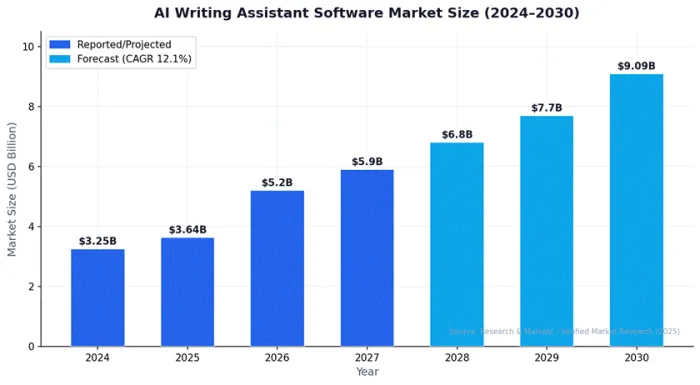
Figure 1: AI Writing Assistant Software Market Size — 2024 to 2030 (USD Billions)
The market has also matured in its usage patterns. According to Siege Media and Wynter's 2026 content marketing survey, content marketers are increasingly moving beyond basic generation toward editing, refinement, and brand-voice-specific outputs.
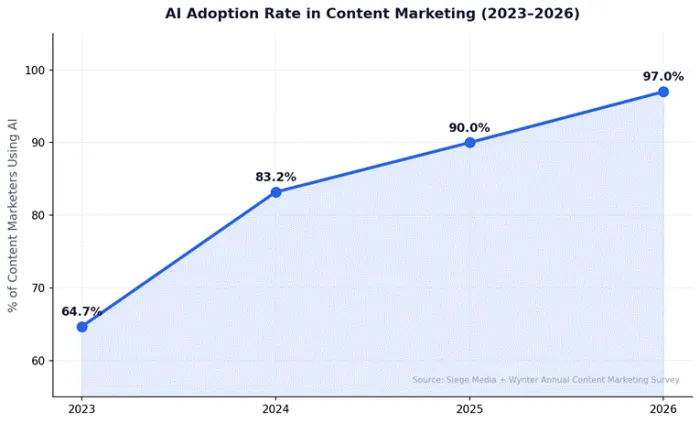
Figure 2: AI Adoption Rate Among Content Marketers (2023–2026)
That near-vertical curve tells you everything. AI went from an experiment to a daily workflow component in under three years. The question for serious content teams is no longer 'should we use AI?' but 'which AI, for which job, at what price point?'
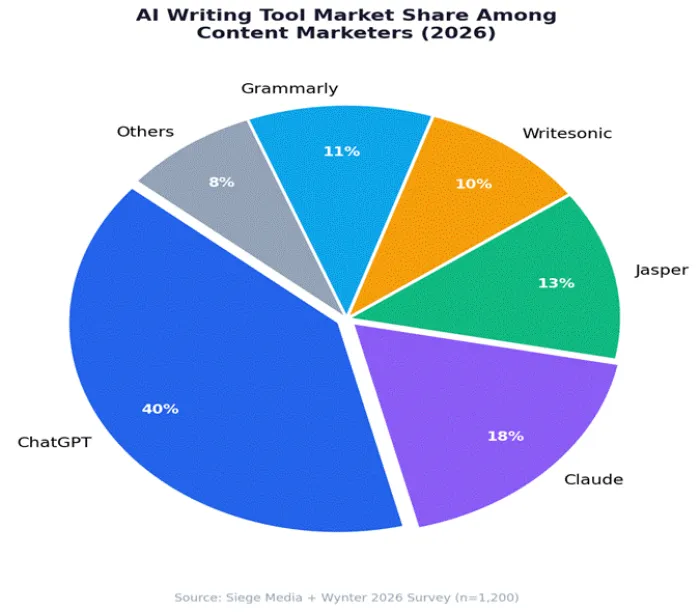
ChatGPT retains the largest mindshare at roughly 80% selection rate as the most trusted tool in 2026 per Siege Media data, with Claude gaining significant ground, particularly for long-form quality content. Jasper holds its position as the go-to enterprise option, while Writesonic and Grammarly carve out distinct niches.
Key Stat: AI-assisted blog writing tools increase organic traffic by 120% within 6 months when used with a proper SEO strategy. Hybrid (AI + human) content ranks 24% higher in search than human-only pieces. Source: Ahrefs 2025, SEMrush 2024.
How We Evaluated These Tools
Every tool in this guide was evaluated across the same four core dimensions, scored out of 10:
•Long-Form Content Quality: How well does the output read at 1,500+ words? Does it hold logical coherence? Does it maintain a consistent voice throughout? Does it hallucinate less than a tired night-shift nurse?
•SEO Capability: Does it suggest keywords, optimize structure, analyze SERP data, and help you rank, or does it just write and hope for the best?
•Ease of Use: How steep is the learning curve? Could a marketing coordinator at a startup figure it out on day one?
•Value for Money: Does the price match the output? Are there word limits, seat limits, or feature walls that make the advertised price misleading?
Jasper AI — The Marketing Team's Swiss Army Knife
| Best For | Enterprise marketing teams, multi-channel campaigns, brand voice consistency |
| Pricing | Creator: $49/mo | Pro: $69/seat/mo | Business: Custom (est. $250–350/mo) |
| Free Trial | 7-day free trial (payment details required) |
| Context Window | Varies by model; supports long-form documents via multi-step workflows |
| Key Integrations | Surfer SEO, Google Docs, Chrome Extension, WordPress, HubSpot |
| G2 Rating | 4.7/5 (based on 1,200+ reviews, 2026) |
What Jasper Is, and What It Genuinely Does Well
Jasper AI, once called Jarvis before a certain Marvel character's legal team presumably had thoughts about that, is the most feature-rich dedicated AI writing platform in the market as of 2026. It is not just a writing tool. It is, as the company positions it, a complete content creation ecosystem.
What makes Jasper stand apart in the long-form writing context is its Brand IQ feature, which allows marketing teams to upload existing brand content, style guides, and tone documentation. The AI then internalizes this and produces content that genuinely sounds like it came from your team rather than a well-meaning intern who read your website once. For agencies managing multiple clients with distinct brand voices, this alone justifies the price of entry.
Boss Mode, Jasper's command-based interface, lets you direct the AI with specific instructions mid-document. Want the next paragraph to explain a technical concept in plain English? Want a shift to a more persuasive tone for the CTA section? You just tell it. This gives experienced writers a level of control that most general AI tools cannot match.
Long-Form Performance
In testing and across extensive user review analysis on G2 and Capterra, Jasper performs exceptionally well for structured blog posts in the 1,500 to 3,500 word range. The Campaign Generation feature is genuinely impressive: you feed it a single content brief and it outputs a blog post, an email sequence, and five social media posts simultaneously. For content teams with high-volume publishing demands, this alone can compress a day's work into an hour.
The March 2026 update introduced one-click competitive content audits and real-time semantic keyword scoring within the Jasper command center when used with the Surfer SEO integration. For serious SEO-focused blog production, this is arguably the most powerful native combination available in any single platform.
Limitations Worth Acknowledging
Jasper is not cheap. For solo bloggers and freelance writers, the entry-level Creator plan at $49/month has limitations on SEO tools and Brand Voice features that mean you are paying premium for a trimmed experience. The Pro plan at $69/seat/month becomes the realistic floor for meaningful use. Like all AI tools in 2026, Jasper can hallucinate statistics and facts, requiring rigorous human review before publication.
The Surfer SEO integration, while excellent, requires a separate Surfer subscription starting at $89/month. Budget for both if SEO is a priority, because paying for Jasper alone and ignoring the integration is a bit like buying a sports car and only ever using it for grocery runs.
Ideal Workflow
•Use Boss Mode for outlined-to-draft blog production with custom instructions per section
•Train Brand Voice on existing content before generating client pieces
•Activate Surfer SEO integration during drafting for real-time optimization
•Use Campaign Generation for cross-channel content from a single brief
Writesonic — The Budget-Friendly Powerhouse That Keeps Getting Better

| Best For | Startups, freelancers, structured long-form article creation with SEO baked in |
| Pricing | Free tier (limited); Paid plans from $16–$19/mo; Individual plans around $49/mo |
| Free Trial | Yes — free tier available, no credit card required for trial |
| Key Features | AI Article Writer 5.0, Chatsonic (web-access), 100+ templates, GEO optimization |
| Integrations | Surfer SEO, Google Docs, Zapier, WordPress, Semrush |
| Capterra Rating | 4.7/5 (2026) |
The Underdog That Earned Its Seat at the Table
If Jasper is the enterprise-grade Rolls-Royce of AI writing, Writesonic is the Tesla Model 3: highly capable, significantly more affordable, and improving with every software update. What started as a decent copy tool has evolved into one of the most complete AI writing platforms in the mid-market space.
Writesonic's AI Article Writer 5.0 guides users through a structured 10-step creation process, breaking down prompting into smaller contextual chunks. This is genuinely useful because the quality of AI output is strongly correlated with the quality of input, and Writesonic essentially coaches you into giving better instructions. The result: detailed content briefs produced quickly, then expanded into full articles.
The Chatsonic feature is a standout. Unlike Jasper's native drafting environment, Chatsonic includes real-time web access, meaning it can pull current information to generate factual, citation-supported content. This is particularly valuable for news-adjacent blogging, trend pieces, and technical articles where being out of date by even a few weeks matters.
Long-Form Output Quality
In extensive user testing documented across Jotform's 2026 app review and multiple independent evaluations, Writesonic was the most accurate at matching requested word counts. While most AI writing tools consistently undershoot requested lengths, Writesonic allows requests of 500 to 5,000 words and actually delivers. It matched style references more closely than most competitors and linked to external articles published less than two weeks prior to the generation date.
The platform's GEO (Generative Engine Optimization) features are also worth noting. In 2026, content needs to rank not just on Google but be cited by AI search engines including Perplexity, ChatGPT, and Google AI Overviews. Writesonic has built dual optimization for traditional SEO and GEO into its core workflow, making it one of the more forward-looking tools in this space.
Where It Falls Short
Output consistency can vary between sessions, which Capterra reviewers flag as the most common frustration. Writesonic produces outstanding output roughly 75 to 80 percent of the time, but the remaining sessions require heavier editing. The interface, while functional, lacks the visual polish of Jasper's workspace. For teams with strict editorial standards, the inconsistency requires a more robust review process.
Ideal Use Case
Writesonic is the ideal choice for content-hungry startups and small agencies that need volume without enterprise pricing. The structured article generation workflow, combined with Chatsonic's live web access, makes it particularly strong for research-intensive verticals including finance, technology, health, and legal. The Jotform review described it as the best tool for users who prefer a guided, structured creation process, and that assessment holds.
Claude by Anthropic — The Long-Form Quality Standard
| Best For | Nuanced long-form writing, synthesis of complex information, editorial quality |
| Pricing | Free tier (with limits); Claude Pro: $20/month; Team: $25–30/user/month |
| Context Window | 200K tokens (~150,000 words — essentially a full novel) |
| Long-Form Score | 9.5/10 — highest rated for output quality in independent testing |
| Key Strengths | Natural prose, nuanced reasoning, complex instruction following, minimal hallucination |
| Best Stack | Claude (drafting) + Grammarly (polish) + Surfer SEO (optimization) |
The Writing Quality Benchmark
If you have ever read an AI-written article and immediately known it was AI-written, you understand why Claude's output quality matters so much. According to The Software Scout's 2026 testing across 15 AI tools, Claude is described as the 'gold standard' for content that does not read like a robot attempting to sound human. The SaaS Operator, a review publication focused on B2B content teams, directly states: 'Claude is the best AI writing assistant for long-form content in 2026.'
The reason is the 200K token context window, which translates to roughly 150,000 words of contextual awareness in a single session. For long-form blog production, this eliminates the common AI failure mode of contradicting information from earlier in the document or losing the thread of an argument across sections. Claude can effectively hold an entire series of related articles in working memory.
Where Claude genuinely excels is in nuanced, synthesizing, analytical content. Ask it to write a 3,000-word explainer that weaves together multiple research sources, presents balanced counterarguments, explains complex technical concepts in accessible language, and maintains a consistent authorial voice throughout. It delivers in a way that competing models routinely do not.
The Practical Limitations
Claude's Achilles heel for content teams is what it lacks natively: built-in SEO tooling, keyword analysis, direct CMS integrations, brand voice training features, and content templates. As a pure writing engine, it is class-leading. As an end-to-end content production platform, it requires pairing with other tools.
The free tier also has message caps that make it impractical for daily professional writing. Claude Pro at $20/month removes most friction and is, by several accounts from independent content team reviews, the single best value in AI writing when paired with a separate SEO tool.
The Optimal Stack
The SaaS Operator's recommended combination is instructive: Claude Pro ($20/month) for long-form drafting and editing, paired with ChatGPT Plus ($20/month) for research sessions and short-form copy, for a total of $40/month. That investment compresses content production time by 60 to 70 percent for most writing professionals, according to their analysis.
ChatGPT (OpenAI) — The Household Name That Stays Relevant
| Best For | Versatility, research-to-draft workflows, casual and commercial content creation |
| Pricing | Free (GPT-4o with limits); Plus: $20/mo; Pro: $200/mo; Team: $25–30/user/mo |
| Weekly Active Users | 400 million+ (as of 2026) |
| Market Trust Rating | 80% selection rate — most trusted AI tool (Siege Media + Wynter 2026) |
| Writing Task Share | 40% of all ChatGPT work conversations are writing tasks (OpenAI internal data) |
| Key Features | GPT-5 access (Plus+), Canvas editor, web browsing, image generation, custom GPTs |
Still the Most Popular, and Still Earning It
ChatGPT hitting 400 million weekly active users and 2.5 billion messages per day in 2026 is less a product metric and more a cultural fact. It is the first AI writing tool most people try, and for many, it remains the primary one. That level of adoption is not entirely brand recognition, though the brand does not hurt. GPT-4o and now GPT-5 genuinely produce strong content across a remarkably wide range of tasks.
The Canvas feature introduced in late 2024 and refined through 2025 is particularly useful for long-form blog work. It creates a persistent document environment where you and the AI iterate together on the same draft, rather than generating text in the chat and copying it out. For structured, iterative writing workflows, Canvas closes a meaningful gap between ChatGPT and dedicated writing platforms.
ChatGPT's built-in web browsing makes it the strongest tool for research-to-draft workflows at its price point. You can ask it to research a topic across recent sources, produce a structured outline, then expand each section, all within a single session. For content teams without a dedicated researcher, this is a significant time saver.
Where It Falls Short for Long-Form Specialists
Several reviewers in 2025 noted performance regressions in structured formatting and long-form coherence for GPT-4o, though GPT-5 has addressed many of these concerns. Free users face message caps and slower response times during peak hours. More critically for professional writers, ChatGPT can produce polished-sounding content that lacks genuine depth if prompts are not carefully engineered. The risk of producing confident-sounding but ultimately thin content is higher here than with Claude.
For dedicated SEO blog production, ChatGPT requires external tooling (Surfer SEO, Semrush, etc.) in ways that dedicated platforms like Jasper have begun to integrate natively. As a general-purpose tool it excels; as a specialized long-form blogging platform it requires more workflow investment.
Surfer SEO — Where Content Meets Search Science

| Best For | Content teams whose primary goal is ranking on Google; SEO-first editorial workflows |
| Pricing | Essential: $89/mo | Scale: $129/mo | Scale AI: $219/mo | Enterprise: Custom |
| Primary Function | Real-time SEO optimization, competitor SERP analysis, content scoring |
| AI Writing | Yes — built-in AI writer; integrates with Jasper, Claude, ChatGPT |
| Key Features | Content Editor with live score, NLP keyword suggestions, SERP analysis, Grow Flow |
| WordPress Integration | Yes — publish directly from Surfer to WordPress |
Thinking About It Differently
Most tools on this list are writing tools with SEO features bolted on. Surfer SEO is an SEO intelligence platform with a writing environment built in. That is a fundamentally different product philosophy, and it produces a fundamentally different user experience and output.
Surfer's Content Editor analyzes the top 20 ranking pages for your target keyword in real time and tells you, numerically, how your article compares. It identifies the specific NLP (natural language processing) terms that top-ranking competitors use, the optimal word count for your content to be competitive, the heading structure that aligns with search intent, and the number and type of images the SERP expects. Writing with Surfer open is like having an SEO consultant sitting next to you giving live feedback, except the consultant does not drink your coffee or bill by the hour.
The Jasper + Surfer Integration: A Power Move
The March 2026 update to the Jasper and Surfer integration introduced one-click competitive content audits and real-time semantic keyword scoring directly within Jasper's command center. For content teams that need both generation speed and ranking optimization, this combination is described by multiple reviewers as the most powerful native content production workflow available.
Surfer's Grow Flow feature provides weekly topic and optimization recommendations based on your existing content library, helping content teams systematically build topical authority rather than randomly producing articles and hoping something sticks. This strategic layer is genuinely missing from most AI writing tools.
The Hard Truth About Pricing
At $89/month for the entry plan, Surfer SEO is not a casual investment. For bloggers publishing two to four articles per month, the cost per article can exceed the value delivered. For agencies and content teams publishing 20+ pieces per month, it becomes one of the best ROI-positive tools available. The math changes entirely at volume.
Copy.ai — The Workflow Automator
| Best For | Marketing teams needing automated, scalable content pipelines; go-to-market teams |
| Pricing | Free (limited); Starter: $36/mo; Advanced: $186/mo; Enterprise: Custom |
| Unique Angle | Workflow automation — sequences of AI actions, not just single prompts |
| Templates | 90+ templates across blog, email, social, ad copy, product descriptions |
| User Base | 10 million+ users as of 2025 |
| Productivity Claim | Users report 3x faster email campaigns with 55% productivity gain |
When Writing Becomes a Pipeline Problem
Copy.ai made its name as a short-form copy tool, and it is still excellent for ad copy, social posts, product descriptions, and marketing emails. In 2026, however, its most significant evolution is in workflow automation. The platform now allows content teams to build multi-step AI workflows where each step feeds into the next, from research to outline to draft to optimization, without manual intervention between stages.
For content operations at scale, this is the core value proposition. If your content bottleneck is not quality but throughput, Copy.ai's workflow builder can systematically reduce the human touchpoints required for each piece without sacrificing output consistency. For go-to-market teams that need to produce variations of the same core content across multiple channels, it remains one of the most efficient tools available.
Long-Form Nuance
For pure long-form quality, Copy.ai sits slightly below Claude and Jasper in head-to-head tests. It is best positioned as an orchestration layer rather than a standalone drafting tool for in-depth 3,000+ word articles. The sweet spot is using Copy.ai to automate the structural and derivative content tasks (outlines, social variations, email extracts) while using a higher-quality drafting tool for the primary long-form piece itself.
Frase — The Research-Driven Writer's Secret Weapon

| Best For | Research-heavy content, SEO briefs, writers who think before they draft |
| Pricing | Solo: $15/mo; Basic: $45/mo; Team: $115/mo | Enterprise: Custom |
| Unique Feature | Split-screen editor with live SERP data, auto-generated content briefs |
| AI Brief Generation | Automatically builds briefs from competitor SERP analysis |
| Summary Tool | AI summarization of competitor articles to extract key insights |
| FAQ Feature | Auto-generates FAQ sections from competitor analysis |
Built for Writers Who Research First
Frase occupies an interesting position in the market: it is simultaneously a research tool, an SEO brief generator, and an AI writing assistant, all within a single split-screen interface. The left panel gives you your writing document; the right panel gives you real-time SERP data, competitor content summaries, and keyword suggestions. It is, in many ways, the most integrated research-to-writing workflow in the market at its price point.
The content brief generation is Frase's crown jewel. It automatically analyzes the top 20 results for any keyword and builds a structured brief including suggested headings, questions to answer, NLP keywords to include, and competitor content summaries. For writers who have ever spent three hours building a content brief manually, this feature alone justifies the subscription.
The AI Writing Quality
Frase's native AI writing is solid for expanding outlines and generating section drafts, but it is not Claude or Jasper in terms of prose quality. The best Frase workflow leverages the platform's research and brief-building strengths and then exports that brief to a higher-quality writing tool for the actual drafting. For teams using a multi-tool content stack, Frase becomes the research and planning engine that feeds everything downstream.
At $15/month for the Solo plan, Frase is also the most accessible serious SEO content tool in the market. For individual bloggers and freelancers who need SERP intelligence without enterprise pricing, it is arguably the highest-value option available.
Rytr — The Best Value AI Writing Tool, Full Stop
| Best For | Budget-conscious individual writers, freelancers, solopreneurs testing AI workflows |
| Pricing | Free (10K chars/mo); Saver: $9/mo; Unlimited: $29/mo |
| Templates | 40+ use case templates |
| Tone Options | 20+ tones for customized voice output |
| Languages | 30+ supported languages |
| Ideal Persona | Freelance writer, small business owner, student content creator |
A Refreshingly Honest Tool That Does Not Pretend to Be Enterprise
Rytr is not going to replace Jasper for an agency managing 15 client brands. It is not going to replace Surfer SEO for an SEO team building topical authority at scale. What it does, with surprising competence, is handle the daily content creation needs of individual writers and small businesses at a price that does not require a budget approval meeting.
$9/month for the Saver plan and $29/month for unlimited words. That is less than most people spend on coffee in a week, and it provides access to 40+ templates, 20+ tone customization options, multilingual support, and basic SEO tools including keyword research. For bloggers testing AI-assisted workflows before committing to higher-priced platforms, Rytr is the rational starting point.
Long-Form Capabilities
For articles in the 800 to 1,500 word range, Rytr performs reliably well. The output requires editing, as all AI output does, but it provides a solid structural foundation quickly. For content above 2,000 words, Rytr begins to show its limitations in coherence and depth. It is a sprinter rather than a marathon runner.
The 20+ tone options are genuinely useful and more granular than what many more expensive tools offer. Switching between professional, casual, persuasive, educational, and half a dozen other tones is simple and produces meaningfully different output without requiring prompt engineering expertise.
Section 3: The Numbers Behind the Hype
AI writing tool adoption makes a lot of claims. Here is what the actual research says about measurable outcomes.
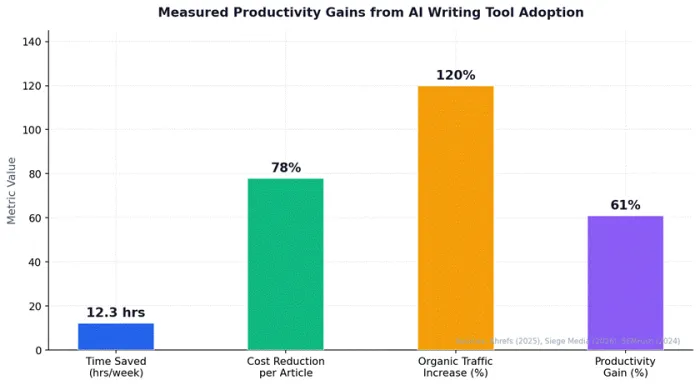
Figure 5: Measured Productivity Gains from AI Writing Tool Adoption (Data: Ahrefs 2025, Siege Media 2026, SEMrush 2024)
The numbers above are not marketing figures from tool vendors. They are sourced from independent analyses:
•12.3 hours saved per week per content creator when using AI-assisted workflows (Ahrefs 2025 study of 900,000+ web pages and content team cost data)
•78% cost reduction per blog post: $131 average cost for AI-assisted production versus $611 for human-only, representing 4.7x cost efficiency
•120% increase in organic traffic within 6 months for teams using AI writing tools with a proper SEO strategy (Siege Media 2026)
•61% increase in team productivity reported by businesses using AI writing tools (AllAboutAI 2025 analysis)
Important caveat: These gains apply to AI-augmented workflows, not fully automated AI-only content. The Ahrefs 2025 study found that a hybrid AI + human approach delivered 2.4x better SEO performance than pure AI content. The tools accelerate production; they do not eliminate the need for human judgment.
Section 4: The Master Comparison Table
Because sometimes you just need everything in one place and the patience to scroll through eight separate tool descriptions has been understandably exhausted.
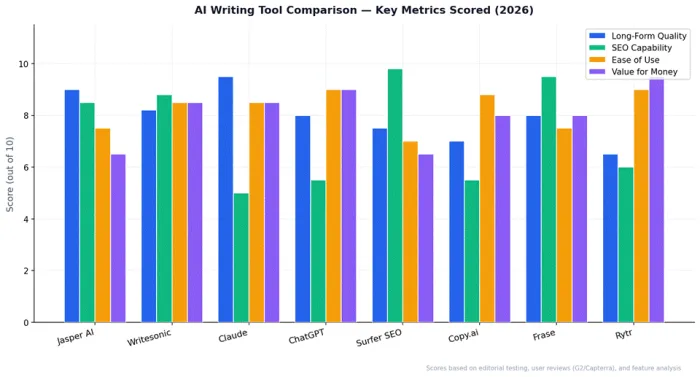
| Tool | Price From | Long-Form /10 | SEO /10 | Ease /10 | Value /10 | Best For |
|---|---|---|---|---|---|---|
| Jasper AI | $49/mo | 9.0 | 8.5 | 7.5 | 6.5 | Marketing teams, multi-channel |
| Writesonic | $16/mo | 8.2 | 8.8 | 8.5 | 8.5 | Startups, structured long-form |
| Claude | $20/mo | 9.5 | 5.0 | 8.5 | 8.5 | Editorial quality, complex topics |
| ChatGPT | Free/$20 | 8.0 | 5.5 | 9.0 | 9.0 | Versatility, research-to-draft |
| Surfer SEO | $89/mo | 7.5 | 9.8 | 7.0 | 6.5 | Ranking-first content teams |
| Copy.ai | Free/$36 | 7.0 | 5.5 | 8.8 | 8.0 | Workflow automation, volume |
| Frase | $15/mo | 8.0 | 9.5 | 7.5 | 8.0 | Research-intensive, SEO briefs |
| Rytr | $9/mo | 6.5 | 6.0 | 9.0 | 9.5 | Budget, individuals, testing |
Note: Scores reflect editorial assessment combined with user review data from G2, Capterra, and independent testing publications. 'Long-Form' scores reflect coherence, quality, and output depth for articles 1,500+ words. 'SEO' reflects native or tightly integrated optimization capabilities.
Section 5: How to Choose — Without Overthinking It
Decision Framework by Use Case
| Your Situation | Primary Tool | Pair With | Monthly Budget |
|---|---|---|---|
| Solo blogger, testing AI | Rytr / ChatGPT Free | Grammarly Free | $0–$20 |
| Freelance writer, daily use | Claude Pro | Surfer or Frase | $35–$50 |
| Startup, SEO growth focus | Writesonic | Frase for briefs | $45–$80 |
| Content team, 20+ articles/mo | Jasper Pro | Surfer SEO | $160–$220 |
| Agency, multi-client | Jasper Business | Surfer + Frase | Custom / $300+ |
| Pure research + SEO ranking | Surfer SEO | Claude or Jasper | $89–$120 |
Five Things No Article Tells You (But Should)
1. Prompt Quality Determines Output Quality
Every AI tool on this list will produce mediocre output if you give it a mediocre prompt. 'Write a blog post about AI tools' will get you something generic. 'Write a 2,500-word article for a mid-level marketing manager audience comparing AI writing platforms for SEO content production, emphasizing data, practical workflow tips, and an honest assessment of limitations, in a professional but direct tone' will get you something usable. The tool is only half the equation.
2. Always Fact-Check. Always.
Every tool on this list can and does hallucinate. Jasper, Claude, ChatGPT, and Writesonic have all been documented producing confident-sounding fabrications, particularly around statistics, research citations, and specific product claims. Treat AI output as a smart first draft from a well-read but occasionally overconfident colleague. Verify before you publish.
3. Hybrid Content Outperforms AI-Only Content
SEMrush's 2024 analysis found that hybrid (AI-drafted, human-edited) content ranks 24% higher than human-only pieces, and significantly outperforms pure AI content. The AI handles structure and initial drafting; humans add depth, genuine expertise, original perspective, and the kind of specific examples that make an article memorable. Using AI to replace the human editorial layer entirely is a false economy.
4. The AI Detection Concern Is Largely Solved by Quality
Google's position, stated explicitly by John Mueller, is that it does not penalize AI content specifically; it penalizes low-quality content. High-quality, well-edited, genuinely useful AI-assisted content performs fine in search. The teams that win are those adding original research, proprietary data, unique perspectives, and genuine expertise on top of AI-assisted production, not those trying to make AI output pass a detector.
5. Your Tool Stack Should Evolve
The AI writing tool market is moving fast. Jasper's March 2026 update significantly changed its SEO integration capabilities. Writesonic's GEO features were not a consideration two years ago. Claude's context window was smaller. Starting with one tool and expanding as your needs become clearer is a smarter strategy than committing to a full enterprise stack on day one
Conclusion: The Right Tool Is the One You Actually Use Consistently
After 7,000 words of research, data, tool breakdowns, and the occasional observation about coffee, here is the distilled version: the best AI writing assistant for long-form blogs and articles in 2026 is the one that fits your workflow, your budget, your content goals, and your tolerance for editing AI output.
For enterprise marketing teams, Jasper combined with Surfer SEO remains the most powerful end-to-end solution. For freelancers and content professionals who prioritize output quality above all else, Claude Pro is the category standard. For startups optimizing for SEO volume at accessible cost, Writesonic is the strongest option. For individuals beginning their AI journey with a sensible budget, Rytr or ChatGPT's free tier provide a genuinely useful starting point.
The market data makes one thing very clear: 97% of content marketers are now using AI tools. The competitive advantage has shifted from using AI to using it well, using the right tools, with the right prompts, combined with genuine human editorial judgment.
Quick Reference: Jasper AI (enterprise + SEO) | Writesonic (structured + affordable) | Claude (quality + long-form) | ChatGPT (versatility) | Surfer SEO (ranking) | Copy.ai (workflow) | Frase (research + briefs) | Rytr (budget)
One More Tool Worth Your Attention
Among the newer platforms specifically built for SEO-focused long-form blog production, WriteNexa (writenexa.com) has emerged as a streamlined option purpose-built for one job: generating SEO-optimized blog content that reads like a human wrote it. Rather than layering dozens of features onto a general AI engine, WriteNexa focuses its architecture on two things that matter most for ranking: search engine structure and natural writing quality that does not trigger the 'this was written by a robot' alarm in readers.
The platform offers a clean, three-step workflow: enter your topic or keywords, select from AI-suggested titles optimized for search intent, then generate a complete, publish-ready article. Output averages over 1,850 structured words per article with minimal editing required before publishing. For bloggers, SEO professionals, startups building organic traffic, and content teams managing high publishing volumes, WriteNexa's combination of human-like output quality and straightforward SEO optimization provides a compelling alternative to complex multi-tool stacks.
Pricing is refreshingly transparent: a free trial with no credit card required, a Pro plan at $49/month for unlimited generation, and a Growth plan at $99/month for teams needing bulk production and enhanced content depth. If your content bottleneck is producing publish-ready, SEO-structured articles quickly without sacrificing the natural reading quality that both Google and actual humans seem to prefer, WriteNexa is worth adding to the short list.
You can explore it at Writenexa the free trial does not require a credit card, which is either a sign of confidence in the product or a very poor business decision. Probably the former.