
I have published AI-drafted articles on live sites, watched them in Search Console for months, and watched a couple of them quietly sink. So when someone asks me whether Google can detect AI content, I do not reach for a hot take. I reach for what I actually saw, and for what Google has written down.
Here is the version I wish someone had given me two years ago. Google is not sitting behind a screen running your blog post through a robot-versus-human scanner, waiting to slam a penalty button when the needle twitches. That mental picture is wrong, and it pushes people into bad decisions: paying for "humanizer" tools they do not need, or rewriting pages that were ranking fine out of pure nerves. What Google can do, and does do every single day, is measure whether a page is useful, original, and worth showing to a searcher. Authorship is not the signal. Value is.
● THE 30-SECOND ANSWER Can Google detect AI content? Not directly, and not reliably. Google has never confirmed a working AI-text detector, and the purpose-built ones get it wrong often enough that OpenAI shut down its own. What Google does detect is thin value, sameness, and content mass-produced to game rankings. AI writing that clears those bars is fine. AI writing that does not gets treated like any other weak page, no robot scanner required. |
You are asking the wrong question
"Can Google tell a machine wrote this?" is the question everyone types into the search bar. It is the wrong one. The question Google's systems are actually built to answer is different: "Is this page the best result for the person searching?" Those are not the same test, and mixing them up is where most of the panic comes from.
Google's public position is blunt about it. Its systems are built to reward helpful, original content, not to identify which tool typed the words. Once you internalize that, the whole topic gets calmer. A brilliant page written with AI help is still a brilliant page. A lazy page written by a tired human at 2am is still a lazy page. The engine cares about the second thing, not the first.
MYTH Google flags anything written with AI. It does not. Google's own documentation states plainly that appropriate use of AI and automation is not against its guidelines. The line it draws is about intent and quality, not the tool. |
MYTH There is a secret "AI penalty." There is no penalty for being AI-made. There are consequences for spam, thin content, and scaled abuse, which can be human-made just as easily. The label on the tin is not what gets scored. |
What Google actually says, word for word
Google's guidance page on generative AI, last refreshed in December 2025, is refreshingly plain-spoken. It says AI can be genuinely useful for researching a topic and adding structure to original work. In the same breath, it warns that using AI to spin up many pages without adding value for users can violate its spam policy on scaled content abuse. That is the whole tension in two sentences: helpful tool, yes; page factory, no.
The most quoted line is from Google's 2023 guidance, and it still holds up as the cleanest gut-check available. If you see AI as an essential way to help produce content that is helpful and original, that is fine. If you see AI as a cheap, easy way to game search rankings, then it is not. Same tool, two intentions, two very different outcomes.
What often gets lost is that this is not a new stance dressed up for the AI era. Google made the point that its focus is on the quality of content rather than how it is produced, and it reached back about a decade for the comparison: there were once real worries about a flood of mass-produced but human-written content, and nobody thought it reasonable to ban all human writing in response. AI is being handled the same way. The bar is the output, not the origin.
HOW GOOGLE'S POSITION MOVED OVER TIME
| When | What changed |
|---|---|
| Apr 2022 | Google's John Mueller calls AI writing "auto-generated content," which at the time fell under a spam guideline. This is the quote people still cite, and it is now largely out of date. |
| Feb 2023 | Google publishes dedicated AI guidance. The message flips to quality-first: appropriate use of AI is not against the guidelines. |
| Mar 2024 | A major core update lands alongside new spam policies. The old "spammy auto-generated content" wording is replaced by scaled content abuse, which targets mass low-value pages however they are made. |
| Jan 2025 | The Search Quality Rater Guidelines add a formal definition of generative AI and rewrite the spam sections around effort, originality, and value. |
| 2025 | Google begins issuing manual actions for scaled content abuse, confirming the policy has teeth and is being enforced. |
Sitting underneath all of it is E-E-A-T: experience, expertise, authoritativeness, and trustworthiness. It is not a direct ranking dial you can turn, but it is the framework Google uses to describe what "quality" looks like. The first E, experience, is the one AI cannot fake for you. A tool can summarize what the web already knows. It cannot have used the product, visited the place, or run the test.

The part most articles skip
Google pays thousands of external Quality Raters to grade search results by hand. Two things matter before you read too much into their handbook. First, their ratings do not directly change rankings. They are a report card on whether Google's automated systems are working, not a lever that moves your page. Second, and this is the interesting part for our question: the handbook gives raters no reliable way to detect AI. It tells them to look for symptoms of low effort, not for the fingerprint of a machine.
The January 2025 rewrite is worth knowing in detail, because it shows exactly what Google treats as a problem. Here are the sections that touch AI content.
| Section | What it covers |
|---|---|
| 2.1 | Generative AI, defined. Google calls it a helpful tool for creating content that, like any tool, can be misused. Neutral by design. |
| 4.6.5 | Scaled Content Abuse. Creating a lot of content with little effort or originality, and no real editing or curation. AI is named as one example of a tool used to do this. |
| 4.6.6 | Little effort, originality, or value. The "Lowest" rating applies when almost all of a page is copied, paraphrased, or AI-generated with little effort, originality, or added value. Crediting a source does not save it. |
| 4.6.7 | Paraphrased content signals. Telltales include heavy overlap with sources like Wikipedia, only commonly known facts, and giveaway phrases such as "As an AI language model" left in the text. |
| Filler | Padding. Content that inflates a page to look richer than it is, burying the useful part under generic intros and bloat. |
| 5.6 | Overstated credentials. Claims of experience or expertise that seem exaggerated or manufactured now warrant a lower rating, judged on what the content actually demonstrates. |
Read that list again and notice what is missing. Not one of those sections says "run the text through a detector." They describe what weak content looks like from the reader's side: recycled facts, no original angle, no evidence of a real person doing real work, sometimes a literal AI disclaimer the writer forgot to delete. Raters catch bad AI content the same way you would, by reading it.
THE INSIGHT THAT REFRAMES EVERYTHING Google's own trained human raters are given no AI-detection tool. The guidelines admit there is no AI-specific method and tell raters to look at effort and value instead. If the people paid to grade quality cannot detect AI on sight, that tells you how the automated systems think too: they score the page, not the pen. |
Can anything actually detect AI writing?
This is the honest core of the whole question. If dedicated AI detectors worked cleanly, "can Google detect it" would be an easy yes. They do not, and the evidence is not close.
Start with the most telling admission. In July 2023, OpenAI, the company behind ChatGPT, quietly retired its own AI Classifier tool because of a low accuracy rate. Its own numbers: it correctly caught only about a quarter of AI-written text, while wrongly flagging roughly one in eleven pieces of genuine human writing. The maker of the model could not reliably spot the model's output. That should end the conversation, but it is worth seeing the wider picture.
26% AI text correctly caught by OpenAI's own classifier before it was pulled in July 2023. | 12–26% Rate at which leading detectors falsely flag human writing as AI, across independent studies. |
10–75% How much detection swings on the same text after light polishing with GPT-4o, depending on the tool. | Higher False-positive rate documented for non-native English writers, a persistent bias in these tools. |
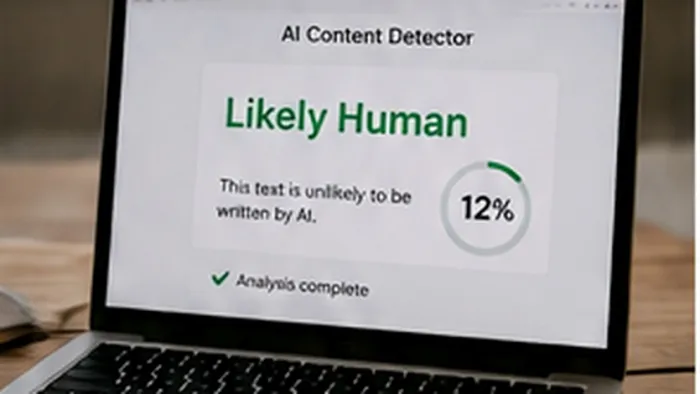
Why do they fail? Most detectors measure two things: perplexity, roughly how predictable the word choices are, and burstiness, how much sentence length and rhythm vary. The assumption is that AI writes in a flatter, more predictable way than people. The problem is that clear, concise human writing, the kind you find in good technical, academic, and professional work, looks exactly like that too. Write cleanly and a detector may accuse you. Add a little mess, paraphrase, or run AI output through an editing pass, and detection accuracy falls off a cliff. Researchers have taken to calling it a cat-and-mouse game, and the mouse is winning.
Now scale that up. If specialists cannot cleanly identify AI in a single isolated paragraph handed to them on a plate, the idea that Google runs a flawless authorship detector across billions of pages does not survive contact with reality. Detection scores are a signal to question, never a verdict to trust.
What gets buried, and what ranks fine
Strip away the AI question entirely and you are left with the thing Google has always scored. Here is the honest split, based on the guidelines above and on watching pages live in search.
RANKS FINE Green light
| GETS BURIED Red flags
|

Look at both columns and the pattern is obvious. Nothing in the right-hand list is bad because a machine was involved. It is bad because it is thin, interchangeable, and built for the algorithm instead of a person. AI just makes it faster and cheaper to produce that kind of page at volume, which is precisely why Google wrote the scaled content abuse policy.
How to publish AI-assisted content safely
This is the actionable payoff. Follow these and it does not matter whether a tool helped you draft, because you are clearing the bar Google actually measures.
✓ Edit every single draft Cut the filler, fix the errors, and add specifics only you know. Raw output is a starting line, not a finish line. |
✓ Add what the web does not already have Original testing, real data, a screenshot, a genuine opinion, a customer example. This is the one thing AI cannot borrow for you. |
✓ Put a real author on it When a reader might reasonably ask "who wrote this and why should I trust them?", give them a credible answer with actual credentials. |
✓ Be honest about how it was made Google suggests disclosure for content where people would reasonably wonder how it was created. It builds trust and costs you nothing. |
✓ Do not publish at scale for scale's sake Ten strong pages beat a thousand thin ones every time. Volume without value is the exact behavior the spam policy targets. |
✓ Label AI images if you run a shop For ecommerce and Merchant Center, AI-generated images need the required metadata, and AI product data should be marked as such. |
Final VerdictMy honest take, after running it both ways The sites I watched lose rankings did not lose them because a detector caught a machine. They lost because the pages were thin, interchangeable, and clearly built for the algorithm instead of a reader. When I went back and looked, every one of them would have failed a human read, never mind an algorithmic one. I have also kept AI-assisted pages ranking for years, and the reason is dull: I treat the draft as raw material and do the real work on top of it. I check the facts. I add what I actually know. I cut the parts that sound like everyone else's post on the same topic. The tool saved me time on the blank page. It did not do the thinking, and I never asked it to. So can Google detect AI content? Not in the way the fear implies. It can detect laziness, sameness, and pages that exist only to rank, and it is very good at that. Use AI as a tool and you are fine. Use it as a shortcut around doing the work, and the guidelines, the raters, and the ranking systems are all pointed in the same direction. Away from you. |