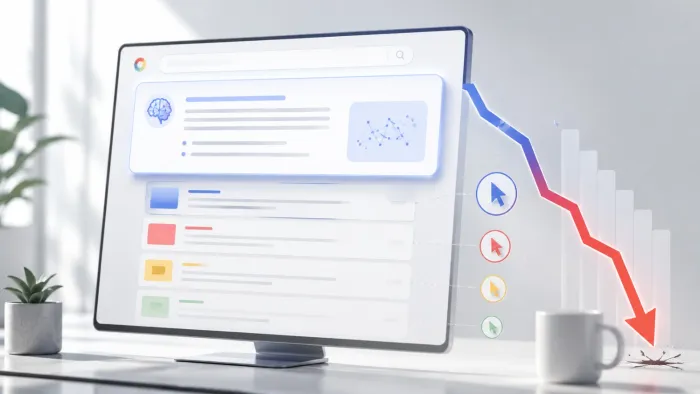
Google visibility is no longer the same thing as Google ranking.
That is the biggest SEO shift emerging from recent AI Overview data. For years, the central goal was clear: rank on page one, preferably in the top three, and traffic would usually follow. AI Overviews are weakening that link. The generated answer panels that appear above traditional search results can cite pages from across the web, including URLs that do not rank in the top 10 for the same query.
That means a page can rank well and still be absent from the AI-generated answer. Another page can rank lower, or even outside the visible first page, and still be cited inside the answer box.
For publishers, brands and SEO teams, the unit of competition is changing. Ranking position still matters, but it is no longer the whole game. Visibility now also depends on whether a page is cited, whether the brand is mentioned, and whether the appearance produces a useful click.
The Ranking-Citation Split
Recent large-scale research shows how far the gap has opened. One major analysis of hundreds of thousands of keywords and millions of AI Overview URLs found that only 38% of pages cited in AI Overviews also ranked in the top 10 for the same query.
The flip side is even more important: roughly 62% of cited pages came from outside the traditional top 10.
Other studies have reported even lower overlap, depending on the tracking method. In some datasets, only a small share of AI Overview citations matched classic page-one rankings, while many citations came from pages ranking 11 to 100 or not ranking in the top 100 at all.
There is a caveat. Some of the measured drop may come from improved citation tracking rather than a pure change in Google’s behavior. But the direction is clear enough: ranking well in traditional results is now a weaker predictor of being cited in an AI Overview.
Why Clicks Are at Risk
This shift matters because AI Overviews can reduce the number of users who click through to websites.
When a generated answer gives users enough information directly on the search page, many do not need to visit the original source. Several studies have found sharp organic click-through declines when AI Overviews appear, especially for top-ranking pages that would normally capture a large share of search traffic.
That creates a painful situation for publishers. A site may do the work of producing the information, but Google’s AI answer may satisfy the user before the click happens.
Zero-click behavior is also becoming more common. As more search queries are answered inside Google’s interface, the value of ranking alone becomes less predictable. Traffic is no longer guaranteed by visibility in the old sense.
The New Opportunity
The story is not only negative. AI Overviews also create a new path for smaller sites.
In traditional SEO, a smaller publisher often had little chance of outranking a high-authority domain for competitive queries. But AI Overview citation patterns appear less tied to classic top-10 rankings. That means a smaller page with a direct, well-structured, useful answer may be cited even if it does not win the standard ranking battle.
Being cited can still matter commercially. A cited source may earn more trust, brand visibility and clicks than a page that is not included in the AI answer at all.
The new challenge is to write and structure content in a way that AI systems can confidently extract, summarize and attribute.
Length Is Not the Answer
One surprising finding is that content length alone does not appear to strongly predict AI Overview citations. Some analyses suggest that many cited pages are under 1,000 words, and the relationship between word count and citation probability is weak.
That is important for content teams that still believe longer automatically means better. AI Overviews do not reward padding. They reward clarity, relevance and extractable answers.
A concise page that answers a specific question clearly may be more useful to AI systems than a long page that buries the answer under repeated explanations.
Which Content Is Most Exposed
Not every type of page faces the same risk.
The most vulnerable content includes simple definitions, basic factual answers, simple calculations, generic how-to guides and early research queries with weak purchase intent. These are easy for AI Overviews to summarize.
More insulated pages include pricing pages, local service pages, branded navigational queries and high-intent transactional pages. If a user wants to buy, book, compare a plan or contact a business, they still usually need to click.
B2B content sits in the middle. Glossaries, comparison pages and educational blog posts may be highly exposed to AI Overviews, but they can also win citations if they provide clear answers and strong evidence.
What SEOs Should Do
The practical response is not to abandon SEO. It is to run two strategies in parallel: traditional ranking optimization and AI citation optimization.
Pages should answer the main question quickly, then support that answer with examples, proof, data, comparisons or first-hand experience. Headings should be descriptive. Paragraphs should be clean. Tables, lists and definitions should help extraction rather than decorate the page.
Entity clarity also matters. A business that describes itself vaguely across multiple pages gives search systems weaker signals. Clear positioning, consistent terminology and precise product descriptions make content easier to retrieve and cite.
The biggest mistake is publishing generic AI-written articles that repeat what already exists. AI systems have little reason to cite content that adds no original value.
The winning approach is human-led content that AI can understand: direct answers, clear structure, genuine experience and proof that the page offers something beyond a rewritten summary.
Google rankings still matter. But in the AI Overview era, the bigger question is no longer only “Where do we rank?” It is “Are we the source Google chooses to cite?”