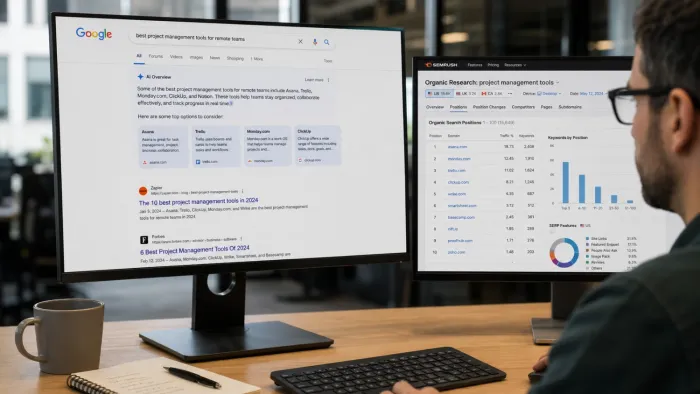
Google’s AI Overviews are sharply changing the economics of organic search, with new research showing that AI-generated answer boxes are reducing the number of people who click through to websites.
The latest data points to a major traffic shift for publishers, bloggers and content teams. When an AI Overview appears above the traditional search results, users often get enough information directly on Google’s results page and do not need to open the source website.
A late-August 2026 study found that AI Overviews reduce organic clicks by 58.6%, cutting traffic from 87 clicks per thousand impressions to 36. The finding lines up closely with earlier independent research, which also reported a similar collapse in clicks when AI-generated summaries appear.
The message for website owners is clear: ranking in Google still matters, but it no longer guarantees the same level of traffic.
Zero-Click Search Is Now Normal
One of the biggest changes is the rise of zero-click search. The study found that 74.6% of tracked Google searches now end without a click, up from 54.1% in 2022.
That means nearly three out of four searches may now be resolved without the user visiting a website. The growth has been steady for several years, with AI summaries, featured answers and richer search results all reducing the need to click.
The pace of zero-click growth appears to have slowed slightly in 2026, but not because the problem has gone away. The likely reason is that many of the easiest informational clicks have already been absorbed. What remains are more complex, commercial or transactional searches that still require users to compare, buy, book, contact or investigate further.
The Top Ranking Loses the Most
The data also challenges one of SEO’s oldest assumptions: that ranking number one protects traffic.
The study found that the top organic position loses 56.9% of its click-through rate when an AI Overview appears. On a clean results page, the first result pulled a 27.4% CTR. With an AI Overview present, that dropped to 11.8%.
Lower positions also lose clicks, but the relative damage is smaller because those positions already received fewer clicks. The effect is that AI Overviews compress the value gap between rankings. Being first is still better than being tenth, but it is no longer as powerful as it used to be.
For SEO teams, this changes the target. The question is no longer only “Can we rank first?” It is also “Can we become the source Google cites inside the AI answer?”

Informational Content Takes the Hit
The most exposed content is purely informational.
The study found that informational queries carried most of the traffic loss, falling 43.9%. The zero-click rate for informational searches has now reached 91.7%, which is a serious warning for blogs built around simple explainers, definitions and basic how-to posts.
Transactional searches are holding up much better, with a much smaller decline. That makes sense. If someone is comparing products, choosing a vendor, booking a service or looking for something local, they usually still need to click.
This creates a new divide in SEO. Content that simply answers a basic question is easier for AI to replace. Content that helps someone make a decision, compare options, use a tool or evaluate real experience still has a better chance of earning the click.
Some Industries Are More Exposed
The traffic impact varies by industry. Media and publishing appear to be among the hardest hit, followed by education and healthcare. These sectors depend heavily on general-knowledge searches, where AI Overviews can answer the query directly.
Local services, real estate and ecommerce are less exposed because their searches often require action. A user may want a nearby provider, a listing, a price, a booking option or a product page. AI can summarize information, but it cannot fully replace the transaction.
The strongest predictor of organic traffic loss appears to be how often AI Overviews appear for a site’s target topics. The more frequently AI summaries show up, the more pressure a site is likely to feel.
The Silver Lining
The news is not entirely negative. The clicks that still come through from search appear to be more valuable.
The study found that users who do click from organic search now spend more time on-site and convert at a higher rate than before. That suggests AI Overviews may be filtering out casual users while leaving behind people with stronger intent.
There is also a new traffic source emerging: AI assistants. Traffic referred directly from AI platforms has grown quickly and is converting at a higher rate than traditional organic traffic in some datasets.
That is why many SEO teams are now focusing on AI visibility, not only Google rankings. Being cited by AI tools, included in AI Overviews and referenced by assistants may become a new form of search visibility.
What Creators Should Do
For bloggers and content teams, the strategy needs to change.
Generic informational posts are becoming more vulnerable. A basic article that simply defines a term or repeats common advice may be summarized by an AI Overview before anyone clicks.
The stronger approach is to add what AI summaries cannot easily replace: first-hand testing, original data, screenshots, examples, product comparisons, expert opinions, tools, templates and real use cases.
Content also needs to be structured clearly. Direct answers, descriptive headings, short sections, comparison tables and specific examples make it easier for AI systems to understand and cite a page.
Search has not disappeared. It has split into two tracks. One track is the shrinking pool of traditional clicks. The other is AI visibility, where citations, brand mentions and assistant referrals are becoming more important.
For creators, the challenge is no longer just getting indexed or ranking high. It is creating content good enough to be cited by AI and valuable enough that readers still want to click.