
A few months ago, a friend who runs a small travel blog texted me in a slight panic. She'd just published twelve new city guides, mostly drafted with the help of an AI tool and then edited by hand, and a colleague had warned her that “Google can tell, and it will bury you for it.” She wanted to know if she should pull the posts down before the damage was done.
If you've felt that same flutter of anxiety, you're far from alone. Search “Google AI content detector” and you'll find a small industry of fear built around it: detector tools promising 99% accuracy, horror stories about traffic crashing overnight, and “humanizer” services selling a way around it all. Some of that fear is reasonable. Most of it is noise.
So let's actually look at what's true. Not vibes, not vendor marketing, not screenshots from a forum, but the real data on how Google treats AI-assisted writing in 2026, what its detection systems can and can't do, and what genuinely moves the needle for your rankings.
Does Google Actually Have an “AI Detector”?
Here's the short version: Google has never denied having systems that can spot statistical patterns typical of machine-generated text. What it has been consistent about, going all the way back to a February 2023 policy post, is that detecting AI involvement is not the same as penalizing it.
“Our focus on the quality of content, rather than how content is produced, is a useful guide that has helped us deliver reliable, high quality results to users for years.” Google Search Central, official guidance on AI-generated content |
That single sentence is really the whole policy. Google built the Helpful Content System and the broader E-E-A-T framework (Experience, Expertise, Authoritativeness, Trustworthiness) to judge the output, not the typewriter. A flowery, AI-sounding paragraph and a flowery, human-sounding paragraph that both fail to answer the searcher's question get treated the same way: quietly pushed down.
Where it gets nuanced is the word “primary purpose.” Google's spam policies don't ban automation; they ban automation “used to generate content with the primary purpose of manipulating ranking in search results.” That distinction, intent and value rather than tooling, is the thread running through every update since.
Myth vs. Reality, Side by Side
| The Common Myth | What Google Actually Says |
|---|---|
| Google has a binary “AI vs. human” switch that auto-penalizes AI text. | Google evaluates helpfulness, originality, and E-E-A-T signals, not the production method. |
| Using any AI assistance puts your site at risk. | Risk comes from publishing thin, unedited, mass-produced pages, human or AI. |
| AI content can never rank on page one. | AI-assisted content holds roughly 1 in 5 of the top 20 results as of 2026. |
| A “humanizer” tool is a real SEO strategy. | Google's own systems and spam policies target intent to deceive, which evasion tools don't fix. |
| Disclosure of AI use is always mandatory. | Disclosure is only “reasonably expected” in specific cases, e.g. bylines on YMYL or news content. |
A quick reference for separating SEO folklore from Google's published guidance.
What the 2026 Data Actually Shows
Forget opinions for a second. Here's what large-scale studies of real search results found this year.
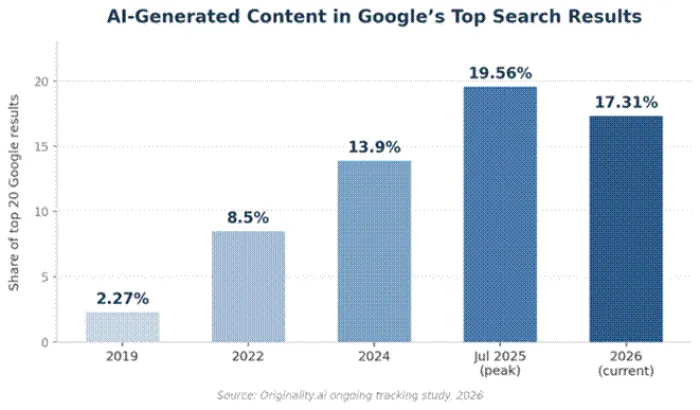
AI-detectable content's share of top search results has grown nearly 8x since 2019, yet it has actually pulled back slightly from its mid-2025 peak.
That dip after the peak is worth sitting with. It lines up almost exactly with several 2025–2026 core and spam updates that explicitly targeted “scaled content abuse,” not AI content broadly, but the specific pattern of publishing hundreds of near-identical, low-effort pages. The content that vanished wasn't punished for being AI-written. It was punished for being empty.
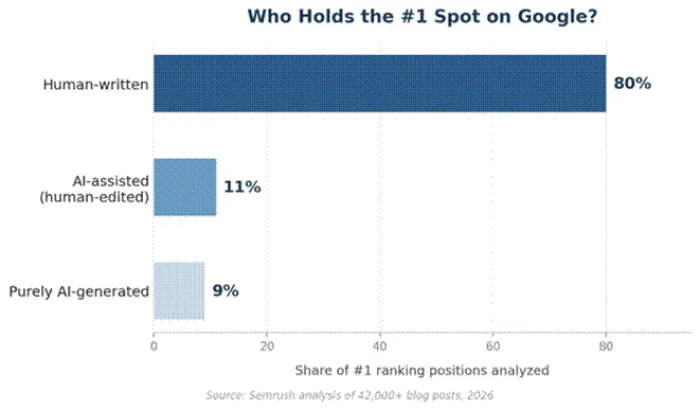
Human-written pages still dominate position #1, but AI-assisted, human-edited content earns its own meaningful share. Purely AI content lags both.
Notice that AI-assisted content (drafted with AI, then genuinely edited by a person) holds a respectable slice of the top spot. It isn't invisible. What's nearly absent is the third category: AI content nobody touched after generation. That's the pattern Google's systems are actually tuned to catch, and it shows up clearly even without any “AI detector” at all, since thin, generic writing simply fails the same quality bar it always has.
Key Numbers Worth Remembering
| Metric | Figure | Why It Matters |
|---|---|---|
| AI content in top 20 results (2026) | 17.3% | Up from 2.3% in 2019. AI assistance is now mainstream, not fringe. |
| Correlation: AI content & ranking penalty | 0.011 | Essentially zero. Origin alone doesn't predict ranking outcomes. |
| New web pages with some AI involvement | ~74% | Most online writing today is a human-AI blend, not one or the other. |
| Pages that are “pure AI,” no editing | ~2.5% | The riskiest category, and the smallest slice of the web. |
| Traffic drop for AI sites hit by scaled-content enforcement | 50–80% | Reserved for high-volume, templated, zero-editorial-oversight sites. |
| AI-assisted, human-edited content vs. pure human in AI citations | +12% | Editing AI drafts can outperform writing from scratch, not just match it. |
Figures compiled from Originality.ai, Ahrefs, Semrush, and Presenc AI research published in 2025–2026.
What Actually Gets Penalized (and What Doesn't)
If origin doesn't decide your fate, what does? Google's own spam policy documentation, refreshed as recently as May 2026, spells it out under a category it calls “scaled content abuse.” The wording is precise: pages created “primarily to manipulate search rankings, with little or no value added for users.”
Patterns That Tend to Get Hit
• Hundreds of near-identical local or product pages that differ only by a swapped city or keyword.
• AI-generated drafts published with zero human review, fact-checking, or original input.
• Content stitched together from other sites' feeds or search results without adding anything new.
• Pages where the writing technically contains the right keywords but doesn't actually make sense to a reader.
Patterns That Tend to Hold Up Fine
• AI used for first drafts, outlines, or research, followed by a real editing pass.
• Content built around first-party data: your own surveys, case studies, or product usage numbers.
• Clear author attribution and a visible editorial process, especially on YMYL topics (health, finance, legal).
• Long-tail or niche pages that each answer a genuinely distinct question, even if AI-assisted.
| “If you prompt an AI tool to ‘write a blog post about X’ and publish the output without editing, you're publishing the same generic content everyone else is publishing. Google's systems can spot that pattern, not because they detect AI, but because they detect sameness.” |
What About Third-Party AI Detectors?
This is a different question from “does Google penalize AI content,” and it trips people up constantly. Tools like Originality.ai, GPTZero, Copyleaks, and Turnitin are not part of Google's ranking system at all. They're independent products, often bought by teachers, editors, or publishers trying to verify how a piece of text was made.
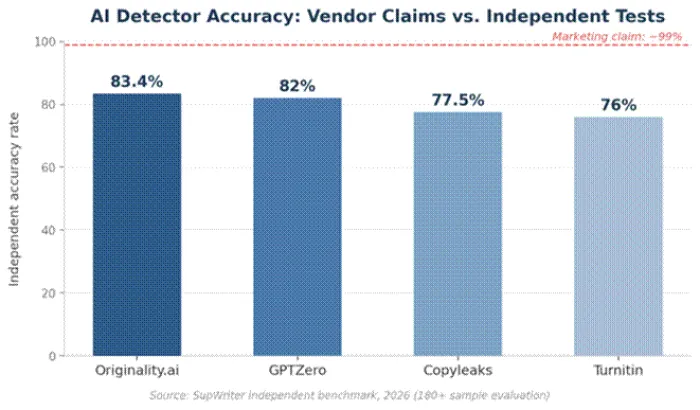
Marketing pages often advertise near-99% accuracy. Independent, controlled benchmarks tell a humbler story.
The gap between marketed accuracy and tested accuracy matters because of what sits on the other side of a wrong call: a false positive. Independent testing puts false-positive rates for these tools anywhere from roughly 1-in-20 to as high as 1-in-7, depending on the tool and the type of writing. Non-native English writers, formulaic academic prose, and very short text are flagged disproportionately, through no fault of the writer.
None of this is Google's doing. But it's the source of a lot of misplaced anxiety, because people conflate “a detector flagged my essay” with “Google will bury my website.” They are unrelated systems solving different problems, and only one of them affects your search rankings.
A Practical Checklist Before You Hit Publish
If you take nothing else from this article, take this list. It's a distillation of what every 2026 spam and core update has rewarded or punished.
| Question to Ask | Green Flag | Red Flag |
|---|---|---|
| Did a person actually read and edit this? | Yes, with fact-checks and added insight | Published straight from AI output |
| Does this page say something the top 10 results don't? | New data, examples, or angle | Same structure, same points, reworded |
| Is there a real author or entity behind it? | Named author, bio, contact info | Anonymous, byline-free, untraceable |
| How many similar pages did we publish this week? | A handful, each genuinely distinct | Dozens, templated, city/keyword swapped only |
| Would this page exist if Google didn't exist? | Yes, it serves a real reader need | No, it exists purely to capture search traffic |
The Bottom Line
I never did tell my friend to take her city guides down. We went through them together instead: added her own photos and a couple of restaurant recommendations she'd never trust to an algorithm, fixed a few details an AI had gotten subtly wrong, and cut two posts that genuinely didn't say anything new. The ones that stayed are still ranking today.
That, really, is the whole story behind the “Google AI detector” panic. The tool you used to get the first draft on the page has never been the variable that decides whether people find it useful. Effort, accuracy, and a point of view that didn't exist anywhere else on the internet, that's what was always being measured, long before AI writing existed, and it's what's still being measured now.
If there's a practical takeaway, it's this: spend less energy worrying about being caught, and more energy making sure there's actually something worth catching attention with. That starts at the generation step itself. The closer a first draft already sounds like a person who knows the topic, and the more it's structured around what readers are actually searching for rather than just stuffed with keywords, the less distance there is between draft and publish-ready. Newer blog-writing platforms such as WriteNexa lean into exactly that gap, aiming for SEO structure and a natural, human-sounding voice straight out of the first output rather than something that needs a heavy rewrite to feel real, which lines up well with where Google's actual incentives sit in 2026.
Write the thing only you could write. The rest tends to take care of itself.