
Google has updated its Open Knowledge Format with new signals designed to help AI agents judge where information came from, whether it is still reliable, and whether a computed number was produced correctly.
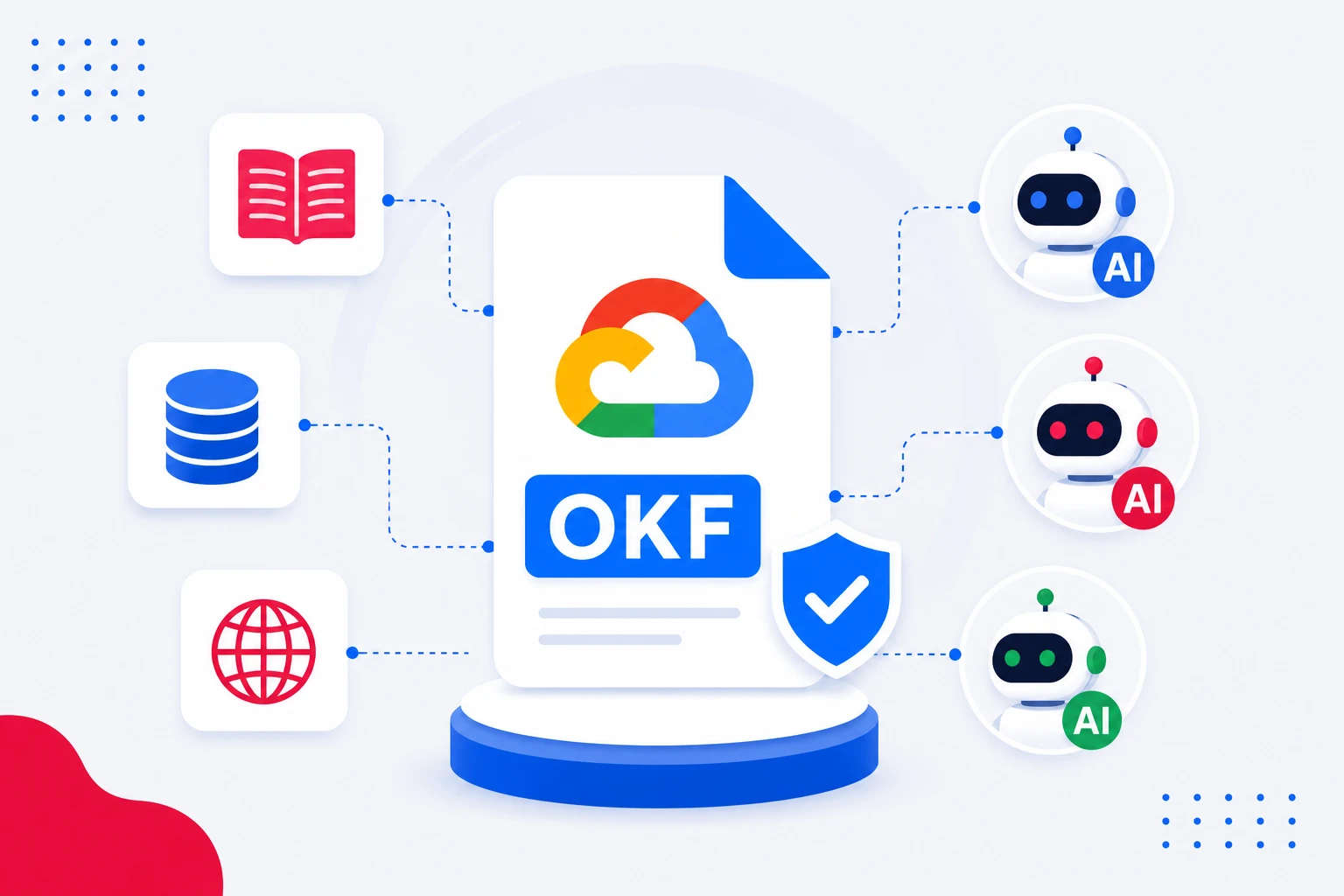
The update, published on July 24, 2026, builds on the first version of the format introduced in June. Open Knowledge Format, or OKF, is Google’s attempt to give AI agents a structured way to read and exchange business context such as table schemas, metric definitions, runbooks, and operational knowledge.
The idea is simple: as AI agents become more common in analytics and business workflows, they need dependable context. That context should not live only inside proprietary systems or scattered documents. It needs a portable format that both humans and machines can inspect.
Why Version 0.2 Matters
The second version of OKF focuses on a problem that becomes serious once agents start creating knowledge at scale.
A human-written wiki page carries a basic accountability signal. A person wrote it, and someone can be asked whether it is accurate. But if an AI agent creates thousands of definitions, summaries, or concepts overnight, that human guarantee disappears.
Google’s new version tries to solve that by adding explicit trust signals. Instead of expecting users to assume a piece of context is reliable, OKF v0.2 gives systems a way to ask: where did this come from, who generated it, who verified it, when does it become stale, what stage of life is it in, and was a number actually computed the approved way?
Provenance and Trust
One of the core additions is provenance. OKF can now record the sources behind a concept, including signals such as author, usage count, and last modified date.
Google’s important design choice is that OKF does not assign a universal credibility score. A score can be subjective, outdated, or meaningless across different consumers. Instead, the format records the evidence and lets each system decide how to interpret it.
Trust is handled separately through generated and verified fields. The generated field records how the content was produced and when it last meaningfully changed. The verified field records independent confirmations.
That separation matters because the person or system that creates content may not be the same one that confirms it. A machine may generate a metric definition, while a human analyst later reviews it. A consuming system can then treat machine-confirmed and human-reviewed content differently.
For example, a company could decide that only human-reviewed metrics should appear in an executive dashboard, while machine-confirmed content may be acceptable for exploration or internal testing.
Freshness and Lifecycle
OKF v0.2 also adds a freshness signal through a stale_after date. Instead of using a relative time limit, the format uses a fixed date. That makes staleness easier to evaluate because a system only needs to compare today’s date with the stored date.
Lifecycle is handled through a status field. A concept can move from draft to stable to deprecated. If no status appears, the concept is treated as stable.
This is especially useful for analytics teams. A deprecated metric definition may still need to exist so old reports and historical queries remain reproducible, but it should not be recommended for new work.
Attested Computation
The most technical addition is the Attested Computation type. This addresses a different problem from provenance.
Provenance explains where a claim came from. Attestation checks whether a number was produced using the sanctioned method. In practical terms, it helps answer whether an AI agent ran the approved computation or simply wrote its own SQL.
Under this model, the concept contains the approved computation and the method for checking that it ran correctly. The agent is allowed to fill declared parameters, but it is not allowed to edit the computation itself.
A separate executor runs the computation and returns a receipt. A deterministic attester then checks that receipt without relying on another language model. If the query was rewritten, the computation file was swapped, or a dependency was changed, the check fails.
That makes the feature important for businesses that want AI agents to work with trusted metrics. It gives teams a way to use agents without letting them quietly invent calculations.
What Shipped
The update includes changes across Google’s reference tooling. The reference agent can now emit provenance and trust fields as it generates content. The static visualizer can show trust tier, status, and staleness. Sample bundles have been updated with v0.2 fields, including examples for e-commerce, Stack Overflow, Bitcoin, and a retail demo.
The version is additive and backward-compatible. Existing v0.1 bundles can still work unchanged. The only always-required field remains type, and teams can adopt the new fields gradually.
Why It Matters
OKF v0.2 is not a consumer AI feature. It is infrastructure for a future where AI agents create, read, verify, and reuse business knowledge continuously.
The update shows that the next AI problem is not only generating answers. It is knowing whether the context behind those answers can be trusted.
For data teams, analytics leaders, and companies building agent workflows, that may be the real shift. Agents need access to knowledge, but they also need proof that the knowledge is current, reviewed, and computed correctly.