Before paying for any AI humanizer, most people want answers to two questions: does it actually fool the detectors, and does the rewritten text still read like a person wrote it? Rather than trust the marketing, I sat down with GPTHuman AI and ran my own controlled test. I made a fresh account, generated a brand-new piece of AI text with ChatGPT, scored it on three separate AI detectors, fed it through GPTHuman AI, and then scored the output on the same three tools to see what moved. Along the way I looked at the dashboard, the free credits you start with, the full pricing across every plan, and what other users and reviewers are saying.
This article walks you through that entire process from a user's seat. You will see how I logged in, what the free credits got me, the real before-and-after detector numbers in tables, how the tone and readability shifted, the complete pricing converted to dollars, a snapshot of reviews across several platforms, and where the tool falls short. By the end you will have a clear picture of whether GPTHuman AI fits what you are trying to do, plus my own verdict after putting it to work.
What GPTHuman AI is
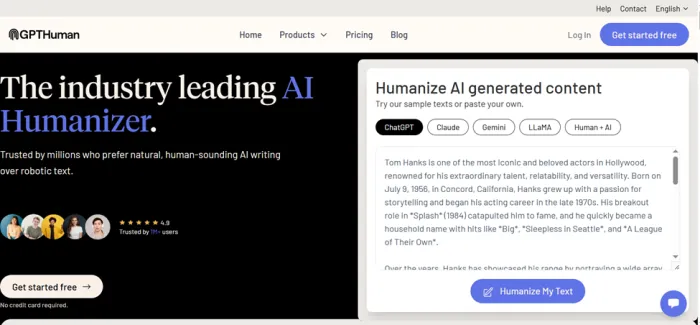
GPTHuman AI, found at gpthuman.ai, is a web-based tool built around a single job: taking text written by an AI model and rewriting it so it reads more naturally and is less likely to trip an AI detector. It is not a sprawling writing suite, and the product line is narrow on purpose. Here is the shape of it at a glance.
| Detail | What you get |
|---|---|
| What it is | Web-based AI humanizer at gpthuman.ai |
| Core job | Rewrites AI text to read more naturally and lower detector scores |
| Product line | Humanizer, AI detector, paraphraser, and an API |
| Writing modes | Casual, formal, and storytelling |
| Languages | 50-plus supported |
| Free credits | 300 on signup (enough to try, not to work) |
| Standout features | Shield Guard, ChatGPT watermark removal, built-in AI detector |
| Guarantee | Free re-write if humanized text still gets flagged |
| Billing | Monthly or annual (annual up to ~45% cheaper) |
The pitch on the site is bold, promising to bypass leading AI detectors, and those different modes matter more than they sound, because the right one depends heavily on what kind of text you are feeding it. One naming note worth flagging up front: a few similarly named sites float around, including gpthuman.com and gpthumanizer.ai, and they are separate products. Everything in this review is about gpthuman.ai specifically.
The tools I used to test it
A humanizer is only as trustworthy as the detectors you check it against, and no single AI detector is the final word. They disagree with each other, they throw false positives on real human writing, and they miss AI text too. So I leaned on three well-known detectors instead of one, scored the same text on all of them, and looked at the pattern rather than any one number.
| Detector | What it does | Why I used it |
|---|---|---|
| ZeroGPT | Free detector that returns a quick percentage estimate of how much of a passage looks AI-generated | Fast first check, and the kind of free tool a teacher or editor tends to reach for first |
| QuillBot AI Detector | Percentage AI reading from QuillBot's checker, sitting right alongside its own humanizer | A useful second opinion from a different engine than ZeroGPT |
| Originality.ai | Paid, publisher-grade detector with a reputation for being stricter than the free tools | The toughest bar of the three, so passing it carries more weight |
Using three detectors with different reputations, one lenient, one middling, and one strict, gives a far more honest read than trusting a single score. And because I generated my test sample with ChatGPT, the input was genuinely AI-written, not something I lightly edited into shape.
Signing up and the dashboard
Getting started was quick. The login screen offers two routes, a Google sign-in and a standard email-and-password option. I went with email. After entering my details, GPTHuman AI sent a verification link to my inbox, I clicked it, and that confirmed the account. Nothing unusual, and no friction beyond that one extra email step.
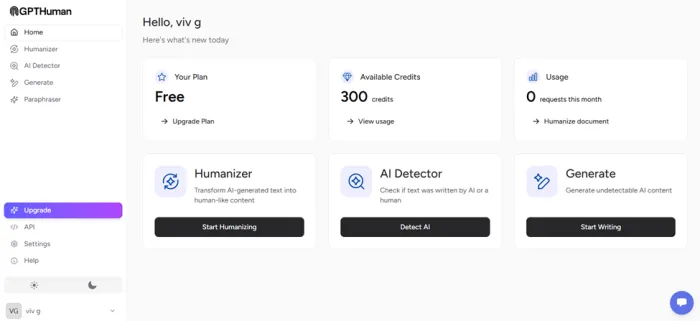
The dashboard that loaded after sign-in is clean and to the point. Right away it showed me three things: my available credits, my current plan, and my usage. I started with 300 credits on the free account, which is the allowance you get to try the tool before paying. The plan and usage readouts make it easy to see at a glance how much room you have left, which is helpful, because as I found out, those free credits go faster than you would hope. With the account set up, I headed straight for the feature I cared about: the AI humanizer.
How I tested the humanizer
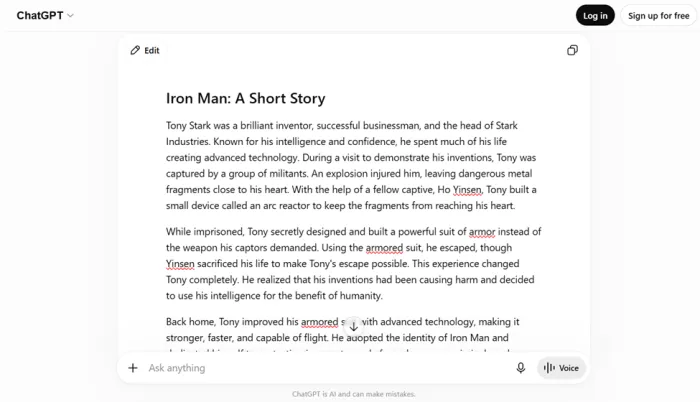
I wanted a clean test, so I generated brand-new AI text rather than reusing anything. I asked ChatGPT to write a short story about Iron Man, and it produced a tidy, four-paragraph origin summary of Tony Stark. It is exactly the kind of competent, slightly flat AI prose that detectors are built to catch. Here is the text I started with:
INPUT · CHATGPT-GENERATED STORY (~210 WORDS) Tony Stark was a brilliant inventor, successful businessman, and the head of Stark Industries. Known for his intelligence and confidence, he spent much of his life creating advanced technology. During a visit to demonstrate his inventions, Tony was captured by a group of militants. An explosion injured him, leaving dangerous metal fragments close to his heart. With the help of a fellow captive, Ho Yinsen, Tony built a small device called an arc reactor to keep the fragments from reaching his heart. While imprisoned, Tony secretly designed and built a powerful suit of armor instead of the weapon his captors demanded. Using the armored suit, he escaped, though Yinsen sacrificed his life to make Tony's escape possible. This experience changed Tony completely. He realized that his inventions had been causing harm and decided to use his intelligence for the benefit of humanity. Back home, Tony improved his armored suit with advanced technology, making it stronger, faster, and capable of flight. He adopted the identity of Iron Man and dedicated himself to protecting innocent people from dangerous criminals and powerful enemies. Unlike many superheroes, Iron Man did not possess supernatural abilities. His greatest strengths were his creativity, determination, and willingness to solve problems through science and innovation. |
Before touching GPTHuman AI, I ran that story through all three detectors to establish a baseline. The results were about as clear-cut as it gets.
BEFORE HUMANIZING · ORIGINAL CHATGPT TEXT
| Detector | AI score | Verdict |
|---|---|---|
| ZeroGPT | 97.6% AI | 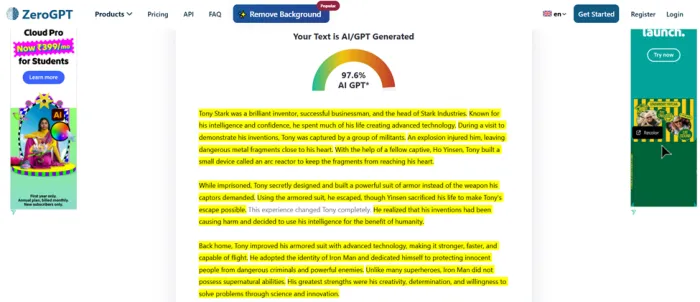 |
| QuillBot AI Detector | 87% AI | 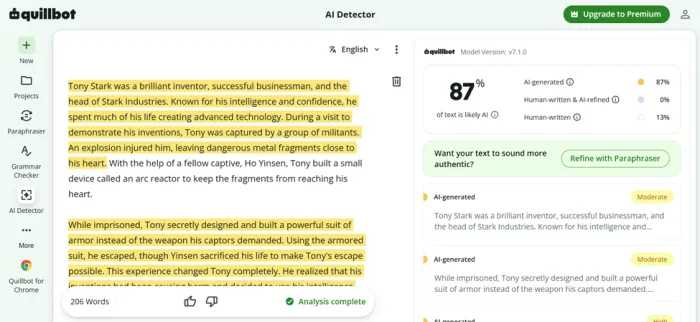 |
| Originality.ai | 100% AI | 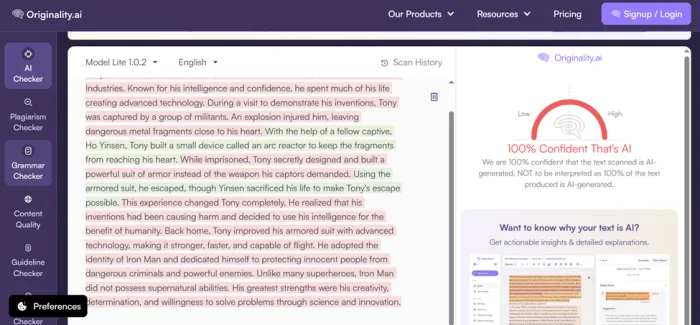 |
All three agreed: this reads like a machine wrote it, because one did. That is the starting line.
The humanizing process and what came back
I pasted the same story into GPTHuman AI and ran the humanizer. It worked fast, returning a rewritten version in roughly 5 to 10 seconds. No long wait, no queue. Here is what it gave back:
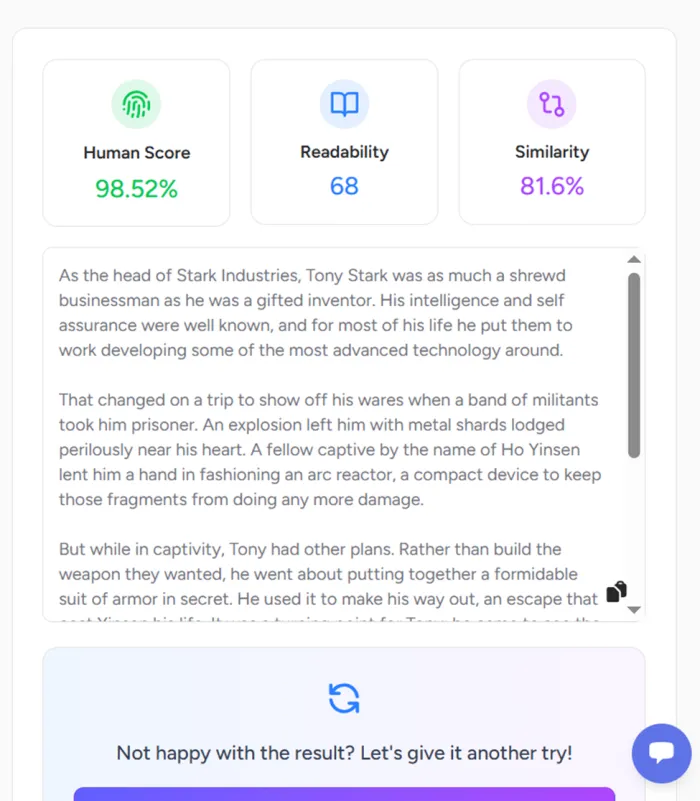
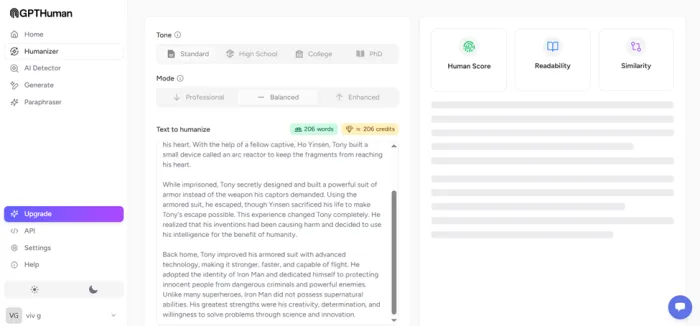
OUTPUT · GPTHUMAN AI REWRITE (~250 WORDS) As the head of Stark Industries, Tony Stark was as much a shrewd businessman as he was a gifted inventor. His intelligence and self assurance were well known, and for most of his life he put them to work developing some of the most advanced technology around. That changed on a trip to show off his wares when a band of militants took him prisoner. An explosion left him with metal shards lodged perilously near his heart. A fellow captive by the name of Ho Yinsen lent him a hand in fashioning an arc reactor, a compact device to keep those fragments from doing any more damage. But while in captivity, Tony had other plans. Rather than build the weapon they wanted, he went about putting together a formidable suit of armor in secret. He used it to make his way out, an escape that cost Yinsen his life. It was a turning point for Tony; he came to see the harm his work could do and made up his mind to put his mind to something that would be of service to mankind. When he returned home, he set about upgrading the suit with top notch tech to give it greater speed and power, even flight. In the guise of Iron Man, he made it his business to stand between the innocent and whatever threats or enemies might come their way. You won't find any superpowers in Tony Stark, however. Where other heroes have those kinds of gifts, he has his ingenuity and a ready willingness to let science and innovation be his weapons. |
Reading it side by side with the original, the changes are easy to spot. The rewrite opens sentences differently, varies their length, and trades the textbook phrasing for something more conversational. Lines like “show off his wares,” “lent him a hand,” and “top notch tech” give it a looser, more human rhythm, and it even slips into direct address with “You won't find any superpowers in Tony Stark.” Then I ran the humanized version back through the same three detectors. This is where it earned its keep.
AFTER HUMANIZING · GPTHUMAN AI OUTPUT
| Detector | AI score | Verdict |
|---|---|---|
| ZeroGPT | 0% AI | 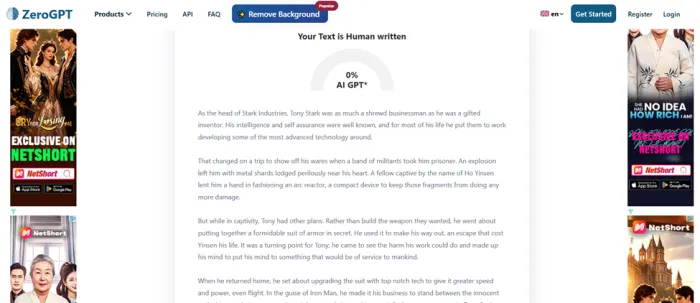 |
| QuillBot AI Detector | 0% AI | 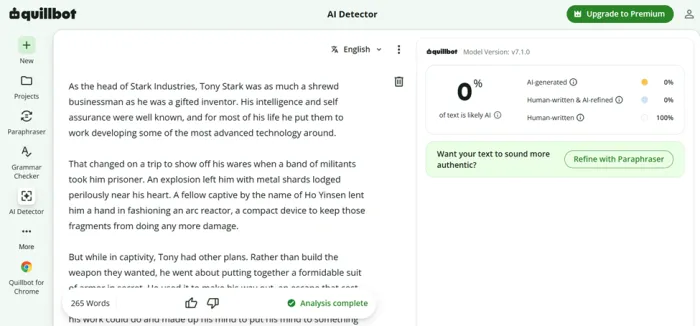 |
| Originality.ai | 0% AI · 100% human | 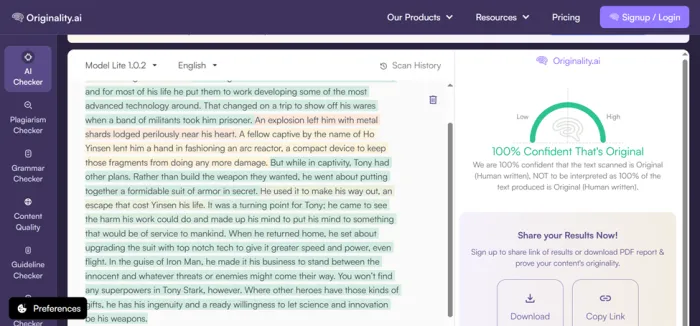 |
That is a clean sweep. The same passage that scored 97.6%, 87%, and 100% AI dropped to zero across the board, including on Originality.ai, the strictest of the three. On this particular piece of casual narrative text, GPTHuman AI did exactly what it claims to do.
A FAIR CAVEAT My sample was a casual story, and that is the kind of content these tools handle best. Performance on dense academic or technical writing is a different matter, and I cover that under the reviews and limitations below. |
What changed in tone and readability
Passing detectors is one thing. Whether the rewrite is any good to read is another, and this is where you have to look past the score. The humanized Iron Man story stayed clear and easy to follow, but its character shifted noticeably.
TONE & READABILITY · ORIGINAL VS HUMANIZED
| Aspect | Original ChatGPT text | After GPTHuman AI |
|---|---|---|
| Overall tone | Neutral, encyclopedic, report-like | Conversational, storytelling, magazine-style |
| Sentence structure | Uniform, mostly subject-first statements | Varied openings and lengths, more rhythm |
| Vocabulary | Plain and direct | Idiomatic (“show off his wares”) |
| Reader address | Third person throughout | Adds direct address (“You won't find any superpowers”) |
| Flow / burstiness | Even and predictable | More variation, less predictable |
| Length | ~210 words | ~250 words |
| Readability | Easy, but flat | Easy and more engaging, occasional wordiness |
The original read like an encyclopedia entry: even, neutral, and a little flat. The humanized version reads more like a magazine feature, with varied sentence openings, idiomatic phrasing, and a narrator who occasionally talks to you. That variation in sentence length and structure, sometimes called burstiness, is a big part of why detectors stopped flagging it.
It is not flawless. The rewrite runs a touch longer than the original, and a few lines drift toward wordiness, such as turning a simple idea into “put his mind to something that would be of service to mankind.” For a casual story that is fine, even charming. For tight professional copy you would want to trim it. But on clarity and natural flow the output held up well, and it did not read like it had been mangled, which is a common failure mode for weaker humanizers.
GPTHuman AI pricing, in dollars
GPTHuman AI runs on a word-limit model with three plans, and it offers both monthly and annual billing. Annual billing is paid as one upfront charge for the year and is meaningfully cheaper per month, with the site advertising savings of up to 45 percent.
The plans are priced in Indian rupees on the site, so the figures below are approximate conversions to US dollars at roughly 95 rupees to the dollar, the rate around late June 2026. These numbers were recorded in June 2026.
MONTHLY BILLING · APPROX. USD (RECORDED JUNE 2026)
| Plan | Monthly words | Words per output | Price / month |
|---|---|---|---|
| Starter | 25,000 | 750 | ≈ $6.84 |
| Plus | 60,000 | 1,200 | ≈ $11.58 |
| Unlimited | Unlimited* | 2,000 | ≈ $22.11 |
ANNUAL BILLING · APPROX. USD (RECORDED JUNE 2026)
| Plan | Effective / month | Billed yearly | Vs monthly |
|---|---|---|---|
| Starter | ≈ $3.79 | ≈ $45.47 | ~45% less |
| Plus | ≈ $6.37 | ≈ $76.42 | ~45% less |
| Unlimited | ≈ $12.16 | ≈ $145.89 | ~45% less |
All three tiers include the same core feature set: the humanizer, Shield Guard, ChatGPT watermark removal, the built-in AI detector, 50-plus language support, and the bypass guarantee. What changes between them is the monthly word allowance and how many words you can humanize in a single output, from 750 on Starter up to 2,000 on Unlimited. The Unlimited plan's “unlimited” is also marked as subject to abuse guardrails, so it is not a blank check.
THINGS THAT CAN CHANGE Prices, word limits, plan names, and features are all set by GPTHuman AI and can change at any time without notice. The dollar figures above are conversions from rupee prices recorded in June 2026, so the exact amount you are charged depends on the current exchange rate and may differ. Always check the official pricing page before subscribing. If you are still evaluating the tool, pick monthly first so you are not locked into a full year. |
Reviews across platforms
My single test is one data point. To round out the picture, here is how GPTHuman AI is rated and described elsewhere as of June 2026. Worth noting that several of these come from competing tools, which have their own reasons to be critical, so I have read their conclusions with that in mind.
HOW GPTHUMAN AI IS RATED ELSEWHERE (JUNE 2026)
| Source | Type | Rating / sentiment | Key takeaway |
|---|---|---|---|
| Trustpilot | User reviews | ~3.9 / 5 (about 20) | Many pass detectors and like the natural rewrites; some note grammar slips and slow support |
| Leap AI | Editorial (competitor) | Mixed-positive | Praises budget pricing and simple interface; suggests pricier tools for heavier needs |
| Phrasly | Editorial test (competitor) | Critical | In their Claude-based test, Originality still flagged the output high; notes grammar errors |
| GPTHumanizer blog | Editorial (competitor) | Balanced | Calls it a real, polished product; says the free tier is a demo and to test low-risk text first |
| ScamAdviser | Automated scan | Low auto score | Flag driven by a young domain and thin review count; SSL present, manual checks advised |
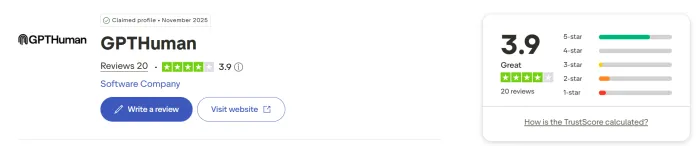
The pattern across these sources lines up with what I saw and with the tool's own positioning. On casual, blog, and marketing-style content, GPTHuman AI tends to perform well and reads naturally. On dense academic or technical writing, results get shakier, detectors are more likely to flag it, and the output usually needs a human editing pass. Several reviewers also flagged occasional grammar slips and slower customer support, and a few users reported billing and refund frustrations, which is a reminder to start small.
What users are saying
To put some real voices to those numbers, here is a sample of what people report on Trustpilot, summarized by sentiment. Like any review platform, these are individual experiences, and the picture is mixed rather than uniformly glowing.
★★★★★ My university runs AI detection, and so far everything I've put through it has come back clean. It's become a normal part of how I hand work in. 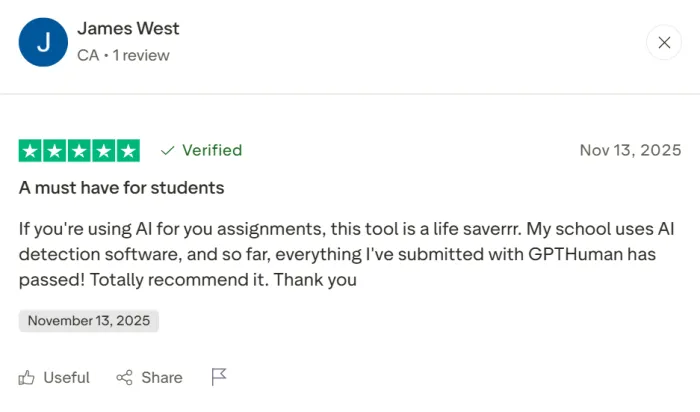 Student · Trustpilot | ★★★★★ For academic writing it's been dependable. It smooths out clunky sentences and the readability actually goes up, which I didn't expect. 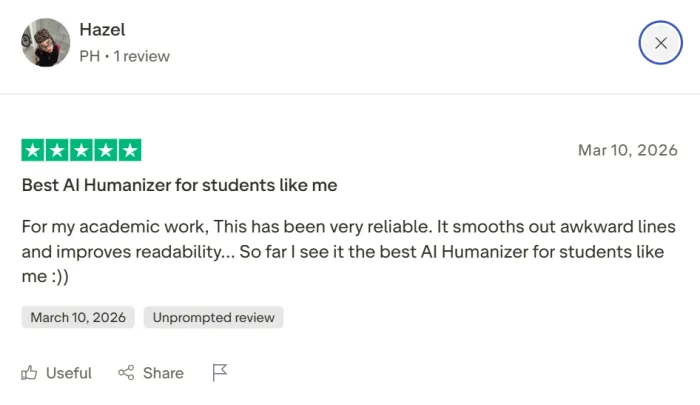 Student · Trustpilot |
★★★★☆ A client once asked if a blog post was AI. I ran it through this, resent it, and heard nothing back. It's part of my routine now. Freelance writer · Trustpilot | ★★★★☆ Not flawless, there are small grammar things to fix, but it reads far less robotic than raw AI. A quick proofread and it's ready to send. Blogger · Trustpilot |
★★☆☆☆ I checked the output in a free detector afterward and it still scored high. That left me wondering what I was paying for. 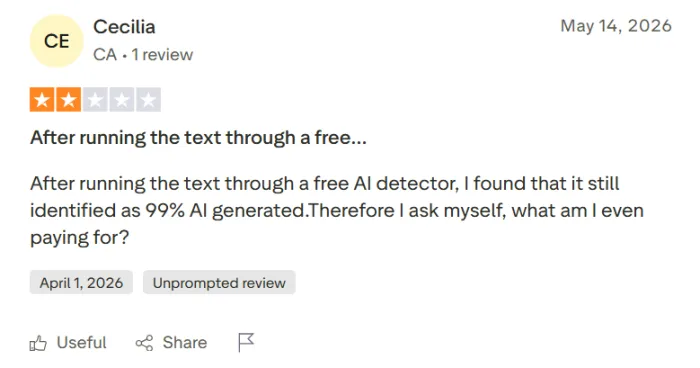 Critical review · Trustpilot | ★★☆☆☆ It leaned on filler words and slang that made my professional copy feel amateurish. Fine for casual writing, less so for formal work. 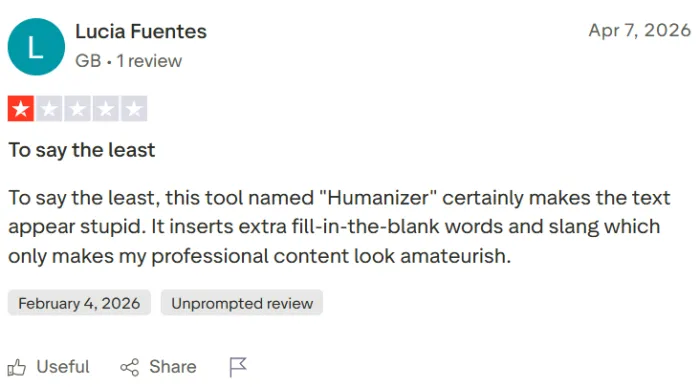 Critical review · Trustpilot |
A common thread runs through them: people are happiest using it for casual and blog-style content, which lines up with everything I saw in my own testing.
The Biggest Limitation
300 credits do not go far
Here is the catch I ran into. The 300 free credits are enough to run a test or two and form an impression, but not enough to do any real work. I used them up quickly just putting the tool through its paces, and there was nothing else I could do once they were gone. There is no meaningful free tier to settle into, so after you have kicked the tires, you are looking at a paid plan to use it for anything ongoing. That is fair as a business model, but go in expecting the free credits to be a demo rather than a workspace.
| WHAT I LIKED | WHERE IT FALLS SHORT |
|---|---|
• Strong detector results on casual text: 0% across all three tools in my test • Fast, with rewrites in about 5 to 10 seconds • Clean dashboard showing credits, plan, and usage at a glance • Budget-friendly pricing, among the cheaper humanizers around • Multiple modes and 50-plus language support • Free re-write guarantee if humanized text still gets flagged | • 300 free credits are only enough to try it, not to work • Weaker on academic and technical writing per multiple reviewers • Occasional wordiness and minor grammar slips to edit out • Some reports of slow support and refund issues • Prices shown in rupees, so the dollar cost shifts with exchange rates |
A NOTE ON RESPONSIBLE USE A detector score is a signal, not permission. If your school, employer, or publisher has rules about AI assistance, those rules still apply, and no humanizer changes that. Treat the output as a draft to review for accuracy and meaning, not a finished piece to hand off without reading. |
Privacy, data use, refunds, and cancellation
Detector performance and writing quality are only part of the buying decision. There are also a few account-policy details I would want to know before putting private or client material into GPTHuman.
Your text may be used to improve GPTHuman
GPTHuman’s privacy policy says the company collects the content users provide to the service, including prompts and uploaded content.
More importantly, the policy says that submitted content may be used to improve the service, including training the models that power GPTHuman. According to the company, account holders can opt out by changing the relevant setting inside their account.
That means I would think twice before pasting confidential client documents, unpublished research, sensitive business information, or other material you would not want used for service improvement unless you have reviewed and adjusted your privacy settings first.
There is an interesting distinction for developers: GPTHuman’s separate API page states that API content is private, encrypted, and is not stored or used to train its models. If privacy is critical to your workflow, verify which policy applies to the specific GPTHuman product you are using rather than assuming the web app and API work identically.
Refunds are another thing to know before subscribing
GPTHuman’s published Terms and Conditions currently state that all purchases are non-refundable.
Subscriptions can be cancelled, but cancellation takes effect at the end of the current paid term. In practical terms, that is another reason I would test the service with the smallest commitment available before buying a yearly subscription.
There is also some inconsistency in GPTHuman’s public documentation: its Terms still mention a seven-day free trial, while its current pricing page describes the free offering as a 300-word Humanizer trial. I would therefore rely on whatever conditions are shown in the current checkout and account dashboard when you subscribe.
Final verdictAfter sitting with GPTHuman AI and running my own before-and-after test, my view is that it does the core job well within its lane. Feeding it a casual ChatGPT story and watching three detectors, including the strict Originality.ai, fall from 97.6%, 87%, and 100% AI down to a flat zero was a striking result, and the rewrite stayed readable instead of turning into word salad. It is fast, the interface is uncluttered, and the pricing is gentle next to a lot of the competition. Where I would temper expectations is on two fronts. First, the 300 free credits are a taste, not a trial you can lean on, so you will need to pay to get real value. Second, the strong showing on my casual sample does not fully carry over to harder content. The weight of other reviews, and the tool's own design, points to weaker, more flag-prone results on academic and technical writing, where you will want to edit the output and check it against more than one detector. So who is it for? If you write blog posts, marketing copy, or general prose and want a quick, affordable way to make AI drafts read more naturally, GPTHuman AI is a reasonable pick, and the monthly plan is a low-risk way to try it on your own work. If your writing is academic, technical, or high-stakes, set your expectations lower, test it on a small piece first, and keep a human in the loop. Used that way, with eyes open about where it shines and where it strains, it held up well in my testing, and I would be comfortable reaching for it on the kind of content it is built for. |
What I would check before paying
Before subscribing, I would test GPTHuman with my own content and check more than just the AI detector score.
| Check | Why it matters |
|---|---|
| Test your own content | Results can vary by writing style |
| Compare before and after | Make sure facts and tone stay accurate |
| Use more than one detector | AI detector results can differ |
| Read the output yourself | Human quality matters more than a score |
| Check limits and privacy | Word caps, cancellation, and data policies matter |
The free allowance is the best place to start before paying for a plan.