Choosing an AI writing tool in 2026 is less about whether the software can generate text and more about how it fits a specific workflow, team size, and budget. GravityWrite and Jasper both produce solid content, but they are built for different kinds of users. Picking wrong means either overpaying for features that go unused or hitting frustrating limits halfway through a project.
This comparison looks at the parts that actually shape a buying decision: what each platform charges, where the feature sets diverge, how the writing reads, and which type of user gets the most value. Pricing and feature notes reflect publicly listed information as of mid-2026, though both vendors update plans frequently, so the official sites are always worth a final check before purchase.
Quick Snapshot
Before the deep dive, here is the high-level picture. GravityWrite leans toward affordability, breadth, and one-click speed across many content types. Jasper leans toward brand consistency, team collaboration, and marketing-grade governance at a premium price point.
Table 1. At-a-glance comparison of the two platforms
| Attribute | GravityWrite | Jasper |
|---|---|---|
| Best for | Solo creators, bloggers, small businesses, budget marketers | Marketing teams, agencies, brand-driven enterprises |
| Entry price | Free plan, then $8/month | $39/month (annual), no free tier |
| Core strength | Affordable, all-in-one breadth and speed | Brand voice control and team workflows |
| Templates | 250+ across many formats | Library plus app and agent tools |
| Standout feature | Built-in AI humanizer and image generation | Multiple brand voices, agents, app builder |
| Languages | 30 to 50 plus | 30 plus |
What Each Tool Actually Is
GravityWrite

GravityWrite is an all-in-one AI content platform that supports blogs, social posts, images, videos, and even basic website creation, which makes it versatile for marketers, small businesses, and individual creators looking at GravityWrite alternatives. Its workflow is built around template selection and short prompts rather than long, detailed instructions. A user picks a content type, answers a few questions, and receives a draft within seconds.
Jasper

Jasper positions itself further up the market as a marketing-focused content platform. The 2026 lineup centers on brand systems: brand voices that learn a company's tone, knowledge assets that store product and company information, audience profiles, and collaboration features for teams. Higher tiers add Jasper Agents for research and personalization plus a no-code app builder for custom workflows.
The practical difference is philosophy. GravityWrite optimizes for getting usable content out the door quickly and cheaply. Jasper optimizes for keeping content consistent across many writers and channels, which matters more once content production becomes a team sport with approval layers and style rules.
Pricing Compared
Price is where these two diverge most sharply. GravityWrite offers a genuinely usable free tier and low monthly entry points. Jasper has no permanent free plan and starts at a price that reflects its team-oriented positioning.
GravityWrite
GravityWrite's structure begins with a free plan that allows up to 1,000 words and requires no payment method to start. Paid plans start around $8 per month, with a higher Pro tier around $49 per month aimed at higher-volume users and agencies. Some resellers and reviews list slightly different figures, so plan names and credit allowances shift over time.
Jasper
Jasper's 2026 pricing centers on three tiers. The Creator plan runs $49 monthly or $39 billed annually, the Pro plan runs $69 monthly or $59 billed annually, and the Business plan uses custom enterprise pricing. All paid plans include unlimited word output, and a 7-day free trial is available, though it typically requires card details upfront.
Table 2. Plan and pricing comparison (mid-2026, annual billing where noted)
| Plan tier | GravityWrite | Jasper |
|---|---|---|
| Free option | Yes, around 1,000 words/month | No permanent free plan |
| Trial | Free plan acts as the trial | 7-day trial, card required |
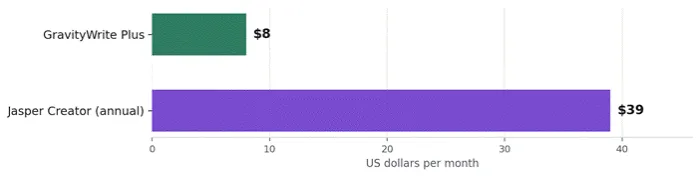
| Entry paid plan | ~$8/month (Plus) | $39/month annual (Creator) |
| Mid / Pro plan | ~$49/month (Pro) | $59/month annual (Pro) |
| Enterprise | Covered within Pro for most | Custom Business pricing |
| Word limits | Credit-based per plan | Unlimited words on paid plans |
| Hidden cost note: Jasper's deepest SEO value comes through its Surfer SEO integration, which is a separate subscription. Analysts have pointed out that the real cost of running Jasper for SEO content can land closer to $158 per seat per month once Surfer is added on top of the Pro plan. |
Entry-Level Monthly Cost
Lowest paid plan, in US dollars per month. Shorter bars are cheaper.
Feature-by-Feature Breakdown
Both platforms cover the core of AI writing, so the differences live in the surrounding tools. GravityWrite bundles a wide spread of content types into one affordable subscription. Jasper concentrates on depth around brand management and team operations.
Table 3. Feature availability across both platforms
| Feature | GravityWrite | Jasper |
|---|---|---|
| Long-form blog writer | Yes | Yes |
| Template library | 250+ | Extensive |
| AI image generation | Built in | Limited |
| AI video / short-form | Yes | Limited |
| Built-in text humanizer | Yes | No native tool |
| Multiple brand voices | Basic | Strong, multi-voice |
| Knowledge assets / memory | Limited | Yes |
| Team collaboration | Basic | Advanced |
| Surfer SEO integration | No | Via add-on |
| No-code AI app builder | No | Business tier |
| WordPress publishing | Yes | Via integrations |
| Browser extension | Varies | Yes |
GravityWrite's advantage is range inside a single low-cost plan. Reviewers note that it lets users handle blogs, social posts, images, videos, summaries, and basic website building without paying for multiple tools. The built-in text humanizer is a real differentiator, since many competing platforms, including Jasper, do not ship that as a native feature.
Jasper's advantage is governance and connectivity. Its brand voice system goes well beyond simple tone presets, learning a company's vocabulary and applying it across every writer and template. The trade-off is that even the Pro plan caps brand voices and knowledge assets, which pushes agencies managing several client brands toward the custom Business plan fairly quickly.
Content Quality and Output
Raw writing quality is closer than the price gap suggests, but the platforms shine in different places. In hands-on testing, Jasper produced polished, readable output that aligned with brand tone and needed minimal surface-level editing. That consistency is the payoff for its brand systems and is most visible across long documents and multi-piece campaigns.
GravityWrite generates content fast and covers a wide spread of formats, but the trade-off shows up in depth. One 2026 review summarized it bluntly, praising the generous free plan and ad-copy strength while flagging weaker long-form output. For short marketing assets, product descriptions, and social copy, that limitation rarely bites. For flagship long-reads where nuance matters, more editing is typically needed.
| The practical read: GravityWrite is excellent for high volume across many small formats, while Jasper edges ahead when a single polished, on-brand long-form piece needs to land with minimal cleanup. |
SEO and Optimization Tools
SEO is a major decision factor for anyone publishing to rank. GravityWrite builds optimization into its blog workflow directly. Its blog writer can generate long articles while analyzing keywords and competitor content to improve search visibility, and reviewers highlight the ability to pull a competitor URL and build a structured outline from it, which speeds up research.
Jasper takes a partner approach instead. Rather than a fully native SEO suite, it leans on the Surfer SEO integration for keyword targeting and on-page scoring. That delivers strong, data-rich optimization for teams already invested in Surfer, but it adds cost and a second tool to manage. For a solo blogger who simply wants SEO-aware drafts inside one subscription, GravityWrite's built-in approach is more convenient.
Table 4. SEO and publishing capabilities
| Capability | GravityWrite | Jasper |
|---|---|---|
| Native keyword analysis | Built in | Via Surfer add-on |
| Competitor content analysis | Yes | Via integration |
| On-page optimization scoring | Basic | Strong (Surfer) |
| One-click long-form drafts | Yes | Yes |
| Extra SEO cost | None | Surfer subscription |
Ease of Use and Learning Curve
GravityWrite is built for beginners. The interface is clean, and instead of demanding detailed prompts, it asks a few guided questions and generates content instantly. That lowers the barrier for anyone new to AI writing. The only mild friction is the sheer number of templates and tools, which can feel overwhelming at first while users figure out which module fits each task.
Jasper is more powerful and, accordingly, has a steeper learning curve. Setting up brand voices, knowledge assets, and audience profiles takes time before the platform pays off. For a solo user who just wants a draft, that setup can feel like overhead. For a team that will reuse those assets across hundreds of pieces, the upfront investment compounds into real consistency gains.
Side-by-Side Scorecard
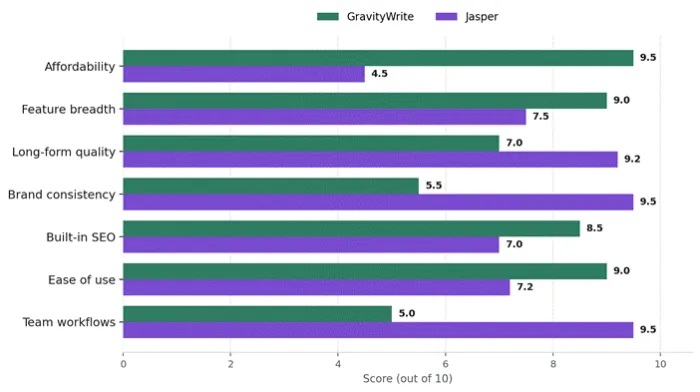
The scorecard below summarizes how the two platforms tend to perform across the criteria that matter most to buyers. These ratings synthesize current reviews and reflect typical user fit rather than a single benchmark test.
Performance by Criterion (out of 10)
Longer bars indicate stronger performance in that category.
Who Should Pick Which
There is no universal winner here, only the right fit for a given situation. The decision usually comes down to budget, team size, and whether brand governance is a real requirement or a nice-to-have.
Choose GravityWrite if Budget matters, the work spans many content formats, or the team is small. It suits bloggers, solo creators, and small businesses that want fast, SEO-aware drafts plus images and social posts inside one affordable plan, with a free tier to test first. | Choose Jasper if Content runs across a team with multiple writers, strict brand standards, and approval layers. It suits marketing departments and agencies that need consistent brand voice, deep integrations, and governance, and can absorb the higher per-seat cost. |
A useful rule of thumb: if the goal is high-speed publishing at a predictable low cost, GravityWrite is the more sensible starting point. If editorial consistency and cross-team coordination are operational requirements rather than preferences, Jasper's premium becomes easier to justify. Many small operations start on GravityWrite and only graduate to Jasper once team workflow demands outgrow what a lightweight tool can handle.
Both GravityWrite and Jasper are capable platforms in 2026. The smartest approach is to match the tool to the actual workload: test GravityWrite's free plan for affordable, versatile output, and trial Jasper when brand consistency and team scale justify the premium. Pricing and features shift regularly, so confirming current details on each vendor's official site before subscribing is always worthwhile.