I have kept Grok and ChatGPT open side by side since early July, when OpenAI rolled out GPT-5.6, and again after 12 August, when SpaceXAI shipped Grok 4.6. Both launch posts were written for coders and people who build agents. I do not build agents. I write: product pages, email sequences, a weekly newsletter, the odd 1,500-word blog post, and a client's LinkedIn feed that burns through hooks faster than I can think of them. So this comparison is about the one question the launch posts barely touched. Which of these two is the better writing partner right now?
The short version is that they are not interchangeable, and the gap shows up inside the first ten minutes. Grok writes like a clever colleague who has been scrolling X all morning and has opinions about it. ChatGPT writes like an editor who wants the piece to ship. I have a favourite for most jobs, but there are two writing tasks where I now reach for the other one without a second thought.
Everything below comes from my own drafts or from tests other people published this year, which are linked so you can check them.
Pick ChatGPT if You write for clients or a brand, work from a voice guide, need clean structure on the first pass, and want the flagship model at the $20 tier. | Pick Grok if You write about things happening today, want a sharper voice for social hooks and opinion pieces, translate often, or need the cheaper API for bulk drafts. |
What changed this summer
Both products replaced their flagships within five weeks of each other, and the tiers you pay for map onto different models.
| Detail | Grok | ChatGPT |
|---|---|---|
| Current flagship | Grok 4.6 | GPT-5.6 Sol (Luna on Free and Go) |
| Shipped | 12 August 2026, after Grok 4.5 on 8 July | 9 July 2026, with a chat-focused Sol update on 6 August |
| Who makes it | SpaceXAI, formerly xAI, bought by SpaceX in February | OpenAI |
| Model family | One flagship, plus a separate Grok Build model for coding | Three tiers: Sol, Terra and Luna |
| API price per million tokens | $2 in, $6 out. Rates double once a prompt passes 200K tokens | Sol lists at $5 in, $30 out; $4 and $20 on a promotional rate since 21 August |
| Context window on the API | 500K tokens | Varies by tier; OpenAI does not lead with the figure |
| Writing workspace | Draft in the chat, no separate editor | Writing blocks inside the chat. Canvas has been retired |
| Live information | Native X feed plus web search, always on | Web search on demand |
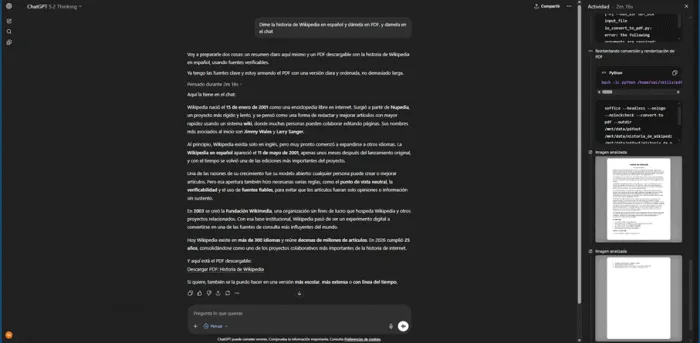
ChatGPT's desktop layout: sidebar, conversation, and a file it produced during the reply. Captured on the 5.2 Thinking model earlier this year; the layout is unchanged under Sol. Screenshot via Wikimedia Commons, public domain.
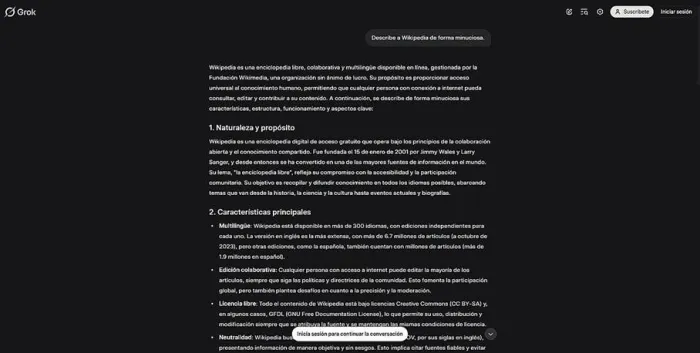
Grok's web app at grok.com. Answers arrive as long paragraphs by default, which is the first thing a writer notices. Screenshot via Wikimedia Commons, public domain.
The writing head-to-head
Ten jobs that come up every week for a working writer. Where a published test matched my own results I have said so; otherwise my draft is the tie-breaker.
| Job | Winner | Why |
|---|---|---|
| Long-form blog posts | ChatGPT | Consistent tone across 1,500 words, sensible heading hierarchy, fewer detours into side topics. |
| Taglines and brand copy | ChatGPT | tl;dv's brand-kit test preferred ChatGPT's tagline, values and tone-of-voice examples. Same on my briefs. |
| Social hooks for LinkedIn and X | Grok | Same test: Grok's hooks were the ones that stopped the scroll. Its diet of live X posts shows here. |
| Email and newsletter copy | ChatGPT | Narrow win. Tighter calls to action and shorter paragraphs. Grok runs long unless you cap it. |
| Fiction and humour | Split | Tom's Guide gave the comedy round to GPT-5 in August 2025, then named Grok 4.1 the bolder creative writer that November. Only Sol is worth using for fiction among the 5.6 tiers. |
| Writing to a style guide | ChatGPT | Sol takes voice from samples and guides better than anything I have used. |
| Translation and localisation | Grok | Native speakers in a blind test picked Grok's Spanish, Russian and Japanese every time. |
| Research-backed drafts | Grok | Won every research task in tl;dv's March round, 15 points to 0, with better citations and no invented products. |
| Editing and rewriting loop | ChatGPT | Writing blocks, memory, projects and faster replies make revision rounds shorter. |
| Formatting on the first pass | ChatGPT | Grok often returns unbroken paragraphs. ChatGPT structures without being asked, and the August update trimmed the excess. |
| Tally | ChatGPT 6, Grok 3, split 1 | Grok's three wins are the three jobs where being current or being blunt matters most. |
Voice and tone
This is the difference you feel before you can measure it.
Grok: direct, a little cocky, comfortable with a joke It takes a position in the first sentence and defends it. Fun mode pushes that further. This is the voice you want for opinion columns, contrarian hooks and any post where a flat corporate register would sink it. The cost is restraint. Asked a vague question, it hands you an essay instead of asking what you meant. | ChatGPT: measured, professional and, since August, shorter The updated Sol leads with the recommendation instead of burying it, adapts its length to the question, and will disagree with you when agreeing would be unhelpful. It is the safer voice for client work. Push it for personality and it obliges, but you have to ask. Left alone it sounds like a good corporate blog, which is either exactly what you need or exactly the problem. |
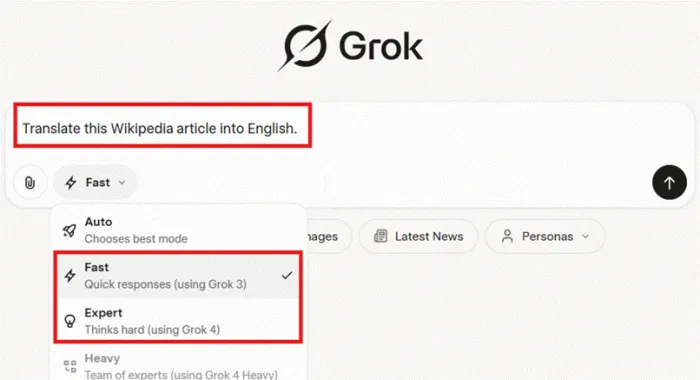
Grok's mode picker on a paid plan: Auto, Fast, Expert and Heavy. Expert is the one to use for drafting; Fast is fine for hooks and subject lines. Screenshot via Wikimedia Commons, CC0.
Formatting: the thing you notice in the first five minutes
Ask both for a comparison post and look at the raw output. Grok tends to answer in dense paragraphs, sometimes ignoring the numbered list in your prompt. tl;dv's tester called Grok's presentation the one thing that consistently dragged its scores down. ChatGPT arrives with headings, subheadings and bold key phrases without being told.
For years the complaint ran the other way, that ChatGPT turned every answer into bullet soup. OpenAI went after that on 6 August. The updated Sol adapts its level of detail to the question, drops formatting that does not help, and answers a simple question in a sentence. The change is real. Blog sections still come back structured, but a request for one subject line now returns one subject line.
Feeding it a style guide
This is where I stopped treating them as equals. I keep a 600-word voice guide plus three sample posts for each client. Paste those into ChatGPT, ask for a first draft, and the result lands close enough to the house voice that my edit is mostly cutting. Every.to's Katie Parrott reported the same in her GPT-5.6 review.
Grok reads the guide and follows the obvious rules, then drifts back toward its own voice by the third paragraph. If you write as someone else for a living, that drift costs you time on every job.
When the draft needs facts
Writers who cover news, markets, sport or anything with a date on it need the draft to be right today. Grok pulls from X live and searches the web unprompted. In tl;dv's March tests it named the correct funding round when ChatGPT cited a three-week-old one, and refused to invent a product that did not exist. If your article opens with "this week", start in Grok.
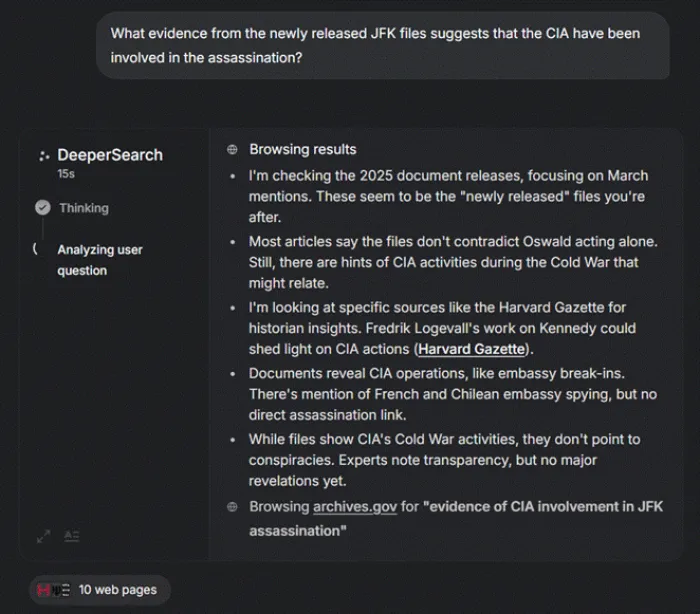
Grok's DeeperSearch panel working through sources before it answers. This is the mode to use for any draft that leans on recent reporting. Screenshot via Wikimedia Commons, public domain.
Two cautions. Grok's confidence does not always track its accuracy; the same test caught it stating a wrong fact with no hedge, and Artificial Analysis measured a sharp rise in hallucinations between Grok 4.3 and 4.5, even though xAI says 4.6 now leads on that metric. OpenAI, meanwhile, reports the August Sol update cut factual errors on finance, legal and medical prompts by 68 percent against GPT-5.5 Instant, an internal figure. My rule: draft time-sensitive pieces in Grok, then check every number elsewhere before it ships.
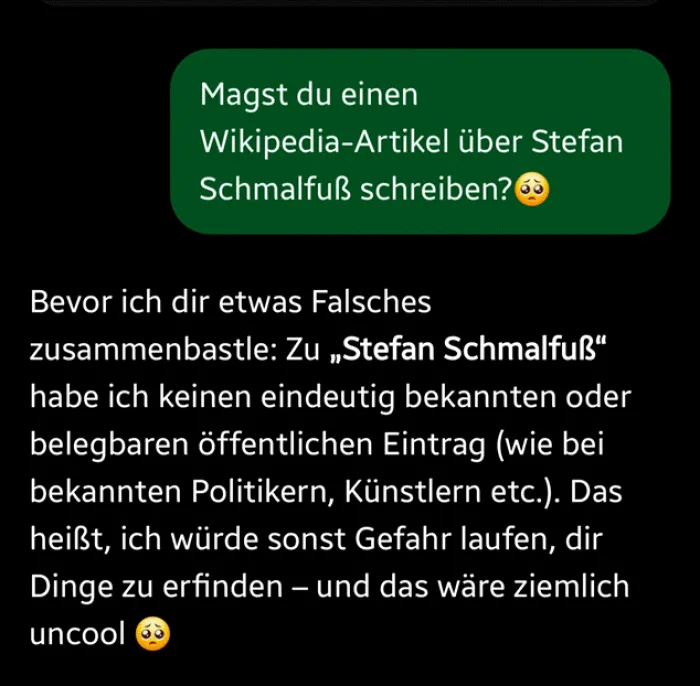
ChatGPT, asked in German to write an encyclopedia entry about an unknown person, declines rather than invent one. The guardrail is welcome; the flip side is that ChatGPT sometimes hedges where Grok would go and look. Screenshot via Wikimedia Commons, public domain.
The editing loop
Most writing time is revising, not drafting, and ChatGPT wins the loop on mechanics. It replies faster, holds a long conversation without losing the thread, and its writing blocks let you rework one paragraph in place now that Canvas is gone. Memory means it remembers that you hate exclamation marks. Grok's paid plans now list Memory and Projects, which closes part of the gap, but it still thinks for longer before answering and a third-round revision feels like starting over more often than it should.
What each plan costs a writer
For writing alone, the like-for-like comparison is ChatGPT Plus at $20 against SuperGrok at $30. Grok's extra ten dollars buys live X data and a generous image and video allowance, not better prose.
| Plan | Price | What a writer gets |
|---|---|---|
| ChatGPT Free | $0 | Unlimited Luna text chats since August, with ads in the US and Europe. Fine for ideas, weak for polished drafts. |
| ChatGPT Go | $8/mo | Roomier Luna limits and longer memory. No Sol, and still ad-supported. |
| ChatGPT Plus | $20/mo | Sol with the effort slider, writing blocks, projects and deep research. The tier this article assumes. |
| ChatGPT Pro | $100 or $200/mo | Five or twenty times Plus usage plus Sol Pro. Two plans share the name, so check the label. |
| Grok Free | $0 | Tight caps, and image generation was removed in March. |
| SuperGrok Lite | $10/mo | Longer chats and basic images. No Expert mode, DeepSearch or Big Brain. |
| SuperGrok | $30/mo | Full model access, Expert mode, DeepSearch, Imagine, Memory and Projects, all drawing on one shared weekly pool. $300 a year. |
| SuperGrok Heavy | $300/mo | Priority access and first crack at new models. Not a writing plan. |
| X Premium and Premium+ | $8 / $40/mo | Grok bundled into X. Premium+ costs more than SuperGrok for the same AI. |
Review table
Scores are out of ten and cover writing work only, not the coding and agent tasks both launches were built around.
| Criterion | Grok 4.6 | GPT-5.6 Sol |
|---|---|---|
| Prose quality on a first draft | 7.5 | 8.5 |
| Voice and personality | 9.0 | 7.0 |
| Holding a supplied style guide | 6.5 | 9.0 |
| Formatting and structure | 6.0 | 9.0 |
| Facts, citations and live data | 9.0 | 7.5 |
| Revision workflow | 6.5 | 8.5 |
| Value at the $20 to $30 tier | 7.0 | 8.5 |
| Overall for writers | 7.4 | 8.3 |
What people are saying
Six sources I trust enough to link, in their own findings rather than mine.
Across 28 hands-on tests Grok won the overall scorecard 46 to 34, yet ChatGPT took Writing and Creativity 7 to 4 on tagline, brand story and short fiction. Grok won translation after native speakers judged the outputs blind. tl;dv, hands-on comparison, updated July 2026. | A nine-prompt face-off named Grok 4.1 the winner over GPT-5.1, finding it bolder with creativity and sharper on emotional framing, while ChatGPT did better whenever brevity mattered. The reviewer called Grok "the more human of the two chatbots". Tom's Guide, November 2025. |
Writer Katie Parrott found Sol stronger than Claude models at using style guides and samples, and rated its speed and willingness to take direction as ideal for collaborative writing, while doubting any frontier model has reached human-level prose. Every.to, Vibe Check on GPT-5.6 Sol, August 2026. | A blind fiction test rated Sol the only GPT-5.6 tier worth using for stories. Luna finished last and renamed its own protagonist mid-story. GPT-5.5 won the first round by writing about half again as much text under the same brief. Noren, GPT-5.6 writing test, July 2026. |
Grok 4.6 and GPT-5.6 Sol score the same 61 on the Artificial Analysis Intelligence Index, which puts them level on raw capability and leaves cost, context and workflow to decide the choice. DataCamp, citing Artificial Analysis, August 2026. | Its Grok 4.6 report paired the benchmark numbers with the vendor history enterprise buyers still weigh, including Ofcom's January 2026 investigation into image generation on X, noting that procurement teams rarely judge a model apart from its maker. VentureBeat, August 2026. |
Pros and cons
Grok Pros • Live X and web data with no toggle to remember • Sharper hooks and a willingness to take a side • Best translation in the one blind test I know of • Cheapest frontier API for bulk drafts at $2 in and $6 out • Fewer refusals on edgy or sensitive topics Cons • Walls of text on the first pass • Drifts away from a supplied voice guide • $30 for the writer tier, ten dollars above Plus • Slower to answer and slower to revise • Vendor history that some clients will not sign off on | ChatGPT Pros • Best first-pass structure of any chatbot • Strongest at absorbing style guides and samples • Writing blocks, memory and projects built for revision • The flagship model is included at $20 • The August update cut the padding Cons • Free and Go carry ads and run on Luna, the weakest writer • Web research trails Grok and dated facts slip in • The default voice is safe; edge has to be requested • Two plans called Pro make it easy to buy the wrong one • Sol on the API costs several times Grok's rate |
Final verdict
After two months of running the same briefs through both, here is how my week actually splits. Client blog posts, landing pages, email sequences, anything that has to match a voice guide: ChatGPT on Plus, with the Sol slider two notches up. It gets the structure right the first time, it remembers my rules, and the August update killed the bullet-point habit that used to make me rewrite every intro by hand.
Newsletter roundups, hot-take LinkedIn posts, and anything about a story that broke this morning: Grok on SuperGrok, because it already knows what people are saying and it is not shy about saying something itself. Translation checks also go to Grok, after the blind results changed my mind.
| If you can only pay for one and you write for money, pay for ChatGPT Plus. The finished draft is closer to done, and the ten dollars you save against SuperGrok is real. |
If you write in your own voice about the world as it is today, and you would rather edit a sharp draft than polish a safe one, SuperGrok will earn its price. What I would not do is choose on benchmark scores. The two flagships tie on the main independent index, and every difference that matters for writing lives in temperament and tooling, not in intelligence.