99% The number most detector homepages lead with, usually measured on clean, unedited AI text under lab conditions. | 60–85% What independent tests report once the text is human, translated, technical, or lightly rewritten. That spread is the whole story. |
Here is the short version before the detail. AI detectors are decent at catching raw, untouched output from a chatbot. They get shaky fast the moment a human edits that output, and they wrongly accuse real people often enough that several large universities have switched them off. The tool is a smoke alarm, not a judge. It can tell you to go look. It cannot tell you what happened.
THE 30-SECOND ANSWER CATCHES Unedited AI text from a known model, in plain English, at reasonable length. This is where the high scores are earned. MISSES Paraphrased or “humanized” AI. Detection drops by 15 to 30 points once a rewriting tool touches it, and can fall below 25%. FALSELY FLAGS Human writing, especially from non-native English speakers. One Stanford study saw 61% of genuine essays by non-native writers marked as AI. DEPENDS ON Length, genre, and which model wrote it. Short, technical, or translated text throws the score off in both directions. |
What “accuracy” even measures
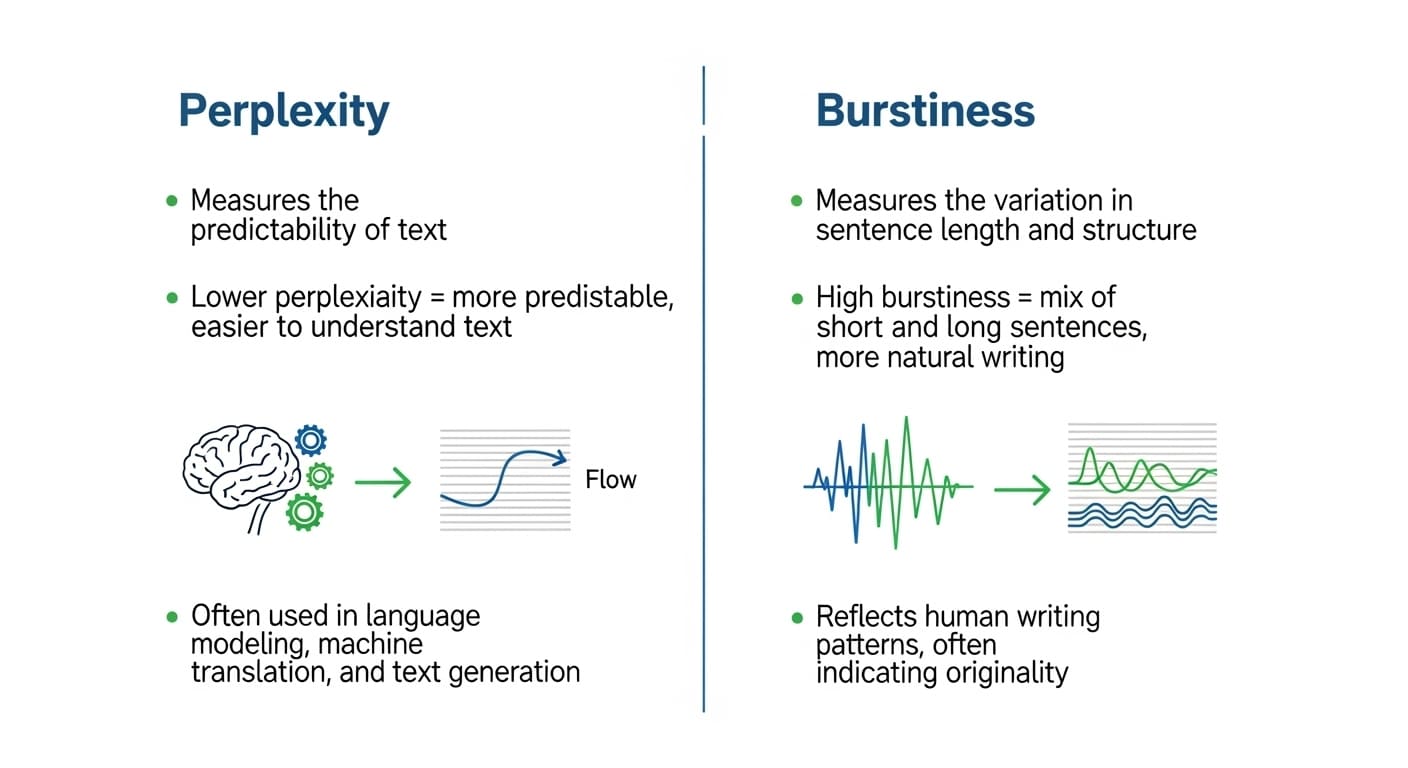
Almost every detector works the same way under the hood. It does not read for meaning. It measures two statistical fingerprints and guesses from there.
| Perplexity | Burstiness |
|---|---|
| How predictable the next word is. AI text tends to pick likely words, so it scores low. Trouble is, so does clean, plain, deliberately simple human writing. | How much sentence length and rhythm vary. Humans tend to swing between long and short. AI tends toward an even pace. A careful editor flattens that swing too. |
That design has a built-in flaw. The features that supposedly mark “AI” are the same features that mark a writer who is careful, concise, or working in a second language. A single accuracy percentage hides all of it, because a tool can score 99% on lab text and still misread the person in front of it. Worse, these thresholds were calibrated on older models. As GPT-5, Claude, and Gemini write more naturally, the statistical gap the whole method relies on keeps shrinking.
| The math guarantees mistakes: human and AI writing overlap in feature space, so no threshold can separate them cleanly. |
The accuracy numbers that actually got published
Vendor pages love a round 99%. Independent researchers keep landing somewhere lower and much messier. Here is the spread from studies and benchmarks, not marketing.
Accuracy claims vs. independent findings
| Source of the number | Claimed / found | The catch |
|---|---|---|
| Vendor homepages (most tools) | 98–99%+ | Measured on clean AI text, rarely on a shared public benchmark. |
| OpenAI’s own detector (2023) | 26% | Caught only a quarter of AI text, wrongly flagged 9% of human text. OpenAI shut it down after six months. |
| General academic evaluations | ~88% | On unedited AI content only. Roughly 1 in 8 slips past even in ideal conditions. |
| Turnitin, real-world (independent) | 60–85% | Detection drops sharply once submitted text has been edited or paraphrased. |
| RAID benchmark (Penn, 6M+ samples) | Near zero | True-positive rates collapse when false positives are forced below 0.5%. Adversarial edits fool most detectors easily. |
| Originality.ai, Arabic study (Nov 2025) | 96% | Best commercial tool in that test, but still an 8% false-positive rate on human writing. |
| ZeroGPT, same study | 80% | Paired with a 38% false-positive rate. Four in ten human samples wrongly flagged. |
| The pattern: the closer a test gets to messy real writing, the further the accuracy falls from the number on the box. The RAID team put it plainly. Detectors that advertise 99% are almost never tested on hard, varied, adversarial text, and they fold when they are. |
False positives: when the tool accuses a real person
Missing AI text is annoying. Flagging a human as a cheat is the failure that ends careers and gets tools banned. And it happens at rates that sound small until you multiply them by real submissions.
| 61% | 97.8% | 20% |
|---|---|---|
| of genuine essays by non-native English speakers were flagged as AI in Stanford’s Liang study. Native-English essays scored near-perfect. | of those same human essays were flagged by at least one of the seven detectors tested. The bias is systematic, not a fluke. | false-positive rate for Black students in a 2024 Common Sense Media review, versus 10% for Latino and 7% for White students. |
The reason ties straight back to how the tools work. Perplexity punishes simpler vocabulary and steadier sentence structure, which is exactly how many second-language writers, and plenty of careful native ones, actually write. The detector reads clarity as a confession.
Turnitin false-positive rate: stated vs. observed
| Measurement | Rate |
|---|---|
| Turnitin false-positive rate, as the company states it | <1% |
| Turnitin false-positive rate, independent real-world reads | 2–5% |
| ZeroGPT false-positive rate on human text (published study) | 38% |
A sub-1% error rate feels harmless until you scale it. Vanderbilt University did that math on 75,000 papers a year: even at 1%, that is roughly 750 students wrongly accused annually. The university disabled Turnitin’s AI detector in August 2023 and has not turned it back on.
What that looks like when it lands on a person
Australian Catholic University · 2024 Roughly 6,000 students were flagged for suspected AI use in a single year, about 90% of misconduct cases. Around a quarter were later dismissed. Investigations dragged on for months and delayed graduations. ACU discontinued the AI indicator. |
Yale School of Management An MBA student was suspended for a year on the strength of a GPTZero score and later sued. A detector reading became the primary evidence in a case with real consequences. |
Liberty University A student’s personal essay about her own cancer diagnosis was flagged as machine-written. The writing that detectors most often misread is often the most human. |
How little it takes to fool them
This is the part vendors talk about least. If a detector can be defeated in one click, its high accuracy score is close to meaningless for anyone actually trying to hide AI use. So I tested the obvious evasions, and the research backs up what I saw.
Detection after adversarial edits
| Evasion method | Effect on detection | Effort |
|---|---|---|
| Paraphrasing tool (e.g. QuillBot) | Drops detection 15–30 points; one study saw it fall to about 22%. | 1 click |
| Dedicated “humanizer” services | Marketed specifically to clear Turnitin, GPTZero, and Originality. | 1 click |
| Synonym swaps (RAID / DAMAGE test) | GPTZero fell to 61% on academic text; Binoculars to 43.5%. | light |
| Manual edits: typos, restructured sentences | Substantial accuracy loss across every major tool. | light |
| The uncomfortable conflict: several companies that sell AI detection also sell the “humanizer” tools built to beat detection. The same vendor profits from the lock and the key. That alone should temper how much weight anyone puts on a single score. |
So the tools fail in two directions at once. They wave through the motivated cheat who spent ten seconds paraphrasing, and they accuse the honest student whose plain prose happens to look predictable. That combination is why a detector score should never be the end of a conversation.
The detectors, reviewed
I ran the same batch of known-origin text through the major tools and cross-checked every impression against independent benchmarks rather than vendor pages. Accuracy figures below are directional reads from published tests, not lab marketing. Prices are current as of 2026 and drift often, so confirm before you buy.
AI detector review · 2026
| Tool | Best for | Free option | Independent read | FP risk | Rating |
|---|---|---|---|---|---|
| GPTZero | Student self-checks, education | 10,000 words / mo | Strong on raw AI; sentence-level highlights | Moderate | 4.0 |
| Originality.ai | Publishers, content teams | 50 credits at signup | Best commercial in the Arabic study (96%) | Moderate | 4.2 |
| Turnitin | Institutional plagiarism + AI | None (school licence) | 60–85% on edited text; opaque method | Moderate | 3.3 |
| Copyleaks | Enterprise, multilingual, API | 10 pages / mo | Solid on direct AI; large scan size | Moderate | 3.8 |
| Winston AI | Document + multimedia screening | 7-day trial | Claims 99.98%; OCR and file support | Moderate | 3.6 |
| Pangram | Fairness-sensitive checks | Limited | Lowest false positives (~1 in 10,000) | Low | 4.1 |
| ZeroGPT | Quick, casual look only | Unlimited, free | ~80% accuracy, high false-positive rate | High | 2.2 |
A few things stood out after living with these for a while. GPTZero’s free tier is genuinely the most useful entry point, and its sentence-level highlighting at least shows you where it is suspicious instead of handing down a bare percentage. Originality.ai was the sharpest on unedited AI and bundles plagiarism and fact-checking, but the pay-only model stings and it still let a healthy share of my paraphrased samples through. Pangram was the standout on the metric that matters most for accusations, its false-positive rate, which is the number I would weigh above raw accuracy if a person’s record is on the line. The free unlimited tools like ZeroGPT are fine for a curious glance and nothing more. I would not let one near a grade or a paycheck.
When a detector is worth running
None of this means the tools are useless. It means they have a narrow job and a wide danger zone. The difference is entirely in how you treat the output.
| REASONABLE USES | WHERE IT BREAKS |
+ A first-pass screen that tells you which pieces to read more closely + Self-checking your own writing before submitting, to see what a tool might flag + Spotting lazy, fully unedited AI dumps in a large content pile + One input among several, weighed with drafts and edit history | – As standalone proof of misconduct or grounds for punishment – On writing by non-native English speakers, where bias runs high – On short, technical, or translated text, where scores swing wildly – Against anyone who paraphrased, since a click erases the signal |
The institutions that thought hardest about this landed in the same place. Vanderbilt, Curtin, Johns Hopkins, the University of Cape Town, Waterloo, and several University of California campuses have all disabled or restricted AI detection, most citing false positives and bias against non-native writers. Curtin pulled the plug in January 2026 and shifted toward trust-based assessment instead. When the buyers with the most data walk away, that is worth noting.
The VerdictSo, are they accurate? After weeks of feeding these tools text whose origin I already knew, my honest answer is: accurate enough to be a hint, nowhere near accurate enough to be an authority. On raw, untouched AI writing in plain English, the good ones do their job, and watching Originality and GPTZero light up a paragraph I had generated minutes earlier was genuinely convincing. Then I paraphrased the same paragraph once, and most of that confidence evaporated. Then I ran a decade-old essay I wrote by hand, and a tool told me a real memory was probably machine-made. That is the whole experience in three steps. The technology is real and sometimes impressive, but it is fragile at both ends: too easy to slip past on purpose, too quick to accuse by accident. If you use one, use it the way you would use a metal detector at an airport. It beeps. It does not convict. Pair every score with context, drafts, and a human read, and never let a percentage be the last word about a person. Treat it as a smoke alarm and it earns its place. Treat it as a verdict and it will eventually burn someone who did nothing wrong. |
| Yes* | Barely | Never |
|---|---|---|
| On unedited AI text | On edited or human text | As sole proof of misconduct |