
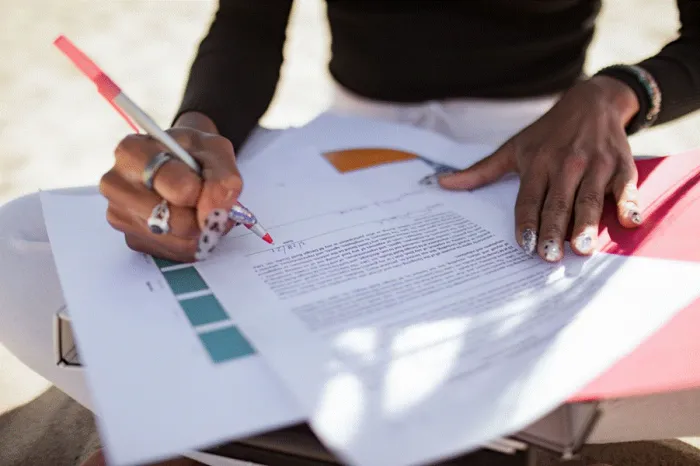
In today's fast-paced digital landscape, it's important to note that editing isn't just about fixing typos, it's about weaving a rich tapestry of polished, persuasive, publishable content. Marked in red: filler, a "not X but Y" contrast, and a triplet. |
| Rewrite: Editing an AI draft is mostly deleting. |
I have been drafting with AI since the spring of 2024, and for most of that time I have kept a plain text file open beside the chat window. Every time I fixed the same thing twice, I wrote it down. That file is where this checklist comes from.
The drafts themselves have improved a lot. Claude gives me cleaner structure than it used to, ChatGPT has mostly stopped opening every article with a definition, and Gemini now holds a word count without being reminded. What has not changed is the shape of the editing job. A draft still arrives with confident numbers I cannot trace, sentences that all run to the same length, and at least one paragraph that says nothing at all. Last month I timed myself on a 1,600-word product comparison. The draft took four minutes to generate and 55 minutes to make publishable. The generation is the cheap part.
What follows is the order I now edit in. Each pass has one job. It is slower than one read-through, but it catches far more, and it stops the worst habit AI editing encourages: polishing sentences in a paragraph that should have been deleted.
The nine passes at a glance
| Pass | What it fixes | Time on a 1,500-word draft |
|---|---|---|
| 1. Brief check | Wrong angle, missing sections, off-topic padding | 5 min |
| 2. Facts and numbers | Unverifiable claims, invented sources, stale prices | 15 to 25 min |
| 3. Structure | Buried answers, mirror-image sections, weak endings | 10 min |
| 4. Filler | Throat-clearing openers, restated points, stacked hedges | 10 min |
| 5. Vocabulary | Words the models overuse | 5 min |
| 6. Rhythm and punctuation | Uniform sentence length, triplets, dashes | 10 min |
| 7. Your own knowledge | Missing experience, examples, opinions | 15 min or more |
| 8. Reader layout | Headings, tables, lists, first-screen answer | 10 min |
| 9. Final read | Typos, dead links, one last listen | 10 min |
Timings are mine, from roughly 60 drafts this year. Yours will differ, but the proportions hold: facts and your own additions take longest.
Why AI drafts need their own editing routine
None of this is about hiding that a model was involved. AI drafts fail in predictable ways, and predictable failures deserve a fixed routine. Four pieces of evidence shape the passes below.
The tells are documented Wikipedia's volunteer editors run WikiProject AI Cleanup and maintain a public page called Signs of AI writing. It lists the patterns they see in undisclosed AI text: promotional framing, rule-of-three lists, contrasts that correct a misconception nobody held. They call it a field guide, not a rulebook. Since March 2026, Wikipedia's guideline on large language models has prohibited using them to generate or rewrite article text. Wikipedia:Signs of AI writing | The vocabulary shift is measurable A University of Tübingen team analysed more than 15 million PubMed abstracts from 2010 to 2024 and found an abrupt jump in certain style words after ChatGPT arrived: "delves" at 28 times its expected rate, "underscores" at 13.8, "showcasing" at 10.7. They estimate at least 13.5% of 2024 abstracts were processed with an LLM, and about 40% in some subsets. Science Advances, July 2025 |
Sources cannot be trusted on sight The Tow Center for Digital Journalism at Columbia tested eight AI search tools with 1,600 queries, each asking the tool to identify the article a real quote came from. Collectively the tools answered incorrectly more than 60% of the time, and they rarely signalled uncertainty when wrong. Even the best performer, Perplexity, was wrong on 37% of queries. Columbia Journalism Review, March 2025 | Google does not grade the tool Google's Search Central guidance says generative AI is useful for researching a topic and adding structure to original content, and that Search judges quality rather than production method. The same page warns that using AI to generate many pages without adding value for users may violate the scaled content abuse spam policy. Google Search Central |
The nine passes, in order
Pass 1: Check the draft against the brief
Before you touch a sentence, reread your own prompt, then read the draft in one go without editing. You are asking one question: did it write the article I asked for, or a nearby one? Models drift toward the most common version of a topic. Ask for "how to edit AI drafts" and you will often get "the pros and cons of AI writing" with an editing section bolted on.
Look for • Sections you did not ask for • Sections you asked for that are missing or thin • An intro that answers a broader question than your headline | Fix Mark each section keep, cut, or regenerate. I regenerate rather than rewrite when a section is off-angle, because a fresh section from a tighter prompt costs two minutes and a rewrite costs twenty. |
Before, prompt that drifts Write about editing AI content. | After, prompt that holds Write a 1,500-word checklist for editing a ChatGPT blog draft before publishing. Audience: freelance writers. Do not explain what AI is. |
Pass 2: Verify every fact, number, and name
This is the pass I never skip and the one that takes longest. Treat every statistic, date, product name, price, and quotation as unverified until you have opened the source yourself. A model will produce a plausible study title, a real-sounding author, and a percentage that looks right, and all three can be invented.
Look for • Round percentages with no source, or "studies show" with no study • Named reports with no year or link • Quotes attributed to real people • Prices and version numbers, which go stale fastest | Fix Open a second window. Find the primary source: the paper, the company page, the government statistics page. If you cannot find it in five minutes, delete the claim. Do not soften it to "some experts say"; that is the same unverified claim wearing a hedge. |
Before, draft Studies show 73% of marketers now use AI daily. | After, edited Google's Search Central page on generative AI says the company judges content by quality, not by how it was produced. (A claim I can link.) |

Pass 3: Fix the structure
AI drafts are symmetrical. Every H2 gets three paragraphs, every list gets five bullets, and the most useful sentence in the piece is often sitting in paragraph four.
Look for • The real answer buried below background • Sections of identical length regardless of importance • A closing section that restates the intro • Headings that are labels ("Benefits") rather than statements | Fix Move the answer to the first screen. Merge or cut sections that exist only for symmetry. Rewrite headings so a reader who reads nothing else still learns something. Delete the summary section at the end and finish on a specific, useful point instead. |
Before, heading Overview of the Editing Process | After, heading Verify every fact, number, and name |
Pass 4: Cut the filler
Models pad. They open a paragraph with a sentence announcing what the paragraph will say, then say it, then summarise it. Deleting the first and last sentence of every paragraph is a blunt first move, and surprisingly often the paragraph is better for it.
Look for • "It is important to note that" and "In today's fast-paced digital landscape" • Sentences that restate the heading • A summary sentence closing each section • Stacked hedges such as "can potentially help to" | Fix Delete the sentence, then reread. If nothing is missing, it stays deleted. I usually lose 15 to 20% of the word count on this pass, which is why I ask the model for a draft about 20% longer than I need. |
Before, draft It is important to note that fact-checking is a crucial step that should never be overlooked in the editing process. | After, edited Fact-check everything. |
Pass 5: Swap the words models overuse
Some words are fine on their own and damning in clusters. The Kobak paper found "delves", "underscores", and "showcasing" among the words whose frequency jumped hardest after 2023, alongside more common ones like "crucial" and "potential". None are banned. The problem is density: three in one paragraph and the reader stops trusting the page.
Look for • delve, tapestry, landscape, leverage, robust, seamless • unlock, elevate, harness, navigate, testament, pivotal • "in the realm of", "a myriad of", "game-changer" | Fix Search the document for each word. Replace it with the plain word you would say out loud: use, strong, easy, look at, important. The swap table below is the one taped above my desk. |
Before, draft Let's delve into how robust editing can elevate your content in today's competitive landscape. | After, edited Here is how careful editing improves a draft. |
Pass 6: Break the rhythm and fix the punctuation
Read a paragraph aloud and you will hear it: sentences of the same length, lists of exactly three, and the "it isn't X, it's Y" contrast that sets up a misconception nobody held. Then there are the dashes. Models reach for them constantly, and readers have learned to notice.
Look for • Three-item lists everywhere, and "not just X, but Y" • Sentence after sentence of 18 to 22 words • Rhetorical questions the next sentence answers • Dashes doing the job of commas, colons, or full stops | Fix Vary length on purpose. Follow a long sentence with a short one. Cut a triplet to two items, or extend it to four when the content justifies it. Replace each dash with the punctuation it is standing in for. Turn rhetorical questions into statements. |
Before, draft Editing isn't just about fixing typos, it's about transforming raw output into polished, persuasive, publishable prose. | After, edited Editing an AI draft is mostly deleting. The typos come last. |
Pass 7: Add what only you know
Everything above makes the draft less bad. This pass makes it worth reading. A model cannot tell the reader what happened when you tried the thing, what it cost, what broke, or what you would do differently. That material is what Google's quality rater guidelines describe as experience, and it is what a reader remembers.
Look for • Paragraphs that could sit unchanged on a competitor's site • Advice with no example • Claims of "best" with no comparison • No first person anywhere, even where it would help | Fix For each section, add at least one thing from your own notes: a number you measured, a screenshot, a mistake, a preference and why. If you have nothing to add, the section may not belong in your article. |
Before, draft Fact-checking AI content can be time-consuming. | After, edited On a 1,600-word comparison last month, fact-checking took 25 of the 55 minutes I spent editing. |
Pass 8: Lay it out for a reader who scans
Web readers rarely go top to bottom. Nielsen Norman Group's original study on the subject found 79% of test users scanned any new page rather than reading it, and only 16% read word by word. A wall of paragraphs, however well edited, loses most of them.
Look for • Three or more paragraphs in a row with no heading, list, or table • Comparisons written as prose that would be clearer as a table • Steps written as a paragraph • An opening that takes two screens to reach the point | Fix Put the answer or the checklist on the first screen. Turn comparisons into tables and sequences into numbered lists. Keep paragraphs to four lines on a phone. Add a summary table near the top, like this article's. |
Before, draft Pass one takes about five minutes, pass two takes fifteen to twenty-five, pass three takes ten, and so on through all nine. | After, edited A three-column table: pass, what it fixes, time. |
Pass 9: The final read
Read the whole piece aloud, or use your system's read-aloud voice. Your ear catches what your eye skips: doubled words, a sentence that never lands, a heading that no longer matches its section after Pass 3. Then run spell check, click every link, and check each number once more against your source tabs. If you have the time, leave it overnight. The morning read always finds something.
Look for • Typos the spell checker accepts (form for from) • Links that redirect or die • Pass numbers or steps out of order • A title and meta description still describing the old angle | Fix One slow read. No new edits beyond what the read turns up. Then publish. |
Before, draft Once you you have completed the the passes above | After, edited Once you have completed the passes above |
The swap table for Pass 5
Words and phrases I search for on every draft, and what I replace them with. "Cut" means the sentence usually reads fine without it.
| Search for | Replace with |
|---|---|
| delve into | look at, examine |
| tapestry, rich tapestry | mix, range, or cut |
| landscape (the SEO landscape) | field, market, or cut |
| leverage (as a verb) | use |
| robust | strong, reliable |
| seamless | smooth, easy |
| unlock, elevate, harness | get, improve, use |
| navigate (a challenge) | handle, deal with |
| a testament to | shows |
| crucial, pivotal | important, or cut |
| in today's fast-paced world | cut |
| it is important to note that | cut |
| not just X, but Y | pick one |
| in conclusion | cut the section, end on a point |
Three mistakes I made early on
Editing sentences before checking structure I once spent 20 minutes polishing a section I cut ten minutes later. Structure first, sentences after. That is the whole reason the passes are numbered. | Trusting citations that looked real I published a statistic attributed to a real research firm. The firm existed. The report did not. Now every number gets its own browser tab before it gets into the article. | Over-correcting For a while I stripped every dash and every three-item list until the text sounded flat. The goal is a page that sounds like you, and you probably use a triplet now and then. |
Final verdict
After more than two years of doing this almost daily, my view is simple. AI drafting is a good trade if you edit like this, and a bad one if you do not. I get a structured first draft in minutes and I spend most of an hour turning it into something I would put my name on. That hour has stayed roughly constant across model updates. The models have got better at grammar and structure, but they have not got better at knowing what I know, and they still cannot open a source and check it.
If you take one thing from this page, make it this: do the passes in order and keep them separate. Facts before structure, structure before sentences, sentences before layout, and your own knowledge added before you decide the piece is done. The list below is what I print. Tick it and the draft is ready.