
Three sentences into my first AI-drafted post, a longtime reader emailed me one line: “Did you write this?” She wasn't angry. She was bored, and she was right.
That email kicked off eight weeks of testing: 40 drafts, one blog, and a logged edit for every single post, until I could reliably turn a machine draft into something that sounded like it came from my desk. This article is that process. Not ten vague tips to “humanize” content. The actual passes I run, in order, with the time each one takes and what changed in my reader stats as a result.
Fair warning up front: editing well takes me about 20 to 25 minutes per thousand words. If that sounds like a lot, the data further down might change your mind. If it sounds like nothing, you've clearly edited before.
Quick answer Rewrite the intro and the ending yourself, purge stock phrases, vary your sentence lengths, swap generic claims for your own numbers and stories, then read the whole thing out loud. Hand the mechanical checks to a tool like Writenexa and keep the voice work human. Budget 20 to 25 minutes per 1,000 words. |
40 drafts edited | 8 weeks of testing | 63h of edits logged | 21 stock phrases tracked |
Why every AI draft sounds the same
Language models predict the most probable next word, and probable is the enemy of personal. When every choice is the safest one available, drafts converge: same openers, same hedges, same evenly weighted sentences, no matter who wrote the prompt.
My log backs that up. Of the 40 raw drafts I collected, 31 opened with some variation of “in today's fast-moving landscape.” 26 used “it's important to note” at least once. Sentence length barely moved either; most drafts averaged 16 to 21 words per sentence, while my own published writing swings anywhere from 4 to 38.

None of this makes the drafts useless. The structure, the coverage, the research scaffolding: genuinely good, and a real head start. The problem sits on the surface, in word choice, rhythm, and the total absence of lived detail. Which is convenient, because surface is exactly what editing fixes.
Here are the eight tells I hunt for first, straight from the log.
| The tell | How it reads | The fix |
|---|---|---|
| Stock openers | “In today's fast-paced digital landscape...” | Delete the whole first paragraph. Start where the point starts. |
| Hedge stacking | “It's important to note that this may potentially...” | Say the thing. One hedge per section, maximum. |
| The eternal rule of three | “faster, smarter, and more reliable” | Keep the strongest word. Cut the other two. |
| Uniform sentence length | Every sentence lands between 16 and 21 words | Follow a long sentence with a four-word one. |
| Empty transitions | “Moreover... Furthermore... Additionally...” | Use “and”, “but”, “so”, or nothing at all. |
| Dash splices | A long dash stitches every other sentence together | Swap most for periods. One per section is plenty. |
| Ghost examples | “Imagine a small business owner...” | Name a real client, a real number, a real screenshot. |
| Formatting inflation | Bullets and bold on everything | Bullets for true lists only. Prose carries the rest. |
The six passes, in order
Times below assume a 1,200-word draft. They shrink fast: by week eight, my full edit ran about 40 percent quicker than in week one.

Pass 01 5 min Read it cold, touch nothing Read the whole draft once without changing a word. You're checking the skeleton, not the paint: is the structure right, is a section missing, did it invent a fact? I keep a scratch note with three columns (keep, cut, wrong) and fill it as I go. Editing line by line before you've seen the shape is how you end up polishing paragraphs that should have been deleted. |
Pass 02 10 min Rewrite the opening yourself Delete the first paragraph. Don't negotiate with it. AI intros exist to warm the engine, and readers don't wait around for that. Write your own opener from the moment the topic became real for you: an email, a mistake, a number on a dashboard. My rule is simple. If the first sentence could sit on anyone's blog, it doesn't get to sit on mine. |
Pass 03 4 min with a tool · 15 by hand Run the phrase purge Hunt down stock phrases and cut or replace every one. I track 21 of them; the starter list is further down. This pass is purely mechanical, which makes it the right one to delegate: I run drafts through Writenexa's phrase scan against my custom list and accept or reject its flags in a few minutes. No tool? Ctrl+F works, phrase by phrase. Slower, same result. |
Pass 04 10 min Break the rhythm Read each paragraph and listen for the metronome. If three sentences in a row land at the same length, compress one into a fragment or fuse two together. A short sentence after a long one hits harder. Like that. Most of what readers call “voice” is really rhythm, and rhythm is the one thing models flatten every single time. |
Pass 05 15 min Trade generic for specific The draft says “many businesses struggle with pricing.” You have an actual pricing story, so tell it. My minimum is one lived detail per section: a stat from my own dashboard, a client question I really got, the thing I got wrong in 2024. No tool can run this pass, because the missing ingredient lives in your head. Slowest pass, worth the most. |
Pass 06 8 min Read it out loud, then ship Out loud, at talking speed, no skimming. Every stumble is a flag: run out of breath, split the sentence; cringe, cut the line. When it reads like something you'd say across a table, it's done. Resist a seventh pass. In my log, edits past this point changed the reader stats exactly zero times. |
What the passes actually do
Here's a real paragraph from week three, pulled from a draft about pricing pages. The first version is raw model output. The second is what shipped after pass five.
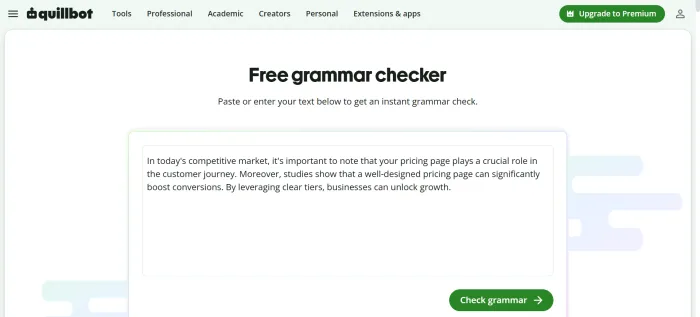
Before · raw draft In today's competitive market, it's important to note that your pricing page plays a crucial role in the customer journey. Moreover, studies show that a well-designed pricing page can significantly boost conversions. By leveraging clear tiers, businesses can unlock growth. |
AFTER · PASS FIVE Your pricing page does the closing. Mine converted at 1.9 percent until I cut it from four tiers to two; the next month it hit 3.4. Clear beats clever here, every single time. |
Edit time: 4 minutes. Word count: 54 down to 31. Sentences a reader might quote back to you: one more than before.
The purge list (start with these 16)
| in today's world | it's important to note | delve into | moreover |
| furthermore | robust | seamless | leverage |
| game-changer | unlock | elevate | landscape |
| navigate the complexities | harness the power | dive deeper | comprehensive guide |
Grow it toward your own list. Mine sits at 21 phrases because two of the worst offenders were habits from my pre-AI writing. The purge is humbling like that.
Cut the editing before it starts
A better prompt doesn't remove the edit, but it shrinks it. These three tweaks took my average draft from rough to workable and saved about six minutes per post:
• Feed it three samples of your published writing and ask it to match the rhythm, not the topics. Rhythm transfers surprisingly well; opinions don't.
• Paste your purge list straight into the prompt as banned phrases. My drafts arrived with roughly half the usual flags once I did.
• Ask for no introduction and no conclusion. You're rewriting both in pass two anyway, so skip the part you'll delete.
What prompting never fixed, in eight weeks of trying: pass five. The model can imitate your cadence, but it has never seen your dashboard, met your clients, or made your mistakes. That part stays yours.
Where a tool earns its slot
I tested tools the same way I tested drafts: with a timer. The honest result is that no tool can run passes two and five, because those need your memory. The mechanical passes are a different story, and the time difference is not small.

The mechanical passes are the only ones worth handing to software.
| Editing task | By hand | With Writenexa |
|---|---|---|
| Phrase purge (pass 3) | 15 min | 4 min |
| Rhythm check (pass 4 prep) | 10 min | 3 min |
| Consistency read | 12 min | 5 min |
| Total mechanical time | 37 min | 12 min |
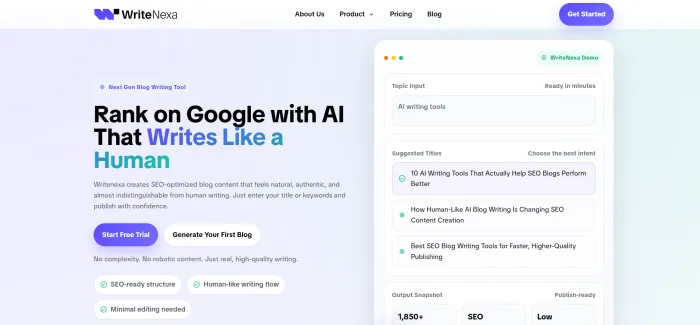
I settled on Writenexa for three specific reasons: it scans against my custom 21-phrase list instead of a generic dictionary, its sentence-length report shows the rhythm spread per paragraph at a glance, and its tone check compares the edited draft against samples of my published writing and flags the sections that drift.
| What it can't do: know your stories. If you already keep a purge list and genuinely enjoy Ctrl+F, you can run this entire workflow with zero tools. It works either way; the tool just hands you back roughly 25 minutes per draft. |
Eight weeks of numbers
The method, so you can judge it: I alternated two kinds of posts on the same blog for eight weeks. “Light edit” posts got a typo pass and nothing else. “Full workflow” posts got all six passes. Same topic mix, similar lengths, two posts a week, everything logged in one spreadsheet.
| Metric | Light edit | Full workflow |
|---|---|---|
| Average time on page | 1:46 | 2:27 |
| Replies per post | 0.4 | 1.3 |
| Shares per post | 2 | 5 |
| Editing time per 1,000 words | 6 min | 24 min |
The replies column is the one I care about. People answer posts that sound like a person and skim the ones that don't. Out of curiosity I also ran both sets through two AI detectors: the full-workflow posts scored “likely human” more often, but my readers noticed the difference days before any detector did. Readers are the ones who subscribe.
One more number worth having: my full edit fell from 41 minutes per 1,000 words in week one to 24 by week eight. The passes turn into reflexes faster than you'd expect.

Four ways this goes wrong
01 Polishing before reading You spend ten careful minutes on a section, then realize in pass one that it never belonged in the piece at all. Read the whole thing first. Always. | 02 Keeping the AI's structure The draft's outline is a suggestion, not a contract. If your gut says the story starts in section three, move section three to the top and see. |
03 Faking humanity Sprinkling in typos, forced slang, or jokes you'd never make reads worse than the raw draft. The goal is your voice, not “a” voice. | 04 Editing for detectors Detectors disagree with each other weekly. Edit for the person who replies to your emails, and the scores mostly sort themselves out. |
Final verdictAfter 40 drafts, the six-pass workflow stays. It turned editing from a vague “rewrite everything” dread into a 25-minute checklist, and it was the only variable I changed during a stretch where replies per post tripled.
Workflow: 9/10 as tested · Writenexa in the loop: 8.5/10, cut mechanical time by two-thirds |