The moment you realize AI art isn’t magic, it’s math
There is a very specific kind of confidence that comes from watching viral AI art online. You see flawless anime characters, cinematic lighting, perfect compositions, and you assume the hardest part must be typing the prompt.
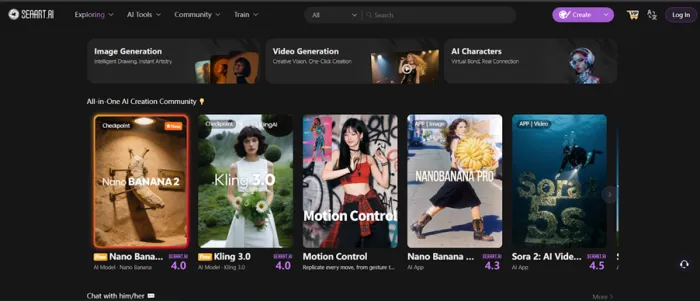
That illusion lasts until the platform politely informs you that you cannot generate anything because your stamina is gone.
At that moment, AI art stops feeling like creativity and starts feeling like budgeting.
SeaArt AI lives exactly in that gap. It looks like a creative playground, but once you start testing it seriously, it becomes clear that the real challenge is not generating images. It is managing constraints.
This article is not about what SeaArt promises. It is about what actually happens when you try to recreate viral AI art with it.
Getting into SeaArt AI is not as smooth as expected
Before generating anything, the first friction appears during onboarding.
Email registration did not work at all. Even though the option existed, the system did not support it in practice. Login was possible through Google, Discord, Facebook, phone number, and email, but email signup remained non-functional.
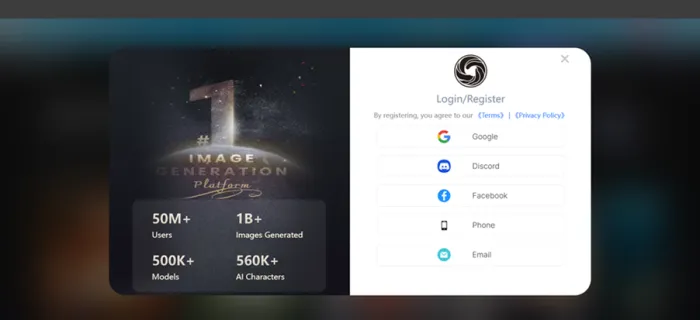
Trying the phone option revealed another limitation. The country code was locked to +86 and could not be changed, suggesting region-specific constraints.

This does not break the experience entirely, but it does make the platform feel uneven in accessibility.
The credit system quietly controls your creativity
Once inside, the real limitation becomes obvious.
SeaArt runs on a stamina and credit system. On paper, this sounds like a fair usage model. In practice, it dictates how much you can actually experiment.
From testing:
- Total credits received: 130
- Average cost per image: ~20 credits
- Some generations required: up to 240 credits
This creates an immediate problem. You cannot even attempt certain outputs on the free tier.
What this means in practice
- You cannot iterate freely, which is essential for AI art
- You are forced to think about cost instead of experimentation
- Higher-quality outputs often sit behind credit limits
SeaArt AI pricing
The pricing structure explains why the free experience feels restricted.
| Plan | Price (USD/month) | Monthly Stamina | Daily Stamina | Practical Use |
| Beginner | ~$6.50 | 9,000 | 300 | Light testing |
| Standard | ~$24 | 54,000 | 1,800 | Regular usage |
| Professional | ~$42 | 120,000 | 4,000 | Heavy workflows |
| Master | ~$85 | 360,000 | 12,000 | Production scale |
The platform becomes significantly more usable once you move beyond the free tier. Until then, experimentation feels limited.
The prompt was strong. The outputs were unpredictable
A detailed prompt was used to simulate viral-level output. It included character design, cinematic lighting, composition, and styling.
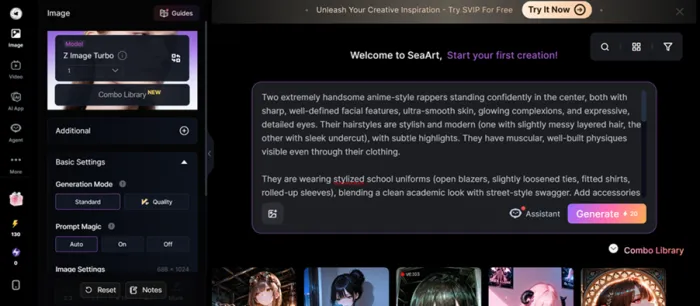
“Two extremely handsome anime-style rappers standing confidently in the center, both with sharp, well-defined facial features, ultra-smooth skin, glowing complexions, and expressive, detailed eyes. Their hairstyles are stylish and modern (one with slightly messy layered hair, the other with sleek undercut), with subtle highlights. They have muscular, well-built physiques visible even through their clothing.
They are wearing stylized school uniforms (open blazers, slightly loosened ties, fitted shirts, rolled-up sleeves), blending a clean academic look with street-style swagger. Add accessories like chains, rings, and headphones to give a rapper vibe.
Behind them, 4–5 gang members posing in a supportive formation, each with unique anime faces and personalities (serious, smirking, confident), also wearing variations of school uniforms mixed with urban fashion (hoodies under blazers, caps, sneakers).
The scene should feel like a powerful group introduction, with cinematic composition, low-angle perspective to enhance dominance.
Lighting: dramatic, soft glow with neon accents (purple/blue tones), subtle rim lighting highlighting their silhouettes.
Background: urban school courtyard or rooftop with graffiti elements, slightly blurred for depth of field.
Style: high-detail anime illustration, ultra-clean linework, smooth shading, semi-realistic rendering, 4K resolution, highly polished, vibrant colors, sharp focus on faces and expressions.
Mood: confident, cool, stylish, dominant, “top of the game” energy.”
The expectation was consistency. The reality was variation.
Each batch generated four images, but they did not follow a single visual direction. One image leaned clearly into anime styling, while the others shifted toward semi-realistic outputs.
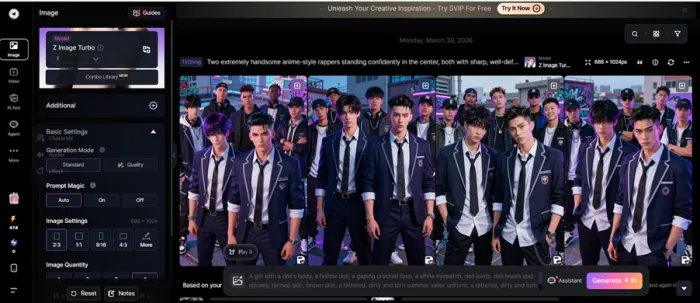
Detail quality was strong, but style consistency was not.
Another pattern emerged. Most characters had similar facial structures with Asian features, even though the prompt did not specify this. This indicates model bias or dataset influence.
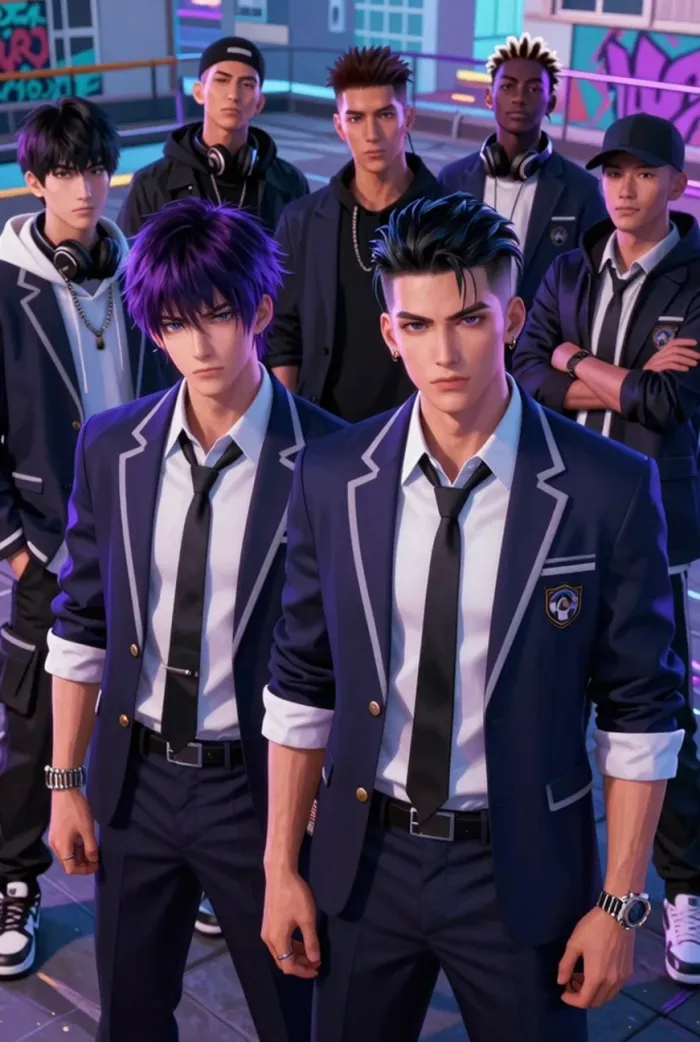
Output behavior breakdown
| Factor | Observed Result |
| Detail quality | High |
| Style consistency | Medium |
| Prompt accuracy | Medium-high |
| Facial diversity | Low |
| Creative control | Limited |
Why copying viral prompts doesn’t work
One of the biggest misconceptions is that prompts are formulas that guarantee results.
In reality, SeaArt interprets prompts rather than executing them precisely. The output depends on the model, its training data, and internal biases.
The same prompt can produce different results every time.
This is why copying viral prompts rarely recreates viral images.
The real limitation is not quality. It is iteration
The most important realization during testing was not about output quality. It was about the ability to iterate.
AI art improves through repetition. You refine prompts, adjust structure, and test variations.
But here, iteration is tied directly to credits.
When each generation consumes a noticeable portion of your daily allowance, experimentation slows down. That creates a ceiling on improvement.
What actually blocks progress
- Limited credits reduce experimentation
- High-cost generations prevent deeper refinement
- Style consistency becomes difficult to achieve
Character chat is smooth but not fully user-driven
SeaArt also includes a character chat feature that stands out.
The interaction is smooth, and the addition of voice gives it a more immersive feel. However, the storytelling feels pre-built.
Instead of building a story from scratch, it feels like the narrative already exists and the user is stepping into it midway. This makes it engaging, but limits creative control.
Scorecard: how SeaArt performs in real usage
| Category | Score | Insight |
| Ease of use | 7/10 | Simple but inconsistent onboarding |
| Output quality | 8/10 | Strong detail, especially in anime |
| Prompt control | 6/10 | Interpretation over precision |
| Consistency | 5/10 | Output varies significantly |
| Pricing efficiency | 6/10 | Limited free usability |
| Innovation | 8/10 | Unique feature mix |
| Overall | 6.8/10 | Capable but constrained |
What worked vs what didn’t
The results clearly showed where SeaArt performs well and where it struggles.
- Anime-style outputs are consistently strong
- Detailed prompts improve quality but not consistency
- Credit limits restrict real experimentation
- Model bias affects output diversity
- High-cost generations reduce workflow flexibility
Final takeaway: viral AI art is curated, not generated
The biggest misconception about AI art is that great results come from a single prompt.
They do not.
What goes viral is usually one strong image selected from many attempts. The process behind it involves iteration, selection, and refinement.
SeaArt AI can produce impressive results, especially in stylized categories. But it does not replace the need for experimentation.
If anything, it makes that process more visible.