SHORT ANSWER No for proofreading. Yes for AI rewrites. No, using Grammarly as a proofreader (spelling, grammar, punctuation, and light clarity edits) does not get you flagged as AI in Turnitin. Turnitin states this directly, and it held up every single time I tested it. Yes, Grammarly's generative features (the rewrite, rephrase, and “improve it” tools, once branded GrammarlyGO) can push your text into AI-flag territory, because they produce the smooth, predictable writing Turnitin's detector is built to catch. The tool you open is not the problem. The button you press inside it is. |
THE DETECTION-RISK SPECTRUM
Spelling & grammar fixes LOW RISK | Heavy tone rewrites MEDIUM RISK | Full AI paragraph rewrite HIGH RISK |
The one distinction that decides everything
Almost every horror story about Grammarly and Turnitin comes from blurring two very different things. Separate them, and the whole topic gets simple.
| Proofreading mode (Low risk) | Generative mode (High risk) |
|---|---|
What it is: the red and blue underlines, spelling and punctuation fixes, small word swaps, light clarity tweaks. What Turnitin sees: your own voice, lightly corrected. Your sentence structure, rhythm, and word choices are still yours, so the statistical fingerprint stays human. | What it is: “Rewrite this,” “Rephrase,” “Improve it,” full tone rewrites, and anything that hands whole sentences back to you rebuilt. What Turnitin sees: text produced by a language model, because that is literally what produced it. The rhythm flattens and the wording turns predictable. |
Grammarly feature versus Turnitin risk
| Grammarly feature | Risk | In plain terms |
|---|---|---|
| Spelling and grammar corrections | LOW | Safe to use freely |
| Punctuation fixes | LOW | Barely registers |
| Single word-choice suggestions | LOW | Leaves your fingerprint intact |
| Small clarity and conciseness tweaks | MED | Fine in moderation; keep your own phrasing where it works |
| Tone adjustments | MED | A light touch is okay; full rewrites read as machine-smoothed |
| “Rephrase” or “Rewrite” a sentence | HIGH | Rebuilds structure; a common flag source |
| “Improve it” on a whole paragraph | HIGH | Produces uniform, low-variation prose |
| Generate text or a draft from a prompt | HIGH | This is AI writing, plainly |
How Turnitin's AI detector actually decides
Turnitin does not scan for the word “Grammarly,” and it keeps no list of banned apps. It reads the text itself and asks one question: does this look like a person wrote it, or a model? Two signals do most of the work.

Perplexity
How predictable your word choices are. Language models are built to pick the most likely next word, so their writing turns unusually smooth and expected. Human drafts are messier: we reach for odd phrasings and change our minds mid-sentence. Very low perplexity looks like AI.
Burstiness
The variation in your sentence lengths and shapes. People naturally mix a long, winding sentence with a short, punchy one. Models keep an even, steady rhythm. Flatten that variation and the text starts to look machine-made, which is exactly why heavy Grammarly rewrites raise scores: they quietly sand it down.
THE ASTERISK VERSUS THE PERCENTAGE Turnitin scores your document in segments, then rolls them up. If the AI likelihood lands between 1 and 19 percent, it shows an asterisk instead of a number, because that low band produces too many false positives to trust. At 20 percent and above, you get an actual percentage with the specific sentences highlighted. So a lone asterisk is not an accusation. It is a shrug. |
How the detector has evolved
| 01 | AIW model (2023) | The first AI writing detector, trained mainly on GPT-3.5 output. |
| 02 | AIW-2 (Dec 2023) | Retrained on newer models, including GPT-4, Claude, and Gemini. |
| 03 | AIR-1 (Jul 2024) | Added detection aimed at AI text that has been paraphrased to dodge checks. |
| 04 | Bypasser coverage (2025) | Expanded to catch popular “humanizer” and paraphraser patterns. |
Every update sharpened the detector's eye for reworded and machine-smoothed text, which is the exact category heavy Grammarly rewrites can fall into.
Quick clarification: the AI score is not the plagiarism score
A lot of the panic mixes up two separate Turnitin reports. They measure different things, and Grammarly touches them differently.
| Similarity report | AI writing report |
|---|---|
| What it checks: how much of your text matches existing sources, journals, and web pages. | What it checks: how much of your text reads as machine-generated, using the perplexity and burstiness signals above. |
| What Grammarly does to it: proofreading changes nothing here, since fixing a comma does not copy anyone. Even a rephrase rarely shifts it much on its own. | What Grammarly does to it: this is the report that matters for our question. Generative rewrites can raise it; plain proofreading does not. |
A clean similarity score and a high AI score can sit right next to each other, and the reverse happens too. Find out which one your instructor actually flagged before you lose any sleep over it.
What testing and research actually found
I am not the only one who has poked at this. Here is where my results at the desk line up with the published research.
| Figure | What it shows | Source |
|---|---|---|
| Under 1% | Turnitin's stated false positive rate for its AI detector, the number it designs around. | Turnitin |
| 16% | AI score a peer-reviewed study got from a human-written abstract after a single Grammarly pass. | Int. Journal of Ed. Tech. in Higher Ed, 2025 |
| About 55% | AI score independent testers recorded for text produced by Grammarly's generative feature. | Independent detector test, 2026 |
| 0 to 100% | The range one study saw for AI text rewritten through Grammarly Premium, run across detectors. | Peer-reviewed study, SAGE |
WHAT THIS TOLD ME The numbers match what I saw. Proofreading barely moved my scores. The moment I let the rewrite feature rebuild a paragraph, the figure jumped. The false positive risk is real but small, and it climbs for non-native English writers, whose simpler, steadier sentence patterns can read as low variation to the detector through no fault of their own. |
Grammarly Authorship: your receipt
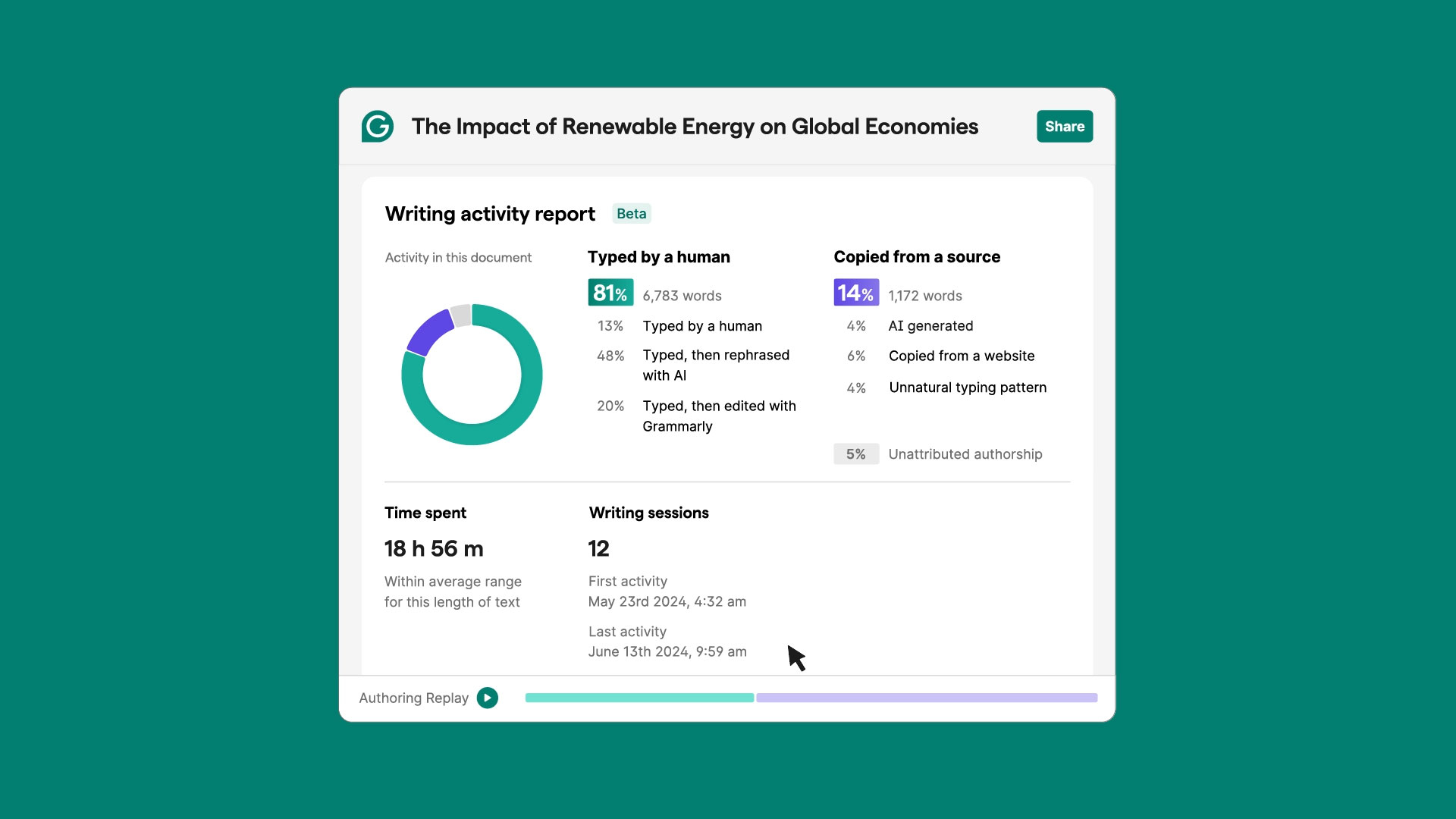
In 2024, Grammarly added a feature that changes this conversation, called Authorship. Instead of guessing after the fact, it records how a document gets written in real time. I turned it on for a week, and it quietly logged everything.
| Typed by human | The words you actually keyed in yourself. |
| AI-generated | Text created by a generative tool. |
| AI-revised | Your words, then reshaped by Grammarly's generative features. |
| From a source | Text pasted from a website or another app. |
It produces a shareable report, plus a replay of your writing session, that you can hand an instructor as proof of process. Basic tracking is free in Google Docs and Microsoft Word, and paid plans add AI and plagiarism checks along with source attribution.
THE HONEST CAVEAT Authorship is not magic. It only sees what happens inside Grammarly's editor. Write in a different app and paste it in cold, or type on a second device, and it has nothing to log. Grammarly itself notes it will not catch every case, for example when keystrokes come in too fast or text arrives from a brand new AI tool it has not categorized yet. |
Grammarly Authorship versus Turnitin AI detection
| Grammarly Authorship | Turnitin AI detection | |
|---|---|---|
| What it does | Records your writing process | Analyzes the finished text |
| When it runs | While you type, live | After you submit |
| What it produces | A source-by-source report and replay | An AI likelihood score with highlights |
| Who it is for | The writer, to show their work | The instructor, to screen work |
| Can it clear you | Yes, as supporting evidence | It is the thing you may need clearing from |
The two do not talk to each other. Turnitin scores your final text no matter what Authorship says. Authorship is the evidence you bring if that score is ever questioned.
How I keep my writing clear of trouble
None of this means writing with Grammarly switched off out of fear. It means using it like a proofreader, not a ghostwriter. This is the routine I settled on.
Do this
• Use it freely for spelling, grammar, and punctuation.
• Read every clarity suggestion and keep your own wording when it still works.
• Write your first draft yourself, then edit. Do not start from a generated draft.
• Save your drafts, outlines, and notes so you can show your process.
• Turn on Authorship if your instructor cares about proof.
• If your school allows it, run a draft through Turnitin's own check before the deadline.
Avoid this
• Clicking “Rephrase” or “Rewrite” on whole sentences and accepting them blindly.
• Running a paragraph through “Improve it” to make it sound smarter.
• Pasting ChatGPT output into Grammarly and hoping a rewrite hides it. The detector is trained on that move.
• Treating a low asterisk score as an emergency.
• Assuming your syllabus allows AI editing. Check it, or ask first.
Myths versus facts
| Myth | Fact |
|---|---|
| Turnitin detects Grammarly by name. | It reads writing patterns, not software labels. It cannot tell which tool touched your text. |
| Any Grammarly use gets you flagged. | Core proofreading does not. Turnitin states its detector is not tuned to flag Grammarly's spelling and grammar fixes. |
| A high AI score is proof of cheating. | It is a probability estimate and a starting point for a conversation, not a verdict. False positives happen. |
| Paraphrasing AI text through Grammarly makes it safe. | Turnitin added detection aimed squarely at paraphrased and humanized AI writing. |
The Final VerdictGrammarly the proofreader and Grammarly the ghostwriter share a login, nothing more. If you take one thing from all of this, take that. I ran plain, honestly written paragraphs through the spelling and grammar tools over and over, and Turnitin kept reading them as mine, because they were. The only time the score climbed was when I stopped writing and let the rewrite feature do the work for me. That is the honest line in the sand. Use Grammarly to catch your typos, tighten a clumsy sentence, and check your commas, and you have nothing to fear from Turnitin. Hand it your paragraphs to rebuild, and you are no longer submitting your own writing, which is the actual thing every AI policy exists to protect. Keep your drafts, keep your voice, and if your instructor is strict, switch on Authorship and let the receipts speak for you. |