67% True-positive rate (500-subject test) | $6+ Credit-based, crypto only | ~18s Average search time | 3.3-4.4 Across review platforms |
FaceCheck.ID does one thing, and it does that one thing better than Google: hand it a face, and it tells you where that face turns up across the public web. Not a name. Not a username. A face.

That single capability has made it a quiet fixture in online-dating safety threads, recruiter due-diligence routines, and open-source intelligence circles. It has also made it controversial, because a tool that can locate someone from a single photo cuts in both directions.
So we spent real time with it, cross-checked every public dataset we could find, and read the verified reviews scattered across G2, Trustpilot, Software Finder, and Reddit. What follows is what holds up, what does not, and the numbers behind both.
What it actually is
Most reverse image tools, Google Images and TinEye among them, hunt for copies of the exact picture you feed them. Crop it, recolor it, screenshot it, and the trail usually goes cold.
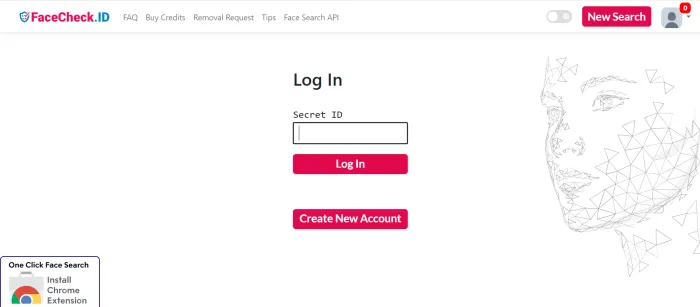
FaceCheck works on a different principle. It detects the face, converts its geometry into a numeric signature (the field calls this a face embedding), then compares that signature against faces pulled from billions of indexed images. The original file barely matters. A scammer can lift a model's photo, crop it tight, drop a filter over it, and post it to a dating profile, and face-based matching can still join the dots that pixel-matching never could.
A few things are worth knowing before you open your wallet:
•It launched in 2022 and indexes social profiles, blogs, news, video stills, and, unusually, mugshot and sex-offender registries that mainstream engines deliberately steer clear of.
•No app, no account. You can search anonymously straight from a browser, and the company also sells a developer API for building face search into other software.
•Every hit gets a match score from 0 to 100, where a flat 100 means it found the identical photo, not merely a face that looks alike.
Under the hood, a single search moves through four stages: detect the face inside your image, encode its landmarks into an embedding, match that signature against the index, then rank the hits with source links and a confidence score.
In day-to-day use, the same engine gets aimed at a handful of recurring jobs:
•Catfish and romance-scam checks, confirming whether a dating match's photos belong to a real account or a lifted stock image.
•Pre-meeting due diligence, where recruiters, journalists, and investigators sanity-check that a person is who their profile claims.
•Stolen-photo and impersonation hunts, finding where your own face, or a client's, has been reposted without consent.
•OSINT lead generation, surfacing a first thread that then gets cross-referenced against other public clues.
What it costs
Pricing is where FaceCheck shows the most personality, for better and worse. There is no monthly plan. You buy credits, each search spends three of them, and packages expire on a timer.
| Plan | Price (USD) | What you get |
|---|---|---|
| Free | $0 | A handful of searches with blurred previews and hidden source links |
| Just a Peek | $6 | 36 credits (about 12 searches), the low-stakes way to test it |
| Rookie Sleuth | $19 | More credits, same per-search unlock of full results |
| Private Eye | $47 | Adds priority queue and export options |
| Deep Investigator | $197 | Recurring searches, Telegram alerts, PDF and Excel reports |
| Professional | $597 | The heaviest tier, aimed at frequent investigative use |
Two things tend to ambush newcomers. First, the cheapest credits can expire in as little as two days, so the instinct to buy a small pack and dip in whenever does not really pay off. Second, since late 2024 the checkout takes cryptocurrency and nothing else: Bitcoin, Litecoin, and a few others, with no card option at all.
The crypto wall is the catch. FaceCheck has never fully explained the switch, though sidestepping payment-processor restrictions on facial-recognition services is the likely reason. For anyone who does not already hold crypto it is a genuine barrier, and the single most common gripe across user reviews.
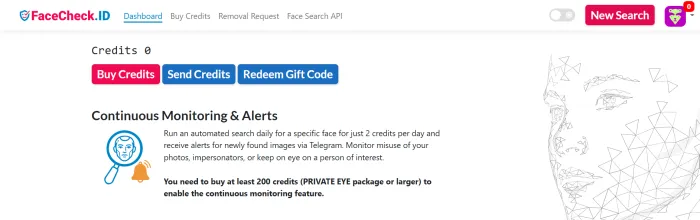
For most people the math is simple. If you are checking one or two profiles, the $6 pack covers it with credits to spare, and the higher tiers only earn their price once you are running searches weekly or need the alerts and exports. Because credits lapse, buying a big pack just in case is usually wasted money rather than a saving.
The free tier does exist, but it serves blurred previews with confidence scores and locks the source links until you pay. It confirms that matches are out there. It is not enough to act on them.
The testing section
Most write-ups wave their hands here. We did two things instead. We ran a live search ourselves, then weighed that experience against the most thorough independent benchmark available.
HANDS-ON: ONE SEARCH, START TO FINISH
For a first pass we picked a deliberately easy subject: a clean, front-facing publicity photo of Kendrick Lamar, a person carrying one of the largest online footprints alive. The flow was short but not frictionless. Upload the image, accept the terms and conditions, then clear a quick are-you-human check before a single result loads.
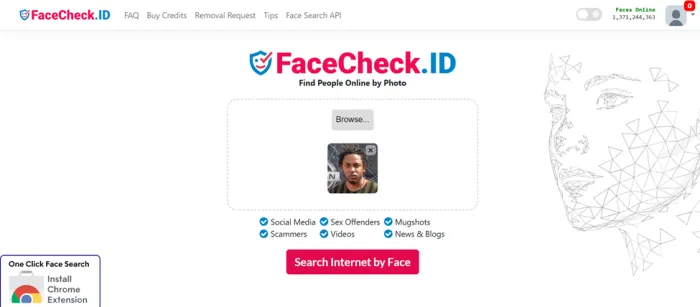
Our free-tier run: a flat 100 “Certain Match” on a high-presence subject. Source icons show, red flags stay paywalled, account credits read zero.
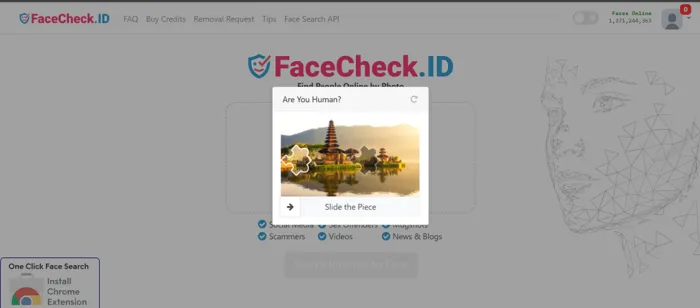
The result was about as strong as the system gets. The top hit came back at a flat 100, the Certain Match band reserved for an exact-photo match, sitting next to a 99x badge that marks the same face turning up across dozens of pages. Source icons pointed at SoundCloud, IMDb, and general web results, the precise trail you would expect for a working musician and actor.
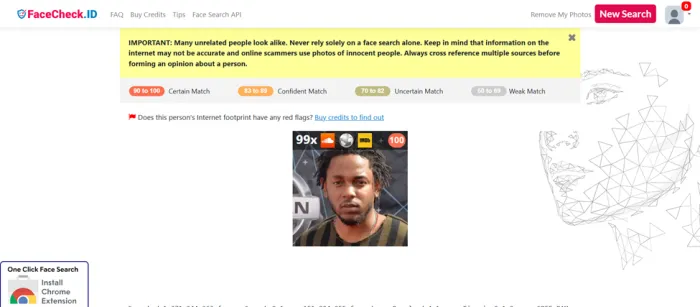
Two details stood out, and both line up with the wider findings:
•The free tier shows the shape of the answer, not the answer. We could see that matches existed and how confident the engine was, but the red-flag check and the real source links sat behind a buy-credits wall, with the account reading zero credits.
•A perfect score is the easy case, not the normal one. A globally famous face in a sharp, well-lit shot is the friendliest input there is. It proves the engine works; it tells you little about an ordinary person photographed badly, which is exactly where accuracy gets tested.
What greeted the search before any result did is telling too: a permanent yellow banner warning that many unrelated people look alike and that no face search should be trusted on its own. The tool says the quiet part out loud, and the numbers below explain why it has to.
THE BENCHMARK: 500 VERIFIED SUBJECTS
One clean celebrity hit is reassuring but unrepresentative, so for the real accuracy picture we leaned on a published six-month study that ran 500 verified subjects through the engine. The headline figures:
67% True positive: found a real online presence | 23% False positive: matched the wrong person | 31% False negative: missed a real profile | ~18s Per search, scanning ~1B faces |
Read those together and the picture sharpens. Two times in three, if a person has a genuine online footprint, FaceCheck will surface it. But roughly one match in four points at the wrong human, and it misses an existing profile about 31 percent of the time. This is a strong lead generator, not a verdict machine.
The more revealing data hides inside the confidence labels. FaceCheck sorts every result into Certain, Confident, Uncertain, or Weak. You would assume a Certain badge means certain. The testing says otherwise, and this is the single most important table here.
| Confidence label | Score range | How often it was WRONG |
|---|---|---|
| Certain | 90 - 100 | 8% |
| Confident | 83 - 89 | 15% |
| Uncertain | 70 - 82 | 28% |
| Weak | 50 - 69 | 45% |
False-positive rate by confidence band. Lower is better. Even the top band is not a guarantee.
The takeaway is blunt: even the Certain Match badge is wrong about one time in twelve, which quietly contradicts the reassurance the label is selling. A Weak match, meanwhile, is barely better than a coin flip. Treat anything below Confident as a hint, never as evidence.
Photo quality moves the needle more than any other factor. Clean, front-facing, well-lit portraits scored around 78 percent accuracy in testing. Low light or a sharp side angle dragged that into the high 30s and low 40s. In practice, the input photo is the biggest lever you control, so feed it the best image you have. Speed is not a worry: a typical query resolves in under 20 seconds while the engine combs roughly a billion faces.
The false-negative number deserves its own caution. A clean miss does not mean a person is invisible online, only that the engine failed to connect this particular photo to their existing pages, which is precisely what tripped up one Trustpilot reviewer. A no-results screen is therefore weak proof of anything. The index is also self-reported and constantly shifting, so coverage that feels thorough for one subject can be patchy for the next.
What real users say
Here is something the marketing pages will not volunteer: for a tool this talked-about, its verified-review footprint is thin, and that thinness is itself a signal. We gathered every platform carrying real ratings.
| Platform | Rating | What the reviews actually say |
|---|---|---|
| G2 | 3.7 / 5 | Consistent pattern: praise for ease of use, the privacy-first posture, fast results, and clean API integration, set against complaints about cost and the occasional wrong match. (13 reviews) |
| Software Finder | 4.4 / 5 | The friendliest scores of the bunch, weighted toward four stars, with value-for-money the weakest sub-score. Small sample, so read it as encouraging rather than conclusive. (8 reviews) |
| Trustpilot | 3.3 / 5 | Tiny and polarized. The loudest negative came from someone with a heavy presence across Facebook, LinkedIn, and business sites whose own face returned none of those known pages. (2 reviews) |
| Mixed | Thin and skeptical. The recurring sentiment is that it does not work as well as some people like to think, and hands-on threads stall because the pay-first wall blocks full testing. | |
| Capterra | No listing | Despite being a facial-recognition product, FaceCheck has no dedicated Capterra page; the category there is filled by enterprise KYC vendors. Logical for a crypto-billed consumer tool, but it leaves buyers with far less independent signal. |
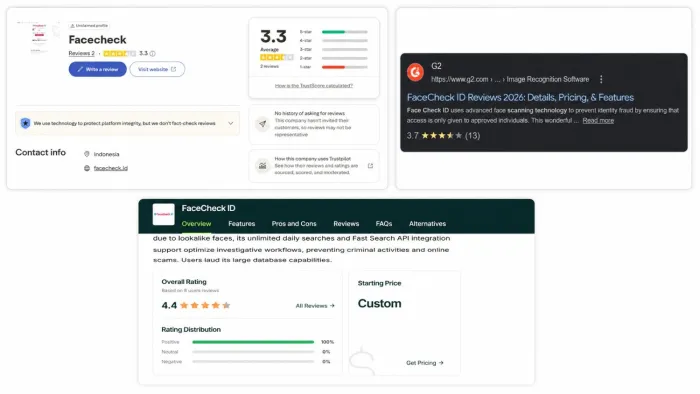
A caveat on the sunny end: several of the higher G2 and Software Finder scores are flagged as incentivized, which tends to inflate averages, so the warmer ratings deserve a pinch of salt. The honest summary still holds. People who use FaceCheck for what it is good at, a quick gut-check on a stranger, tend to walk away satisfied. People who expect a guaranteed, court-ready answer walk away burned.
Privacy and the fine print
FaceCheck's own framing is careful and worth repeating. The company says it stores no names, addresses, or phone numbers, keeps only low-resolution thumbnails and links to public third-party pages, and insists it identifies websites rather than people. It is also explicit that results must never be used to confirm identity for legal or prosecutorial purposes.
The gaps still matter, though. There is an instant photo-removal and opt-out path, which is welcome, yet the very existence of a removal process implies images can persist in the index. The company stays vague about how long uploaded query photos are retained or what happens to them once a search finishes. When the photo you are uploading belongs to someone else, that vagueness stops being academic.
There is a legal layer too. Facial recognition is regulated unevenly around the world, and several jurisdictions treat biometric data as a special category with real penalties for misuse. None of that is FaceCheck's burden to carry on your behalf. The responsibility for how a result gets used sits squarely with the person running the search.
One rule from experienced users: never act on a single match. Plenty of unrelated people look alike, the confidence scores overpromise, and a Reddit or Facebook label only tells you where an image was found, not who the person is. Corroborate across several photos and sources before you believe anything.
How it stacks up
It helps to know where FaceCheck sits among the tools people reach for next.
| vs PimEyes | The closest rival. PimEyes runs on subscriptions, carries more public reviews and a clearer privacy policy, and can work out cheaper for frequent use. FaceCheck wins on anonymous, pay-as-you-go one-offs and on its scammer and registry coverage. |
| vs Google & TinEye | Not really competitors. Google blocks face search and matches visual context, while TinEye tracks where an exact image has been reused. Neither performs biometric face matching. |
| vs Clearview AI | A different universe. Clearview is restricted to law enforcement with a vastly larger database. Ordinary people cannot access it. |
The verdict
Worth it for: vetting a stranger you are about to trust, a dating match, a marketplace seller, a too-good-to-be-true recruiter. At six dollars to confirm whether a profile photo lives elsewhere online, the low-stakes version genuinely earns its keep.
Look elsewhere if: you are making a hiring, legal, or child-safety decision. The 23 percent false-positive rate, the overconfident scoring, the thin third-party track record, and the crypto-only wall add up to a tool that should never be the last word on anyone's identity.
Used as a starting point and not a conclusion, FaceCheck.ID is one of the sharpest face-search engines you can buy. Used as proof, it is a liability. Go in with that distinction fixed firmly in mind.