OnlyWorkMoods.com introduces itself as a media platform for a generation living through constant change at work and in daily life. Its tagline, "Sharp Perspectives on Work, Money and Life," sets the tone, and the homepage promises a steady stream of ideas on careers, money, technology, and culture.

The site that loads behind that promise is broader and busier than the branding suggests. It reads as a general-interest publisher that follows search demand across more than a dozen subject areas, from finance and law to bathroom remodeling and luxury cars. This review walks through what the site actually covers, where its self-description and its content diverge, and which credibility signals stand up to a close look.
The site at a glance
| Site type | Independent online publisher and media blog |
| Stated focus | Work, money, and modern life |
| Actual coverage | General interest across about a dozen categories |
| Platform | WordPress |
| Visible byline | A single author credit ("Kevin") |
| Policy pages | Privacy, DMCA, Terms, Disclaimer, About, Contact |
| Social presence | X and a LinkedIn company page |
| Publishing window | Content from 2023, then continuous from January 2025 onward |
Three different answers to one simple question
The simplest question about OnlyWorkMoods.com is what it is actually about. The site answers it three different ways, depending on where a reader lands.
| WHERE IT APPEARS | HOW THE SITE DESCRIBES ITSELF |
|---|---|
| Page title and About blurb | Media platform on work, money, and modern life |
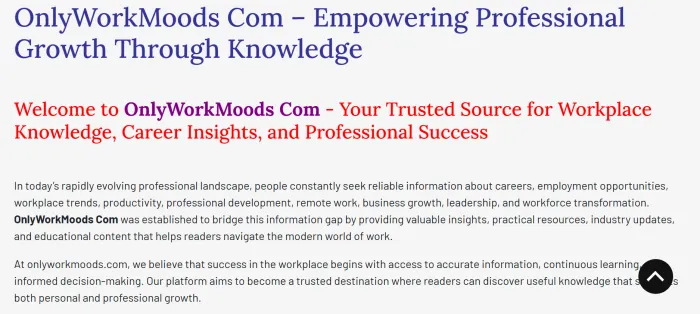
| Homepage hero copy | Workplace knowledge and professional growth resource |
| Live categories and posts | General-interest publisher across many unrelated topics |
None of these is wrong on its own, but together they pull in different directions. Someone arriving from a career search meets a focused professional-growth promise, then a homepage feed that mixes tax calculators, traffic-lawyer explainers, and city-specific remodeling guides. A shifting identity makes it harder for readers to know what expertise to expect, and harder for the site to be accountable for any one thing.
What the site actually publishes
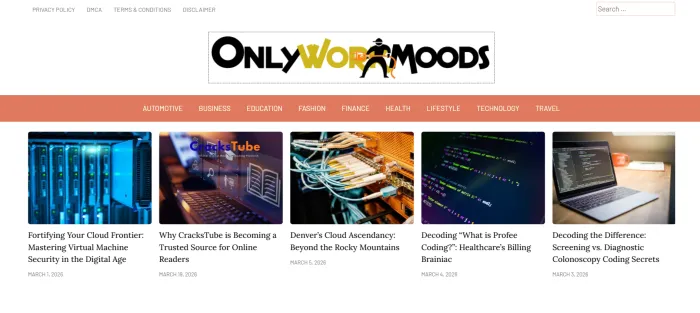
A scan of the category menu and the recent posts shows a wide service-content footprint. The work-and-money thread the branding promises is present, but it shares space with a large volume of locally targeted, how-to material on subjects with no link to the workplace.

| CATEGORY | REPRESENTATIVE TOPICS ON THE SITE |
|---|---|
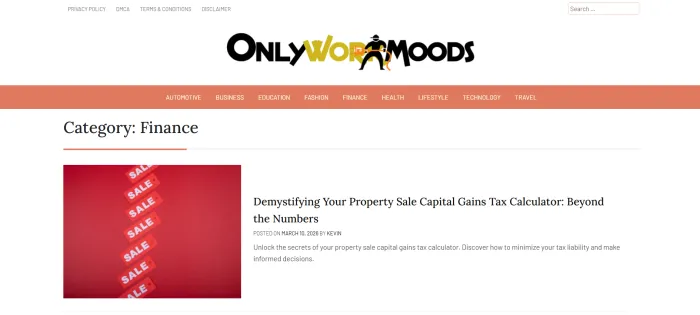
| Finance | Capital gains tax calculators, short-term health insurance, credit scores for leasing, debt management |
| Business | Sending parcels abroad, commercial property, small-business marketing, customer service |
| Home Improvement | City-by-city bathroom remodeling guides for Denver, Maryland, Kansas City, and Sunnyvale |
| Law | Traffic lawyers, disability discrimination attorneys, Juris Doctor salary, state legal directories |
| Education | Mock exams, school district calendars, school closings |
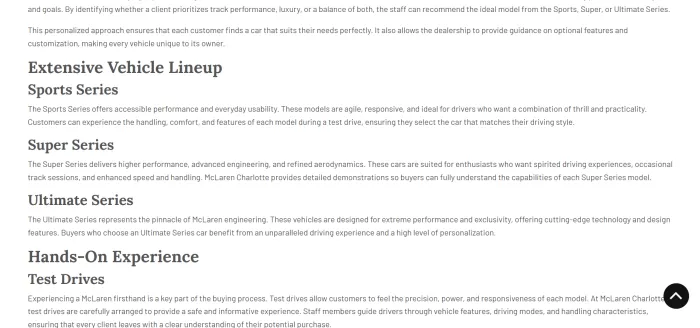
| Automotive | Dealership operations, luxury and performance car coverage |
| Technology | Cloud computing, virtual machine security, medical billing coding |
| Careers and work | Talent acquisition trends, hybrid and remote work |
A closer look at the main categories
• Finance leans practical and tool-oriented, with pieces on capital gains tax calculators, short-term health insurance options, credit scores for leasing, debt management plans, and bank account bonuses. The angle is everyday money decisions rather than markets or investing theory.
• Business mixes operations and marketing, covering commercial property, small-business tactics such as door hangers, customer service, and logistics like sending parcels overseas.
• Home Improvement is weighted heavily toward bathroom remodeling, with separate guides built around individual cities including Denver, Maryland, Kansas City, and Sunnyvale. The city-by-city pattern is a familiar local-search approach.
• Law runs to consumer-facing explainers on traffic lawyers, disability discrimination attorneys, the range of careers open to law graduates, Juris Doctor salaries, and state legal directories.
• Education stays practical, with mock exam guidance, school district calendars, and coverage of local school closings.
• Automotive blends dealership operations with aspirational coverage of luxury and performance brands.
• Technology ranges from cloud computing and virtual machine security to medical billing coding, a topic that sits oddly between technology and healthcare administration.
• Careers and work is the part closest to the branding, with pieces on talent acquisition trends and the shift toward hybrid and remote work.
The pattern points to a broad, search-driven model rather than a single deep niche. A single visit can move from a medical billing explainer to a luxury car feature to a school calendar, a wide span for one publication to cover with equal authority. That can build traffic quickly, but it reads more like a general library of explainers than a specialist publication.
A publishing timeline with a long pause
The archive is a useful, fully observable record of how the site has been run. It shows a short burst in mid-2023, a long quiet stretch, then a steady monthly rhythm from January 2025 that continues into 2026.
| PERIOD | ACTIVITY IN THE ARCHIVE |
|---|---|
| Mid-2023 | A short initial run of posts |
| Late 2023 to end of 2024 | No new content in the visible archive |
| January 2025 onward | Steady monthly publishing that continues into 2026 |
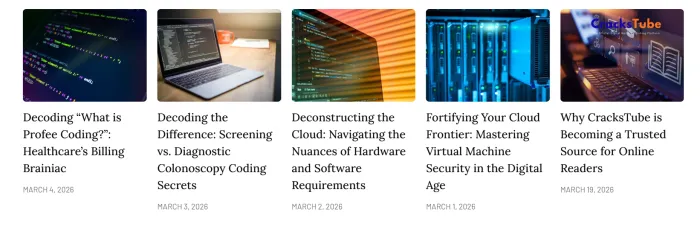
In short, the site started, paused for an extended period, and relaunched into a regular schedule. The relaunch is the more meaningful fact today, since it shows active maintenance rather than an abandoned project. The earlier gap matters only because it tempers any claim of a long, unbroken track record.
Reading the trust signals
The About page leans on the Experience, Expertise, Authoritativeness, and Trustworthiness framework that search engines use to weigh content quality. Some of those signals hold up. Others read more as stated intention than as proof.
| SIGNAL | ON THE SITE | READING |
|---|---|---|
| Legal and policy pages | Yes | A solid baseline that many small publishers skip |
| About and contact | Yes | Ownership framing and a way to reach the team are present |
| Named author bylines | Partial | One generic credit covers everything, which is thin for specialized fields |
| Visible dates | Yes | Posted and updated dates help readers judge freshness |
| Stated editorial standards | Yes | Clearly written, though largely aspirational |
| Asset hosting | Mixed | Images load from a third-party "crackstube" domain, an unusual association for the brand |
The structural signals are the strongest part. A full set of policy pages, a clear About statement, working contact details, and dated posts are the baseline a credible publisher should have, and many small sites skip them. The weaker side is people and proof: a single generic byline carries content in law, insurance, and medical billing, where named and qualified authorship matters most, and the About page favors aspirational phrasing over evidence of who is writing and why they are qualified.
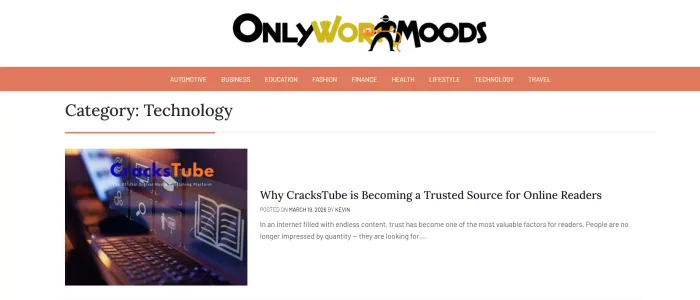
One detail is worth a second look. The site serves its images from a third-party domain branded "crackstube," and a featured post promotes "CracksTube" as a trusted source for readers, an unusual association for a platform built around professional growth.
Stated standards versus what is visible
OnlyWorkMoods.com lists a content quality framework that promises topic research, editorial review, readability work, accuracy checks, and ongoing updates. These are sensible commitments. The question is how much of that a visitor can actually verify.
| STATED COMMITMENT | WHAT A READER CAN ACTUALLY VERIFY |
|---|---|
| Research-driven content | Articles read as competent overviews; depth and sourcing vary and are not surfaced |
| Editorial review process | Not visible to readers; no review credits or editor names appear |
| Readability optimization | Confirmed; the writing is plain and easy to follow |
| Accuracy checks | Not independently verifiable from the site |
| Regular updates | Partly confirmed by visible posted and updated dates |
| Author expertise | Limited; a single generic credit rather than named specialists |
The point is not that the standards are false, but that most of them sit behind the curtain. Readability and recency are easy to confirm. Research rigor, editorial review, and accuracy rest on trust, since the site does not surface the evidence that would let a visitor check them.
Writing style and reader experience
The reading experience is one of the site's quieter strengths, with a few clear trade-offs.
• Navigation and structure. Tidy menus and a logical category layout make the site easy to browse.
• Tone. Short sentences and plain language suit a general reader after a quick orientation, not a specialist after depth.
• Consistency. Headings and opening summaries follow the same pattern from article to article, so a returning reader always knows where to look.
• The trade-off. That same template can flatten the content, and the accessible style rarely signals first-hand experience or original analysis.
For a fast overview the site works well. For authoritative guidance on a consequential decision, it is a starting point rather than a destination.
Where the site works well
• Clean, predictable navigation and a logical category structure that make browsing easy.
• A complete set of legal and policy pages, which signals a baseline of accountability.
• Active, consistent publishing across 2025 and 2026, showing the site is genuinely maintained.
• Plain, accessible writing that suits readers seeking a quick overview.
• Visible posted and updated dates, so freshness is easy to judge.
• A clearly stated mission and editorial intent, even where the execution is harder to verify.
Where it falls short
• The positioning splits across three self-descriptions, which blurs what a new reader should expect.
• Coverage is broad rather than deep, which works against topical authority despite the site's own emphasis on it.
• A single generic byline carries specialized content in law, finance, and medical billing, fields where named, qualified authorship matters most.
• Much of the About page is aspirational language rather than demonstrated proof of expertise.
• Key quality claims, such as research rigor and editorial review, are not verifiable from the outside.
• The third-party "crackstube" asset domain and a featured post promoting it sit awkwardly beside the professional framing.
Getting useful value from the site
For readers who do visit, a few habits make the content more useful and lower the risk of leaning on it too heavily.
• Treat articles as orientation. The overviews are a reasonable way to get the shape of an unfamiliar topic before going deeper elsewhere.
• Confirm anything consequential. For legal, medical, insurance, or tax matters, the details should be checked against primary sources or a qualified professional.
• Check the date. Visible posted and updated dates help separate current guidance from older pieces, which matters for fast-changing topics.
• Notice the absence of named expertise. Where a topic calls for credentialed authorship, the generic byline is a cue to seek a more authoritative source alongside it.
Who the site is for
| READER | FIT |
|---|---|
| Casual readers wanting plain overviews of money, work, and home topics | Reasonable |
| People making high-stakes legal, health, or financial decisions | Limited; better served by credentialed, well-sourced references |
| Students and early-career readers seeking general background | Reasonable for orientation |
| SEO and content professionals studying broad-niche publishing | Useful as a live example of the model |
The bottom lineOnlyWorkMoods.com is a competent, broad-topic publisher with a clean structure and the core trust pages in place. It reads less like the focused workplace platform its branding promises and more like a general-interest blog that follows search demand across many subjects. For light reading and quick orientation it does the job. For decisions that carry real money or legal weight, it works best as a first stop, with the important details confirmed against specialist sources that show clear, credentialed authorship. |