A landmark Pew Research Center study has become one of the clearest pieces of evidence behind the growing concern that Google’s AI summaries are reducing clicks to the open web.
The study, published on July 22, 2025, is still being widely discussed in 2026 because it provides hard data on how users behave when AI summaries appear in search results. It was based on browsing activity collected in March 2025 from 900 U.S. adults who agreed to share their web behavior with researchers.
The central finding is simple but important: when Google showed an AI summary, users were less likely to click traditional search results and far less likely to click links inside the summary itself.
Clicks Drop Sharply
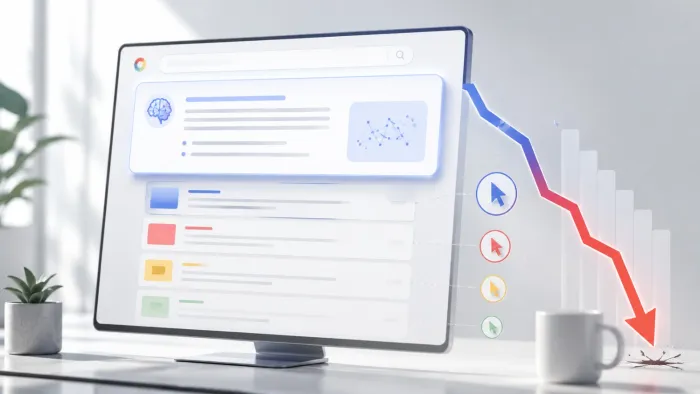
According to the study, users clicked a traditional search result in only 8% of searches that included an AI summary. On pages without an AI summary, the click rate was 15%.
That means the presence of an AI summary was linked to a major drop in clicks to standard search results. The effect was even stronger for the links cited inside the AI summary. Users clicked a link within the AI-generated answer in just 1% of all visits.
The study also found that users were more likely to end their browsing session after seeing a search page with an AI summary. Around 26% of visits with a summary ended without further browsing, compared with 16% of visits without one.
That pattern supports the concern many publishers have raised: AI summaries may satisfy the user directly on Google, reducing the need to visit the source website.
How the Study Was Built
The findings were based on 68,879 unique Google searches from participants in Pew’s KnowledgePanel Digital. More than half of the people in the sample, 58%, made at least one Google search in March 2025 that triggered an AI summary.
Across all searches in the study, about 18% generated an AI summary. That makes the research useful because it was not based on a small set of isolated examples. It looked at real user behavior across a broad pool of searches.
The study also found that AI summaries were more likely to appear for longer and more conversational searches. Only 8% of one- or two-word searches triggered an AI summary, while 53% of searches with ten or more words did. Question-based searches, especially “who,” “what,” and “why” queries, were also much more likely to generate summaries.
That detail matters because users are increasingly searching in longer, more natural-language formats, especially as AI search becomes more familiar.
Which Sources Get Cited
The study found that AI summaries usually cited multiple sources. Most summaries included more than three links, while very few cited only one source.
The most commonly cited sites included large information platforms, video platforms, forums, government sources, and news publishers. Government websites appeared more often in AI summaries than they did in standard results, while news sites appeared at similar levels across both formats.
For publishers, this creates a new visibility problem. Ranking on page one may no longer be enough. A site may need to be selected as a cited source inside the AI summary to gain visibility, but even then, the click-through rate may remain extremely low.
Why It Matters Now
Although the study was published in 2025, its findings have become more relevant as AI Overviews and AI Mode continue to expand. Google’s search results are moving from a list of links toward answer-based experiences, where users can receive summarized information without leaving the page.
For websites that depend on organic traffic, this changes the meaning of search visibility. A page can rank well, appear near the top, or even be cited in an AI-generated answer, but still receive fewer visits than before.
This is the core of the zero-click concern. Google may still show sources, but if the answer is complete enough, many users may not feel any need to click.
The New Content Challenge
The takeaway for publishers, bloggers, and SEO teams is not to abandon search. It is to understand that generic informational content is becoming easier for AI to replace.
To earn clicks in this environment, content needs to offer something the AI summary cannot fully satisfy. That may include original research, first-hand testing, interactive tools, expert analysis, strong visuals, comparisons, case studies, or updated reporting that goes beyond a quick answer.
The study shows that being visible in Google is no longer the same as earning traffic from Google. In the AI search era, publishers need two goals at once: become a trusted source that AI systems cite, and create enough original value that users still have a reason to visit the page.