Quick take
If you only read one box, read this one.
My rating 3.2 / 5 Promising, with real caveats | Best for Casual copy A quick first-pass polish on everyday text | Watch out for The limits 200-word cap, two free runs, expiring credits | My test result Half a win ZeroGPT fell to 33.8%, QuillBot held at 100% |
I did not come to Rephrasy as a fan or a skeptic. I came the way most people do: with a deadline, and a paragraph in front of me that very obviously sounded like a machine wrote it, because one had. That felt like the fair way to test a tool built for exactly this moment.
I have tried enough of these humanizers to know the script by heart. The landing page promises one click between your text and something no detector can catch. The reality is usually messier, and the only honest way to find out where a given tool lands is to stop reading its marketing and start feeding it real writing. So I signed in, ran one clean and measurable test on the free tier, and then checked the output somewhere the tool had no say in the verdict.
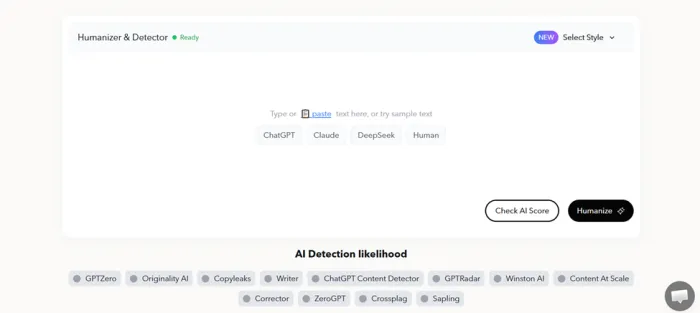
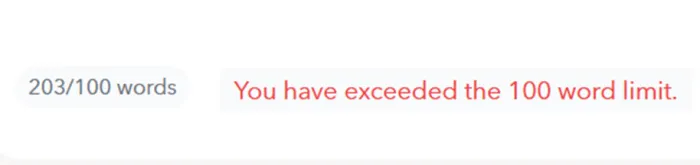
How much did I get to use it? Barely, and that turned out to be a finding on its own. The free tier caps you at 200 words per run and hands you two humanize attempts before it asks for a card. I spent one on the test, reached for the second, and hit a wall. Everything below came out of that small window, numbers included.
Short version, before we dig in: in a single test the tool did something real and also failed flatly. That is not a contradiction. That, it turns out, is just Rephrasy.
So what is Rephrasy AI?
Strip away the marketing and Rephrasy is two tools wearing one coat. It is an AI humanizer with an AI detector bolted onto the side. You paste in text that a model wrote (ChatGPT, Claude, Gemini, and the rest), and it rewrites that text so it reads less like a machine and, in theory, slips past the software that hunts for AI writing. It will also score any text for you on the spot, and on paid plans it runs a plagiarism check too.
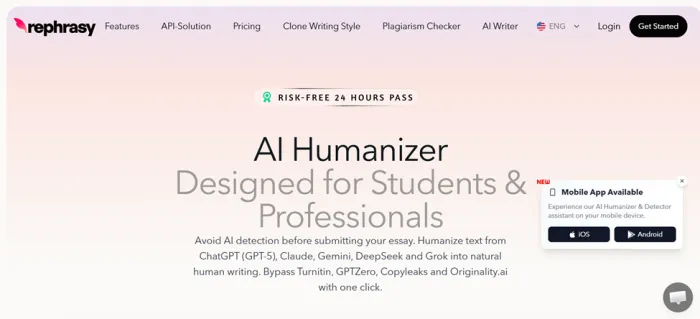
That basic pitch is identical to a dozen rival tools. Where Rephrasy tries to stand apart is a handful of features it leans on hard:
• Writing-style cloning. Its headline claim is that it can learn your voice from samples and rewrite in it, rather than flattening everything into one generic tone.
• Four rewrite models. From a gentle touch-up to an aggressive undetectable pass, so you can trade subtlety against how hard it pushes.
• A checker on the same screen. You can score text without opening a second tab, which is convenient as long as you know its limits.
• Reach. Support for 50-plus languages, a Chrome extension, and an API for anyone who wants to run it in bulk.
Here is the whole thing at a glance before we put it to work.
| Rephrasy AI at a glance | |
| What it is | An AI text humanizer with a built-in AI detector |
| Core job | Rewrites AI-written text to read as human and dodge detectors |
| Also does | AI detection, plagiarism check, readability scoring |
| Rewrite models | Four, ranging from a light touch to an aggressive undetectable pass |
| Standout feature | Writing-style cloning that aims to copy your voice |
| Languages | 50-plus |
| Where it runs | Web app, Chrome extension, and developer API |
| Pricing model | Credit-based, and credits do not roll over month to month |
| Free tier | Roughly 200 words per run and two humanize runs |
| Best suited to | Short, casual, everyday text |
| Weakest on | Academic and technical writing, by most accounts |
The test
Signing in, and putting it to work
Enough description. Here is what happened when I sat down with it, from the login screen to the moment the free tier ran dry.
One click in, one paywall to dodge
Signing in was the easy part: one tap with Google and I was through. Then, before I had typed a single character, Rephrasy dropped me straight onto a payment page. I closed it, and the real editor was sitting right behind it. That is worth knowing if you sign up yourself, so file it away: the paywall is a door you can walk around, not a wall.
From there the session ran as a tight, repeatable loop. Here is the whole thing, step by step.
1. Signed in with Google. One click, no friction, no email form to fill out.
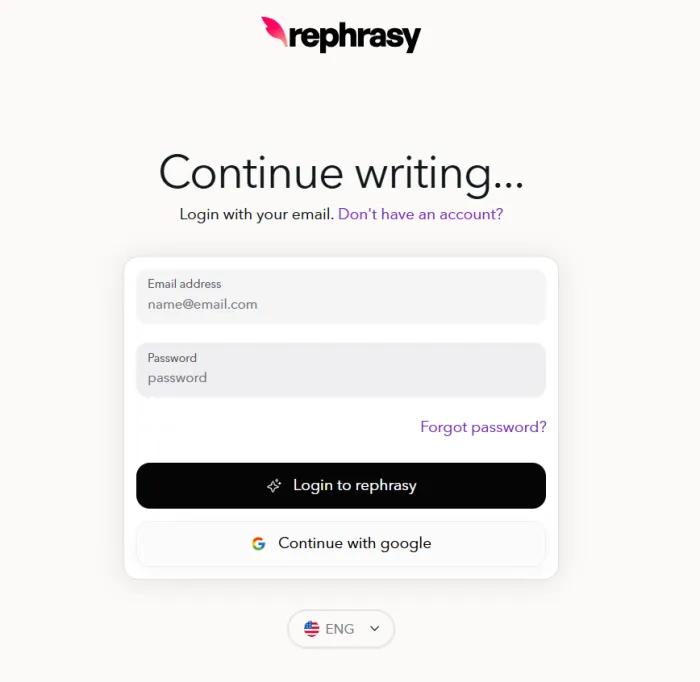
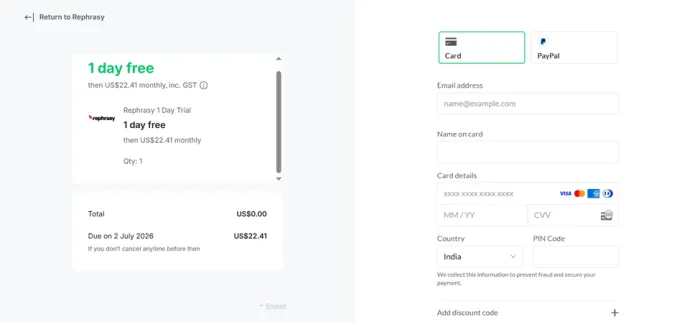
2. Dismissed the payment page. It appeared instantly, before any work. Closing it revealed the actual editor.
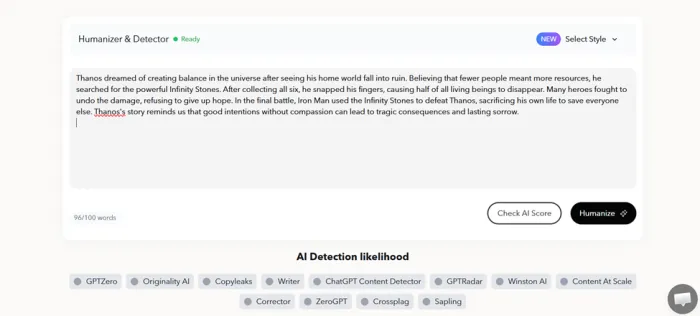
3. Pasted in a 96-word GPT paragraph. A short Thanos summary from ChatGPT, well under the 200-word cap.
4. Took a baseline reading. Scored the raw text on Rephrasy's own detector, ZeroGPT, and QuillBot.
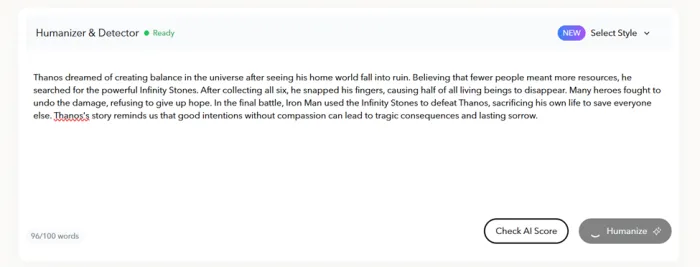
5. Hit humanize once. Spent the first of two free runs, then copied out the rewritten text.
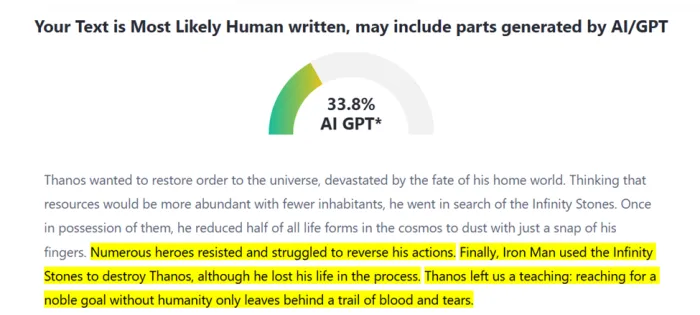
6. Re-scored the output. Ran the humanized version back through ZeroGPT and QuillBot.
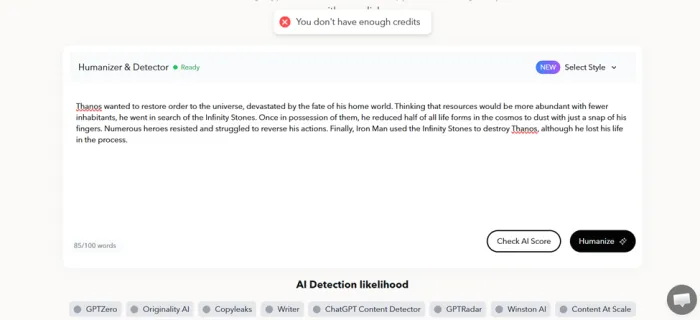
7. Tried a second pass, and stopped. Rephrasy said I was out of credits. The free tier had nothing left to give.
B · The workspace
What the editor put in front of me
Behind that payment screen, the free workspace was more generous than I expected. Four things stood out, and each earns a quick note.
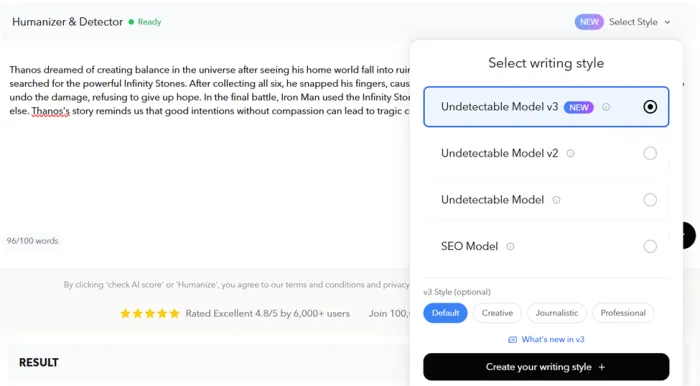
| Four models | Pick how hard it pushes, from a light touch to an aggressive undetectable pass. More control than most free tiers hand you, though heavier rewrites risk bending your meaning. |
| Style presets | Nudge the output toward creative, professional, or journalistic so it does not read like one flat, sanded-down voice. |
| Built-in checker | An AI detector on the same page, so you can score text without leaving the tool. Handy for a quick gut-check, with one catch I come back to later. |
| The limits | Each free run swallows a short paragraph, and you get two before the paywall. A demo, not a trial. |
One paragraph, obviously machine-made
For the test itself I wanted something small enough to fit the cap and unmistakably AI. So I asked ChatGPT for a five-sentence summary of Thanos, the kind of tidy paragraph a student might generate at one in the morning. It came back at 96 words. Here it is, word for word:
TEST SPECIMEN · 96 WORDS · GPT-AUTHORED Thanos dreamed of creating balance in the universe after seeing his home world fall into ruin. Believing that fewer people meant more resources, he searched for the powerful Infinity Stones. After collecting all six, he snapped his fingers, causing half of all living beings to disappear. Many heroes fought to undo the damage, refusing to give up hope. In the final battle, Iron Man used the Infinity Stones to defeat Thanos, sacrificing his own life to save everyone else. Thanos's story reminds us that good intentions without compassion can lead to tragic consequences and lasting sorrow. |
Before and after, nothing rounded
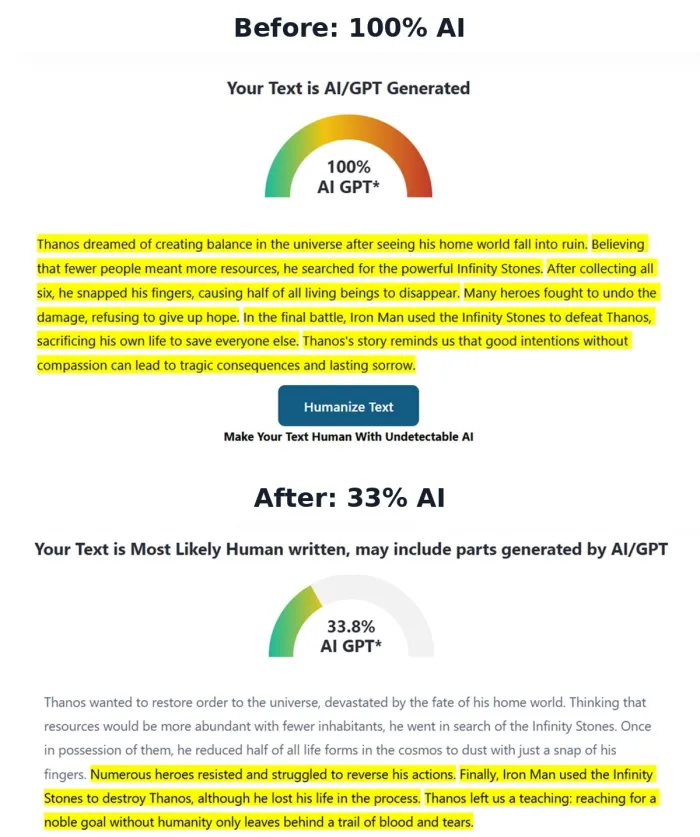
I handed that paragraph to three judges: Rephrasy's own built-in detector, ZeroGPT, and QuillBot. On the raw text they were unanimous.
| Detector | AI score | Verdict |
| Rephrasy (built-in) | 100% | Flagged |
| ZeroGPT | 100% | Flagged |
| QuillBot | 100% | Flagged |
Baseline: raw AI text, before humanizing.
Then I clicked humanize once, spending the first of my two free runs, and fed the rewritten text back to the two outside detectors. The agreement collapsed on the spot.
ZeroGPT dropped from 100% to 33.8%. That is a real, visible move. It is not a clean pass, and a cautious reader would still call roughly a third of the text suspect, but going from “certainly AI” to “mostly not” in one pass is a meaningful shift, and it is exactly the result the tool is selling.
QuillBot did not budge. It read the humanized text as 100% AI, the same score it gave the original. Same words, opposite verdicts, a tidy illustration of how little the detectors agree with one another.
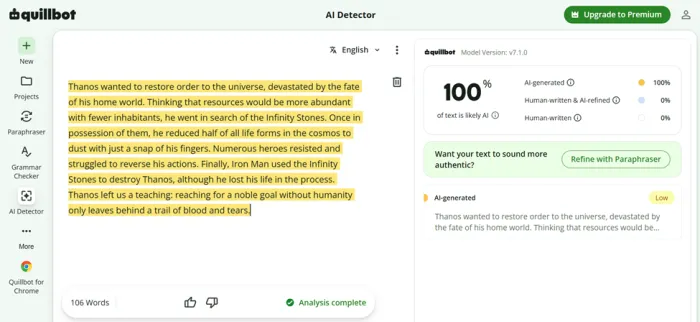
| Detector | AI score | Change |
| ZeroGPT | 33.8% | Down 66 pts |
| QuillBot | 100% | No change |
After one humanize pass: the same text, re-scored.
I wanted a second pass. It is the obvious next move: if one run halved the score on one detector, maybe two runs would clear it. That is where the session ended. When I tried to humanize again, Rephrasy told me I did not have enough credits, and the free tier had nothing left. Two runs total, one spent on the test and one I never got to use the way I wanted, and the door quietly closed.
What one honest test can and cannot tell you
A single 96-word paragraph is not a verdict on a whole product, and I want to be straight about that. But it is a data point, and it lines up neatly with what people who have run the bigger tests keep reporting.
The pattern across the reviews is consistency, not miracles.
Testers who push Rephrasy through many samples describe results that swing by content type: on plain, straightforward copy it can meaningfully lower a detector's score, while on academic or technical writing it tends to stall. One independent reviewer running marketing copy watched a detector fall from the high eighties into the low forties on the first pass, then watched an academic paragraph stay flagged near eighty percent after the very same treatment. My split result, one detector cut by two thirds and one unmoved, is a small echo of that same story.
There is also the built-in-detector catch I promised to return to. More than one independent tester has noticed that Rephrasy's own checker does not always agree with outside detectors on the same text, and it is sometimes the stricter of the two. The practical lesson is worth more than any single score: do not treat a humanizer's own detector as your final word. Check the output somewhere the tool has no stake in the answer, the way I did here, before you rely on it for anything that matters.
Does v4 change the conclusion of my original test?
Potentially, but I would not pretend to know until I run the same experiment again.
My original test produced a split verdict: ZeroGPT's AI score fell to 33.8%, while QuillBot continued to classify the output as 100% AI. Those numbers should stay exactly where they are because they are real results from the version I tested.
Rephrasy's newer v4 benchmark paints a substantially stronger picture. Its own August testing reports nine successful GPTZero results out of ten documents and nine successful ZeroGPT results out of ten. Rephrasy also says v4 performed better than WriteHuman on a public benchmark, with a reported average of 76% versus 64% across three detectors.
That is enough to justify another test, but not enough to rewrite the first one.
The difference matters. A company benchmark tells us what the developer achieved under its testing conditions. An independent review tells us what an ordinary user gets under theirs. Until I put v4 through the same kind of outside-detector test myself, my original 3.2/5 score remains the score for the experience reviewed here.
What other testers and users found
I am one session with one paragraph. To widen the lens, here is how Rephrasy lands with people who have spent longer with it, with a note on who is doing the talking. In this corner of the internet the reviewer's incentives matter almost as much as the review, so I have flagged them.
| Verdict | What they said | Who / caveat |
| Positive | Everyday users on the Google Play listing lean warm. The common praise is speed and relief: it turns stiff AI text into something that reads naturally and spares them from re-prompting by hand. | App-store users Unverified public reviews |
| Mixed | A content strategist testing it on real client work, unsponsored, called it real but frustrating: clean and fast, useful as a first-pass polish, yet inconsistent on detection and unforgiving on the fine print of credits. | Independent reviewer No affiliate ties disclosed |
| Critical | Reviews published by rival humanizers report low bypass rates in their own testing, some landing around the low forties on average, and do not recommend it. The finding may be fair, but the source competes for the same customers. | Competing tools Direct competitor |
| Positive | Several review sites praise the style-cloning concept and claim high success rates against the major detectors. The enthusiasm is real, but many of these pages carry affiliate links. | Affiliate sites Paid links present |
| Critical | Third-party reputation is thin. At the time of writing its Trustpilot footprint is minimal and not flattering, so there is very little independent social proof to lean on either way. | Trustpilot Sparse public record |
| Pattern | Across friendly and hostile reviews alike, two complaints repeat almost word for word: a credit system that does not roll over, and results that hold up on simple text but wobble on anything academic or technical. | The common thread Seen everywhere |
How Rephrasy scores across review platforms
Star ratings are uneven here for one honest reason: some platforms hold a single review while others hold many. Read the table as a spread of signals, not one averaged grade. Ratings reflect the time of writing.
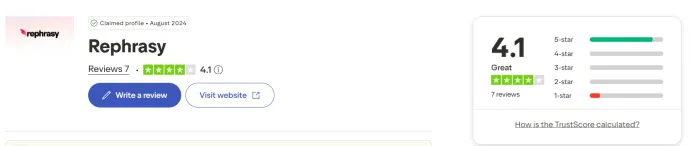
| Platform | Rating | Score | What it reflects |
| Trustpilot | ★★★★☆ | 4.1 | 7 Reviews with Majorly Praises |
| Google Play | ★★★★☆ | 4.0 | User reviews skew positive, praising speed and natural output. |
| Editorial review sites | ★★★☆☆ | 3.0 | Split once you weight for affiliate glow and competitor bias. |
| Apple App Store | NOT RATED | N/A | Too few public ratings to score. |
| G2 & Capterra | NOT RATED | N/A | No established review presence at the time of writing. |
What I liked, and what I did not
Worked for me + A clean, pleasant interface that stays out of your way. + Four models plus style presets give more control than most free tiers. + A built-in detector next to the humanizer is handy for a quick gut-check. + On simple, casual text, one pass produced a real drop on a major detector. + Fast. The rewrite came back almost instantly. | Held it back – A payment page before you have done anything sets a pushy tone. – The 200-word cap turns any real document into a stack of separate runs. – Two free runs is a demo, not a trial. You cannot properly stress-test it. – Results split across detectors: a win on ZeroGPT was a loss on QuillBot. – Its own detector should not be your final judge. – Credit pricing that does not roll over is easy to waste. |
A Price Reality Check
The pricing above reflects the information available around the time of my original review. Rephrasy's current official pricing page now shows a different structure, so I would treat the earlier figures as a historical snapshot rather than today's checkout price.
At the time of this update, Rephrasy lists:
| Plan | Current advertised price | Current advertised allowance/features |
| Quick Pass | $12.99 one time | 24-hour access, unlimited Humanizer and AI Detector usage, plus 20 plagiarism-check credits |
| Growth | $8.25/month, billed $99 yearly | Up to 200,000 humanized words/month, free re-humanization, Chrome extension, 1 custom writing style |
| Business | $10/month, billed $120 yearly | Up to 400,000 words/month, Humanizer API access, Chrome extension, 3 custom writing styles |
| Professional | $18.33/month, billed $220 yearly | Up to 800,000 words/month, Humanizer and Detector API access, Chrome extension, 10 custom writing styles |
| Lifetime Access | $199 promotional price at the time checked | Unlimited Humanizer and AI Detector usage plus 2,400 credits for plagiarism/API use |
These are the prices displayed by Rephrasy when this update was checked on August 24, 2026. Pricing pages change, promotions expire, and monthly figures on annual plans are advertised equivalents rather than month-to-month billing, so check the checkout page before buying.
One particularly useful change is the availability of free re-humanization on the subscription plans. That matters because one of the frustrations in my original test was not being able to properly explore repeated passes on the free allowance. It does not change what happened during that original session, but paid users today appear to have considerably more room to experiment.
One feature that matters more to professional users now: the API
Rephrasy has also expanded the developer side of the product since this review was first published.
Its current Humanizer API supports v4 and can process plain text programmatically. Rephrasy currently advertises API pricing starting at $0.10 per 1,000 words, with both flat-call and word-based billing options. The API can also return readability information alongside the rewritten output.
More interesting for publishers is structured-content support. Rephrasy added an input_format option for HTML and Markdown, allowing the service to rewrite visible text while preserving elements such as headings, links, lists, attributes, and code structure. That makes the product more practical for CMS workflows, documentation sites, newsletters, and bulk publishing than a simple copy-and-paste humanizer.
For an individual writer, this feature may not matter much. For agencies, developers, and publishers moving hundreds of pieces through a content pipeline, it is one of the more meaningful additions Rephrasy has made.
The Verdict
3.2 OUT OF 5 PROMISING, CAVEATS | Not a scam, not a miracle A clean, thoughtfully built humanizer with a real idea at its core, wrapped in a free tier too thin to fall in love with and a pricing model that rewards heavy, steady use while punishing everyone else. In my one test it did something real, and it also failed plainly. That split is the whole tool in miniature. |
How the score breaks down
| Category | Rating | Score | Why |
| Interface & ease of use | ★★★★☆ | 4.0 | Clean, uncluttered, and quick to learn. |
| Detection bypass | ★★½☆☆ | 2.5 | A real drop on ZeroGPT, no movement on QuillBot. |
| Features & control | ★★★★☆ | 4.0 | Four models, style presets, checker, plagiarism, API. |
| Free tier & trial | ★★☆☆☆ | 2.0 | A 200-word cap and two runs. A demo, not a trial. |
| Value for money | ★★½☆☆ | 2.5 | Credits expire, and pricing runs high for the results. |
| Speed | ★★★★½ | 4.5 | Rewrites come back almost instantly. |
| Overall | ★★★☆☆ | 3.2 | Promising, with real caveats. |
Who should try it. Writers working with casual, everyday text who want a quick first-pass polish and are happy to verify the output elsewhere. For light, low-stakes work, the free runs alone will tell you what you need to know.
Who should look harder before paying. Students and professionals whose work will face strict, high-stakes detection, where “a third of it still looks AI” is not a passing grade and one uncooperative detector is a real problem.
My advice is the same one my test kept pointing at. Use the free runs to see whether the tool moves the needle on your kind of writing, always check the result in a detector the tool does not own, and do not pay for credits until you have proven, on your own text, that it does the job you need. The promise on the landing page is easy to make. Make the tool earn it.