
There is a strange confidence in the way people talk about AI and content now. The tone usually sounds like this: the machines are here, the words are cheap, the output is endless, and the only thing left to do is scale. Somewhere in the background, a content manager is staring at a dashboard full of drafts and calling it a strategy.
That is the wrong conclusion.
AI has changed content production, but it has not solved the hardest part of content. It has made generation easier. It has not made judgment easier. It has made volume cheaper. It has not made relevance automatic. It has made structure faster. It has not made meaning inevitable. That difference matters because audiences do not reward content for existing. They reward content for helping them understand something, decide something, trust something, or feel that something real was said by someone who understood why it mattered.
That is why the future of content is not AI. It is direction. Not because AI is unimportant, but because once generation becomes widely available, the actual competitive edge shifts somewhere else. It shifts to the people who know what to say, what not to say, what angle matters, what proof is needed, what sequence makes sense, what tone fits the audience, and what outcome the content is supposed to create. In other words, the advantage moves from production to editorial control. The strongest teams will not win because they can make more content. They will win because they can direct content better.
Why “AI-Created Content” Is Not the Destination
A lot of current content thinking still treats AI as the main event. That is understandable. The visible change is dramatic. Tools can draft articles, captions, outlines, landing page copy, product descriptions, hooks, scripts, and emails in seconds. For anyone who has spent years wrestling with deadlines, blank pages, and underfunded content calendars, that feels like a breakthrough.
But production breakthroughs often hide a second problem. Once everyone has the same production advantage, output stops being the differentiator. It becomes the baseline. If every competitor can generate fluent text, then fluent text alone becomes far less valuable.
This is exactly what is happening to content now. The market is filling with material that is fast, readable, and structurally acceptable, yet still weak in the places that matter most. The ideas feel familiar. The angle feels safe. The tone feels interchangeable. The conclusion feels inevitable. You finish reading and realize the article was not wrong, but it also was not necessary.
That is what happens when generation is mistaken for strategy. The tool delivers language, but nobody has clearly directed the why behind it.
The Current AI Content Landscape
The modern content workflow has become heavily AI-assisted, whether publishers admit it publicly or not. Brainstorming, outlining, summarizing, drafting, rewriting, paraphrasing, and repurposing now move much faster than they did even a short time ago. The practical result is that content teams can produce far more raw material than before.

But speed creates a temptation. Once a team can produce more, it often starts assuming that it should produce more. Quantity begins to look like momentum. More posts, more pages, more topical coverage, more variations, more “presence.” Unfortunately, presence is not the same thing as position. A site can publish constantly and still fail to build authority if the material feels derivative, underdirected, or structurally thin.
This is why the conversation around AI and content often feels misframed. The real issue is not whether AI can create content. It clearly can. The issue is whether anyone is directing that creation with enough intelligence to produce distinctiveness, usefulness, and trust. Without that layer, the content economy becomes a race to flood the feed with acceptable-looking sameness.
| Layer | What AI Makes Easier | What AI Does Not Solve by Itself | Why the Gap Matters |
| Drafting | Faster first drafts and rewrites | Strong thesis selection | A weak idea stays weak even when phrased well |
| Output scale | More pages, posts, and versions | Audience prioritization | More content can still mean more noise |
| Structure | Faster basic sectioning | Editorial logic and pacing | A clean outline is not the same as a strong argument |
| Tone imitation | Style mimicry and fluency | Genuine brand voice | Readers can feel the difference between imitation and identity |
| Topic coverage | Broad subject expansion | Strategic positioning | Covering a topic does not mean owning it |
| Speed | Shorter production cycles | Judgment and restraint | Fast publication can amplify weak thinking |
That table is the heart of the issue. AI is very good at accelerating visible production tasks. The future of content, however, will be shaped by the invisible decisions those tasks still depend on.
What “Direction” Actually Means
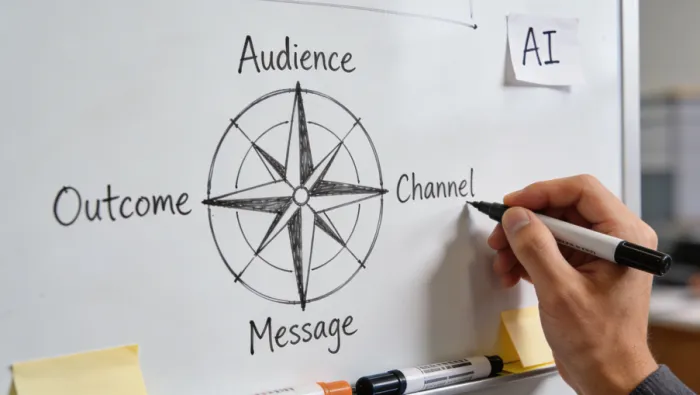
Direction is the human layer that decides what content should exist, why it should exist, who it is for, what it should do, and how it should move a reader from one state of mind to another.

That sounds abstract until you compare it with the alternative. An undirected content workflow starts with a topic and a prompt. A directed workflow starts with intent, audience, message, proof, format, and outcome. In the first case, the content is generated because a system can produce it. In the second, it is shaped because someone knows exactly what job it needs to do.
Direction includes several kinds of decision-making at once. It includes message architecture, which decides what the article is fundamentally trying to say. It includes audience framing, which decides how much context the reader needs and what level of language fits them. It includes content design, which shapes hierarchy, tables, examples, and transitions so the piece becomes usable rather than merely readable. It includes brand judgment, which ensures the content sounds like it belongs to a coherent point of view rather than to a machine that learned what “professional” sounds like on the internet.
This is also why direction cannot be reduced to “better prompts.” A better prompt can improve output quality. But direction begins before prompting and continues after drafting. It lives in the sequence of editorial choices that define what the piece is actually for.
| Component of Direction | What It Decides | Example of the Difference It Makes |
| Audience understanding | Who the content is for and what they need most | A beginner explainer reads very differently from a buyer guide |
| Strategic positioning | What angle the content should take | “Sustainable fashion trends” becomes “How Gen Z is changing sustainable fashion buying behavior” |
| Message hierarchy | What comes first, what supports it, what gets cut | The strongest content answers the core question before wandering into side notes |
| Proof selection | What evidence, examples, or cases are needed | Real examples create trust faster than broad claims |
| Brand voice | How the content should feel and what it should avoid | A distinctive voice is remembered; a generic one is absorbed and forgotten |
| Outcome design | What the reader should do, think, or understand next | Good content does not just inform; it changes a next step |
Direction, in other words, is not decoration. It is authorship at the systems level.
The Problem With AI Without Direction
AI without direction becomes a content factory. And content factories always look more impressive internally than they do to the people outside them.
The first consequence is sameness. If the inputs are broad and the editorial control is weak, AI will usually produce the center of the distribution. That means common phrasing, safe framing, familiar examples, and predictable structures. It may not be bad, but it will not be hard to replace.
The second consequence is search fatigue. Readers may not consciously say, “This sounds like AI,” but they often feel the pattern. The prose is smooth but strangely weightless. The article says what it is supposed to say, section by section, but never develops the pressure of a real point of view. Over time, this trains readers to skim more aggressively, trust less quickly, and retain less of what they read.

The third consequence is brand dilution. If your content sounds like every other brand using the same generation tools, then your publishing operation stops building memory. That matters because content is not only about ranking. It is about becoming recognizable. A brand voice is a cumulative asset. Direction is how that asset gets protected.
The fourth consequence is internal confusion. Once a team sees that generation is cheap, it may start filling the site with overlapping pages, near-duplicate angles, and loosely differentiated posts. This can create content cannibalization, weaker topic clarity, and a bloated editorial footprint that looks broad but feels strategically fuzzy.
| Failure Pattern | What It Looks Like in Practice | Long-Term Cost |
| Search fatigue | Readers encounter familiar phrasing and stop engaging deeply | Lower trust and weaker repeat readership |
| SEO cannibalization | Multiple similar pages compete for the same intent | Diluted ranking strength |
| Brand dilution | Every article sounds “generically competent” | Lower memorability and weaker authority |
| Editorial bloat | The site grows faster than its strategic clarity | Harder maintenance and weaker content identity |
| Overproduction bias | Teams prioritize output count over outcome quality | Activity without meaningful traction |
This is why the central problem is not AI itself. It is the absence of guided editorial thinking.
Why Direction Outperforms Pure Automation
Every lasting content advantage over the last several years has depended on some form of direction. Better personalization required direction. Better storytelling required direction. Better multimedia integration required direction. Better brand consistency required direction. Even the most successful AI-assisted workflows still depend on humans deciding what counts as useful, what counts as proof, and what counts as worth publishing.
Direction outperforms pure automation because it aligns content with the reasons users care in the first place. A directed article usually has sharper topic selection, stronger relevance, better sequencing, and more durable differentiation. It is less likely to exist just because a tool could make it. It exists because someone understood the user journey and designed the page accordingly.
It also creates SEO durability. Content shaped by direction tends to have stronger intent match, better topical depth, more useful structure, and clearer originality. Those qualities matter far more over time than the mere ability to publish quickly. The pages that survive updates and continue earning traffic are usually the ones that feel more intentionally built.
And then there is brand. Automation can help maintain consistency only after direction has already defined what consistency means. Without that human layer, scale makes content flatter, not stronger.
How Creators and Marketers Can Build Direction Into AI Workflows
The next era of content work requires a shift in role. Writers and marketers cannot think of themselves only as producers anymore. Increasingly, they have to think like content directors. That means making stronger decisions earlier and relying on AI later, not the other way around.
The workflow starts with purpose mapping. Before asking AI for anything, the team should define the goal of the content. Is the page meant to build awareness, drive consideration, capture a lead, support retention, or strengthen authority around a category? If that is unclear, the draft will usually drift into generic explanation.
Then comes audience alignment. What does this reader already know? What are they likely to misunderstand? Are they early in the funnel or close to decision? Which question brought them here, and which one do they need answered next? AI can help with expansion, but the human team has to define relevance.
After that comes prompt direction, but prompt direction is only one part of the system. The real editorial work continues in revision. This is where human teams sharpen the angle, add proof, reduce clichés, improve flow, insert examples, remove generic filler, and ensure that the content sounds like a coherent publication rather than a decent machine draft.
Finally, performance data should feed redesign. A directed workflow is not static. It measures CTR, engagement, dwell behavior, conversion patterns, and content overlap, then uses those insights to refine the next cycle.
There are only a few operating rules here that matter enough to keep visible at all times:
- Define the purpose and audience before asking AI to generate anything.
- Use AI to accelerate drafting, not to replace the editorial angle.
- Add human proof, examples, and judgment before publication.
- Measure outcomes and revise structure, not just wording, when content underperforms.
These are simple rules, but they create a completely different quality standard.
The SEO Edge: Why Search Rewards Direction
Search engines do not reward content for having been generated efficiently. They reward content that satisfies intent, creates value, and proves itself more useful than competing pages. That is why direction creates an SEO edge.
A directed article is more likely to answer the actual reason behind the query rather than just matching the phrase. It is more likely to have stronger information hierarchy, better engagement design, and clearer differentiation. It is also more likely to contain the kind of human signals that make content feel credible: sharper judgment, better examples, stronger context, and more intentional structure.
Undirected AI content often fails because it confuses topical coverage with usefulness. It covers the subject, but it does not create enough value to deserve durable ranking. Direction is what closes that gap.
| SEO Dimension | Content Led Mostly by Automation | Content Led by Direction |
| Intent match | Often broad and keyword-shaped | Built around the real question behind the query |
| Differentiation | Low, because output reflects common patterns | Higher, because the angle is intentionally chosen |
| Engagement depth | Smooth but often forgettable | More likely to retain and move the reader |
| Topical clarity | Can become bloated or overlapping | Better content boundaries and stronger purpose |
| Update resilience | Vulnerable if value is thin | More durable because usefulness is more explicit |
| Brand-authority effect | Adds indexed pages | Adds recognizable trust and memory |
The key point is simple: AI can help produce content faster, but direction is what gives that content staying power.
The Future Role of the Writer, Marketer, and Editor
As AI becomes normal, the most valuable people in content will be the ones who can direct systems, not just feed them. That means the future role is less about raw drafting stamina and more about editorial orchestration.
The strongest writer in an AI-heavy workflow will not necessarily be the person who types fastest. It will be the person who can frame a topic sharply, spot a weak angle quickly, guide structure intelligently, know where proof matters most, and preserve a recognizable voice under pressure. The strongest marketer will not be the person who can generate the most assets in a week. It will be the person who can decide which assets deserve to exist and how they should work together across the funnel. The strongest editor will not simply clean prose. They will decide what makes the prose worth reading.
That is the real shift. AI changes the mechanics of production, but direction changes the economics of attention.
Conclusion: AI Is a Tool. Direction Is the Craft
AI will keep improving. It will get faster, smoother, more integrated, and more capable across formats. It will help with drafting, repurposing, summarizing, scripting, and production speed in ways that genuinely matter. But none of that changes the deeper truth at the center of good content: people do not respond to generated text just because it exists. They respond to relevance, judgment, clarity, usefulness, and voice.
That is why the future of content is not AI. It is direction. AI can generate possibilities. Direction decides which possibilities deserve to become published reality. AI can expand. Direction can choose. AI can scale output. Direction can turn output into value.
And that is the skill that will matter most. Not typing faster. Not producing more. Not sounding polished by default. The real advantage will belong to the people who can guide the machine toward something worth saying and then refine it until it no longer feels machine-led at all.