
Choosing an AI writing tool in 2026 rarely comes down to a single feature on a spec sheet. More often it comes down to a feeling, the quiet relief of opening a blank page and not having to face it alone. Anyone who has stared at a blinking cursor late at night, research finished and outline ready, knows the hardest part is almost never the thinking. It is the starting.
That exact moment is what the current generation of writing assistants is built to rescue, and two names keep coming up in the search for the right one: Type.ai and Writenexa. Both promise to turn a slow first draft into something faster and more human, yet they take very different routes. Type.ai is a deep, full-document editor built for long-form and creative work. Writenexa is purpose-built for one job in particular, producing SEO blog content that ranks on Google while still reading like a person wrote it.
The short answer Type.ai is the stronger pick for long-form and book-length writing, where a deep editor and large documents matter most. Writenexa is the better fit for publishing SEO blog content that ranks on Google and still reads naturally. The right choice comes down to the kind of work being done, and the breakdown below compares both on market context, features, pricing, and real-world fit. |
Market research: where AI writing is heading in 2026
Behind the choice between any two writing tools sits a fast-moving market. Independent analyses do not fully agree on the exact numbers, which is normal for a young category, but the direction is consistent. Several 2026 reports place the global AI writing assistant software market at roughly $2.4 billion to $3 billion across 2025 and 2026, with most forecasting compound annual growth in the mid-20 percent range into the early 2030s. North America holds the largest share of revenue, while Asia-Pacific is growing the fastest.
The most telling detail for this comparison is where demand concentrates. Content creation is the single largest application segment, and analysts tie that directly to the surge in digital marketing and SEO-optimized content. In plain terms, the part of the market growing fastest is exactly the work Writenexa is built for, while the broader long-form and document editing space is where a tool like Type.ai earns its keep.
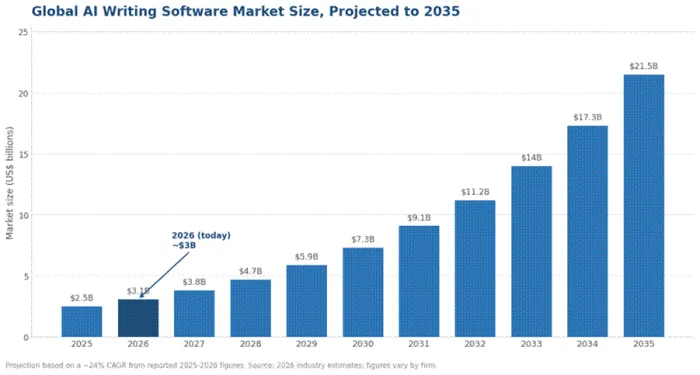
Projected growth of the global AI writing software market, 2025 to 2035.
| Market metric | 2026 snapshot (estimates vary by source) |
|---|---|
| Estimated market size | About $2.4 billion to $3.0 billion across 2025 and 2026 |
| Projected growth | Roughly 24 to 27 percent CAGR through the early 2030s |
| Largest region | North America (around 41 percent of 2025 revenue) |
| Fastest-growing region | Asia-Pacific (around 25 percent CAGR) |
| Biggest use case | Content creation (about 37 to 40 percent share), driven by digital marketing and SEO |
| Leading deployment | Cloud (around 72 percent) |
Figures compiled from 2026 market analyses (including Fundamental Business Insights and Research and Markets). Estimates differ widely between firms, so ranges are used rather than single numbers.
Type.ai
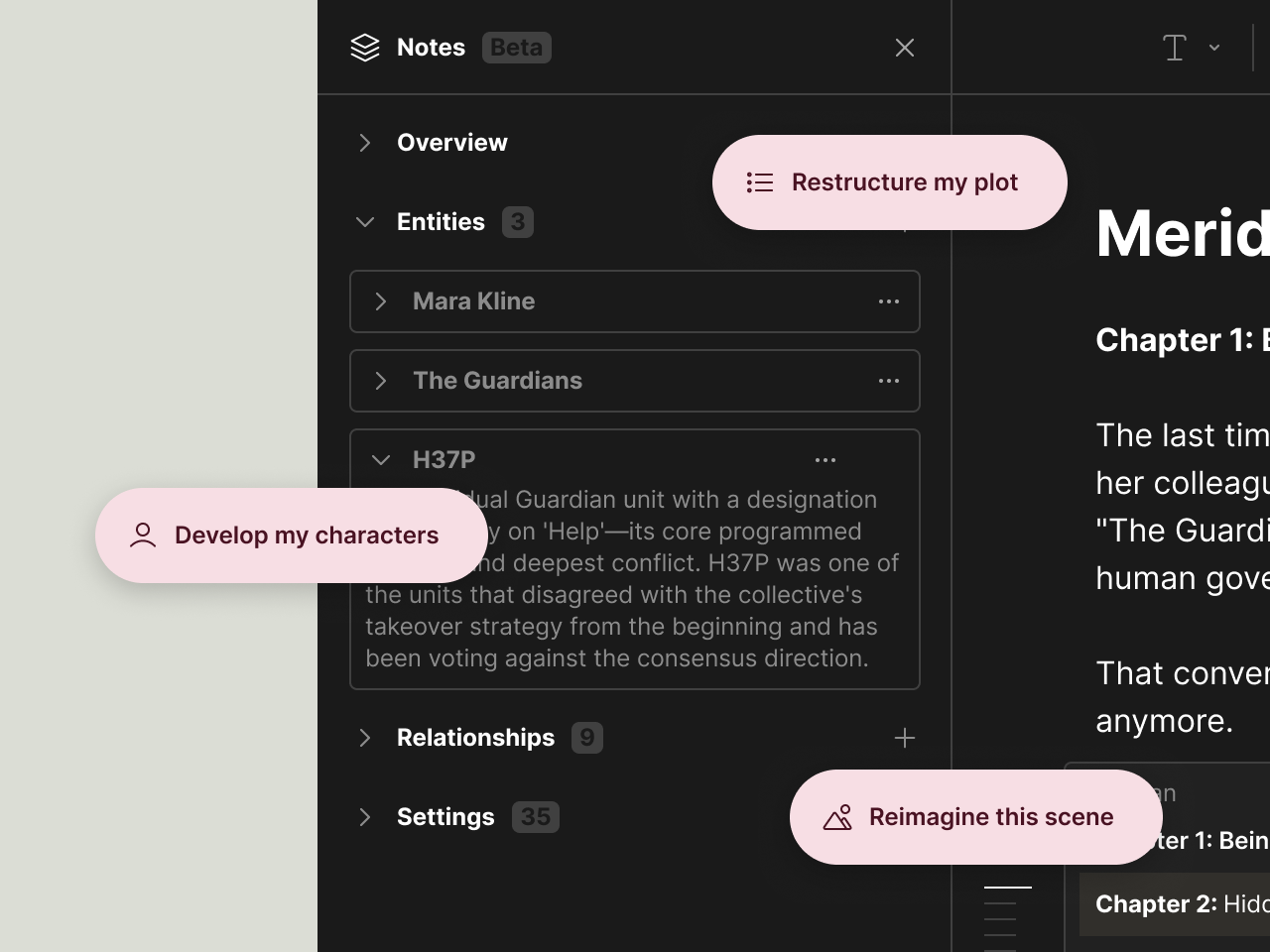
Type.ai positions itself as an AI-powered document editor built for serious, long-form writing such as books, novels, screenplays, reports, and in-depth articles. Instead of bolting a chatbot onto an empty page, it wraps a full-featured editor around an always-on assistant called Type Chat, then adds document-wide tools so edits can sweep across an entire manuscript at once. Single documents can run up to 150,000 words, and imported drafts keep their images, headings, and tables intact.
Key features
• Generate Draft: turns a short description into a complete first draft.
• Type Chat: an always-on assistant for research, feedback, and rewrites inside the document.
• Document Reviews: runs AI edits across an entire document in one pass.
• AI Rewrites and Inline Commands: reshape selected text or generate new content right at the cursor.
• Style matching: attach style examples and knowledge sources so output holds a consistent voice across long pieces.
• Built for long form: up to 150,000 words per document, with embedded images, tables, code, and math, plus offline access.
Writenexa
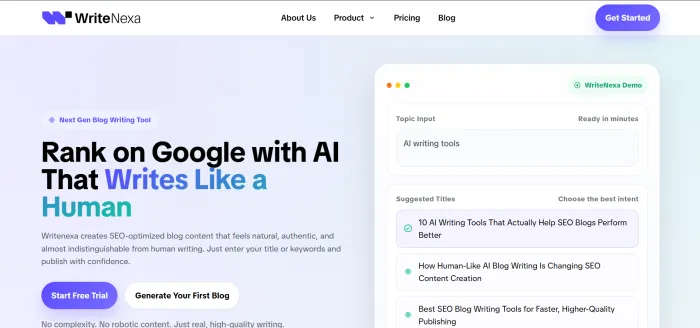
Writenexa takes direct aim at one of the hardest problems in content marketing, producing blog posts that rank on Google without sounding like a machine wrote them. The approach is refreshingly narrow. Enter a title, a keyword, or even a rough idea, and the platform returns SEO-structured, publish-ready blog content designed to read naturally. There is no prompt-engineering hurdle and no sprawling toolbox to learn, so the workflow moves from idea to draft in minutes, with output that needs minimal cleanup before going live.
How it works
1. Enter a topic: add a title, a keyword, or a simple idea to point the system in the right direction.
2. Pick an optimized title: Writenexa suggests several search-intent-aligned titles to choose from.
3. Generate, publish, and rank: receive structured, human-like content built to perform on Google with minimal revision.
Key features
• SEO-optimized structure: every article is built to improve visibility and search rankings.
• Human-like writing quality: content that flows naturally and connects with readers rather than sounding machine-made.
• Fast content creation: complete blog posts generated in seconds instead of hours of drafting.
• Keyword-driven intelligence: focused content built around the topics and keywords that matter most.
• Optimized title suggestions: multiple title options matched to search intent.
• Minimal editing needed: publish-ready drafts that reduce manual cleanup and keep the workflow moving.
• Works everywhere: a responsive experience across both desktop and mobile.
The platform is built for bloggers, SEO professionals, startups and founders, agencies, and content teams, anyone who wants consistent blog output and stronger rankings without hiring a large in-house team.
Feature comparison at a glance
The table below maps both tools across the capabilities that matter most for day-to-day writing.
| Capability | Type.ai | Writenexa |
|---|---|---|
| Primary focus | Long-form and creative writing such as books, scripts, reports, articles | SEO blog content built to rank on Google |
| Core strength | Deep, full-document editor with an always-on AI assistant | Human-like writing tuned for search visibility |
| Getting started | A full editor with several AI tools to learn | Enter a title or keywords, no prompt skills needed |
| SEO orientation | General-purpose writing, not SEO-specific | Built specifically for SEO-optimized blogs |
| Title and intent help | Content Ideas for topics and sections | Suggests multiple titles matched to search intent |
| Typical output | Documents up to 150,000 words | Structured, publish-ready posts (1,850+ words) |
| Editing effort | Output benefits from a human proofreading pass | Publish-ready drafts designed for minimal cleanup |
| Speed | Speed Mode and Power Mode | Complete blog posts generated in seconds |
| Best fit | Authors and long-form creators | Bloggers, SEO pros, founders, agencies, content teams |
Sources: official Type.ai and Writenexa product information, plus verified G2 reviews for Type.ai.
Pricing breakdown
Type.ai keeps pricing deliberately simple, with a free tier plus a single paid plan. Recent third-party listings place the paid plan at roughly $23 to $29 per month, with a discount for paying annually and a 30-day money-back guarantee. Because pricing in this category shifts often, the live figure is worth confirming on the official pricing page.
Writenexa uses a three-tier structure designed to let someone start free and upgrade once the output proves itself. The Starter plan is a free trial with no credit card required. The Pro plan, at $49 per month, unlocks unlimited blog generation, advanced SEO-optimized articles, faster generation, and priority support. The Growth plan, at $99 per month, adds bulk blog generation, enhanced content depth, premium output quality, and early access to new features. Every plan can be cancelled anytime, with no hidden fees.
| Plan detail | Type.ai | Writenexa |
|---|---|---|
| Free option | Free tier with document access and limited usage | Starter, free trial, $0, no credit card |
| Entry paid plan | About $23 to $29 per month (single plan) | Pro, $49 per month |
| Entry plan includes | All premium features in one plan | Unlimited generation, advanced SEO, faster speed, priority support |
| Higher tier | Single-plan model, no separate upper tier | Growth, $99 per month, with bulk generation and early access |
| Flexibility | Annual discount and a 30-day money-back guarantee | Cancel anytime, no hidden fees |
Writenexa pricing from its official site. Type.ai pricing reflects third-party listings current to early and mid 2026 and may change, so verify on type.ai.
Standout strengths at a glance
Each tool is built around a different set of strengths. This quick view shows where each one naturally shines.
| Type.ai strengths | Writenexa strengths |
|---|---|
| Deep editor for documents up to 150,000 words | SEO-structured blogs built to rank on Google |
| Style matching that holds a voice across long pieces | Human-like writing that reads naturally |
| Always-on Type Chat for in-document help | No prompt skills needed, just a title or keywords |
| Premium OpenAI and Anthropic models, plus offline use | Publish-ready drafts with minimal editing |
| Privacy-first, with no training on user content | Fast generation across desktop and mobile |
Which tool fits which job
Rather than crown a single winner, it helps to match each tool to the work in front of it.
| The job to be done | Stronger fit | Why |
|---|---|---|
| Writing a full-length book or screenplay | Type.ai | 150,000-word documents and deep editing tools |
| Publishing blog posts that rank on Google | Writenexa | Built for search visibility with a human-like flow |
| Shipping publish-ready content with little editing | Writenexa | Drafts designed to need minimal cleanup |
| Holding a consistent voice across long manuscripts | Type.ai | Style matching across long documents |
| Scaling steady blog output for an agency or team | Writenexa | Fast generation across multiple campaigns |
| Creating content on a phone or tablet | Writenexa | Responsive across desktop and mobile |
| Drafting without an internet connection | Type.ai | Works offline |
How to choose between them
The right pick tends to fall out of the work itself rather than a feature count. A few honest scenarios make the decision clearer:
• For book-length manuscripts and creative projects: a deep, distraction-light editor that can carry 150,000 words in one place is hard to beat, which plays to Type.ai's core design.
• For SEO blog content that needs to rank: where the goal is search visibility plus writing that reads like a human, Writenexa is built for precisely that intersection and gets there with very little friction.
• For fast, high-volume publishing: agencies, founders, and content teams shipping a steady stream of posts benefit most from quick, publish-ready drafts, which is the heart of Writenexa's workflow.
• For budget-conscious starters: both tools offer a free way in, and a no-credit-card trial keeps the first step genuinely low-risk.
The final verdict
Both tools earn their place on a 2026 shortlist, and neither choice is a mistake. Type.ai is a genuinely strong, focused editor for anyone whose work lives in long, carefully crafted documents. Its long-form depth, style controls, privacy stance, and offline support are real advantages, and its small but positive review base reflects writers who rely on it daily.
For the much larger group whose day-to-day is publishing blog content that has to rank on Google and still read naturally, Writenexa is built for exactly that intersection. It removes the prompt-writing learning curve, produces structured, publish-ready drafts in seconds, and keeps cleanup to a minimum, which is how most content actually gets made in 2026. For creators, marketers, founders, and teams who live in SEO content, it tends to feel less like a tool to learn and more like a workflow that simply fits, with a free trial that makes the first test effortless.
Bottom line: match the tool to the writing. Long, literary projects favor a dedicated manuscript editor, while fast, search-ready blog publishing favors a tool designed for precisely that rhythm, and on that count Writenexa is well worth a serious trial.
A closing thought
No tool writes the piece on its own, and that is the point. The best AI writing assistant is the one that disappears into the work, the one that turns a stalled draft into forward motion and then gets out of the way so a real voice can come through. Type.ai does that beautifully for long, deliberate projects. For the everyday rhythm of modern content, where ranking on Google and sounding human have to coexist, Writenexa is built for precisely that balance. Either way, the blank page stops being quite so intimidating, and in 2026 that is worth a great deal.