OUR SCORE 2.5 /5 ★★½☆☆ Weighted toward its core promise | The short version Fast, cleanly designed, and easy to use, yet in my hands-on test it did not deliver on the one thing it sells. My humanized text still scored 96.5% AI on ZeroGPT and 77% AI on QuillBot, and the rewrite read worse than the original. Independent testers and hundreds of reviewers describe the same pattern: it works sometimes, for some content, against some detectors. ✓ 3-4 sec processing ✓ Simple, clean UI ✓ Support is well rated ✗ Failed both detectors in my test ✗ Readability dropped $ From $5/mo (yearly) · $19/mo (monthly) |
THE SCOREBOARD · SAME TEXT, BEFORE & AFTER HUMANIZATION
| DETECTOR | ORIGINAL (CHATGPT STORY) | AFTER UNDETECTABLE AI | CHANGE | VERDICT |
|---|---|---|---|---|
| ZeroGPT | 100% AI | 96.5% AI | -3.5 pts | STILL FLAGGED |
| QuillBot AI Detector | 100% AI | 77% AI / 23% human | -23 pts | MAJORITY AI |
Single test on default settings, July 2026: one piece of ChatGPT creative fiction. Detector scores vary by content, length, and settings, so treat this as one honest data point, not a universal benchmark.
I didn't set out to write a takedown. I signed up genuinely curious, because if any tool in the "AI humanizer" category should work, it's the one that practically named the category. What follows is exactly what I did, in order, with the actual numbers, plus what 900+ reviewers across Trustpilot, G2, and independent test labs have found. Where their experience and mine line up, that should tell you something.
What Undetectable AI actually is
Undetectable AI (undetectable.ai) launched in 2023 and is headquartered in Sheridan, Wyoming. It does two things: it detects AI-written text by running it through the patterns major detectors look for, and it "humanizes" AI text, rewriting it so those same detectors are supposed to read it as human. Around that core sit extras: an AI essay writer, a Chrome extension, an API, 50+ languages, readability targets (High School through Doctorate, plus Journalist and Marketing), and purpose presets like Essay, Article, and Cover Letter.
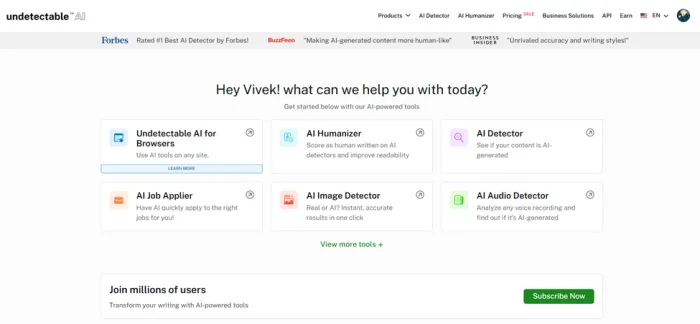
The pitch is direct: every plan lists "Passes AI detectors" as its first feature, and a site banner advertises a money-back guarantee if output gets flagged as not human. Those are checkable claims, which is the whole reason this review exists.
WORTH SAYING UP FRONT If you're considering this for coursework: most universities treat submitting humanized AI text as an integrity violation regardless of whether a detector catches it. This review evaluates whether the tool does what it advertises, nothing more. |
How I tested it, step by step
No affiliate link, no press account, just a normal signup and the workflow any real user would follow. The full log:
1. Signed up (two options offered: email or Google)
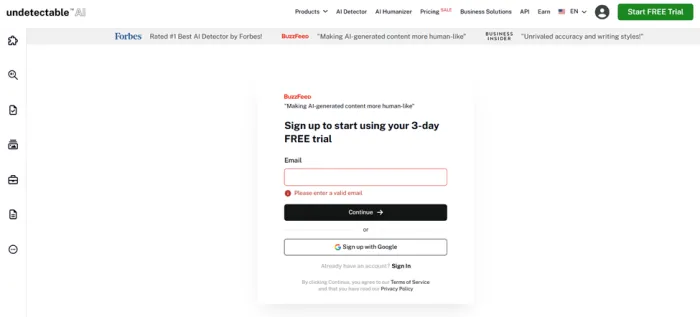
I chose Google. Instant: no friction, no card required to reach the dashboard. Credit where due: onboarding is genuinely smooth.
2. Generated the test text in ChatGPT
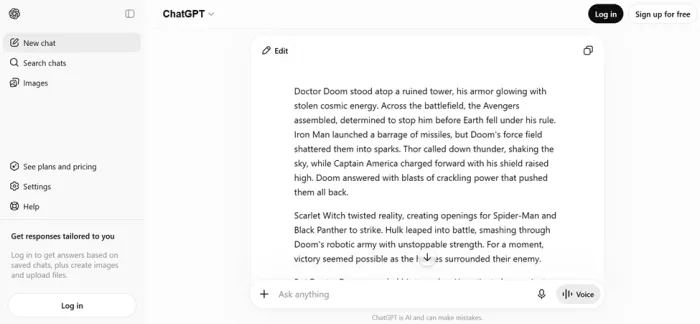
I asked ChatGPT to write a short fictional story of Doctor Doom fighting the Avengers. Deliberately easy mode: loose, stylistic fiction is exactly what humanizers should handle best, far more forgiving than an academic essay.
3. Established the baseline (ZeroGPT & QuillBot)
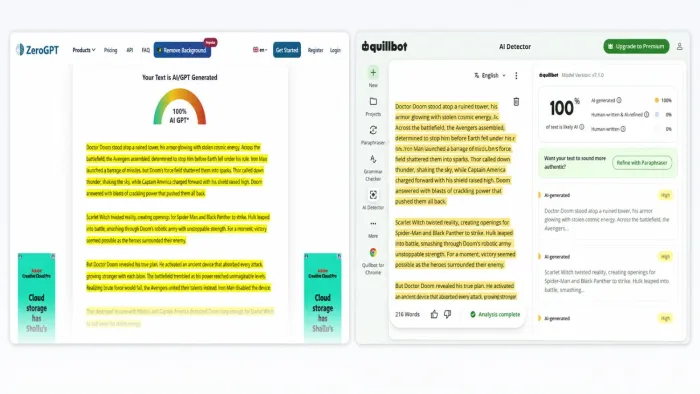
Before touching Undetectable AI, I ran the raw story through both detectors. Both returned 100% AI: a clean, unambiguous starting line.
4. Ran it through the AI Humanizer
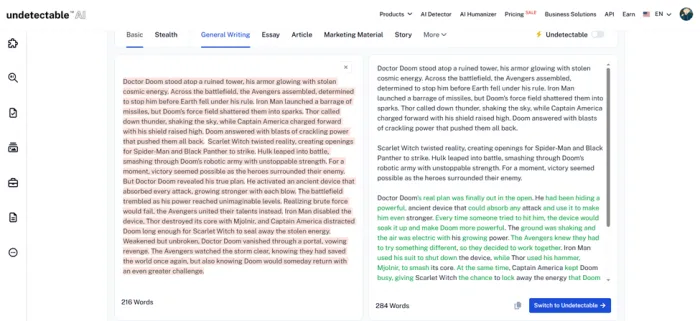
I pasted the same story into the humanizer at undetectable.ai. Processing took about 3-4 seconds, impressively quick. Honestly the best moment of the test.
5. Re-tested the humanized output
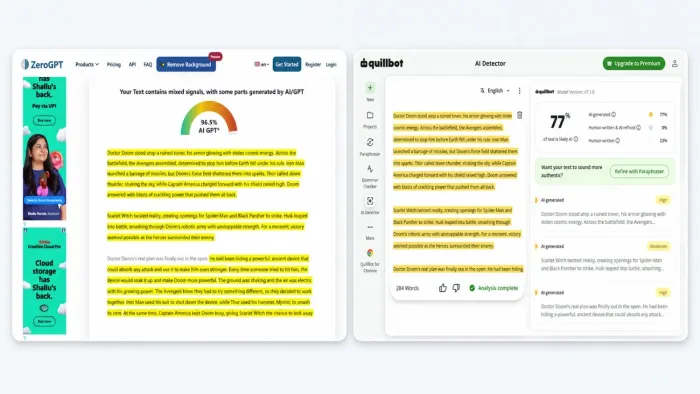
ZeroGPT: 96.5% AI. QuillBot: 77% AI, 23% human. And beyond the scores, the rewrite read noticeably worse than what ChatGPT gave me: clunkier phrasing, less natural flow.
03 · ANALYSIS
What those numbers actually mean
Let's be precise, because this is where most reviews get sloppy.
Against ZeroGPT, a 3.5-point drop from a 100% baseline is functionally nothing; nobody reads 96.5% differently than 100%. Against QuillBot, the 23-point drop is real movement, but 77% AI is still a decisive flag, not a borderline result. In pass/fail terms (the only terms that matter for a tool whose first advertised feature is "Passes AI detectors"), my test produced two fails out of two.
And the output quality stung more than the scores. The point of paying for a humanizer is getting text you can actually use. What came back wasn't that: sentences turned awkward, the story's rhythm broke, and I'd have needed to rewrite it anyway. A rewrite that fails detection and reads worse is a negative-value trade.
Claim vs. My Test
| Claim | What happened | Result |
|---|---|---|
| Passes AI detectors | ZeroGPT: 96.5% AI | ❌ Failed this test |
| Passes AI detectors | QuillBot: 77% AI | ❌ Failed this test |
| High-quality content | Some wording became clunkier | ⚠️ Mixed |
| Fast processing | Took a few seconds | ✅ Yes |
Is my result an outlier? Not really.
One test on one story proves only so much, so I checked mine against people who've tested it at scale in 2026. The honest summary: inconsistent, and trending downward against modern detectors.
• Cybernews (research-team test, updated 2026) found the humanizer can reduce detection rates but called its accuracy inconsistent, wouldn't rely on it for high-stakes academic or professional writing, and recommended human oversight. It also noted the site's "#1 AI detector rated by Forbes" claim didn't appear in Forbes' own ranking, a marketing red flag.
• EyeSift (2026 test) measured bypass rates of roughly 54-67% against Turnitin's updated model (about one in three humanized submissions still flagged) and found the aggressive settings that bypass more reliably also introduce grammar errors.
• Detector-side and competitor tests routinely show its output still scoring high on ZeroGPT and GPTZero. Obvious incentives, so I weigh them lightly, but their numbers rhyme with mine, not with the marketing.
The pattern across all of it: Undetectable AI sometimes works, on some content, against some detectors, while Turnitin and GPTZero have been retraining on humanizer output since 2024. It's an arms race, and in mid-2026, on my text, the detectors were winning.
| Test | QuillBot | ZeroGPT | GPTZero | Copyleaks |
|---|---|---|---|---|
| Your test | 77% AI | 96.5% AI | Not tested | Not tested |
| Cybernews | 25% AI | 33% AI | 100% AI | 100% AI |
TO BE FAIR TO IT Some verified reviewers report genuinely good results: natural rewrites that pass the detectors they care about. Performance clearly varies by content, language, and settings. My test is one data point; it just happens to be one the marketing says shouldn't exist. |
What you get on every plan
One structural thing it does well: no feature-gating by tier. Every paid plan, from 10K to 50K+ words, carries the identical feature list; you pay purely for volume. From the pricing page:
• Passes AI detectors: the headline claim, which my test contradicts and independent tests call inconsistent.
• High quality, legible content: also a claim; in my test, legibility is exactly what degraded.
• Watermark and future proof: labs are developing cryptographic watermarking that paraphrasing may not remove, so "future proof" is a promise nobody in this category can honestly make.
• Writing level matching: readability targets from High School to Doctorate; genuinely useful for tone.
• API compatible: for developers wiring humanization into a pipeline.
• Unlimited Human Auto Typer: simulates human typing of text into other applications.
• Unlimited AI Detecting: the built-in multi-detector checker. Honestly the most defensible part of the product: checking your writing before submission is useful even if you never humanize anything.
What it costs (captured from the live pricing page)
Pricing is volume-based: identical features everywhere, more words as you pay more. Two things stood out. First, the toggles don't just change the price; they change the lineup: the cheapest 10K tier only appears on yearly billing, so the real monthly entry price is $19. Second, the yearly discount is steep (50%), which is exactly why to be careful with it: annual billing is where most complaints in the next section live.
MONTHLY BILLING
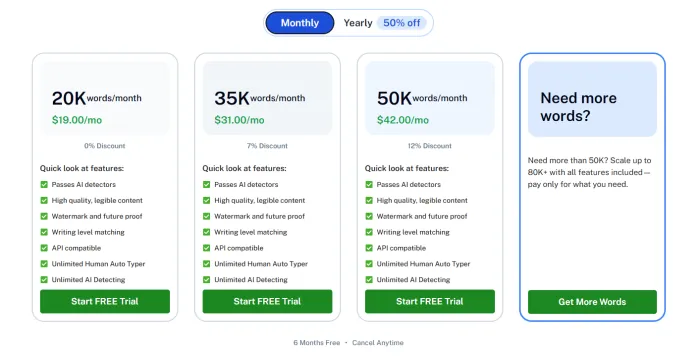
| PLAN | PRICE | COST PER 1K WORDS | LISTED DISCOUNT | FREE TRIAL |
|---|---|---|---|---|
| 20K words / month | $19.00/mo | $0.95 | 0% | Yes |
| 35K words / month | $31.00/mo | $0.89 | 7% | Yes |
| 50K words / month | $42.00/mo | $0.84 | 12% | Yes |
| Custom ("Need more words?") | Scales to 80K+ words, all features included, pay for what you need | n/a | ||
YEARLY BILLING (ADVERTISED AS 50% OFF)
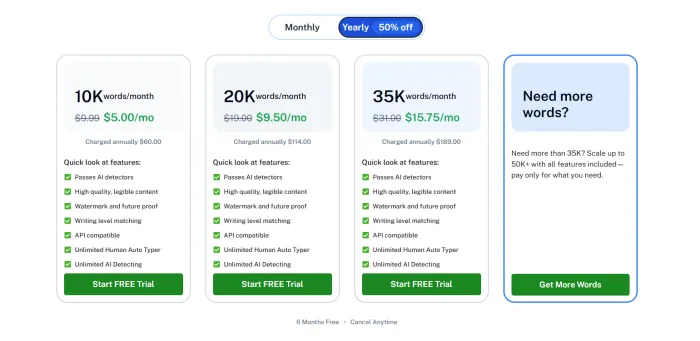
| PLAN | EFFECTIVE MONTHLY | BILLED ANNUALLY | COST PER 1K WORDS |
|---|---|---|---|
| 10K words / month YEARLY ONLY | $9.99 $5.00/mo | $60.00 | $0.50 |
| 20K words / month | $19.00 $9.50/mo | $114.00 | $0.48 |
| 35K words / month | $31.00 $15.75/mo | $189.00 | $0.45 |
| Custom ("Need more words?") | Scales to 50K+ words, all features included | ||
On paper, $0.45-$0.50 per thousand words on annual plans is competitive for the category. But value math only works if the output is usable, and in my test I'd have paid for words I then had to rewrite. Three practical notes before you enter a card number:
• The free trial is small: reported at roughly 250 words over three days, which is one short test, not an evaluation. Reviewers also describe confusion about what "activating" it does, so read the checkout screen slowly.
• Annual is charged upfront. $60-$189 leaves your account on day one, and multiple reviewers report losing remaining credits after cancelling. Test on monthly first.
• There is a money-back guarantee: a refund of humanization costs if output gets flagged as AI. Experiences claiming it are mixed: some smooth, at least one honored only after a public complaint. Screenshot your detector results immediately.
Ratings across platforms
A single reviewer's test, mine included, is a sample size of one. So I pulled the public record, and what's striking is how split it is: the consumer platform is harsh, the business platform is warm, and both agree on the same strengths (support, ease of use) and weaknesses (billing surprises, inconsistent results).
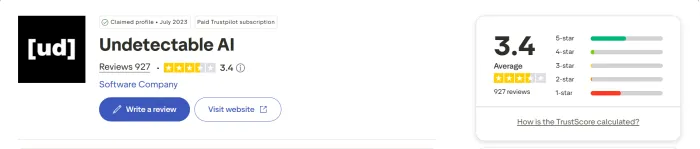
PUBLIC RATINGS AS OF JULY 2026
| PLATFORM | RATING | VOLUME | WHAT THE REVIEWS CLUSTER AROUND |
|---|---|---|---|
| Trustpilot | 3.5/5 ★★☆☆☆ | 950+ reviews | Deeply polarized: five-star reviews praise the support team by name; one-star reviews center on trial/billing surprises and text still being flagged. (Score as reported in spring 2026; it moves.) |
| G2 | 4.4/5 ★★★★☆ | 37 reviews | Small, verified, business-leaning sample. G2 category data: 9.1/10 ease of use, 8.4/10 quality of support. Critiques focus on grammar slips and mangled technical terms. |
| Capterra | Not yet rated ☆☆☆☆☆ | 0 reviews | Listed (from $9.99/mo) but no user reviews at the time of writing, so no signal either way. |
| This review | 2.5 / 5 ★★½☆☆ | 1 structured test | Failed both detectors tested; excellent speed and onboarding; output needed a human rewrite. |
OUR SCORECARD: HOW THE 2.5 BREAKS DOWN
| CRITERION | SCORE | NOTES FROM TESTING |
|---|---|---|
| Onboarding & ease of use | 4.0 / 5 | Google or email sign-in, straight to the dashboard, zero learning curve. |
| Speed | 4.5 / 5 | ~3-4 seconds to humanize my full story. Best-in-test moment. |
| Detector bypass (the core promise) | 1.5 / 5 | 96.5% AI on ZeroGPT, 77% on QuillBot from a 100% baseline. Two fails. |
| Output readability | 2.0 / 5 | The rewrite read worse than the ChatGPT original: clunky phrasing, broken flow. |
| Pricing & value | 2.5 / 5 | Fair per-word rates undermined by output you may have to redo; tiny trial. |
| Support reputation | 4.0 / 5 | Not tested directly, but it's the most consistently praised thing across 900+ public reviews. |
What users actually say
Paraphrased from public Trustpilot and G2 reviews (2025-2026), chosen to represent the recurring themes on each side.
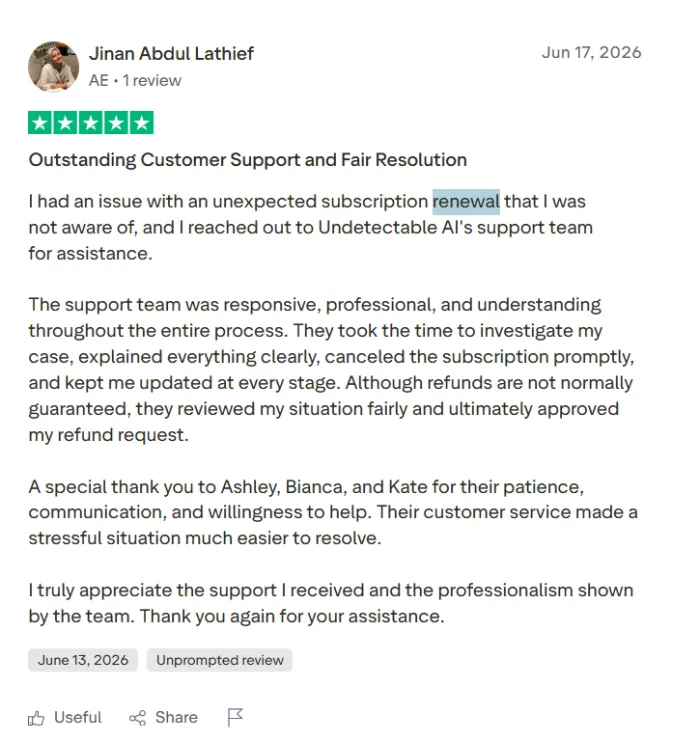
TRUSTPILOT ★★★★★ “Got hit with a renewal I wasn't expecting. Support investigated properly, explained everything, cancelled it, and approved my refund even though refunds aren't guaranteed, and kept me updated throughout.” Trustpilot reviewer · billing issue, resolved · paraphrased |
TRUSTPILOT ★★☆☆☆ “The support agent was professional and genuinely helpful; five stars for her. But I'm not happy with the Humanizer itself: the humanized text still comes back with AI detection scores.” Trustpilot reviewer · product complaint · paraphrased |
G2 · VERIFIED ★★★★☆ “I use it on work emails and messages so they don't come across as AI-generated. The person on the other end feels like they're actually talking to me. It keeps things personal.” Verified G2 reviewer · business user · paraphrased |
G2 · VERIFIED ★★★☆☆ “Rewrites sometimes need grammar tweaks, and with specialised or technical content it doesn't always pick the right terminology; those cases need a manual pass afterwards.” Verified G2 reviewer · mixed · paraphrased |
TRUSTPILOT ★★★★☆ “The platform is fast, clean, and simple to work with. It makes my writing sound more natural, and the experience has been smooth for what I need.” Trustpilot reviewer · positive product experience · paraphrased |
Star counts reflect the original ratings. The split mirrors the overall distribution: support and usability earn the praise; billing and detection results draw the fire.
Who this is for (and who it isn't)
REASONABLE FIT + People who mainly want the free unlimited detector + Low-stakes smoothing of emails or marketing copy, with a human edit after + Teams who verify every output against their own detector first + API users experimenting with humanization in a pipeline they control | POOR FIT x Students: integrity policies aside, 2026 tests show Turnitin catching a meaningful share of output x Anyone who needs detection bypass to work reliably, every time x Anyone who won't watch billing closely or read trial terms x Long-form or technical writing, where reviewers report the most quality damage |
Final verdict: a polished product with an unreliable core
Here's the uncomfortable summary. Everything around the main event is good: sign-up took seconds, the interface is clean, humanization ran in 3-4 seconds, the detector is free and unlimited, and support is, by a wide margin, the most praised thing in 900+ public reviews. This is a real company shipping a real product.
But a humanizer has one job, and in my test it left a 100%-AI story at 96.5% on ZeroGPT and 77% on QuillBot while making the prose worse. Independent 2026 testing lands in the same uncomfortable middle: partial success against detectors that have spent two years learning to catch exactly this kind of rewriting. And the most common complaint on record isn't even the technology; it's trials and billing.
2.5 out of 5. If you try it anyway, do it in this order: spend the small free trial on your actual content type, test the output against the specific detector you care about, screenshot everything for the money-back guarantee, and if you subscribe, start monthly, not annual, with a renewal reminder. That isn't cynicism; it's just the user-first way to buy this product.