
Publishing random blog posts no longer moves the needle. Search engines reward depth, AI-driven discovery rewards structure, and audiences expect complete answers instead of scattered fragments. The brands winning in this environment do not chase topics one at a time. They build their content around a clear, organized framework.
That framework is the content pillar. According to the Content Marketing Institute, 97 percent of B2B marketers now have a documented content strategy, yet only those who structure it around pillars see their content compound into long-term authority. The table below offers a quick reference before the deeper sections.
| Quick Question | Quick Answer |
|---|---|
| What is it? | A central, in-depth content piece that anchors a cluster of related articles |
| Why use it? | Build topical authority and capture self-directed buyer research |
| Who popularized it? | HubSpot, in 2017, in response to shifts toward semantic search |
| Core structure? | One pillar page + 10 to 15 cluster articles + consistent internal links |
| Time to results? | 4 to 6 months for first ranking gains; 7 to 12 months to hit full stride |
| Best suited for? | Brands seeking durable organic growth and long-term category authority |
Table 1. Content pillar at a glance: the essentials in plain language.
What Is a Content Pillar?
A content pillar is a core topic that anchors your content strategy. In SEO, it is a comprehensive pillar page supported by a cluster of interlinked articles. On social media, it is one of 3–5 recurring themes that keep your posts consistent, recognizable, and on-brand.
The concept was popularized by HubSpot in 2017, when search behavior began shifting toward longer, conversational queries. A content pillar gives search engines a clear signal of topical authority while giving readers a logical journey through a topic.
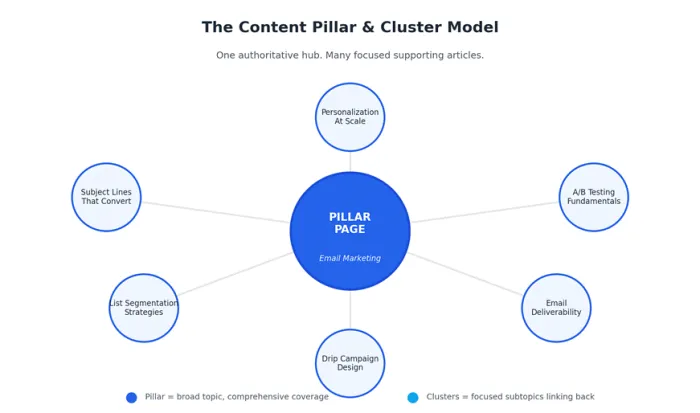
Figure 1. The hub-and-spoke structure that defines every effective content pillar.
The Two Meanings of Content Pillar
| SEO / Website Content Pillar | Social Media Content Pillar | |
|---|---|---|
| What it is | One long-form pillar page + 10–15 linked cluster articles | One of 3–5 recurring themes guiding your posts |
| Primary goal | Rank for competitive terms, build topical authority | Consistency, brand recognition, engagement |
| Typical quantity | 1–3 pillars to start, scaling to 5–8 | 3–5 themes per platform |
| Lives where | Your website / blog | Instagram, LinkedIn, TikTok, YouTube, X |
| Measured by | Rankings, organic traffic, backlinks | Engagement rate, reach, follower growth |
| Origin | HubSpot's topic cluster model (2017) | Social strategy / editorial theme planning |
Content Pillar vs Regular Blog Post
A standard blog post and a content pillar play different roles in a marketing ecosystem. The table below compares them across six dimensions that consistently matter to teams planning their strategy.
| Feature | Regular Blog Post | Content Pillar |
|---|---|---|
| Purpose | Addresses a specific question or angle | Covers an entire topic comprehensively |
| Length | Typically 800 to 1,500 words | Usually 2,000 to 5,000+ words |
| Keyword Focus | One primary long-tail keyword | Broad head term plus many supporting keywords |
| Lifespan | Often time-sensitive or trend-based | Evergreen and continuously updated |
| Structure | Linear and standalone | Hub-and-spoke with internal linking |
| Primary Goal | Capture short-term traffic | Build long-term topical authority |
Why Content Pillars Matter in 2026
Several long-running shifts in digital behavior have made content pillars more relevant than ever, summarized in the data below.
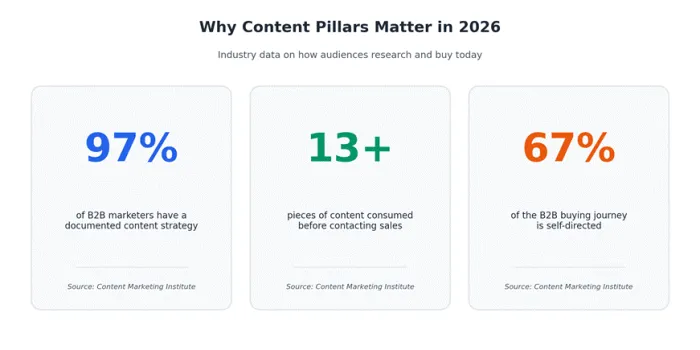
Figure 2. Key 2026 data points that underline the value of a pillar-based content strategy.
The first shift is self-directed research: B2B buyers now consume more than 13 pieces of content before contacting sales, and roughly 67 percent of the buying journey is completed independently. The second is the maturation of search algorithms, which now reward demonstrated expertise and clear semantic relationships rather than keyword density. The third is AI-driven discovery, where structured content with clear topical signals is far better positioned to be cited by generative search and AI summaries.
The Three Components of a Content Pillar
A complete content pillar strategy has three working parts. Each plays a distinct role, and none works as well in isolation.
1. The Pillar Page
The pillar page is the long-form anchor. It provides a broad overview of the central topic, addresses the major questions a reader might have, and outlines the subtopics covered in greater depth elsewhere. It is generally evergreen and designed to rank for a competitive head term such as email marketing or retirement planning.
2. Cluster Content
Cluster content consists of focused articles, videos, or guides that each tackle a specific subtopic within the pillar's umbrella. HubSpot recommends starting with 10 to 15 cluster articles per pillar. Pillars without enough supporting content rarely build the topical authority needed to compete on broad terms.
3. The Internal Linking Structure
Internal links hold the system together. The pillar links to every cluster article, and every cluster article links back. HubSpot's own experiments confirmed that more deliberate interlinking translated directly into higher rankings for the pillar page.
The Four Main Types of Content Pillars
Content pillars take several shapes depending on the platform, audience, and business goal. The table below outlines the four most common types and where each one fits best.
| Pillar Type | Primary Goal | Best Format | Example |
|---|---|---|---|
| Educational | Teach a topic in depth | Long-form guide or course | Complete Guide to Cybersecurity for SMBs |
| Thought Leadership | Establish authority through insight | Original research or POV piece | Annual State of the Industry Report |
| Product or Service | Educate prospects at consideration | Use-case pages, comparison guides | How CRM Software Solves Sales Bottlenecks |
| Social Media | Create recurring on-brand themes | Posts, reels, stories | Workouts / Nutrition / Transformations |
Table 3. The four most common pillar types, what they aim to achieve, and where they shine.
How to Analyze Competitor Pillars
A pillar strategy rarely succeeds in isolation. Before committing to a topic, map how competitors already cover it. Effective analysis answers two questions: who currently owns this space, and what can a new entrant do differently or better?
Mapping Competitor Coverage
Start with the three to five organizations that consistently rank on page one for the topic's head terms. For each, record format, length, freshness, internal linking depth, and the keywords they rank for. Tools like Semrush, Ahrefs, and Google Search Console accelerate this, but a manual review of two or three competitors usually reveals the pattern.
Identifying Content Gaps
The clearest opportunities come from subtopics competitors have ignored, addressed superficially, or covered with outdated information. Look for high-volume questions current pillars do not answer, audience segments competitors overlook, and stale statistics on otherwise strong pages. Each gap is a defensible angle for a new pillar or cluster.
How to Build a Content Pillar in Six Steps
Building an effective pillar is methodical work. The visual below summarizes the framework.
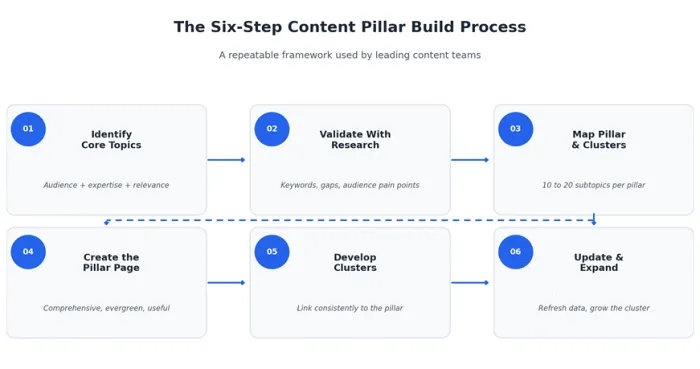
1.Identify your core topics. Pick themes at the intersection of audience interest, business expertise, and long-term relevance.
2.Validate with research. Confirm people are actively searching the topic. Review the questions your audience asks in support tickets, communities, and social media.
3.Map the pillar and clusters. List the central topic and the 10 to 20 subtopics that naturally branch from it. Each subtopic becomes a cluster article.
4.Create the pillar page first. Write a comprehensive overview that introduces every subtopic with descriptive subheadings, a table of contents, and concise paragraphs.
5.Develop and link cluster content. Publish cluster articles steadily, each linking back to the pillar with consistent anchor text.
6.Update and expand regularly. Refresh statistics, add new sections as the topic evolves, and integrate new clusters as the strategy matures.
A Sample Pillar Page Template You Can Reuse
Most pillars succeed or fail at the outline stage. The structure below is a flexible, reusable template that works across industries. Adjust the word counts to match the breadth of the subject.
| Section | Suggested Length | Purpose |
|---|---|---|
| Introduction or Hook | 100 to 200 words | Frame the problem and preview the answer |
| Definition or 'What is X' | 150 to 300 words | Establish the core concept clearly |
| Why It Matters Now | 200 to 400 words | Anchor in current data, trends, or pain points |
| Core Components | 300 to 500 words | Break the topic into its essential parts |
| Step-by-Step or How-To | 400 to 600 words | Make the content directly actionable |
| Common Mistakes | 200 to 300 words | Add nuance and earn reader credibility |
| Examples or Case Studies | 200 to 400 words | Show rather than tell |
| Measurement and Metrics | 200 to 300 words | Help readers track and improve outcomes |
| Conclusion or Takeaways | 100 to 200 words | Reinforce the key points and next step |
Table 4. A reusable section-by-section template for structuring a pillar page.
This is a starting framework, not a rigid rule. Adjust the ratio for research-heavy or technical pillars; the goal is balance between depth and readability.
Technical Foundations for Pillar Pages
Strong content alone does not guarantee performance. The technical layer determines how easily search engines and AI systems can interpret and surface a pillar.
Schema Markup
Structured data is one of the most underused signals available. For pillars, three schema types matter most. Article schema helps search engines categorize the content. FAQPage schema, applied to Q&A sections, often qualifies pillars for rich results and AI summaries. HowTo schema works for process-driven pillars. At least one relevant schema type is now table stakes.
Multi-Format Content
The most resilient pillars do not rely on text alone. Embedded videos summarize complex sections and reduce bounce rate, particularly on mobile. Interactive elements such as calculators or comparison sliders increase dwell time and earn natural backlinks. The pillar page is where this investment yields the strongest compounding return.
Common Content Pillar Mistakes to Avoid
Even well-designed pillar strategies underperform if a few key issues are overlooked. The four below appear most frequently in audits.
Building Too Many Pillars at Once
Spreading effort across too many topics is the most common mistake. Five focused pillars supported by strong clusters outperform fifteen shallow pillars every time. Depth signals authority; sprawl signals confusion.
Treating the Pillar as a Sales Pitch
Writing the pillar like a brochure is another common error. If the page reads as promotional, it will not earn the engagement, backlinks, or trust it needs to rank. The pillar's job is to educate first and convert second.
Inconsistent Internal Linking
If cluster articles do not consistently point back to the pillar with relevant anchor text, the topical authority signal weakens. Every cluster should reinforce the pillar, and the pillar should link out to each cluster.
Skipping Promotion and Updates
Publishing a pillar and walking away rarely works. Pillars need launch energy similar to a major product release, plus regular refreshes as statistics age and the topic evolves.
Implementation Challenges and How to Overcome Them
Even teams that understand the pillar model often struggle to execute. Each challenge below has a repeatable solution.
Limited Time and Budget
Content Marketing Institute research consistently identifies resource constraints as the top barrier. The pragmatic response is sequencing, not scaling. Commit to one pillar at a time, repurpose existing high-performing posts as the initial cluster set, and reserve net-new production for genuine gaps.
Securing Executive Buy-In
Pillars require sustained investment before producing clearly attributable returns. Frame the pillar as a long-term asset comparable to product investment, present a quantified competitive analysis, and plan for early proof points such as long-tail ranking gains within months one to three.
Maintaining Momentum Over Time
Many pillars stall after launch. Assign a single owner accountable for the pillar's growth. Build a quarterly review into the editorial calendar. Treat each pillar as a living asset with a roadmap, not a one-time deliverable.
Real-World Content Pillar Examples
The pillar model works across industries, brand sizes, and budgets. The examples below show how very different brands apply the same fundamental structure.
| Brand or Type | Pillar Theme | Format | Outcome or Approach |
|---|---|---|---|
| HubSpot | Inbound marketing, sales, service | Long-form web guides with linked clusters | Ranks for thousands of keywords; sustained traffic for years |
| HubSpot agency case study | Topic cluster implementation | Pillar page + supporting cluster articles | Organic traffic grew from ~500 to ~190,000 monthly visitors |
| Nike | Sport, performance, lifestyle | Recurring social media pillars | Diverse-feeling feed that stays unmistakably on-brand |
| Local financial advisor (SMB) | Retirement planning | Pillar page + niche subtopic articles | Establishes the go-to local authority on the subject |
Table 5. Content pillar examples across industries and company sizes.
Real-World Content Pillar Examples
| Industry | Example content pillars |
|---|---|
| SaaS | Product education · Industry benchmarks · Customer stories · Integrations/how-tos |
| Ecommerce (skincare) | Ingredient science · Routines by skin type · Before/after results · Sustainability |
| Fitness coach | Training tips · Nutrition · Transformations · Myth-busting |
| Real estate | Local market updates · Buying guides · Selling guides · Neighborhood spotlights |
| B2B agency | Original research · Frameworks/playbooks · Client case studies · Industry commentary |
| Creator/solopreneur | Core expertise · Behind the scenes · Lessons learned · Community Q&A |
Content Pillar Audit Checklist
Whether evaluating an existing pillar or planning a new one, the checklist below identifies the elements that consistently separate effective pillars from underperforming ones. Use it quarterly.
| Audit Item | Pass Criteria |
|---|---|
| Topic relevance | Pillar clearly addresses an audience pain point or major search intent |
| Depth and coverage | Every major subtopic a reader would expect is addressed |
| Cluster volume | At least 10 to 15 cluster articles support the pillar |
| Internal linking | Every cluster links back to the pillar with relevant anchor text |
| On-page SEO | Title tag, meta description, headings, and schema are optimized |
| Schema markup | Article, FAQ, or HowTo schema applied where relevant |
| Multimedia | Images, diagrams, or video included where they aid understanding |
| Update freshness | Statistics, examples, and references are from the past 12 to 18 months |
| Conversion path | At least one clear CTA matches the pillar's intent and audience |
| Mobile and performance | Renders cleanly on mobile and loads in under three seconds |
Table 6. A ten-point audit checklist for evaluating and improving any content pillar.
How to Measure Content Pillar Success
A pillar's performance should be evaluated over months, not days. The most useful metrics fall into three categories, summarized in the timeline below.
| Stage | Timeframe | What to Expect | Metric to Track |
|---|---|---|---|
| Foundation | Months 1 to 3 | Long-tail keywords index; baseline traffic appears | Indexed pages, impressions |
| Growth | Months 4 to 6 | Inflection point; rankings climb; clusters compound | Keyword rankings, organic sessions |
| Maturity | Months 7 to 12 | Page one positions; sustained traffic; conversions | Page-1 rankings, conversions |
| Compound | Year 2 and on | Backlinks accumulate; authority deepens; ROI scales | Backlinks, pipeline contribution |
Table 7. A realistic timeline of what to expect from a well-built content pillar.
Search Performance
Track keyword rankings for the pillar's primary term and the long-tail keywords its clusters target. Monitor organic traffic, impressions, and click-through rate over time.
Engagement
Time on page, scroll depth, and pages per session indicate whether readers actually find the pillar useful. Engagement is the leading indicator of long-term ranking durability.
Business Impact
Track conversions tied to the pillar: signups, demo requests, downloads, attributed pipeline. Well-built pillars convert at higher rates than typical blog posts because they reach readers already researching the topic.
Final Takeaways
A content pillar is more than a long blog post. It is a strategic asset that anchors a brand's expertise, gives audiences a clear path to information, and compounds in value as it matures. The principles are straightforward: choose topics that genuinely matter to your audience, analyze how competitors cover them and find the gap, build a comprehensive pillar page using a clear template, surround it with focused cluster content, and connect everything with thoughtful internal linking and structured data. Audit quarterly. The payoff is patient but durable, doing the kind of compound work paid media cannot replicate.