Every ad you remember, every email subject line that made you click, every landing page that nudged you toward a purchase, was built on a framework. Content writing frameworks are the proven structures that turn raw ideas into copy that moves the reader from headline to action.
They are not magic. They are not formulas that guarantee conversion. What they do is take the most fragile part of writing, the blank page, and replace it with a clear pattern of what comes first, what comes next, and what closes the deal. The result is faster drafts, sharper messages, and copy you can actually test and improve over time.
This guide walks through the major frameworks, compares the top three side by side, shows real-world examples from Dropbox to David Ogilvy, and ends with a decision flowchart you can use today. The data is sourced from working copywriters, industry agencies, and the original creators where possible.
THE NUMBERS BEHIND THE CRAFT
1898 AIDA framework created | 4 stages Attention, Interest, Desire, Action | 3 steps PAS and BAB structures | 16% Organic content conversion rate |
Sources: E. St. Elmo Lewis (1898), Digitaloft 2025 conversion rate benchmarks.
What Is a Framework?
A framework is a proven, repeatable structure for organizing persuasive copy. It tells you what comes first, what comes next, and what closes the deal. Frameworks turn the blank page into a fillable template, which is why even experienced copywriters lean on them every day.
Think of frameworks the way a chef thinks of a recipe. You still need taste, timing, and good ingredients. But the recipe means you do not have to reinvent the structure of a dish every time you cook. The same logic applies to copy. The opening hook, the build-up, the turn, and the call to action all sit in predictable places.
Every framework gives the writer four things:
•A clear opening move, so you never start with throat-clearing
•A defined middle, where most copy collapses without a structure
•A close that earns the click, the sale, or the signup
•A shared vocabulary, so teams can review and improve copy quickly
Why You Need a Framework
| Frameworks are not formulas. They are scaffolding that lets your voice carry weight. |
Writers who skip frameworks end up rewriting the same first paragraph fifteen times. Writers who use them know exactly what each section is meant to do, which frees the creative energy for the parts that actually need it: the voice, the imagery, the specific words.
| Outcome | Without a Framework | With a Framework |
|---|---|---|
| Time to draft | Slow, lots of staring at the blank page | Fast, structure tells you what comes next |
| Message clarity | Often wanders or buries the lead | One clear arc from headline to CTA |
| Reader engagement | Risk of losing them in paragraph two | Built-in pacing keeps eyes on the page |
| Conversion rate | Unpredictable, depends on instinct | More consistent, easier to test and improve |
| Skill transfer | Hard to teach a new team member | Anyone can learn the pattern in a day |
The other reason frameworks matter is measurement. When you write to a known structure, you can test variations on a single element, such as the headline, the agitation, or the call to action. Without a framework, A/B testing becomes guesswork because you cannot tell which variable made the difference.
How Content Frameworks Actually Work
Most frameworks are built on the same psychological foundation: pull the reader in, make them feel something, and then offer a path forward. The differences come down to where each framework places its emphasis.
AIDA emphasizes the funnel. It walks the reader through every stage from cold awareness to action. Best for full-length copy where you have room to build.
PAS emphasizes emotion. It hits the pain point first, makes it sting, then offers relief. Best for cold audiences who do not yet know they need you.
BAB emphasizes transformation. It paints a clear before and after, then names what closes the gap. Best for products that promise a visible change.
FAB emphasizes value. It translates technical features into customer benefits. Best for B2B and product-heavy copy where buyers compare specs.
The unifying idea across all of them is movement. Good copy never sits still. Every line should pull the reader toward the next one, and every section should make the next section feel inevitable.
Consider a simple example. Imagine you sell a budgeting app. With AIDA, you might open with a striking headline about money disappearing each month, then build interest with relatable spending stories, create desire by showing the calm of full financial control, and close with a free-trial CTA. With PAS, you would name the stress of unexpected bills, agitate the feeling of being financially behind, and offer the app as the way out. With BAB, you would paint a chaotic before, a peaceful after, and name the app as the bridge. Same product, three very different paths to the same click.
The Major Writing Frameworks
Most working copywriters know a handful of frameworks well and reach for whichever fits the project. The table below summarizes the most widely used.
| Framework | Full Name | Best For |
|---|---|---|
| AIDA | Attention, Interest, Desire, Action | Ads, sales pages, full-funnel content |
| PAS | Problem, Agitate, Solution | Pain-focused emails, landing pages |
| BAB | Before, After, Bridge | Short ads, social, case studies |
| FAB | Features, Advantages, Benefits | Product pages, B2B copy |
| 4 P's | Picture, Promise, Prove, Push | Long-form sales letters |
| ACCA | Awareness, Comprehension, Conviction, Action | Awareness campaigns, education |
| QUEST | Qualify, Understand, Educate, Stimulate, Transition | High-ticket B2B and consulting |
| 4 U's | Useful, Urgent, Unique, Ultra-specific | Headlines and subject lines |
AIDA, PAS, and BAB are the three you will use most often. Master those first. The rest are specialized tools for specific situations, much like a chef's collection of knives. You only need a few in daily use, but it helps to know they exist.
AIDA, PAS, and BAB Compared Side by Side
The clearest way to feel the difference between the three workhorse frameworks is to line them up by stage. The table below shows how each one moves the reader from opening to close.
| Stage | AIDA | PAS | BAB |
|---|---|---|---|
| Opening | Attention: grab eyes with a hook | Problem: name the reader's pain | Before: paint the current situation |
| Build-up | Interest: hold attention with value | Agitate: deepen the pain, raise stakes | After: show the better future |
| Turn | Desire: trigger the want | Solution: present the fix | Bridge: name what gets them there |
| Close | Action: clear CTA | Implicit CTA at the end | Implicit CTA at the end |
| Total steps | 4 | 3 | 3 |
| Length sweet spot | Medium to long | Short to medium | Short and punchy |
Notice the pattern. AIDA spreads the journey across four beats, which suits longer copy. PAS and BAB each use three beats, which gives them speed and impact. The choice often comes down to length and audience temperature. Cold audiences need the empathy of PAS. Warm audiences respond well to the aspirational pull of BAB. Mixed audiences usually need the full AIDA arc.
Fill-in-the-Blank Templates
Steal these. Replace the brackets, keep the structure, and you have a working first draft in minutes. Templates are starting points — rewrite the wording in your brand's voice once the skeleton is in place.
AIDA template
| Stage | Fill in the blank |
|---|---|
| Attention | "[Number] [audience] lose [time/money] to [problem] every [period]." |
| Interest | "Here's why it keeps happening: [root cause]. And it quietly costs you [specific cost]." |
| Desire | "Imagine [desired outcome] without [the pain]. [Product] makes that the default by [mechanism]." |
| Action | "[Verb] [offer] — [risk reversal]." |
PAS template
| Stage | Fill in the blank |
|---|---|
| Problem | "Still [painful situation] every [time period]?" |
| Agitate | "Every [period] you wait, [consequence] — and it compounds: [second consequence]." |
| Solution | "[Product] handles [the job] so you can [outcome]. [CTA]." |
BAB template
| Stage | Fill in the blank |
|---|---|
| Before | "Right now, [current painful state, described concretely]." |
| After | "Picture [specific better state, with one vivid detail]." |
| Bridge | "[Product/method] gets you there by [mechanism]. [CTA]." |
Which Framework Fits Which Content Type
No framework wins every situation. The table below maps the most common content types to the framework that tends to perform best.
| Content Type | Best-Fit Framework | Why It Works |
|---|---|---|
| Landing page (product) | PAS or BAB | Pain-then-fix matches landing-page intent |
| Sales email | AIDA | Full arc in one read, drives the click |
| Cold outreach | PAS | Empathy first, solution second |
| Product page | FAB | Translates specs into customer value |
| Long-form sales letter | 4 P's or QUEST | Built for sustained attention and proof |
| Headlines and subject lines | 4 U's | Forces useful, urgent, unique, specific |
| Case study | BAB | Before-after structure is the case study |
| Social post (short) | BAB or PAS | Three-step structures fit limited space |
Treat these as defaults, not laws. The strongest copywriters know the defaults so well that they can spot when breaking the pattern serves the message better.
More Specialized Frameworks
The big three cover most days. These seven cover the rest reach for them when the situation matches.
PASTOR — popularized by copywriter Ray Edwards, built for long-form emails and launch sequences where you have room to persuade slowly.
| Stage | What you write |
|---|---|
| Problem | Name the pain in the reader's own words |
| Amplify | Show what it costs to leave it unsolved |
| Story | A short account of someone who faced it |
| Transformation | The measurable change they experienced |
| Offer | What you're selling, stated plainly |
| Response | One clear, low-friction next step |
Example line: "Sarah spent two hours every Sunday on invoices. Now it's eleven minutes — here's what changed."
StoryBrand (SB7) — Donald Miller's narrative model. The customer is the hero; your brand is the guide. The seven beats: a character with a problem meets a guide, who gives them a plan, calls them to action, and shows what failure costs and what success looks like. Best for homepage messaging and brand scripts where a pitch-shaped framework feels too salesy.
Example line: "You didn't start a bakery to fight with spreadsheets. We'll handle the books — here's the three-step plan."
AIDCA — AIDA with a Conviction step inserted before Action: proof, testimonials, data, or a guarantee. Use it whenever the purchase requires trust — B2B, finance, health, anything high-ticket.
Example line: "Rated 4.8 from 2,100 teams, with a 60-day money-back guarantee" — that sentence is the C.
SLAP — Stop, Look, Act, Purchase. The scroll-speed framework: a pattern-breaking first line, one arresting visual or claim, a micro-action ("tap to see your score"), then the buy. Built for paid social and impulse-priced offers.
Star–Story–Solution — open with a character your reader recognizes (the star), tell their struggle honestly (the story), and reveal what resolved it (the solution). The soft-sell cousin of PAS; ideal for founder letters and case-study-led pages.
OATH — not a copy structure but a diagnostic. It sorts your audience into Oblivious, Apathetic, Thinking, or Hurting about the problem. Oblivious readers need education before persuasion; Hurting readers need the offer fast. Run OATH first, then pick the writing framework — it pairs directly with the selection guide below.
4 C's — Clear, Concise, Compelling, Credible. An editing checklist, not a drafting one. After writing with any framework above, pass every paragraph through the four C's and cut what fails.
The Trade-offs and Common Mistakes
Frameworks save you from blank pages. They do not save you from bad copy. Five mistakes show up over and over.
•Formulaic delivery. Lean on AIDA too literally and your copy starts reading like a script. The framework should be invisible to the reader.
•Skipping research. A great structure with weak audience insight produces polished nonsense. Frameworks scale your insight, they do not replace it.
•Forcing the framework. If your product solves a problem that does not feel painful, PAS will fall flat. Pick the framework that matches the truth of the offer.
•Weak agitation. PAS fails when the agitation feels manipulative or fake. Real pain points work. Invented pain points read as marketing speak.
•Buried CTAs. Even AIDA's final A gets forgotten. Make the action specific, visible, and easy. Vague calls to action kill conversion.
The deeper lesson is that frameworks are not a substitute for thinking. They speed up execution and reduce avoidable errors, but they do not tell you what your customer actually wants. That insight has to come from research, conversations, customer support transcripts, reviews, and time spent listening before you start writing.
Real-World Examples
The clearest way to learn a framework is to see it at work in famous copy. The three case studies below are from public, widely-analyzed examples.
CASE STUDY Dropbox's Iconic Homepage A textbook BAB structure that fueled rapid growth In its early years, Dropbox built a homepage that became a case study in transformation-led copy. The page painted a clear before, a clear after, and named the product as the bridge. •Before: The pain of emailing files to yourself, juggling USB drives, losing work across devices •After: Files sync automatically across every device, share with one link •Bridge: Dropbox does the syncing in the background, no manual work required •Format: Famous explainer video paired with simple homepage copy The Dropbox homepage is still cited in marketing courses as proof that BAB beats feature dumps when the audience is unsure why they need a product. |
CASE STUDY David Ogilvy's Rolls-Royce Ad The headline that built a copywriting legend David Ogilvy, founder of Ogilvy and one of advertising's most influential figures, wrote the 1958 Rolls-Royce print ad that ran with the headline: “At 60 miles an hour the loudest noise in this new Rolls-Royce comes from the electric clock.” •Framework: FAB in its purest form, feature into customer benefit •Feature: Exceptionally quiet engine engineering •Advantage: The car runs more quietly than any rival at highway speed •Benefit: A serene, status-defining driving experience Ogilvy spent three weeks researching the car before he wrote a word. The ad ran for years and is now studied in nearly every copywriting course in the world. |
CASE STUDY The Economist Subscription Campaigns AIDA at full length, for decades The Economist magazine has run some of the most studied direct response campaigns in history. The famous 1988 print campaign by AMV BBDO ran the headline “I never read The Economist. Management trainee, aged 42.” •Attention: Provocative, status-anxiety headline •Interest: The reader leans in to understand the joke and the implication •Desire: Triggers the want to be seen as informed and ambitious •Action: Subscription offer, clear and unambiguous The campaign helped grow The Economist's circulation for years and is still cited as one of the cleanest applications of the AIDA framework in print advertising. |
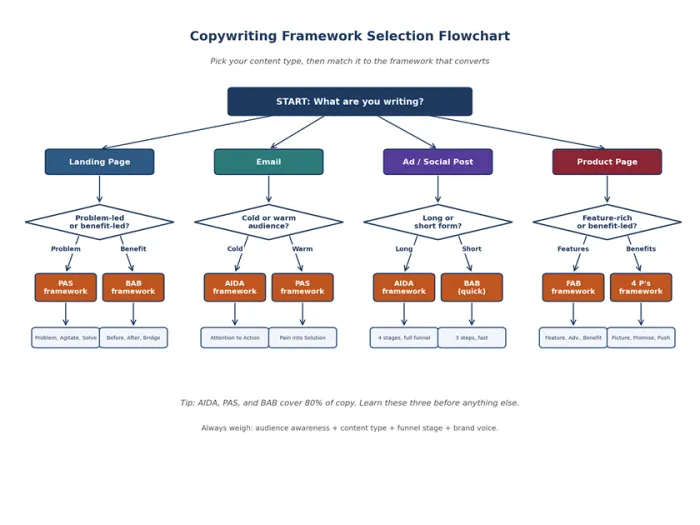
Framework Selection Flowchart
The visual below is a starting point, not a final answer. Use it as a first filter, then refine based on your audience, your funnel stage, and your brand voice.
Combining and Adapting Frameworks
Most experienced copywriters do not pick one framework and stay there. They blend two or three across a single piece of content. A common pattern looks like this.
•AIDA for the macro shape. Use the four stages to anchor the full arc of a sales page or long-form email.
•PAS for the opening hook. Open with a sharp problem-agitate sequence to pull cold readers in.
•BAB for the proof section. Use before-after stories as social proof in the middle of the page.
•FAB for the feature breakdown. Where you need to detail what the product does, translate features into benefits.
The key is to let the reader's journey lead. If a framework demands a beat that does not fit, drop the beat, not the message. The framework serves the copy, never the other way around.
A useful exercise is to draft the same piece using two different frameworks. The places where they diverge are usually the places where one structure fits your message better than the other. That comparison sharpens both the copy and your instinct for next time.
Industry Perspectives
Two well-known and verifiable statements from copywriting history capture the discipline at its core.
“If it doesn’t sell, it isn’t creative.” David Ogilvy, founder of Ogilvy and one of the most influential advertising executives of the twentieth century. The quote remains the field's most cited reminder that copywriting is a commercial craft first. |
“The mission of an advertisement is to attract a reader so that he will look at the advertisement and start to read it; then to interest him, so that he will continue to read it; then to convince him, so that when he has read it he will believe it.” E. St. Elmo Lewis, the American advertising and sales pioneer who first articulated the principles that became the AIDA framework in 1898. |
Both statements point at the same thing. Frameworks exist to do one job: move the reader. A framework without persuasion is a checklist. Persuasion without a framework is luck. The craft is in marrying the two.
How to Choose the Right Framework
Choosing a framework is part strategy and part instinct. Use these five questions as a filter.
•What is the action? Define the one thing you want the reader to do. The framework should make that action feel inevitable.
•How aware is the audience? Cold audiences need PAS. Warm audiences respond to BAB. Mixed audiences usually need AIDA.
•How long is the copy? Short formats reward three-step frameworks. Long formats reward four-step or longer arcs.
•What kind of decision is it? Emotional purchases respond to PAS and BAB. Rational purchases respond to FAB and 4 P's.
•What does your brand voice allow? PAS can feel aggressive for soft brands. BAB feels lighter. Pick a framework your voice can carry.
How to Use Frameworks With AI Writing Tools
AI drafting tools are only as structured as the prompt you give them. Ask for "a marketing email" and you get generic filler; name the framework and fill in the variables, and you get a draft that already has bones. These prompts are ready to paste — swap the brackets.
| What you want | Prompt to paste |
|---|---|
| Cold email (PAS) | "Write a cold email using the PAS framework. Problem: [pain]. Audience: [role, industry]. Product: [name + one-line description]. Agitate with one specific, concrete consequence. Under 120 words, one CTA: [CTA]." |
| Landing page hero (AIDA) | "Write landing-page hero copy using AIDA. Product: [name]. Audience: [who]. Attention = headline under 10 words. Interest = one sentence on the root cause of [problem]. Desire = one sentence on life after. Action = button text, 2–4 words." |
| Social post (BAB) | "Write a [platform] post using Before-After-Bridge. Before: [current pain]. After: [specific outcome with a vivid detail]. Bridge: [product + mechanism]. Under 80 words, conversational tone, no hashtags." |
| Product blurb (FAB) | "Write a product-page blurb using FAB. Feature: [spec]. Translate it into the advantage, then the customer benefit. Audience: [who]. Max 60 words." |
The Future of Frameworks
Frameworks are evolving fast in 2026 as content marketing meets AI tools and new attention patterns. Four shifts are worth watching.
AI-assisted drafting. Most modern AI writing tools default to AIDA, PAS, or BAB. Knowing the frameworks helps you prompt and edit the output.
Shorter forms winning. TikTok-style social copy and short emails favor three-step frameworks like PAS and BAB over longer arcs.
Story-led frameworks gaining. StoryBrand and similar narrative frameworks are pulling market share from pure-pitch templates.
Personalization replacing universality. The same framework now gets rewritten per segment, per channel, per intent. Frameworks are the engine, not the output.
The good news for working writers is that the fundamentals do not change. A reader in 2026 still scans the headline, decides in seconds whether to keep reading, and clicks only when the message lands on something they care about. Frameworks codify that human pattern. The tools and channels evolve, but the psychology underneath stays remarkably stable.
KEY TAKEAWAYS 1. A content writing framework is a proven structure for moving a reader from headline to action. 2. AIDA, PAS, and BAB cover roughly 80 percent of everyday copywriting needs. 3. Match the framework to the content type. Landing pages want PAS or BAB. Emails want AIDA. 4. Frameworks are starting points, not cages. Great copy follows the structure invisibly. 5. Test, measure, iterate. The same framework can produce a flop or a winner depending on execution. 6. Pair frameworks with strong research about your audience. Structure cannot save you from a weak insight. |