I signed up for Writeless and typed in the least serious topic I could think of: Reviewing Water After 22 Years of Drinking It. That was deliberate. A joke topic makes template writing easy to spot, and I wanted to see whether the tool would blink. It did not blink. Six screens and one loading bar later, I was reading a perfectly straight-faced 500 word personal statement about hydration, with a Harvard citation to a real Springer paper at the bottom and an upgrade modal sitting between me and the save button.
This review walks through the whole thing exactly as I experienced it. Every claim below is either something I saw on my own screen or something I checked afterward.
QUICK VERDICT: 3 out of 5. The guided setup is well designed and the citation controls beat most competitors. But the essay gets locked behind a paywall on your very first run, the prose is formulaic, and the flagship premium feature exists to beat AI detectors, which is the wrong reason to use any writing tool. Good for outlines and structure. Not a shortcut for submitting work.
Writeless AI review summary
| CATEGORY | RATING | THE SHORT VERSION |
|---|---|---|
| Ease of use | 4.5 / 5 | Six clear steps, no confusion anywhere |
| Setup options | 4 / 5 | Custom types, custom tones, and rare citation filters |
| Output quality | 2.5 / 5 | Coherent but formulaic, one source overworked |
| Citations | 3.5 / 5 | Real and correctly formatted, but just one, everywhere |
| Free plan value | 2 / 5 | Generate yes, keep no |
| Marketing honesty | 1.5 / 5 | Undetectability claims and a lopsided comparison table |
| Overall | 3 / 5 | Useful scaffold, misleading pitch |
My test setup
| SETTING | WHAT I CHOSE |
|---|---|
| Topic | Reviewing Water After 22 Years of Drinking It |
| Paper type | Personal Statement |
| Writing style | Standard |
| Length | Short, 500 words (1 page) |
| Citations | 1 source, Harvard style, minimum year 2014 |
| Plan | Free |
How I checked this review
| LABEL | WHAT IT MEANS |
| TESTED FIRSTHAND | Something I personally encountered while using Writeless |
| OFFICIAL CLAIM | Something currently stated by Writeless itself |
| EXTERNAL CHECK | Information checked against another independent source or public review platform |
| PEER-REVIEWED EVIDENCE | Findings drawn from published academic research |
| NOT TESTED | A product feature or limit I could see advertised but did not personally put through a full test |
This distinction matters because a product review can easily blur together what the company claims, what a reviewer personally observes, and what outside evidence supports or challenges. The rest of this review keeps those categories separate.
What is Writeless AI?
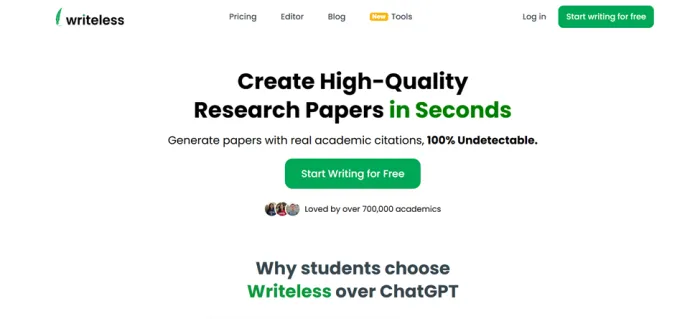
Writeless is a web app built around one job: turning a topic into a structured academic paper. The marketing site keeps things simple, with Pricing, Editor, and Blog in the navigation plus a Tools section flagged as new. The homepage promise is bold: create high quality research papers in seconds, with real academic citations, and the phrase "100% Undetectable" right in the subheading. It also claims to be loved by over 700,000 academics, a figure I could not verify anywhere.
Inside the app you get a clean sidebar with New, Essays, and Summarize, and after you generate something, a Research item shows up there too. The core product is a six-step wizard followed by a built-in editor.
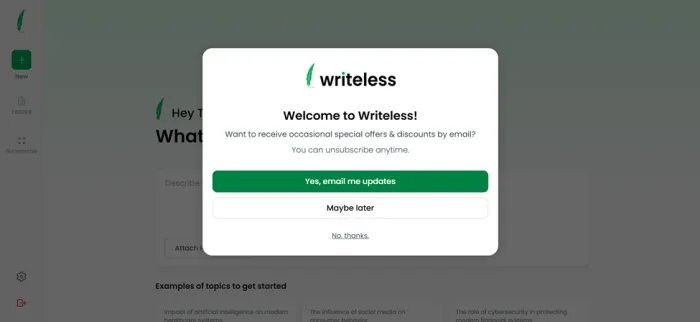
SMALL THING, NOTED: The first screen after account creation is a welcome popup asking whether you want occasional offers and discounts by email, with three choices: yes, maybe later, or a plain no thanks link. Plenty of tools quietly auto-subscribe you, so asking upfront is a small point in its favor.
The six-step walkthrough
Step 1: your topic
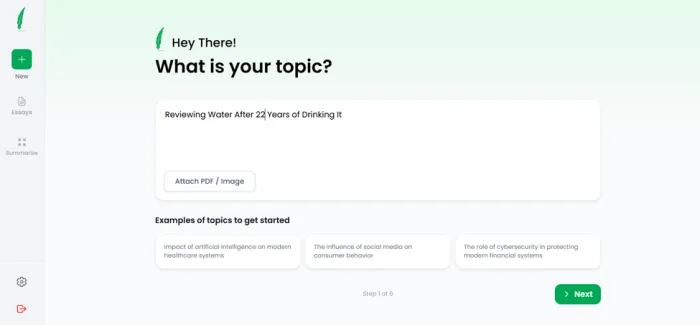
A large text box, an Attach PDF / Image button for adding your own source material, and three example prompts underneath (AI in healthcare, social media and consumer behavior, cybersecurity in finance). I typed my water topic and moved on.
Step 2: paper type
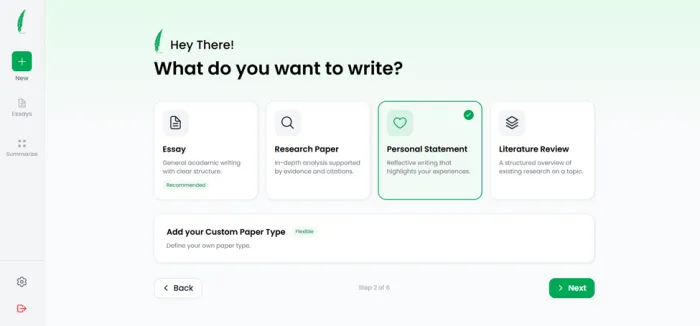
Four cards: Essay (tagged as Recommended), Research Paper, Personal Statement, and Literature Review, each with a one-line description. Below them sits a Custom Paper Type field, tagged Flexible, where you define your own format. I picked Personal Statement, mostly because I wanted to see what reflective writing about drinking water could possibly look like.
Step 3: writing style
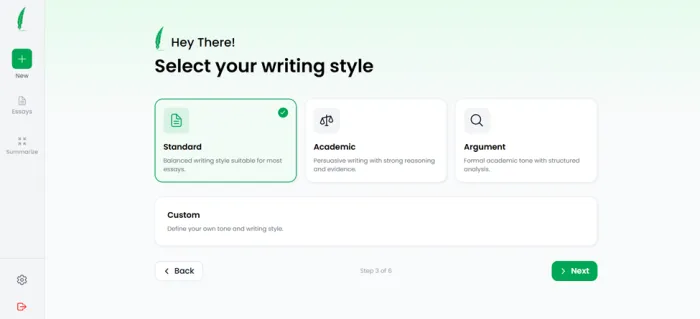
Standard, Academic, or Argument, plus a Custom box where you describe your own tone. I chose Standard. Keep that choice in mind, because it comes back in a minute.
Step 4: length
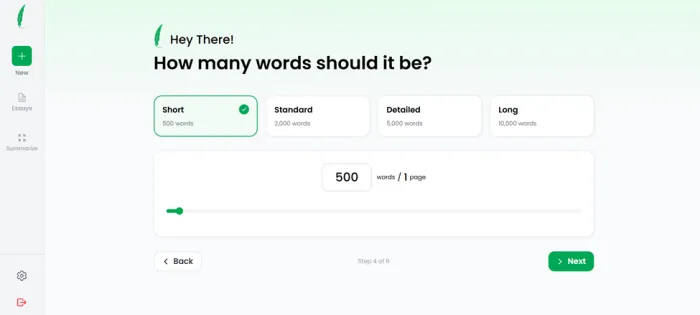
Presets for Short (500 words), Standard (2,000), Detailed (5,000), and Long (10,000), with a slider underneath and a live page estimate next to the number. The homepage claims papers can run up to 20,000 words. I stayed at 500 because I was not about to read a novella on hydration.
Step 5: citations
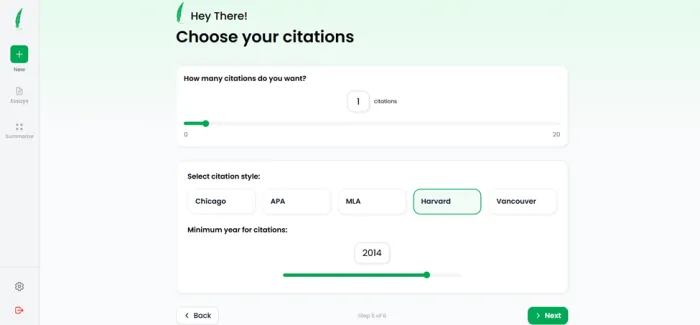
The best screen in the product. You get a slider for citation count from 0 to 20, five style options (Chicago, APA, MLA, Harvard, and Vancouver), and a second slider that sets a minimum publication year for sources. I asked for exactly one Harvard citation no older than 2014. Very few essay generators let you filter references by recency, and for anyone doing legitimate background reading, that filter is genuinely useful.
Step 6: ready to generate
A summary card lists everything you chose, and above it sits the upsell: a Premium feature called Humanize writing, described in the app's own words as one that "Rewrites AI-generated text so it reads naturally and bypasses AI detectors." There is a full section on that phrase further down.
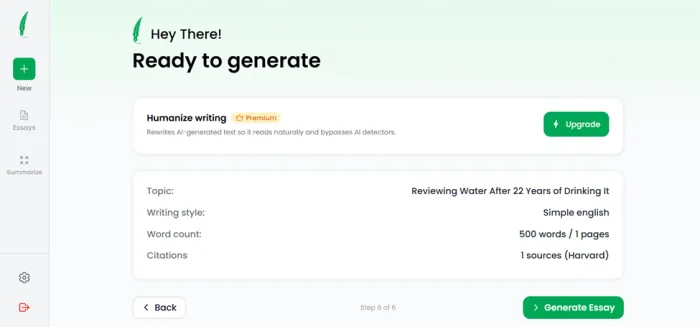
Two small quality slips on that last screen: my writing style, which I had set to Standard, was now listed as "Simple english," and the summary read "1 sources" and "1 pages." Minor, but on the final confirmation screen of a paid product, polish matters.
I pressed Generate Essay, watched a progress bar labeled "Searching for references" climb from 10 percent, and the essay appeared.
What the essay actually looked like
The output opened in a proper editor: font picker, bold, italic, underline, strikethrough, color and highlight controls, four heading levels, lists, alignment, and link insertion across the top, plus a floating action bar along the bottom with Customize, Rewrite, Add Cite, Personalize, Longer, and Shorter. As an editing environment, it is more complete than I expected from an essay generator.
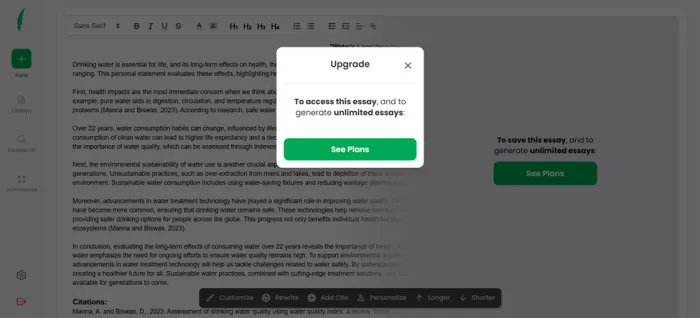
The essay itself, titled around water's long-term impact, followed a textbook scaffold: an introduction, a paragraph on health impacts, one on how consumption habits change over 22 years, one on environmental sustainability, one on water treatment technology, and a conclusion. The transitions were the giveaway: First, Next, Moreover, In conclusion, in that exact order. Nothing was wrong with any individual sentence. Nothing was interesting about any of them either.
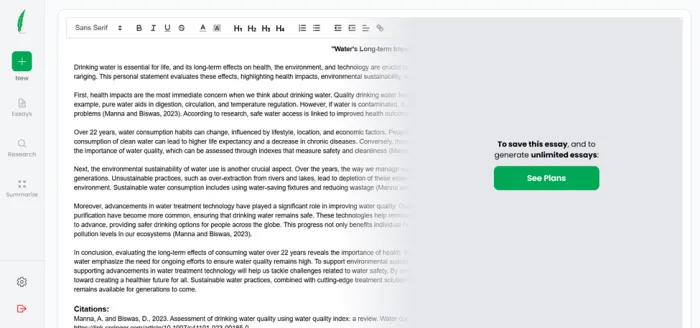
DID IT HANDLE THE JOKE TOPIC? It took Reviewing Water After 22 Years of Drinking It completely seriously and quietly flattened it into a generic statement about hydration and water quality. Coherent, yes. But the odd premise, the one thing that made the topic mine, disappeared entirely. That tells you a lot about how the templates behave with anything unusual.
The citation was real

My single Harvard reference was Manna and Biswas, 2023, a review of drinking water quality assessment using the water quality index. I looked it up afterward. It is a genuine peer-reviewed paper published in Water Conservation Science and Engineering, a Springer journal, and the in-text citations matched the reference list. That is a meaningful pass, because invented references are the single most common failure in AI academic writing. The catch: that one source carried the entire essay, cited in nearly every paragraph. One real reference stretched across five paragraphs is not research, it is decoration.
Then the paywall
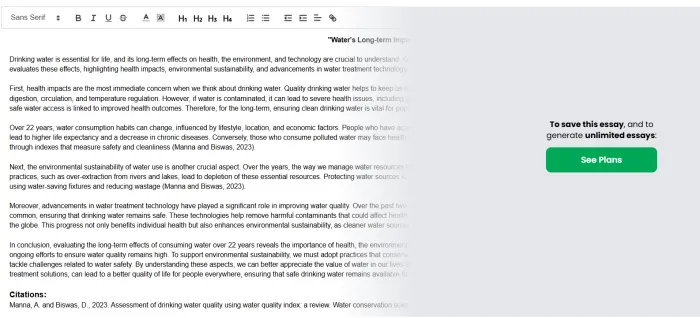
Before I could save the essay, an upgrade modal appeared: to access this essay, and to generate unlimited essays, see plans. Closing the modal left the text only partially readable, with the right side of the screen still pushing a See Plans button and part of the essay obscured. On the free run, I never got a clean, complete copy of the essay I had just configured and generated. Other independent reviewers report the same preview-only frustration, so this is the designed behavior, not a glitch on my account.
Marketing claims vs what I actually saw
The homepage features a side-by-side comparison table against ChatGPT. Here is how the claims held up against my test.
| THE CLAIM | WHAT I FOUND |
|---|---|
| Real academic references from scholarly databases | True in my test. The one reference was a real 2023 Springer paper. Sample size of one, so verify every citation yourself. |
| In-text citations in MLA, APA, Harvard, Chicago, or Vancouver | The Harvard formatting in my essay was correct, both in-text and in the reference list. |
| Papers up to 20,000 words | The controls support it. I only tested 500 words, so I cannot speak to quality at length. |
| "100% Undetectable" and fully humanized | Could not test, because Humanize is a paid feature. No tool can honestly promise this, and at least one independent tester reports the opposite result. |
| Loved by over 700,000 academics | No source given anywhere. Treat it as decoration. |
| ChatGPT is limited to 3,000 words and contains plagiarized content | These read like marketing, not measurement. ChatGPT is not capped at 3,000 words in any current version, and the plagiarism claim comes with zero evidence. A comparison table this one-sided hurts credibility more than it helps. |
Three claims worth separating
| CLAIM OR FEATURE | WHAT WRITELESS CURRENTLY SAYS | WHAT THE EVIDENCE ADDS |
| “100% Undetectable” | Writeless continues to market its essay generator around undetectability | Turnitin now explicitly detects likely use of AI bypasser tools, while independent research shows detector results themselves are imperfect |
| Up to 20,000 words | Current Writeless pricing material advertises papers up to 20,000 words | My test was only 500 words, so this remains a feature-limit check, not a long-form quality test |
| Up to 20 citations | Current paid-plan material advertises up to 20 citations per essay | My test used exactly one citation, so citation quantity at the maximum setting was not tested |
Writeless still publicly markets its product using “100% undetectable” language, including claims around passing AI detectors. Its current pricing material also continues to advertise the 20,000-word and 20-citation limits.
The important distinction is advertised capability versus tested performance. I confirmed what happened during my own 500-word, one-citation run; the larger limits in this table are product claims, not things I personally stress-tested.
About the word “undetectable”
The homepage leads with undetectability, the comparison table repeats it, and the final step of the wizard sells a premium Humanize feature built specifically to get past AI detectors. Here is the problem: whether a detector flags your paper has nothing to do with whether submitting it is allowed. At most schools and universities, handing in undisclosed AI-generated work is a misconduct issue on its own, detected or not. Detectors are also unreliable in both directions, which means a 100 percent guarantee is a promise no product can keep, and one independent review I read claims the output gets flagged anyway.
There are honest ways to use a tool like this: seeing how a literature review is structured, generating a scaffold you then rewrite completely in your own words, or finding one real paper to start your actual reading. The product's own marketing points users somewhere else, and that is a real mark against it, not a footnote.
What has changed in AI detection?
| DATE | CHANGE | WHY IT MATTERS HERE |
| July 2024 | Turnitin separated likely AI-generated text from likely AI-generated text that had been AI-paraphrased | “Humanizing” or paraphrasing AI text does not automatically put it outside detector systems |
| July 2024 | Turnitin stopped displaying exact scores between 1% and 19%, citing the possibility of false positives | A detector result is not the same thing as proof of authorship |
| August 2025 | Turnitin added detection aimed at the likely use of AI bypasser tools | Tools marketed around bypassing detectors are now part of what detection systems explicitly look for |
| February 2026 | Turnitin updated its model again to improve recall while maintaining a low false-positive rate | Detector performance is a moving target, so an “undetectable” result today cannot guarantee the same result later |
Turnitin's own release history shows that AI detection is continuously being updated. It also says an AI-writing score should not be used as the sole basis for adverse action against a student. That makes a permanent “100% undetectable” promise particularly difficult to defend: both the writing systems and the detectors continue to change.
Pricing and the free plan
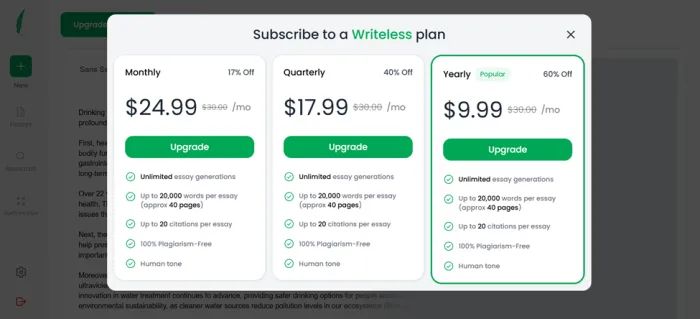
What I can confirm firsthand: signup is free, the full six-step wizard is free, generation is free, and saving or fully accessing the result is not. The Humanize feature is also premium.
I did not subscribe, so for paid pricing I checked what other current reviews report. The figures vary between sources, which is itself worth knowing, but the pattern is a subscription that gets cheaper with longer commitments. Here is the reported shape of it.
| PLAN | REPORTED PRICE | WHAT IT REPORTEDLY INCLUDES |
|---|---|---|
| Free | $0 | One essay generation with preview-only access, no saving or copying |
| Monthly | About $24.99 per month | Unlimited essays, up to 20,000 words and 20 citations per essay, the Humanize rewriter |
| Quarterly | About $17.99 per month, billed quarterly | Same features at a lower effective rate |
| Yearly | About $9.99 per month, billed annually | Same features at the lowest effective rate |
These figures come from independent reviews current at the time of writing, and they do not fully agree with each other, with one outlet reporting $30 per month. The official pricing page loads its numbers inside the app, so confirm the live price before paying, and note that at least one reviewer complains about the gap between the advertised annual rate and the real monthly price.
Pros and cons
| WHAT WORKED | WHAT DID NOT |
|---|---|
| The six-step setup takes under two minutes and never feels confusing | A paywall lands before you can save or fully read your very first essay |
| Citation controls most rivals skip entirely: count, five styles, and a minimum year filter | My Standard style choice showed up as Simple english in the final summary |
| Custom paper type and custom tone fields for formats outside the presets | One source carried the whole essay, cited in almost every paragraph |
| You can attach a PDF or image as source material right at the topic stage | Formulaic structure and connective tissue: First, Next, Moreover, In conclusion |
| The single citation in my test was a real, correctly formatted published paper | The undetectability marketing overpromises and invites misuse |
| The built-in editor with one-click Rewrite, Longer, Shorter, and Add Cite is handy | The ChatGPT comparison table overstates its case badly |
Writeless reviews across platforms
Everything in this section is real and attributable: a platform-by-platform snapshot first, then individual user voices paraphrased from public reviews. No invented testimonials.
| PLATFORM | TYPE | THEIR TAKE |
|---|---|---|
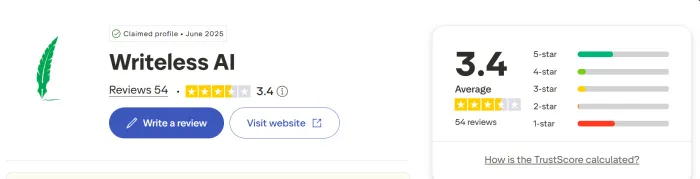
| Trustpilot | User reviews | 54 reviews at the time of writing, sharply split: praise for real citation links and time saved, against complaints about generic output, detection failures, and refunds |
| ScamFighter | Independent tester | The free plan's preview-only access made the generated paper unusable for them, and they are openly skeptical of the detection-proof claims |
| AutoGPT | Independent tester | Found signup and the wizard smooth, documented the same email popup and PDF upload I saw, but advises most people not to pay unless they write constantly |
| AIDetectPlus | Independent tester | Reports output regularly flagged by AI detectors despite the marketing, plus complaints about support and refunds |
| AIChief | Editorial review | Calls it a practical, no-frills essay generator that suits simple citation-backed drafts |
| Slashdot | User review | A paying user describes inaccurate responses and incoherent information that did not justify the cost |
Trustpilot ratings at a glance
Snapshot checked: August 19, 2026
| RATING | SHARE OF REVIEWS |
| ★★★★★ | 39% |
| ★★★★☆ | 9% |
| ★★★☆☆ | 9% |
| ★★☆☆☆ | 2% |
| ★☆☆☆☆ | 41% |
At the time of this update, Trustpilot lists 54 Writeless AI reviews and a 3.4/5 score, with 18 reviews posted in the previous 12 months. The distribution is more revealing than the average: 39 percent are five-star reviews while 41 percent are one-star reviews. In other words, the public feedback is heavily concentrated at the two extremes rather than clustering around the middle.
IMPORTANT CONTEXT: These are user-submitted reviews, not controlled product tests. Trustpilot itself notes that reviews express individual users' opinions. The figures are useful for showing the pattern of customer sentiment, not for proving whether any individual product claim is true.
What users are saying
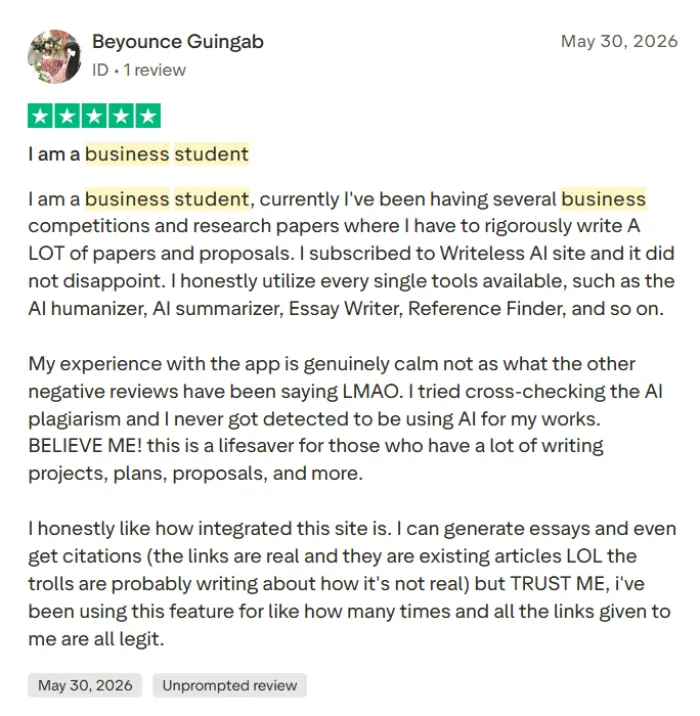
TRUSTPILOT · POSITIVE A business student on a paid plan says the citation links in their essays pointed to real, existing articles, their work was not flagged, and the combined tools carried them through a heavy semester of papers and proposals.
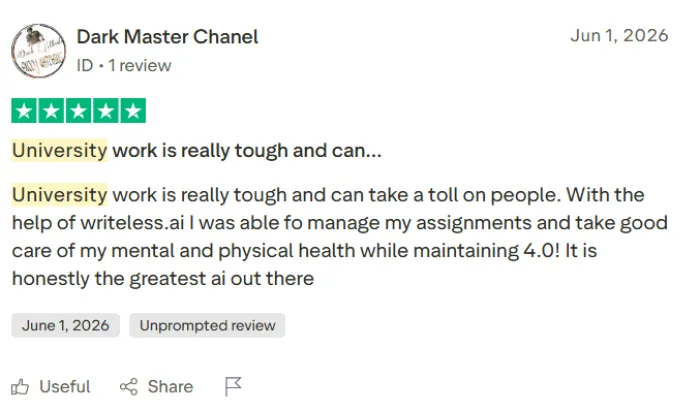
TRUSTPILOT · POSITIVE Another student reviewer says the reference generation alone nearly justified the subscription during a stretch of endless university papers.
TRUSTPILOT · NEGATIVE A paying customer reports the reverse arc on detectability: essays that passed at first later started scoring as fully AI-written, followed by prompts to upgrade again, despite paying for the undetectability promise in the first place.
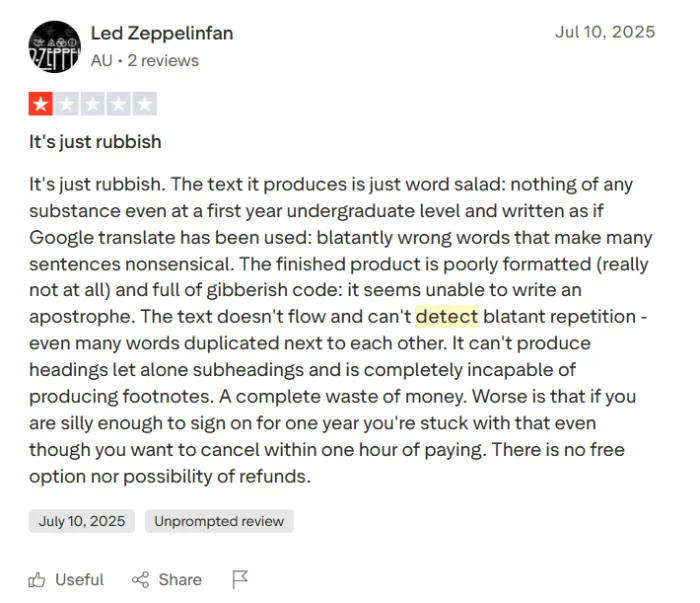
TRUSTPILOT · NEGATIVE One buyer says they spent $30 and got output that mostly restated their question as statements, and calls the purchase a waste.
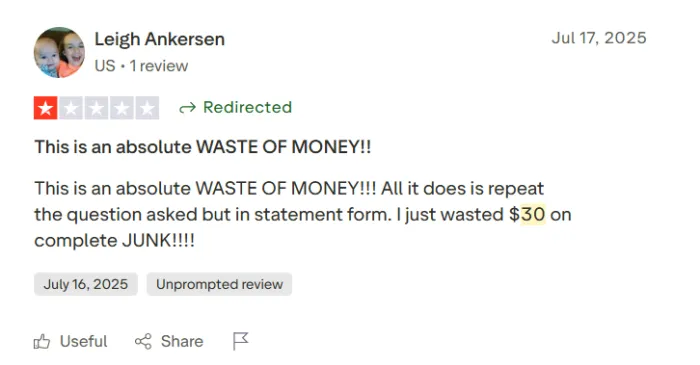
Put together, the platform pattern matches my own run: smooth setup, citations that can be real, quality that thins out fast, and an undetectability promise that keeps breaking.
Who should use Writeless, and who should not
A reasonable fit: someone who wants a structured scaffold to rewrite entirely in their own words, someone studying how papers in an unfamiliar format are organized, or someone who wants a real starting reference filtered by year before doing their own reading.
A bad fit: anyone planning to submit generated output as their own work. That is a policy violation at nearly every institution regardless of what any detector says, and buying an undetectability promise does not change it.
Final verdict after actually using it
After a full run, my honest read is this: Writeless is a well-built wizard wrapped around ordinary AI prose, sold with a claim it should drop.
The setup flow is the best thing about it. The citation year and style filters are genuinely useful, and my single reference checking out as a real Springer paper matters, because that is exactly where most essay generators fall apart. But the writing itself was a template with my topic poured into it, one source got stretched across every paragraph, and the product asked me to pay before I could even keep the 500 words I had just configured. My style setting changed names between screens. And the loudest promise on the homepage, undetectability, is one no product can keep and no student should want kept.
Use it the honest way, as a scaffold and a citation finder whose every output you verify and rewrite yourself, and it earns its three stars. Buy it to sneak past a detector, and you have paid real money for a promise that misses the point entirely.
OVERALL: 3 / 5 Useful scaffold, misleading pitch.