Plenty of teams can produce content faster than ever. Far fewer produce content that actually gets traction. The usual culprit is not effort or word count, it is sameness: a draft spun up in seconds that reads like the dozen pages already ranking for the same query, with nothing a reader could not find somewhere else.
That gap, between content that merely exists and content that holds its own, is where these two tools split. Writenexa is a managed service that puts human writers and editors to work alongside AI. Redeepseek is an AI assistant a person runs solo. Choosing between them is mostly a question of how much work stays on the team once the first draft lands.
What Writenexa and Redeepseek Actually Are
Writenexa positions itself as a specialist content partner for research-heavy, SEO-aligned long-form writing produced by humans with AI support. The model is done-for-you. A brief goes in, and a finished, edited asset comes back, shaped by people who check facts, tighten structure, and align the piece with search intent before it ships.
Redeepseek sits in a different category. It presents itself as an intelligent AI companion, a single chat workspace for generating content, writing code, analyzing documents, interpreting images, and running web search with cited sources. It also offers a set of role-based assistants, from SEO specialists to subject teachers, that a person can prompt directly. The model is do-it-yourself. A prompt goes in, a draft comes back in seconds, and the user handles everything after that.
Because of this, the useful question is less about which tool writes better and more about which delivery model fits the job. The table below frames the core distinction.
| Dimension | Writenexa | Redeepseek |
|---|---|---|
| Category | Managed human and AI content service | Self-serve AI assistant platform |
| Primary output | Edited, ready-to-publish long-form content | On-demand drafts, answers, and research |
| Who drives it | A writing and editing team | The individual user |
| Turnaround | Project-based | Instant |
| Platform maturity | Established content operation | Newer platform, recently launched |
| Best suited for | Brands needing reliable, ready-to-publish content | Users needing fast self-serve drafting and research |
How They Score Head to Head
The Content Outcome Scorecard rates each option on seven dimensions that decide whether content actually performs, not just whether it gets produced. Each dimension is scored from 1 to 10, based on hands-on evaluation of public-facing capabilities, sample outputs, available documentation, and benchmarking against established players in each category. The scores reflect editorial judgment rather than vendor-supplied metrics.
| Evaluation Dimension | Writenexa | Redeepseek | Edge |
|---|---|---|---|
| Output Quality and Editorial Depth | 9.0 | 7.0 | Writenexa |
| SEO and Search Alignment | 9.0 | 7.0 | Writenexa |
| Speed and Turnaround | 7.0 | 9.0 | Redeepseek |
| Ease and Self-Serve Access | 7.0 | 9.0 | Redeepseek |
| Accuracy and Reliability | 9.0 | 7.0 | Writenexa |
| Customization and Brand Fit | 9.0 | 7.0 | Writenexa |
| Accountability and Support | 9.0 | 6.0 | Writenexa |
| Overall Average | 8.4 | 7.4 | Writenexa |
Writenexa leads on the dimensions tied to whether content holds up after it is published: depth, accuracy, brand fit, and accountability. Redeepseek wins clearly on speed and self-serve convenience, which is exactly what a fast-moving solo operator or a small team often needs. Neither score is a knockout. The gap reflects two tools built for different jobs rather than one tool being broadly weak.
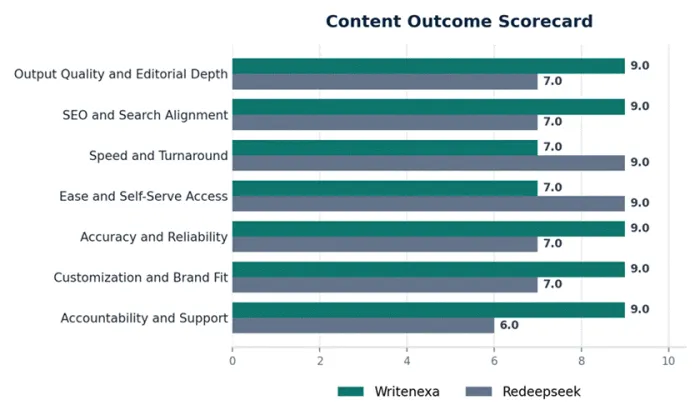
Higher is better. Scores reflect editorial assessment across seven dimensions, out of 10.
Writenexa
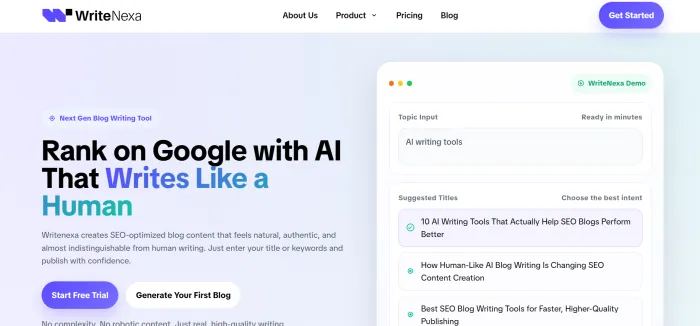
Writenexa is built for organizations that treat content as an asset rather than filler. Its core promise is in-depth, search-focused writing where a human editorial layer sits on top of AI assistance. In practice, that means a brief is turned into a structured draft, then refined by people who verify claims, tighten the flow, and line the piece up with what searchers are actually after before it goes live. The AI speeds up production, but the human review is what separates a piece that earns its ranking from a piece that reads like a template.
Where Writenexa stands out
The value shows up most in competitive niches, where thin or generic content stalls. A human pass catches the vague phrasing, unsupported claims, and weak structure that pure generation tends to produce, which is precisely what search engines and readers reward when they spot the difference.
Strengths
• A human editorial layer catches the generic phrasing and thin claims that quietly hurt rankings.
• Purpose-built for long-form SEO, so structure and search intent are handled by design rather than bolted on afterward.
• Output arrives closer to publish-ready, which reduces the internal editing load on the buying team.
• Pieces are tailored to a brief and brand voice, with room for revision before sign-off.
• Clear accountability, because a defined team owns the deliverable and the outcome.
Things to keep in mind
• It is not instant. A managed service runs on turnaround time, not on seconds, so it suits planned content more than last-minute needs.
• Pricing is quote-based rather than a fixed public tier, which fits custom work but means a short scoping conversation up front.
Redeepseek

Redeepseek takes the opposite approach. It is a self-serve AI assistant that places content generation, code help, document analysis, image interpretation, and cited web search inside one chat interface. Alongside the main workspace, it offers role-based assistants that users can prompt directly. The appeal is immediacy and breadth: one tool, no setup, and a draft or answer in seconds.
It is also a young platform. Public documentation is limited, and independent commentary describes it as an emerging service that is still maturing. That is not a disqualifier, but it does mean outputs are best verified before they are relied on, and it explains why its accountability score sits lower than that of an established operation.
Where Redeepseek stands out
For someone who is comfortable steering AI and editing the result, Redeepseek removes friction. There is no brief to write and no wait, and the same workspace can move from a blog outline to an email draft to a quick code question without switching tools.
Strengths
• Instant output and a near-zero learning curve, which makes it easy to start and iterate quickly.
• Versatile across drafting, research, code help, and document analysis in a single interface.
• Web search with cited sources helps trace where answers come from.
• Free, low-friction access lowers the barrier to testing it on real tasks.
• A privacy-forward stance on how user data is handled.
Things to keep in mind
• Drafts still need human editing and fact-checking before they are published.
• As a newer, less-documented platform, its reliability and long-term stability are less proven than established options.
• A general assistant is not purpose-built for in-depth content that has to compete in search, the way a dedicated content service is.
• It is often confused with DeepSeek, a separate AI lab, which can muddy expectations about what it is.
Feature and Capability Comparison
The scorecard measures outcomes. The matrix below maps the concrete capabilities each option brings, which is useful when matching a tool to a specific workflow.
| Capability | Writenexa | Redeepseek |
|---|---|---|
| Human editing and quality assurance | Yes | No |
| Long-form SEO structure | Yes, core focus | Partial, with prompting |
| Instant output | No | Yes |
| Self-serve, no brief required | No | Yes |
| Research with citations | Partial, human research | Yes, cited web search |
| Code and document analysis | No, content focus | Yes |
| Brand voice and revision rounds | Yes | Partial, by re-prompting |
| Accountable point of contact | Yes | No |
| Free to start | No | Yes |
Which Option Fits Which Need
The right pick depends on what a team values most: a finished, dependable asset, or speed and flexibility on demand.
Writenexa is the stronger fit for
• Brands and publishers that need polished long-form content without building an in-house editorial team.
• Teams in regulated or expertise-heavy niches where accuracy and accountability carry real weight.
• Operations that would rather receive a finished piece than rework a fast first draft.
Redeepseek is the stronger fit for
• Solo operators and small teams that want instant drafts and research on demand.
• Users who are comfortable editing and fact-checking AI output themselves.
• Mixed daily workflows that span writing, code, and document tasks inside one tool.
• Anyone testing AI assistants on a free, low-commitment basis.
These two are not mutually exclusive. A practical pattern is to use Redeepseek for fast first drafts and quick research, then route work to Writenexa when a piece has to be reliable, on-brand, and built to rank.
Verdict
None of this makes one tool good and the other bad. They are built for different moments. Writenexa finishes ahead on the scorecard, 8.4 to 7.4, and the reason is not complicated. When real people research a piece, edit it, and put their name to it, the result usually reads like something worth publishing. That final pass is exactly the part Redeepseek hands back to the user. What it gives in return is speed and range, a usable draft or a researched answer in about the time it takes to type the prompt, which counts for a lot on a busy day.
So the honest call depends on the job. For content that carries a brand and has to hold up over time, the human layer behind Writenexa is hard to do without. For fast drafts, quick research, and the everyday work of getting something on the page, Redeepseek does the job and costs nothing to try. Plenty of teams will end up keeping both within reach and reaching for whichever one the task in front of them actually needs.