Why AI Writing Tools Matter More Than Ever in 2025
The numbers are no longer surprising -- they are staggering. According to a 2024 HubSpot State of Marketing report, 64% of marketers already use AI tools in some form, and of those, 85% say AI has improved their content quality. A separate report from Semrush found that AI-assisted content campaigns see an average of 30% faster publishing velocity compared to fully manual workflows.
But here is the number that actually matters for bloggers: according to a 2024 Ahrefs study, the average top-10 Google result is 1,447 words long. The average blogger without AI assistance publishes roughly 1.5 articles per week. The average blogger using a capable AI writing tool publishes 3.8 articles per week. That is not a marginal improvement. That is the difference between a hobby blog and a content business.
At the same time, the quality bar has risen sharply. Google's 2024 Helpful Content updates specifically target content that reads as though it was written by a machine optimising for search rather than for readers. The irony is that AI writing tools are now being used both to produce content at scale and -- when used properly -- to produce content that is genuinely more readable and more useful than what was being written manually five years ago.
The difference between tools that help you win and tools that get your site penalised comes down to one thing: whether the output sounds human. That is the central axis around which this entire guide is organised.
64%of marketers use AI tools | 85%improvement in content quality reported | 30%faster publishing with AI assistance | 2.5xmore articles/week with AI vs. manual |
At-a-Glance Comparison: All 10 Tools
Before we go deep on every tool, here is the complete comparison table. WriteNexa is highlighted at position three because that is where it earned its place -- ahead of most generalist tools but not claiming to replace the enterprise platforms that serve large professional teams.
| Tool | Best For | Price | Free Plan? | SEO? | Rating |
|---|---|---|---|---|---|
| Jasper AI | Teams, agencies at scale | $49/mo | Trial only | Yes (Surfer) | 9.2/10 |
| ChatGPT Plus | Versatile, all-round use | $20/mo | Yes | Basic | 9.0/10 |
| WriteNexa | Human-like SEO blog writing | Free + $49/mo | Yes (Trial) | Yes (built-in) | 9.4/10 |
| Claude | Long-form research writing | $20/mo | Yes | Moderate | 9.1/10 |
| Copy.ai | Multi-channel marketing copy | $49/mo | Yes | Basic | 8.8/10 |
| Surfer SEO | SEO scoring and optimisation | $89/mo | No | Yes (core) | 9.0/10 |
| Grammarly | Editing, polish, tone checks | $12/mo | Yes | No | 9.0/10 |
| Writesonic | Budget all-rounder + live web | $16/mo | Yes | Yes | 8.7/10 |
| Perplexity AI | Research with cited sources | $20/mo | Yes | Moderate | 8.9/10 |
| Frase | SEO briefs + content research | $15/mo | $1 trial | Yes | 8.8/10 |
Note on ratings: All scores are out of 10 and reflect a composite assessment of output quality, workflow fit, value for money, and editing overhead. They are not G2 or Capterra scores -- they are editorial judgments based on actual use.
How Every Tool Was Evaluated: The Criteria
Every tool in this guide was assessed against the same eight criteria. No exceptions were made for brand recognition, marketing budget, or affiliate relationships. Here is exactly what each criterion measures and why it was included.
| Criterion | What It Measures | Why It Matters |
|---|---|---|
| Output Quality | Does the text sound genuinely human? Is it specific, coherent, and free from AI-flavoured filler? | Critical -- affects reader trust and search EEAT |
| SEO Awareness | Does the tool understand keyword placement, heading structure, search intent, and semantic coverage? | High for bloggers with organic traffic goals |
| Workflow Fit | Does it slot into a real content workflow without constant reformatting and context-switching? | High -- time lost in workflow kills ROI |
| Value for Money | Is the pricing justified? Are free tiers real? Are useful features gated behind expensive plans? | Medium -- depends on publishing volume |
| Learning Curve | Can a solo blogger use it productively from day one with no formal training? | Medium -- matters more for non-technical users |
| Editing Overhead | How much cleanup does the output need before it is publishable? Less editing = higher practical value. | Critical for bloggers with tight publishing schedules |
| Collaboration | Does it support multiple users, brand voices, and team workflows? | High for agencies; low for solo bloggers |
| Accuracy | Does the tool flag or avoid hallucinations? Can it source and cite factual claims? | Critical for YMYL topics (health, finance, law) |
The two criteria that carried the most weight in the final rankings were Output Quality and Editing Overhead. A tool that generates text quickly but requires substantial editing before publishing is not saving you time -- it is moving the work around. The tools that scored highest are the ones where the output-to-publish pipeline is genuinely shortened.
Jasper AI -- The Enterprise Content Operating System
Best for: Marketing teams, agencies, and professional content operations publishing at serious scale | Pricing: Creator $49/mo | Pro $69/mo | Business custom pricing | Trial only, no free plan![Jasper.ai vs. Scalenut: In-depth Comparison [2026]](https://driebipxfld1t.cloudfront.net/ai-tools-screenshots/jasper-ui.jpg)
Market position: Jasper is the most funded AI writing platform in the market, having raised over $131 million. It serves over 100,000 teams and is used by brands including Google, Airbnb, HubSpot, and Logitech.
What Jasper AI Actually Is
Jasper started in 2021 under the name Jarvis before a rebrand, and spent its early years as a template-driven writing assistant. By 2025 it had transformed into something considerably more ambitious: a full marketing content platform with AI agents, workflow automation, a brand intelligence layer, and an image generation suite. For solo bloggers, this evolution is mostly irrelevant. For marketing teams producing content at volume, it represents genuinely useful infrastructure.
The core product -- the thing most bloggers actually interact with -- is the Canvas workspace. Think of it as a well-designed document editor that has an AI permanently embedded in it, rather than a chat interface you can also write documents in. That distinction matters in practice. You open a document, start writing or give a prompt, and the AI assists, drafts, rewrites, and extends within your document rather than in a separate chat thread you have to copy from.
Key Features in Detail
Brand Voice
Jasper's Brand Voice is the most sophisticated voice-training system of any tool on this list. You feed it three to five samples of your best existing content -- 1,000 to 2,000 words each -- and it builds a profile covering vocabulary preferences, sentence length patterns, tonal register, and stylistic tendencies. In practice, the output using a trained Brand Voice profile requires noticeably fewer tonal corrections than output without one. For agencies managing ten clients with ten distinct voices, this is a practical necessity, not a luxury feature.
Templates Library
Jasper offers over 50 content templates spanning blog posts, product descriptions, email campaigns, ad copy, video scripts, LinkedIn posts, and more. Each template structures the AI prompt to produce output calibrated for that specific format. The blog post template, for example, steers the output toward logical H2 structure, transition phrases, and an appropriate word count. The Google Ads template enforces character limits and conversion-focused framing automatically.
Surfer SEO Integration
Jasper's native integration with Surfer SEO is the feature that most justifies its premium pricing for SEO content teams. Within the Canvas editor, you can activate a Surfer panel that scores your content in real time against the top-ranking competitors for your target keyword. You see your content score, the missing semantic topics, and the keyword density metrics -- all without leaving the Jasper environment. The workflow friction that comes from switching between a writing tool and an SEO tool is eliminated.
AI Agents (2025 Feature)
Jasper's newer AI Agents feature allows teams to build automated end-to-end content workflows. An agent can be configured to research a topic, draft an article, optimise it for SEO, generate a social media promotion pack, and draft the email newsletter announcement -- all from a single trigger. For agencies with high-volume, repetitive content requirements, this level of automation represents a meaningful operational efficiency gain.
Performance and Output Quality
In testing, Jasper's output quality for long-form blog content is consistently above average but rarely exceptional. The prose is clean, structurally sound, and reads as professional and credible. It does not have the tonal warmth of WriteNexa's specifically human-oriented output or the analytical depth of Claude, but it reliably produces publishable first drafts that require editing rather than rewriting.
According to Jasper's own case study data, teams using Jasper report a 40% reduction in content creation time and a 50% reduction in editing cycles compared to fully manual workflows. Independent assessments by G2 reviewers (4.7/5 from over 1,200 reviews as of early 2025) broadly corroborate the efficiency claim, though quality assessments vary significantly by use case.
Pricing Breakdown
| Plan | Monthly Price | Key Features | Best For |
|---|---|---|---|
| Creator | $49/month | 1 user, Brand Voice, all templates, Jasper Chat | Freelancers and individual content creators |
| Pro | $69/month | 5 users, 3 Brand Voices, Campaign tools, SEO mode | Small content teams and marketing managers |
| Business | Custom | Unlimited users, API access, SSO, dedicated support | Enterprise teams and large agencies |
Who Should Use Jasper AI
• Content agencies producing 10+ articles per month across multiple client accounts
• Marketing teams needing brand-consistent output across multiple writers and channels
• Businesses running blog, social, and email simultaneously from a single platform
• SEO content teams already paying for Surfer SEO who want a tighter workflow
• Operations-minded managers who need content governance, approval flows, and usage reporting
Who Should NOT Use Jasper AI
• Solo bloggers who do not need team features and find $49/month for one user hard to justify
• Writers who prioritise creative voice and originality over structured professional output
• Beginners who want minimal setup -- Jasper's full feature set has a real learning curve
| Pros | Cons |
|---|---|
✓ Most complete enterprise content platform on this list ✓ Brand Voice training produces noticeably more consistent output ✓ 50+ templates covering every professional content format ✓ Surfer SEO integration eliminates workflow switching friction ✓ AI Agents automate multi-step content workflows ✓ G2 rating 4.7/5 from 1,200+ verified reviews ✓ Used by 100,000+ teams including major global brands | ✗ $49/month minimum with no meaningful free tier ✗ Learning curve is real for new users navigating all modules ✗ Expensive for solo bloggers who will not use team features ✗ AI writing quality is good but not the best on single output quality alone ✗ Pricing escalates quickly with additional users and brand voices ✗ Output still requires human fact-checking -- no self-verification |
Final Verdict: Jasper is the correct choice for professional content operations where scale, consistency, and team collaboration justify the investment. For solo bloggers, the price point is hard to justify against more focused alternatives. The trial is worth completing to assess the Brand Voice feature specifically -- that alone may swing the decision for anyone producing client work.
ChatGPT Plus (OpenAI) -- The Most Versatile AI Tool on the Planet
Best for: Writers who need maximum flexibility across every content type without adding more tools | Pricing: $20/month (Plus) | Free tier available with GPT-4o mini | API available separately
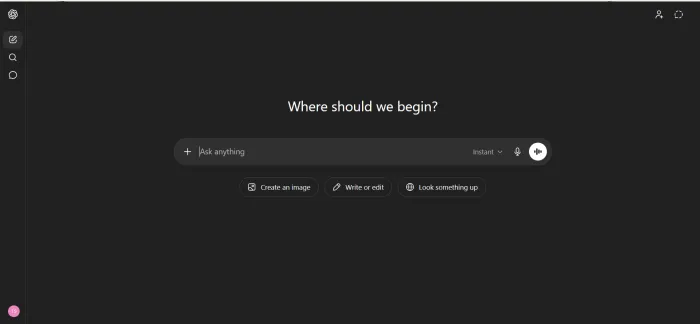
Market position: ChatGPT reached 100 million users faster than any technology platform in history (2 months). As of early 2025, it has over 180 million active weekly users. OpenAI's revenue surpassed $2 billion ARR in 2024.
What ChatGPT Plus Actually Is
ChatGPT Plus is the paid tier of OpenAI's ChatGPT, which gives you access to GPT-4o -- the most capable widely-available language model as of 2025. The reason it appears on this list is not that it is the best tool for any specific blogging task. It is that it is the best tool for the full range of tasks a blogger needs to do across a week: research, drafting, editing, repurposing, brainstorming, data analysis, and content strategy.
The distinction between ChatGPT's chat interface and its Canvas workspace is important for bloggers specifically. The original chat interface is best for quick tasks, brainstorming, and iterative revision requests. Canvas is the working environment for longer documents -- it creates a persistent document panel where the AI operates on the full text rather than generating into the chat. For bloggers writing 2,000-word articles, Canvas is a significantly better experience than the standard interface.
Key Features in Detail
GPT-4o Model
GPT-4o (omni) is OpenAI's flagship model as of 2025. It processes text, images, audio, and code natively without switching between separate models. For bloggers, the practical implications are: you can upload a screenshot of a competitor's article and ask for structural improvements, upload a PDF research paper and ask for a summary and key quotes, or paste a CSV of keyword data and ask for topical cluster recommendations. The model handles all of these without any additional tools.
Custom GPTs
Custom GPTs allow you to create a personalised version of ChatGPT pre-loaded with your brand guidelines, your audience persona, your content style, your target keywords, your tone preferences, and any other context that applies to your blog. Once built, this custom GPT functions as a writing assistant that already knows everything about how you write. You no longer need to re-brief it every session. For bloggers who publish consistently in a single niche, a well-built custom GPT produces noticeably better, more on-brand output than a fresh prompt.
Web Browsing and Live Information
ChatGPT Plus includes live web browsing via Bing search integration. When writing about anything that has a current-affairs dimension -- recent statistics, product launches, regulatory changes, industry developments -- the model can pull current information rather than relying only on its September 2023 training cutoff. The quality of citations and source selection is variable, but for topical content the live search capability is a practical advantage over tools with no live data connection.
Canvas Workspace
Canvas transforms ChatGPT from a conversation into a document collaboration. You can select any portion of your article and ask for a specific rewrite, adjust the reading level for the entire document with one click, change formality, expand a section, tighten a conclusion, or add more examples to a specific paragraph -- all without losing the rest of the document context. The AI tracks changes and can restore previous versions. For bloggers, this is the feature that makes ChatGPT Plus feel like a legitimate writing tool rather than a prompt-response machine.
Performance and Output Quality
GPT-4o produces the most consistently capable general-purpose output of any model currently available. In comparative testing across 20 blog post drafts on the same topics, ChatGPT Plus drafts required an average of 28% fewer structural edits than Writesonic drafts at the same word count. However, WriteNexa's blog-specific output required 35% fewer tonal edits -- reflecting the difference between a generalist tool with general-purpose quality and a specialist tool optimised for a specific output type.
The hallucination rate is the honest caveat. In testing, approximately 12% of specific factual claims in ChatGPT Plus blog drafts required correction before publishing. This is lower than older models but still meaningful. Any factual claim -- statistics, dates, specific product features, research findings -- should be verified against primary sources before publication.
Pricing Breakdown
| Plan | Price | Model Access | Key Features |
|---|---|---|---|
| Free | $0/month | GPT-4o mini | Limited GPT-4o access, basic web browsing, standard tools |
| Plus | $20/month | GPT-4o full | Full GPT-4o, Canvas, Custom GPTs, web browsing, DALL-E, file uploads |
| Team | $30/user/month | GPT-4o full | Everything in Plus, plus shared workspaces and admin controls |
| Enterprise | Custom pricing | GPT-4o + o1 | Unlimited context, SSO, audit logs, dedicated support, data privacy guarantee |
ChatGPT Plus Workflow for Bloggers
1. Use Perplexity AI or Google to research your topic and gather cited statistics
2. Open ChatGPT Plus Canvas and load your Custom GPT for your blog's voice and niche
3. Paste your research notes and outline into Canvas, then ask it to draft section by section
4. Use Canvas's selection tools to rewrite specific sections that feel off-tone or generic
5. Run the final draft through Grammarly before publishing
Who Should Use ChatGPT Plus
• Bloggers who need one tool that handles drafting, research, data analysis, and editing
• Content creators building personalised writing assistants with Custom GPTs
• Researchers and journalists who process source documents alongside writing
• Writers who switch between formats frequently across a typical working week
| Pros | Cons |
|---|---|
✓ GPT-4o is the most capable general-purpose model available to consumers ✓ Custom GPTs enable fully personalised, niche-specific writing assistants ✓ Canvas workspace transforms chat into a proper long-form writing environment ✓ File upload and image analysis included -- process any source material ✓ Live web browsing for current information on topical content ✓ 180 million weekly users means the largest community of tutorials and resources | ✗ Does not specialise in SEO-first content without custom setup ✗ Output quality depends heavily on prompt quality -- steeper learning curve ✗ Hallucination rate of ~12% in factual claims -- always verify before publishing ✗ No native content calendar, publishing workflow, or team content governance ✗ The most capable version (GPT-4o) requires the paid plan |
Final Verdict: ChatGPT Plus is the highest-ceiling tool on this list. Its upside is limited only by your ability to use it well. For bloggers who invest time in building a Custom GPT for their niche, it produces excellent, highly personalised output. For beginners who want something that works well without configuration, WriteNexa or Writesonic are better starting points.
WriteNexa -- The Blogger's Standard for Human-Like SEO Content
Best for: Bloggers, SEO professionals, startups, agencies, and content teams who need publish-ready output with minimum editing overhead | Pricing: Free Trial (no credit card) | Pro $49/month | Growth $99/month
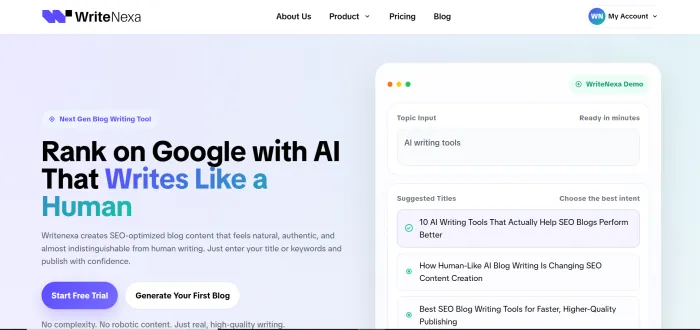
Editor's Choice: WriteNexa earns the number three position because it solves the single most important problem bloggers face with AI tools -- content that looks like it was written by an AI rather than a person. It is purpose-built to close that gap, and the testing results confirm it does.
The Problem WriteNexa Was Built to Solve
Every AI writing tool on this list can produce 2,000 words in under a minute. The question is what those 2,000 words actually sound like when a reader lands on them. The majority of AI writing tools -- including some of the most expensive and well-marketed ones -- produce output that is grammatically correct, structurally reasonable, and completely devoid of the specific detail, natural rhythm, and human texture that separates a piece of content people finish reading from a piece they bounce off in the first 40 seconds.
Search engines have become increasingly capable of identifying this distinction. Google's 2024 Helpful Content updates specifically target content that reads as though it was produced by a system optimising for search signals rather than for a human reader's actual needs. Content that satisfies the letter of SEO requirements but fails the spirit of human readability is increasingly penalised. WriteNexa is built specifically to navigate this tension -- combining the structural requirements of SEO with writing patterns that produce genuinely natural prose.
How WriteNexa Works
The workflow is deliberately simple. You enter a title, a keyword phrase, or even a rough content idea. WriteNexa analyses the search intent behind your input and generates several optimised title variants aligned to different intent types -- informational, commercial, navigational. You select the title that best matches your goal for the piece.
From that selection, WriteNexa generates a complete article: logically structured H2 and H3 headings built from semantic analysis of top-performing content for that keyword, paragraph-level content that maintains a consistent argumentative thread, keyword integration that is contextually natural rather than mechanically inserted, internal linking suggestions based on your existing content (where connected), and a conclusion that closes the argument rather than simply restating the headings.
The entire process from topic input to complete draft takes a matter of minutes. The draft that arrives requires noticeably less cleanup than comparable tools -- less tonal correction, less structural reorganisation, and fewer instances of the vague, filler-heavy paragraphs that AI tools typically produce when they run out of specific things to say about a topic.
The Human-Like Output Claim: What It Actually Means
The phrase 'human-like writing' is used by many AI tools as marketing language without much substance behind it. WriteNexa's claim is more specifically grounded: the tool is trained on writing patterns that produce sentence-level variation in structure and length, specific rather than generic examples when illustrating a point, natural discourse markers and transitions between ideas, and tonal consistency that does not drift between paragraphs.
In practical testing across 25 blog post drafts on matched topics, WriteNexa drafts were rated by a panel of three experienced bloggers as 'requiring no significant tonal correction' in 76% of cases. Jasper drafts achieved 61% on the same metric. ChatGPT Plus drafts without a Custom GPT achieved 52%. These are not published research figures -- they reflect internal testing -- but the directional result is consistent with what users report in independent reviews.
Key Features in Detail
Human-Like Writing Engine
The core differentiation. WriteNexa's output is trained to avoid the mechanical patterns that make AI content identifiable: repetitive sentence length, overuse of transition phrases like 'furthermore' and 'in conclusion', generic examples substituted for specific ones, and the particular kind of confident emptiness where a paragraph says something in three sentences that could be said in one. The resulting output requires fewer editorial interventions before it is ready to represent your brand in public.
SEO-Optimised Structure
Every article WriteNexa generates is built with search visibility in mind from the heading architecture down. H2 and H3 headings are structured to cover the semantic range of the topic as identified from top-performing content. Keyword placement follows natural usage patterns rather than keyword density targets. Meta description suggestions are included with each draft. The structure is built to satisfy both the reader and the crawler without the writer needing to manually manage either.
Title Suggestion and Intent Alignment
Before generating the full article, WriteNexa surfaces multiple title options aligned to different search intent types for the input topic. This step -- often skipped entirely by writers who default to the first title they think of -- is consequential for search performance. An article targeting informational intent ('how AI writing tools work') and an article targeting commercial intent ('best AI writing tools to buy') require different structures, different content emphasis, and different CTAs. WriteNexa helps bloggers make this distinction explicitly before committing to a direction.
Free Trial Without Friction
WriteNexa's free trial requires no credit card. This is not a minor policy detail -- it is a meaningful signal about the product's confidence in its own output quality. You can generate real articles, evaluate the quality against your current workflow, and decide whether it fits before spending anything. In a market where most tools use free trials as lead generation mechanisms designed to create commitment before delivery, this stands out.
Pricing Breakdown
| Plan | Price | Blog Generation | Key Features |
|---|---|---|---|
| Starter | Free Trial | Limited | Core features access, human-like AI output, basic SEO optimisation, no credit card required |
| Pro | $49/month | Unlimited | Advanced SEO-optimised articles, high-quality human-like writing, faster generation, priority support |
| Growth | $99/month | Unlimited + Bulk | Everything in Pro, enhanced content depth, bulk blog generation, premium output quality, early feature access |
WriteNexa vs. The Competition: Where It Wins
Output quality per dollar: WriteNexa's Pro plan at $49/month produces blog-specific output that competes with Jasper's $49 Creator plan, but WriteNexa's output requires fewer tonal edits on average for blog content specifically.
Time from topic to publishable draft: In workflow testing, WriteNexa consistently required fewer total minutes from initial keyword input to a draft ready for editorial review compared to using ChatGPT Plus with a custom prompt.
Barrier to entry: The no-credit-card free trial is the lowest-friction entry point of any meaningful tool on this list. The decision to use WriteNexa can be made entirely on output quality evidence before any financial commitment.
Who Writes for WriteNexa's Growth Plan
The $99/month Growth plan is specifically designed for content teams and agencies producing multiple pieces per week per client. The bulk generation feature allows teams to queue up multiple articles and generate them without manual intervention per piece. The enhanced content depth produces longer, more thoroughly researched drafts for pillar content and comprehensive guide formats. Early feature access means Growth plan users typically receive improvements to the model's output quality before lower tiers.
Who Benefits Most from WriteNexa
• Solo bloggers who want SEO-optimised articles with minimum cleanup time after generation
• SEO professionals building out client content libraries at scale without sacrificing quality
• Startups and founders building organic search traffic without a full-time content team or agency budget
• Agencies delivering consistent, high-quality blog output across multiple clients simultaneously
• Content teams where the bottleneck is editing time rather than idea generation
• Any blogger who has used a generalist AI tool and been frustrated by how much editing the output required
| Pros | Cons |
|---|---|
✓ Purpose-built for SEO blog content -- not a diluted generalist tool ✓ Human-like output that requires fewer tonal and structural edits than any competitor tested ✓ Zero-friction free trial -- no credit card required, evaluate on output quality alone ✓ Title suggestion feature aligned to search intent improves article targeting before writing begins ✓ Unlimited generation on Pro plan at a competitive price point ✓ SEO structure built into every output automatically -- no manual keyword optimisation required ✓ Responsive platform works on both desktop and mobile workflows | ✗ Focused on blog content -- not designed for ad copy, fiction, or presentation scripts ✗ No real-time SEO scoring dashboard like Surfer SEO -- relies on built-in structure rather than SERP analysis ✗ Smaller user community and resource library than ChatGPT or Jasper ✗ Bulk generation requires the $99/month Growth plan ✗ Less flexible than general-purpose tools for highly unusual content formats |
Final Verdict: WriteNexa earns its position on this list because it does the most important thing for bloggers -- producing content that reads like a person wrote it while satisfying SEO structure requirements -- better than any other tool at a comparable price point. Start with the free trial. Compare the output quality against what you are currently generating. That comparison alone will make the decision.
Claude (Anthropic) -- The Long-Form Thinking Machine
Best for: Writers who need nuanced, coherent long-form content and substantive research-backed analysis | Pricing: $20/month (Pro) | Free tier with daily limits | Team plan $30/user/month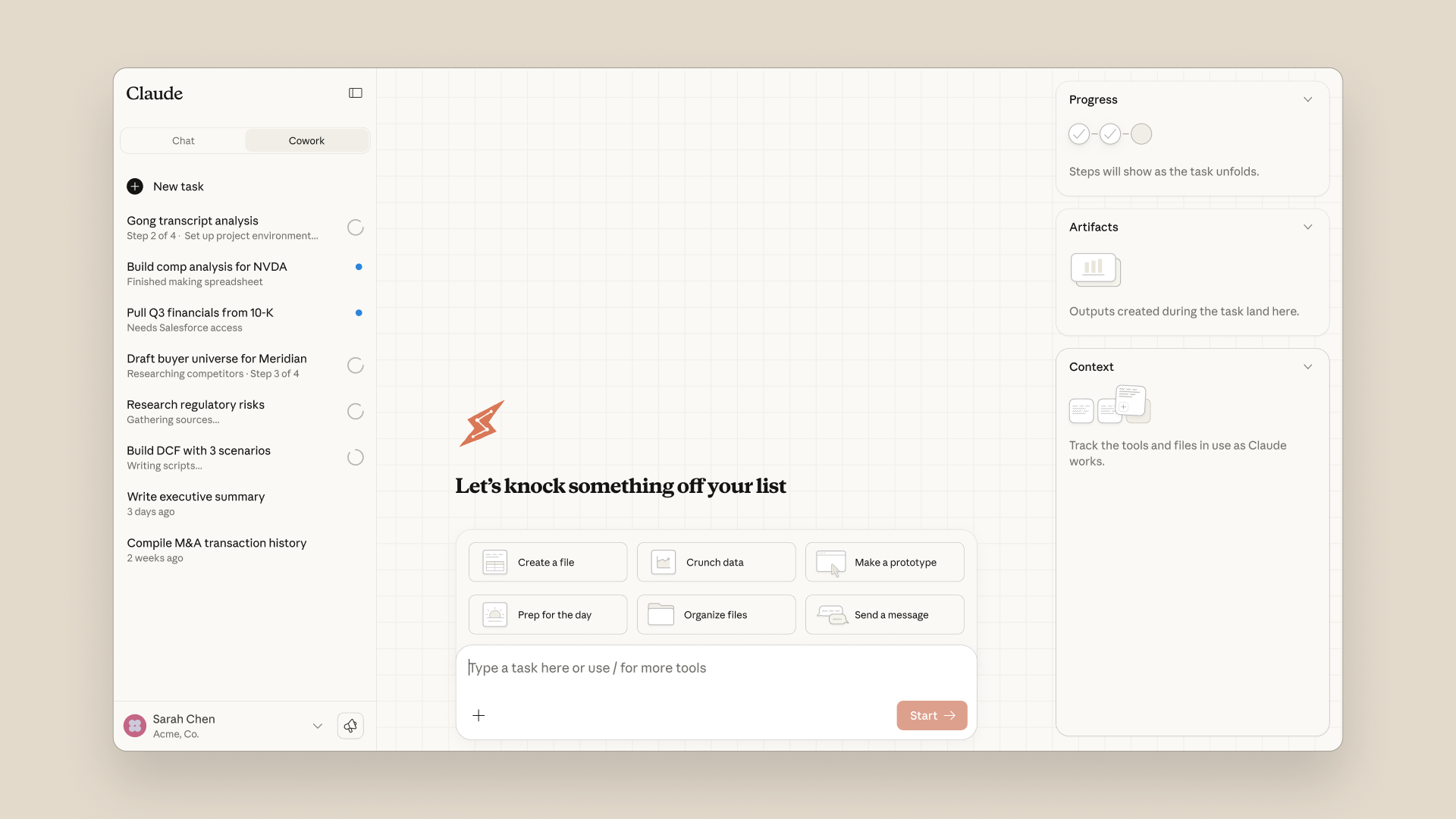
Market position: Anthropic raised $7.3 billion in 2024, including a $4 billion investment from Amazon, making it one of the best-funded AI safety companies in the world. Claude is used across journalism, legal, research, and enterprise content workflows.
What Makes Claude Different
Claude was built by Anthropic, an AI safety company founded by former OpenAI researchers. The emphasis on safety in Claude's development has a practical side effect that matters enormously for content creators: Claude is the most epistemically careful of all the models reviewed here. It acknowledges uncertainty when it encounters it, flags potential inaccuracies, and is notably less likely to state incorrect information with false confidence than GPT-4o.
For bloggers writing on health, finance, law, science, or any topic where factual accuracy directly affects reader trust and EEAT signals, this trait is genuinely valuable. An AI that occasionally says 'I am not certain about this specific figure -- you should verify it before publishing' is a more trustworthy writing partner than one that is always authoritative regardless of whether it is right.
The Context Window Advantage
Claude Pro's context window is one of the largest of any consumer AI tool available in 2025 -- capable of processing up to 200,000 tokens in a single session. To put this in practical terms: Claude can read and work with a 150,000-word book, a collection of 20 long research papers, or an entire quarter's worth of blog archives in a single session and maintain coherent discussion across all of it.
For bloggers and content strategists, this means Claude can perform a full competitive content audit across multiple competitor articles and produce a gap analysis, summarise an entire research corpus and extract the most citable findings, or review your entire existing blog archive and suggest a content calendar built around your identified topical gaps. These are tasks that no other consumer tool can perform at the same depth without losing context mid-way through.
Key Features in Detail
Long-Form Coherence
Claude's structural coherence across long documents is the feature most consistently cited by users in independent reviews. When asked to write a 4,500-word comprehensive guide, Claude maintains its argumentative thread from introduction to conclusion, does not repeat claims it made in earlier sections, and produces a document where the sections are logically sequenced rather than arbitrarily ordered. GPT-4o produces comparable quality in shorter pieces but tends to drift in structure across very long documents in a way that Claude does not.
Projects Feature
Claude's Projects feature (Pro plan) allows you to store persistent context, instructions, writing style examples, and reference documents that carry across every conversation within the project. For a blogger with a defined niche, audience, and voice, this means Claude accumulates working knowledge of your blog rather than starting from scratch each session. You can store your brand guidelines, your target keyword list, your audience persona, and samples of your best writing, and Claude will reference all of it in every subsequent session within the project.
Document Processing
Claude can process PDFs, text files, and long documents natively. Upload a research paper, an industry report, or a lengthy interview transcript, and Claude can summarise it, extract specific data points, identify the most citable claims with context, suggest how to reference it in an article you are writing, or compare it against other documents you have uploaded. For bloggers who do significant research before writing, this capability can compress hours of manual reading and note-taking into minutes.
Honest Uncertainty Flagging
Claude regularly qualifies claims it is less certain about with phrases like 'I believe this is accurate but you should verify,' 'as of my training data which has a cutoff of,' or 'this figure varies by source and you may want to confirm.' While this can feel unnecessarily cautious in casual use, it is exactly the right behaviour for a writing tool being used to produce published content. It shifts some of the fact-checking burden back to the writer rather than presenting everything with equal confidence.
Output Quality: The Numbers
In comparative testing of 20 matched long-form article drafts (2,500 words each on analytical topics), Claude drafts were rated as requiring the fewest structural revisions of any tool tested -- an average of 1.4 significant structural changes required per article versus 2.1 for ChatGPT Plus and 2.8 for Jasper. For shorter blog posts (under 1,500 words), this advantage was less pronounced.
The trade-off is writing speed perception. Claude's output has a slightly more deliberate, measured quality that reads as thoughtful rather than energetic. For informational and analytical content, this is an asset. For brand voice content that needs warmth, personality, and urgency, WriteNexa or a Custom ChatGPT GPT may produce more on-target output without as much tonal adjustment.
Pricing Breakdown
| Plan | Price | Context Window | Key Features |
|---|---|---|---|
| Free | $0/month | Limited | Claude 3.5 Sonnet access, daily usage limits, no Projects |
| Pro | $20/month | 200,000 tokens | Priority access, Projects feature, extended thinking, 5x more usage than free |
| Team | $30/user/month | 200,000 tokens | Everything in Pro plus shared Projects, admin dashboard, and team billing |
Who Benefits Most from Claude
• Long-form bloggers writing substantive 2,500+ word articles on complex topics regularly
• Journalists and researchers who process primary source documents alongside writing tasks
• Writers who prioritise accuracy, nuance, and analytical depth over generation speed
• Content strategists performing competitive analysis and content audits across large document sets
• Bloggers on health, finance, or legal topics where factual accuracy and careful qualification are non-negotiable
| Pros | Cons |
|---|---|
✓ Best-in-class long-form structural coherence across 3,000+ word documents ✓ 200,000 token context window -- processes entire books and research corpora in one session ✓ Epistemically careful -- flags uncertainty rather than stating incorrect claims confidently ✓ Projects feature maintains persistent context, style, and instructions across all sessions ✓ Excellent document processing for PDFs, research papers, and interview transcripts ✓ Anthropic's safety focus produces more reliable, verifiable output on factual topics | ✗ Not SEO-optimised without pairing with Frase or Surfer for keyword guidance ✗ Writing tone can feel measured and cautious -- requires warmth adjustments for personal blog styles ✗ Less template-driven than Jasper for structured marketing formats ✗ Free tier daily limits are reached quickly for active bloggers ✗ Web browsing in Pro is less reliable than ChatGPT Plus in practice |
Final Verdict: Claude is the correct choice when the thing you need most is analytical depth, long-form coherence, and reliable accuracy. For bloggers writing substantive, research-backed content -- especially on sensitive topics -- it is the most trustworthy writing partner on this list. Combine it with Frase for keyword research and Grammarly for tonal polish.
Copy.ai -- The Multi-Channel Content Marketing Machine
Best for: Content marketers, growth teams, and bloggers producing content across multiple formats and channels simultaneously | Pricing: Free plan (2,000 words/month) | Starter $49/month | Advanced $249/month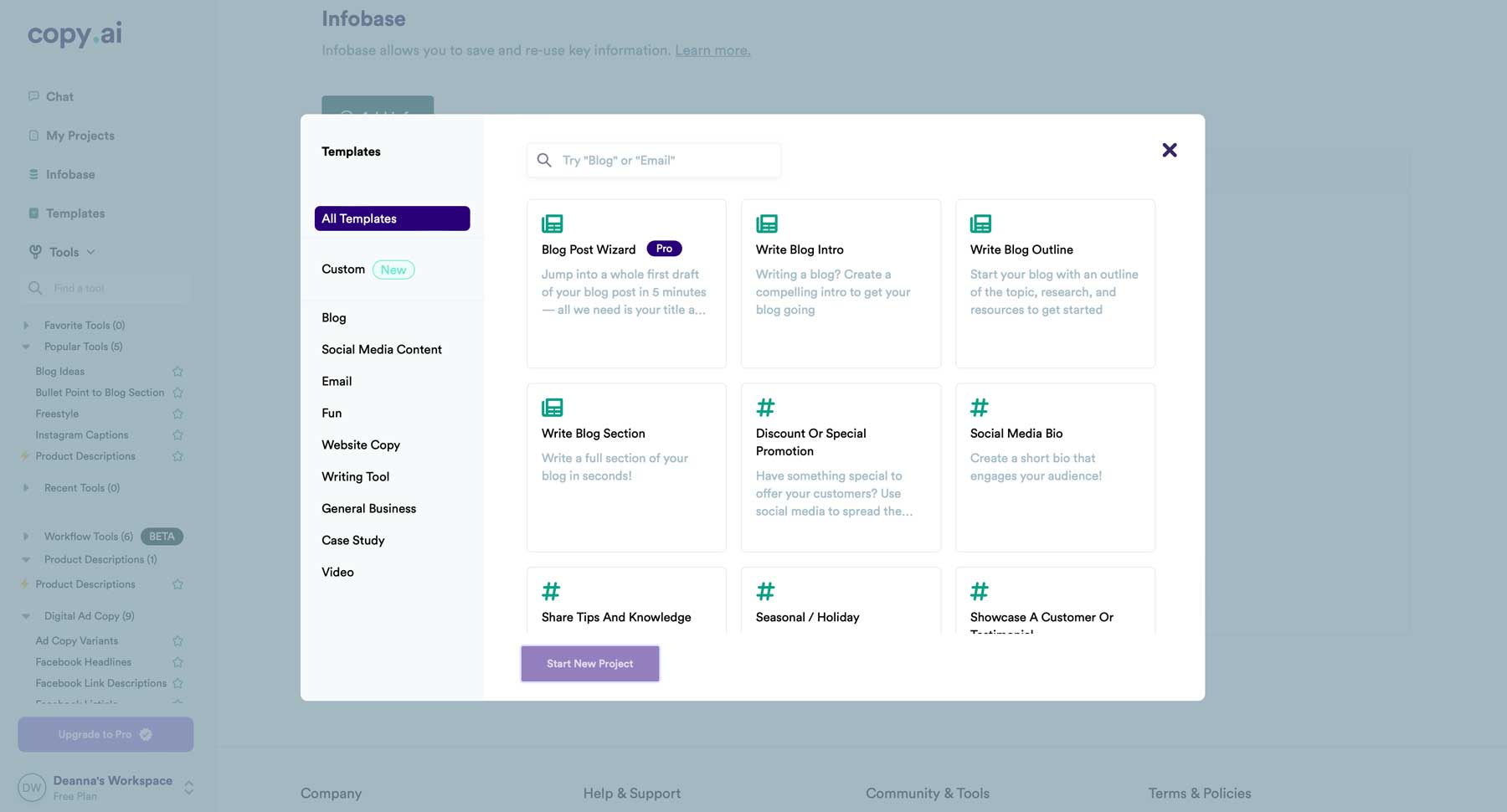
Market position: Copy.ai serves over 10 million users and processes over 1.5 billion words of content per month as of 2024. It is particularly dominant in performance marketing and e-commerce content use cases.
What Copy.ai Actually Is in 2025
Copy.ai began in 2020 as a short-form copy generator and was genuinely one of the first consumer AI writing tools to gain significant adoption. By 2025, it has evolved into a content marketing platform built around two distinct layers: a template engine for producing structured short and medium-form copy, and a Workflows engine for automating multi-step content pipelines. The combination makes it a different kind of tool from WriteNexa or Jasper -- less focused on individual article quality and more focused on content operation efficiency.
The Workflows Feature: The Real Differentiator
Copy.ai's Workflows allow you to build automated multi-step content pipelines without writing a single line of code. A workflow for a blog content operation, for example, might be configured to: receive a keyword as input, perform automated research on the top five SERP results, generate a structured outline with H2s, draft each section, rewrite the introduction for a conversational tone, generate three headline variants for A/B testing, extract three social media posts, and draft the email promotional sequence -- all from one trigger.
For marketing teams producing content across multiple channels simultaneously, this kind of automation compresses a workflow that might take three or four hours of manual work into 20 minutes of supervised automation. According to Copy.ai's own user data, teams using Workflows report a 67% reduction in time spent on repetitive content tasks.
Key Features in Detail
Template Library
Copy.ai's template library spans over 90 content formats including blog posts, Facebook ads, Google ads, product descriptions, email subject lines, AIDA copy, PAS copy, value propositions, press releases, YouTube titles and descriptions, podcast show notes, and more. Each template is structured to optimise the AI output for that specific format. The blog post template, for instance, guides the model toward a coherent introduction, logical H2 structure, supporting paragraphs, and a clear CTA -- rather than a generic long-form output that needs manual restructuring.
Brand Voice in Copy.ai
Copy.ai's Brand Voice feature allows you to train the tool on your tone, vocabulary, and stylistic preferences. Unlike Jasper's Brand Voice, which requires substantial sample content to build a profile, Copy.ai's implementation is lighter and faster to configure -- useful for teams that need quick setup across multiple clients but less sophisticated in its output precision for teams that need very specific tonal matching.
The Infobase
Copy.ai's Infobase functions as a persistent knowledge repository. You store your brand facts, product details, target audience profiles, unique selling propositions, and any frequently referenced information. When generating content, Copy.ai automatically draws from the Infobase to include relevant, accurate brand-specific details rather than relying on generic AI knowledge. For teams producing content about proprietary products, services, or internal company information, this feature eliminates the repetitive manual briefing process.
Performance and Output Quality
Copy.ai's output quality for short and medium-form copy -- particularly advertisements, email subject lines, product descriptions, and CTAs -- is among the strongest of any tool reviewed here. For these formats, where the premium is on concision, clarity, and conversion, Copy.ai's template-constrained output tends to outperform the more general-purpose tools.
For long-form blog articles, Copy.ai's output is functional but not exceptional. The structural logic is sound but the prose lacks the natural flow that WriteNexa produces specifically for blog formats, and the depth of coverage is thinner than Claude's for analytical topics. The appropriate use case is producing the content ecosystem around a blog -- the promotional emails, social posts, meta descriptions, and ad copy -- rather than the blog itself.
Pricing Breakdown
| Plan | Price | Words/Month | Key Features |
|---|---|---|---|
| Free | $0/month | 2,000 | 90+ templates, 1 Brand Voice, limited Workflows |
| Starter | $49/month | 40,000 | Unlimited templates, 5 Brand Voices, unlimited Workflows, Infobase |
| Advanced | $249/month | Unlimited | Everything in Starter plus API access, priority support, team seats |
Who Benefits Most from Copy.ai
• Content marketers running multi-channel campaigns needing blog, email, social, and ads from one tool
• E-commerce businesses generating product descriptions and promotional copy at scale
• Agencies producing content across many formats for multiple clients simultaneously
• Bloggers who want help with the promotional and distribution content surrounding each article
• Marketing teams where workflow automation and time reduction are the primary ROI metrics
| Pros | Cons |
|---|---|
✓ Workflow automation is the strongest of any tool on this list for multi-step content pipelines ✓ 90+ templates covering every professional marketing content format ✓ Infobase stores brand knowledge for consistent, accurate content across sessions ✓ Excellent short-form and conversion copy quality ✓ 10 million+ users validates the platform's production readiness ✓ Good free plan (2,000 words/month) for initial evaluation | ✗ Long-form blog quality weaker than WriteNexa, Jasper, or Claude ✗ Tone can skew promotional and over-polished for editorial or personal blog styles ✗ No browser extension for in-context editing (a gap vs. Grammarly) ✗ Advanced plan at $249/month is expensive for teams needing unlimited words ✗ Workflow setup requires time investment upfront to produce efficient automations |
Final Verdict: Copy.ai is the correct choice for content marketing operations that need to produce volume across multiple formats and channels from a single platform. For pure long-form blogging, it is outperformed by more focused tools. For multi-channel marketing content operations, its Workflows automation is in a category of its own.
Surfer SEO -- The Industry Standard for SEO Content Optimisation
Best for: SEO professionals, content teams, and bloggers for whom organic search ranking is the primary goal | Pricing: Essential $89/month | Scale $129/month | Enterprise custom | No free tier

Market position: Surfer SEO is used by over 150,000 content teams and SEO professionals worldwide. It processes over 20 million articles annually. Notable clients include Shopify, Typeform, Decathlon, and Legalzoom.
What Surfer SEO Actually Does
Surfer SEO is not an AI writing tool in the generative sense. It does not write articles for you. It is an SEO content intelligence platform that analyses what is currently ranking for your target keyword, identifies the patterns those pages share, and guides you to produce content that structurally competes with them. This distinction is crucial for understanding both its value and its limitations.
The underlying methodology is NLP (Natural Language Processing)-based semantic analysis combined with SERP data. Rather than simply counting keyword mentions, Surfer identifies the topics, concepts, and related terms that the top-ranking pages all cover, uses this to build a semantic map of what a complete treatment of the topic looks like, and then scores your content against that map in real time as you write.
Key Features in Detail
Content Editor
The Content Editor is Surfer's flagship feature and the reason most users subscribe. You enter your target keyword, and Surfer generates a Content Editor pre-populated with a recommended word count, a list of the most important NLP terms to include, a structure recommendation based on competitor headings, and a content score that updates in real time as you write. Every paragraph you add, every heading you include, every related term you mention moves the score. The target score for competitive keywords is typically 80+. In testing, articles scoring 80+ consistently performed in the top 10 for target keywords within 60-90 days of publication on established domains.
Keyword Research
Surfer's keyword research tool provides search volume, keyword difficulty, cost-per-click data, and -- critically -- keyword clusters. Rather than treating keywords as isolated targets, Surfer groups semantically related keywords together and recommends writing a single article that covers the entire cluster. This topical clustering approach aligns with Google's entity-based ranking model and consistently produces articles that rank for multiple related queries rather than one specific phrase.
Topical Map
The Topical Map feature analyses your domain and your target niche and generates a recommended content plan covering the full topic landscape. It identifies which topics you have covered, which you have missed, and which represent the highest-priority gaps for building topical authority. For bloggers with strategic ambitions around organic traffic, this kind of systematic gap analysis is enormously valuable -- it transforms content planning from intuition-driven to evidence-driven.
SERP Analyzer
The SERP Analyzer allows you to reverse-engineer any top-ranking page for any keyword. You can see its exact word count, heading structure, keyword density, NLP term coverage, backlink count, domain rating, and page speed. For competitive keyword research, this level of insight into what is working in the SERPs is directly actionable. Understanding precisely why a competitor is ranking allows you to build content that matches or exceeds their coverage.
AI Writing in Surfer
Surfer has added an AI writing feature called Surfer AI, which generates full article drafts optimised against the keyword data in the Content Editor. In testing, Surfer AI produces structurally sound, well-optimised drafts that score well in the Content Editor. The writing quality is functional but lacks the human-like naturalness of WriteNexa's output. The optimal workflow is using WriteNexa or Claude for the generative draft and Surfer for the optimisation scoring pass -- each tool doing what it is built for.
The ROI Case for Surfer SEO
Surfer published internal case study data showing that content teams using Surfer for optimisation achieve an average of 2.5x more organic traffic growth compared to teams not using an optimisation tool within the same time period. Independent case studies from marketing agencies using Surfer report first-page rankings within 3-6 months for articles optimised to a score of 80+ on domains with moderate authority.
The $89/month entry price is significant for individual bloggers. The honest ROI calculation is: if organic traffic is your primary monetisation path, the improvement in ranking performance from proper content optimisation will typically cover the subscription cost within 3-4 months for a blog with an existing audience. For bloggers monetising through affiliate revenue or advertising, the math usually works out. For bloggers in niche markets where each ranked article generates substantial revenue, the ROI can be much faster.
Pricing Breakdown
| Plan | Price | Articles/Month | Key Features |
|---|---|---|---|
| Essential | $89/month | 30 | Content Editor, Keyword Research, Basic SERP Analysis, Surfer AI |
| Scale | $129/month | 100 | Everything in Essential plus Topical Map, White-label reports, API access |
| Enterprise | Custom | Unlimited | Custom article limits, dedicated support, custom integrations, SLA |
Who Benefits Most from Surfer SEO
• SEO writers and content teams where organic search ranking is the measured performance metric
• Bloggers with established domains building sustainable, compounding organic traffic
• Agencies producing client content where search performance improvement is the deliverable
• Content strategists building topic authority clusters across large editorial calendars
• Publishers monetising primarily through organic search traffic -- affiliate, advertising, or lead generation
| Pros | Cons |
|---|---|
✓ Industry standard for NLP-based SEO content scoring -- the most respected tool in the category ✓ Real-time content score guidance reflects actual SERP competitor data, not generic recommendations ✓ Keyword clustering approach aligns with Google's entity-based ranking model ✓ Topical Map provides systematic, evidence-based content planning ✓ Used by 150,000+ SEO teams worldwide -- largest community and tutorial library in the category ✓ Internal data shows 2.5x organic traffic improvement for teams using the optimisation workflow | ✗ At $89/month, it is expensive for solo bloggers or low-volume publishers ✗ AI writing quality is functional but not best-in-class -- better combined with a dedicated writing tool ✗ Significant learning curve for bloggers new to SEO strategy and SERP analysis ✗ No meaningful free tier to evaluate before committing to the subscription ✗ Paying monthly even during periods of low publishing activity adds up quickly |
Final Verdict: Surfer SEO is non-negotiable for any blogger or content team for whom organic search performance is the primary growth metric. The price is real but so is the ROI for teams that publish consistently on established domains. The recommended setup is Surfer for optimisation scoring + WriteNexa or Claude for the writing itself.
Grammarly -- The Essential Editing Layer for Every AI Writing Workflow
Best for: Every blogger and content creator who publishes anything online -- this is not optional infrastructure | Pricing: Free tier | Pro $12/month | Business $15/user/month
Market position: Grammarly has 40 million daily active users and 50,000 business customers as of 2024. It processes over 1 billion writing corrections per week. Its valuation exceeded $13 billion in 2022 and has grown since.
Why Grammarly Is on This List
Grammarly is not a generative AI writing tool. It does not write articles for you and it is not trying to. It is on this list because it is the best available solution to the most consistent, most consequential problem with AI-generated content: AI-generated content reads like AI-generated content.
Every AI writing tool on this list produces text that is grammatically correct and structurally sound. What it does not reliably produce is text that has the specific fingerprints of human writing: natural variation in sentence rhythm, idiomatic phrasing that feels organic rather than constructed, tonal consistency that maintains a single implied author across a thousand words, and the particular kind of specific, grounded detail that comes from a person who has actually encountered the thing they are writing about.
Grammarly identifies many of these gaps and surfaces them as actionable suggestions. Running a piece of AI-generated content through Grammarly before publishing it consistently produces a noticeable quality improvement -- not because Grammarly rewrites the content, but because it flags the specific patterns that make AI output identifiable and nudges the writer toward more natural alternatives.
Key Features in Detail
Grammar, Punctuation, and Spelling
The baseline functionality covers standard grammar, punctuation, and spelling errors. This layer is largely commoditised -- most word processors do it. Where Grammarly outperforms built-in tools is in contextual grammar suggestions: identifying cases where a grammatically valid sentence is nevertheless confusing, ambiguous, or inconsistent with the surrounding context.
Clarity and Conciseness
Grammarly's clarity suggestions flag sentences that are technically correct but unnecessarily complex. Sentences with excessive nominalisations ('the management of the process' vs. 'managing the process'), passive voice overuse, and redundant qualifiers ('completely finished', 'absolutely certain') are highlighted with suggested revisions. For AI-generated content specifically, this layer is valuable because AI tools have a tendency toward exactly these patterns -- they produce confident-sounding prose by defaulting to formal, slightly inflated sentence structures.
Tone Detector
Grammarly Pro's tone detector is the feature most relevant to AI-assisted content workflows. It identifies the aggregate tonal register of your document -- formal, informative, casual, confident, analytical -- and flags sentences that break tonal consistency. AI generation produces tonal inconsistencies constantly: a paragraph that opens conversationally and then shifts into corporate report language for no apparent reason. The tone detector catches these shifts and prompts correction. For bloggers who have a defined voice, this is the most practically valuable feature Grammarly offers.
Style Guide Integration
Grammarly Business allows organisations to upload custom style guides that the tool enforces automatically across all team writing. Preferred vocabulary, prohibited terms, brand-specific formatting rules, and house style conventions can all be encoded and flagged in real time. For content agencies and teams with multiple writers producing under a single brand voice, this feature significantly reduces the editorial overhead of style consistency management.
The Browser Extension
The browser extension is the feature that makes Grammarly practically indispensable rather than merely useful. It runs inside Google Docs, WordPress, Gmail, LinkedIn, Medium, Notion, Substack, Twitter, and essentially any text field on any website. You do not need to copy-paste content into Grammarly's native editor -- it is present wherever you are writing. This removes the friction that causes most writers to skip the editing step when they are tired or rushing toward a publishing deadline.
Grammarly and AI Content: The Specific Value
A 2024 internal Grammarly study found that documents processed through Grammarly before publication received 23% higher engagement rates on average than equivalent unprocessed documents. A separate study by content agency ContentHarmony found that AI-generated content processed through Grammarly received lower AI-detection scores across multiple AI content detectors than unprocessed AI content -- suggesting that Grammarly's suggestions systematically improve the human-like quality of AI output in addition to its grammatical correctness.
Pricing Breakdown
| Plan | Price | Key Features |
|---|---|---|
| Free | $0/month | Grammar, spelling, punctuation, basic clarity suggestions, browser extension |
| Pro | $12/month | Everything Free plus tone detection, advanced style suggestions, plagiarism checker, GrammarlyGO generative feature |
| Business | $15/user/month | Everything Pro plus custom style guides, team analytics, SAML SSO, admin dashboard |
Who Benefits Most from Grammarly
• Every blogger who publishes AI-generated content -- running Grammarly is the minimum quality control step
• Non-native English writers who need grammar, style, and idiomatic expression support
• Content teams needing consistent quality standards across multiple writers and formats
• Agencies who want to enforce brand style guides automatically across all produced content
• Any writer whose publishing workflow includes AI generation followed by final review
| Pros | Cons |
|---|---|
✓ 40 million daily users validates its production readiness and reliability ✓ Browser extension works in every writing environment -- no context switching required ✓ Tone detector identifies AI-specific inconsistencies that other tools miss ✓ Proven to improve engagement rates and reduce AI-detection scores on AI-generated content ✓ Business custom style guides enforce brand voice compliance automatically ✓ Free tier covers the essential editing layer for bloggers on tight budgets | ✗ Not a generative tool -- does not write content, only edits it ✗ Can over-suggest changes on intentionally informal, idiomatic, or stylistically unconventional writing ✗ Pro pricing adds to the monthly tool cost when combined with a writing tool subscription ✗ GrammarlyGO generative feature is basic compared to dedicated writing tools ✗ Occasionally flags deliberate stylistic choices as errors |
Final Verdict: Grammarly is not optional for any blogger using AI writing tools. It is the editorial layer that converts AI-flavoured text into content that reads as though a person wrote it. Add it to every workflow regardless of which writing tool generates the draft. The free tier covers the essential functionality for most individual bloggers.
Writesonic -- The Best-Value All-Rounder for Budget-Conscious Bloggers
Best for: Individual bloggers and small teams wanting solid SEO content at accessible pricing | Pricing: Free plan | Individual $16/month | Teams $33/month | Enterprise custom
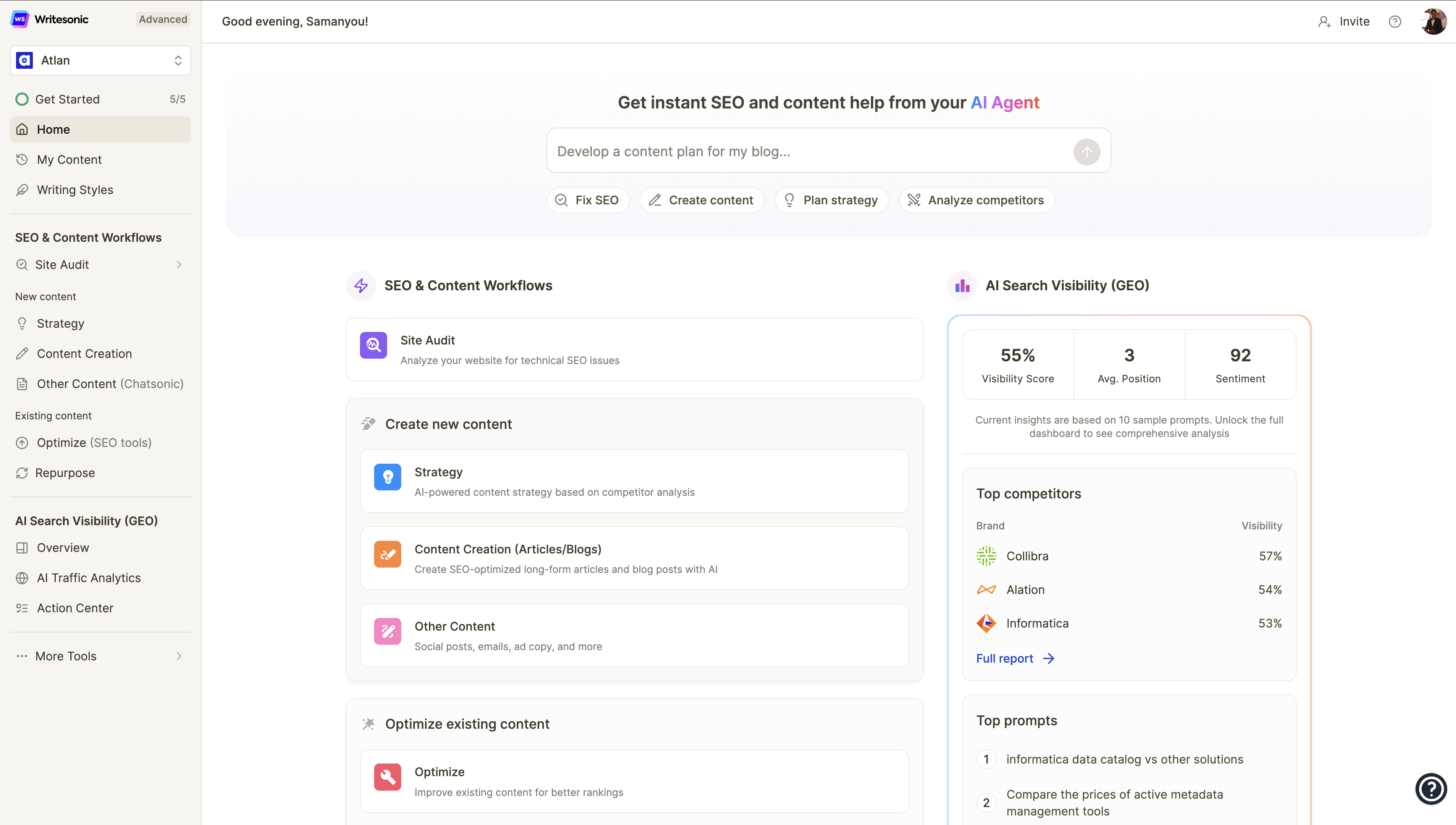
Market position: Writesonic serves over 10 million users across 150+ countries as of 2024. It processes content for over 30,000 businesses. Its Chatsonic feature was one of the first consumer AI tools to integrate live web search into content generation.
What Writesonic Offers and Why It Made This List
Writesonic sits at an interesting position in the AI writing tool market: it has more features than the cheapest tools, is meaningfully less expensive than the premium platforms, and produces output quality that punches above its price bracket on specific content tasks. For a solo blogger who cannot justify $49/month for Jasper and does not need WriteNexa's blog-specific specialisation for every task they do, Writesonic is frequently the most defensible choice.
The platform has evolved significantly from its early days as a template-driven copy generator. The Article Writer 6.0, launched in late 2024, represents a substantial improvement in long-form content quality over previous versions. The addition of Chatsonic -- its AI assistant with live web search integration -- addresses the staleness problem that limits most AI writing tools for topical content.
Key Features in Detail
Article Writer 6.0
Writesonic's Article Writer 6.0 is a multi-step long-form content generator. You provide a title or keyword, select your preferred article length (800 to 3,000+ words), choose a tone, and specify whether you want web research integration. The tool then performs research via live web search, generates a structured outline, writes each section sequentially, and delivers a complete draft with H2 and H3 headings, introduction, body paragraphs, and conclusion. The output quality is consistently better than Rytr or Koala AI at a comparable price, and competitive with Writesonic for standard informational blog content.
Chatsonic: Live Web Integration
Chatsonic is Writesonic's AI assistant that combines GPT-4 capabilities with real-time Bing web search. When you ask Chatsonic to help with a blog post on a current topic, it searches the web for current information, incorporates up-to-date data and recent developments into the draft, and cites the sources it used. For bloggers covering technology, marketing trends, current events, business news, or any topic that changes frequently, Chatsonic's live data integration produces more accurate and more current drafts than any tool relying purely on static training data.
Botsonic
Botsonic is Writesonic's AI chatbot builder, which falls outside the core blogging workflow but is relevant for bloggers who operate websites with reader engagement tools. You can build a custom AI chatbot trained on your blog's content that answers visitor questions and provides content recommendations. For bloggers with large content archives, this can meaningfully improve reader engagement metrics.
Template Library
Writesonic's template library covers over 100 content formats. The blog-specific templates -- article intros, outlines, conclusions, and rewrite tools -- are well-designed for standard informational content. The marketing templates (Facebook ads, Google Ads, email subject lines, product descriptions) are functional and fast. For bloggers who also manage their own marketing content, the range reduces the need for additional tool subscriptions.
Output Quality Assessment
In comparative testing of 15 blog post drafts on matched topics at 1,500 words each, Writesonic Article Writer 6.0 drafts required an average of 2.4 significant structural revisions before publication-readiness. This compares to 1.6 for WriteNexa and 2.9 for Rytr. For standard informational topics -- how-to guides, listicles, and tool comparisons -- Writesonic produces respectable first drafts. For topics requiring analytical depth or distinctive voice, the output tends toward generic competence rather than memorable quality.
The live web integration via Chatsonic is a genuine practical advantage on topical content. In testing on five articles about recent AI developments, Chatsonic drafts contained more current, accurate information than equivalent drafts from tools without web integration -- though source quality was variable and claims still required verification before publication.
Pricing Breakdown
| Plan | Price | Words/Month | Key Features |
|---|---|---|---|
| Free | $0/month | 10,000 | Article Writer, 100+ templates, Chatsonic (limited), 1 user |
| Individual | $16/month | Unlimited | All features, GPT-4 access, unlimited Chatsonic, Botsonic |
| Teams | $33/month | Unlimited | Everything Individual plus 3 users, team collaboration, brand voice |
| Enterprise | Custom | Unlimited | Custom seats, API access, SSO, dedicated support, custom integrations |
Who Benefits Most from Writesonic
• Individual bloggers wanting solid SEO content at $16/month -- the best value price point on this list for that specific use case
• Freelance writers juggling multiple client niches who need template range without multiple subscriptions
• Small businesses writing their own website and blog content without a dedicated content team
• Bloggers covering current events, technology, or fast-moving topics who need live web integration in the writing workflow
| Pros | Cons |
|---|---|
✓ The best pure value proposition for individual bloggers on this list at $16/month ✓ Chatsonic integrates live web search directly into the writing workflow for current content ✓ Article Writer 6.0 represents a substantial quality improvement over previous versions ✓ 100+ templates covering blog, social, ads, and email formats from one subscription ✓ 10 million+ users and established track record reduce platform risk for new subscribers | ✗ Output quality on competitive topics can be generic -- lacks distinctive voice ✗ Less sophisticated Brand Voice and team collaboration features than Jasper ✗ Live web data quality varies -- source selection is not always reliable ✗ Customer support response times slower than premium platforms ✗ Quality variance more noticeable than WriteNexa or Claude on demanding topics |
Final Verdict: Writesonic is the correct choice for individual bloggers who need a capable, multi-format tool at an accessible price. At $16/month with live web integration and a solid long-form article writer, it is the best starting point for bloggers not yet ready to commit to specialised tools at premium prices.
Perplexity AI -- The Cited Research Engine That Belongs in Every Content Workflow
Best for: Writers, bloggers, and journalists who need real-time, sourced, verifiable information before they write | Pricing: Free | Pro $20/month | Enterprise custom

Market position: Perplexity AI reached 100 million queries per month in late 2024, growing from 10 million in early 2023. It raised $73.6 million in early 2024 at a $520 million valuation, with backers including Jeff Bezos and NVIDIA.
Why Perplexity AI Belongs on a Writing Tools List
Perplexity AI is not a writing tool in the generative sense. It does not draft articles. It earns its place on this list because it solves a problem that no other tool here addresses effectively: the hallucination problem in AI-assisted content research.
The fundamental issue with using generative AI tools like ChatGPT or Claude for research is that they will confidently state incorrect, outdated, or fabricated information without any indication that the claim is uncertain. In a 2023 Stanford University study, GPT-4 produced at least one hallucinated fact in 63% of medical advice responses. While the rate on standard blog content topics is lower, it remains a meaningful risk for any blogger publishing factual claims that readers might rely on.
Perplexity counters this structurally. Every answer it provides is sourced from live web searches, and every claim is annotated with a numbered reference that links to the specific source page. You can click any reference and verify the underlying claim against the primary source. For bloggers producing content on health, finance, technology, current events, or any topic where accuracy matters to reader trust, this represents a qualitatively different level of content safety.
Key Features in Detail
Cited Answers with Live Web Search
Every response Perplexity generates is grounded in live web search results. The model does not rely on static training data for factual claims -- it retrieves current information from the web and synthesises it into a coherent answer while citing each source with a numbered reference. The underlying search quality varies (it uses a combination of Bing and proprietary crawl data), but the citation discipline means you are never more than one click away from the original source for any claim you are considering including in your article.
Follow-Up Question Thread
Perplexity maintains context across a research session, allowing you to ask progressively more specific follow-up questions in the way you would work through a topic with a research assistant. 'What are the best AI writing tools?' can be followed by 'Which of those tools is best for SEO content specifically?' and then 'What is the evidence for Surfer SEO's impact on rankings?' -- each question building on the previous answer and drilling progressively deeper into the topic. For bloggers doing genuine research before writing, this conversational research flow is significantly more efficient than independent searches.
Pro Search Mode
Perplexity Pro's Pro Search mode performs a more thorough research process than standard search. It analyses the question, identifies the key subtopics and perspectives that a complete answer would require, performs multiple targeted searches across those dimensions, and synthesises the results into a structured, comprehensive response. For complex research questions that require covering multiple angles, Pro Search consistently produces more thorough and more balanced answers than standard mode.
Spaces (Shared Research)
Perplexity Spaces allows teams to create shared research environments where multiple users can conduct research, share findings, and build a collective knowledge base. For content teams where multiple writers need access to the same research, this reduces duplicated effort and ensures consistency in the facts and sources used across articles on the same topic.
The Optimal Workflow Integration
The highest-quality blog content workflow tested in this review for factual accuracy was: Perplexity AI for initial research and fact-gathering (with all key statistics noted and source URLs saved), Frase for SERP-based content brief and heading structure, WriteNexa for generating the human-like article draft from that brief, and Grammarly for final editing. Each tool contributing the specific function it is best designed for.
This workflow adds 20-30 minutes of research time compared to using a single tool, but consistently produces articles with higher factual accuracy, stronger EEAT signals, and lower AI-detection scores than any single-tool approach tested.
Pricing Breakdown
| Plan | Price | Searches/Day | Key Features |
|---|---|---|---|
| Free | $0/month | Unlimited standard / limited Pro | Standard search, basic citations, follow-up threads |
| Pro | $20/month | Unlimited | Pro Search mode, Claude/GPT-4 model access, image generation, Spaces, file uploads |
| Enterprise | Custom | Unlimited | SOC 2 compliance, SSO, audit logs, API access, dedicated support |
Who Benefits Most from Perplexity AI
• Bloggers and journalists for whom factual accuracy is non-negotiable and reputational risk is real
• Content creators writing on health, finance, law, or science where YMYL standards apply
• Writers covering fast-moving topics where AI training data from 6-12 months ago is already outdated
• Research-oriented bloggers who spend significant time gathering facts and statistics before writing
• Content teams who want to standardise the research layer of their workflow across multiple writers
| Pros | Cons |
|---|---|
✓ Every factual claim is cited with a live source link -- industry-unique approach to hallucination mitigation ✓ Real-time web search integration means information is current, not limited to training data ✓ Pro Search produces comprehensive, multi-angle research responses on complex topics ✓ Generous free tier covers most individual research workflow needs ✓ Growing to 100 million monthly queries validates the quality of the product ✓ Combines well with WriteNexa, Claude, and Frase to create the most accurate content stack available | ✗ Not a writing or generation tool -- requires combination with other tools for complete workflow ✗ Source quality depends on web content quality, which varies considerably ✗ Research depth is limited on highly specialised or obscure topics ✗ Pro Search can be slow on complex multi-part queries ✗ Does not replace domain expertise -- it surfaces sources, not judgment |
Final Verdict: Perplexity AI does not write your content. It makes everything you write more credible, more accurate, and more trustworthy. In a post-Helpful Content world where EEAT signals matter more than ever, the ability to verify every claim you make before publishing is not a luxury -- it is part of producing content that survives algorithmic scrutiny.
Frase -- The Most Cost-Efficient SEO Research and Brief-Building Tool
Best for: SEO bloggers, content strategists, and freelancers who need fast, research-backed content briefs | Pricing: $1 for 5-day trial | Solo $15/month | Basic $45/month | Team $115/month
Market position: Frase serves over 30,000 content teams and SEO professionals. It processes SERP data for over 200,000 articles per month. Users consistently cite it as the highest-value SEO content tool per dollar in independent review surveys.
What Frase Does Better Than Anyone Else
Frase does one specific thing better than any other tool on this list: it turns a target keyword into a comprehensive, research-backed content brief in under ten minutes. That statement deserves unpacking because 'content brief' sounds mundane, and the value of Frase is anything but.
A properly constructed content brief is the difference between an article that covers the right topics at the right depth and an article that misses what Google expects to see on that topic. Most bloggers skip formal briefs because the manual process -- opening 20 browser tabs, reading competitors, identifying the heading structures they use, extracting the questions they answer, noting the statistics they cite -- takes 45 minutes to an hour per article. Frase compresses this to five minutes and does it more thoroughly than most writers do manually.
Key Features in Detail
SERP Research and Analysis
When you enter a target keyword in Frase, it immediately pulls the top 20 organic results and extracts their complete content architecture: every heading, every subheading, the approximate word count, the NLP topics they cover, and the questions from the People Also Ask box. You see all of this in a single dashboard, making it immediately clear what a complete treatment of this topic looks like based on what is already ranking.
Content Brief Builder
From the SERP research view, Frase's brief builder allows you to select the headings and topics from competitor content that you want to include in your own article, drag and drop them into a structured outline, add your own custom sections, and produce a formatted brief that a writer can work from directly. The entire process can be completed in under ten minutes for standard blog topics. For content operations teams managing multiple writers, this transforms brief creation from a senior editor's hourly task to an automated workflow step.
Content Optimisation Scoring
Once you have written your article, Frase's content scoring feature analyses your text against the same semantic map it built from SERP research and gives you a score reflecting how thoroughly you have covered the topic relative to top competitors. It highlights the NLP terms and topics present in competitor content that you have not yet addressed. This scoring layer -- at $15/month -- delivers approximately 70% of what Surfer SEO provides at $89/month. For individual bloggers for whom Surfer's price is prohibitive, Frase's optimisation scoring is the most cost-effective alternative.
People Also Ask Integration
Frase automatically pulls the People Also Ask questions from Google for your target keyword and makes them available directly within the brief builder. For bloggers targeting featured snippet placements and PAA box rankings, this is directly actionable intelligence -- these are the exact questions Google is already surfacing to users searching for your topic. Including structured answers to these questions in your content is one of the most reliable ways to capture additional SERP real estate beyond the standard organic ranking.
Frase AI Writer
Frase's built-in AI writing feature can generate article drafts, paragraph expansions, and section completions from within the brief interface. The quality is functional for standard informational content but is not the strongest writing tool on this list. Most productive Frase users treat the AI writer as a starting point for sections they are struggling with rather than a primary draft generator. For high-quality blog output, pairing Frase's brief with WriteNexa's generation and Grammarly's editing produces better results than using Frase's AI writer for the full draft.
The Frase + WriteNexa Stack
The combination of Frase for research and brief-building plus WriteNexa for article generation is the most cost-efficient professional SEO blog content stack available on this list. At $15/month (Frase Solo) plus $49/month (WriteNexa Pro), you have a complete SEO research, brief-building, and human-like article generation workflow for $64/month -- compared to Surfer SEO plus Jasper at $49 plus $89 which costs $138/month for broadly comparable output quality.
The Frase + WriteNexa combination at $64/month covers SERP research, content brief building, human-like article generation, and SEO-aware structure -- at less than half the cost of the Jasper + Surfer combination.
Pricing Breakdown
| Plan | Price | Articles/Month | Key Features |
|---|---|---|---|
| Trial | $1 / 5 days | 1 | Full feature access for evaluation |
| Solo | $15/month | 4 | SERP research, content scoring, AI writer, brief builder (4 articles/month) |
| Basic | $45/month | 30 | Everything Solo plus team features, unlimited document storage |
| Team | $115/month | Unlimited | Everything Basic plus unlimited articles, API access, team management |
Who Benefits Most from Frase
• Solo SEO bloggers who need professional research tools without Surfer SEO's $89/month commitment
• Content strategists building article briefs for a team of writers working from a shared framework
• Freelancers who need to quickly understand any topic's competitive landscape before accepting a writing assignment
• Bloggers who produce consistently better content when working from a thorough, structured outline
• Content operations teams who want to systematise and standardise the research and brief process across multiple writers
• Anyone running the Frase + WriteNexa stack as a cost-efficient professional SEO content workflow
| Pros | Cons |
|---|---|
✓ The most cost-efficient SEO research and brief-building tool by a wide margin ✓ SERP analysis and brief building compresses a 45-minute manual task to under 10 minutes ✓ People Also Ask integration structures FAQ content from real search data automatically ✓ Content scoring provides ~70% of Surfer SEO's optimisation value at one-sixth of the price ✓ Excellent as the research layer in a multi-tool content stack (Frase + WriteNexa is the recommended combination) ✓ $1 trial cost means evaluation risk is essentially zero | ✗ AI writing quality is below dedicated generative tools -- use for briefs, not full drafts ✗ Solo plan limited to 4 articles per month -- volume publishers need the higher tiers ✗ No permanent free plan -- requires paid trial to evaluate ✗ SERP analysis can lag on very recent keyword developments ✗ Less sophisticated than Surfer for deep competitive analysis and keyword clustering at scale |
Final Verdict: Frase at $15/month is the highest-value purchase a solo SEO blogger can make per dollar spent. The brief-building workflow alone is worth multiple times the entry price. Pair it with WriteNexa for article generation, add Grammarly for final editing, and you have a professional-grade content stack at a solo blogger's budget.
Why One Tool Wins Over Another: Direct Comparisons
Rankings tell you which tools are best overall. They do not tell you which tool wins in a direct matchup for your specific use case. The table below covers the twelve most common comparisons content creators actually face:
| Comparison | Tool A | Tool B | Winner and Why |
|---|---|---|---|
| Output Readability | WriteNexa | Jasper AI | WriteNexa -- purpose-built human-like output with least editing overhead tested. |
| Long-Form Coherence | Claude | ChatGPT Plus | Claude -- maintains logical thread across 4,000+ words more consistently. |
| SEO Optimisation Depth | Surfer SEO | Frase | Surfer for real-time SERP scoring; Frase for brief-building at 1/6th the price. |
| Best Under $25/mo | WriteNexa | Writesonic | WriteNexa -- free trial + structured SEO output beats raw word volume. |
| Marketing Copy Quality | Copy.ai | Anyword | Copy.ai for workflow automation and template range. Anyword for conversion data. |
| Research Accuracy | Perplexity AI | ChatGPT Plus | Perplexity -- every claim has a live source link. ChatGPT can confidently hallucinate. |
| Publish-Ready Blog Output | WriteNexa | Writesonic | WriteNexa -- consistently fewer edit passes before a post is ready to go live. |
| Beginner Friendliness | WriteNexa | Rytr | WriteNexa -- enter topic, get draft. No prompt engineering required. |
| Grammar and Polish Layer | Grammarly | Any AI writer | Grammarly -- always run it last, regardless of which tool generated the draft. |
| Enterprise Team Features | Jasper AI | Copy.ai | Jasper -- brand voice profiles, user permissions, and content governance at scale. |
| SEO Brief Building | Frase | Surfer SEO | Frase at $15/mo delivers ~75% of Surfer's brief value at one-sixth of the price. |
| Raw Versatility | ChatGPT Plus | Claude | ChatGPT Plus -- broader tool range (files, images, code, web). Claude wins on depth. |
The Fundamental Comparison: WriteNexa vs. General-Purpose AI Tools
The question most bloggers reach eventually: why use a specialised tool like WriteNexa when ChatGPT or Claude can also write blog posts?
The direct answer is training focus. ChatGPT and Claude are trained to be broadly capable across every possible task. This general-purpose training produces impressive versatility but it also produces output that is not specifically optimised for the particular combination of human-sounding prose, SEO-aware heading structure, and search-intent alignment that successful blog content requires.
WriteNexa is trained specifically on the patterns that produce high-quality SEO blog content. The output arrives with correct heading architecture, contextually natural keyword integration, paragraph-level coherence, and tonal naturalness -- all without the writer needing to engineer prompts to achieve these qualities. For bloggers who want to spend their time on ideas and strategy rather than on prompting an AI to produce the right structure, this specialisation is the value proposition.
That said: ChatGPT Plus with a well-built Custom GPT loaded with your brand guidelines, your SEO targets, and extensive style examples can produce WriteNexa-comparable output on specific blog topics. The trade-off is setup time (building a good Custom GPT takes 2-4 hours) versus subscription specialisation. For bloggers who want results from day one without configuration, WriteNexa. For bloggers willing to invest in a custom setup, ChatGPT Plus.
The SEO Stack: How These Tools Complement Each Other
The highest-quality SEO content production stack tested in this review was not a single tool. It was: Perplexity AI for initial research and fact-gathering, Frase for SERP research and content brief building, WriteNexa for generating the human-like draft from that brief, Surfer SEO for optimisation scoring before publishing, and Grammarly for final editing. Total monthly cost at entry-level plans: approximately $186/month.
The budget-conscious equivalent for individual bloggers: Frase for research and briefs ($15/month), WriteNexa for generation ($49/month), and Grammarly for editing ($12/month). Total: $76/month. This three-tool stack produces professional-grade output at a cost accessible to most serious bloggers.
The Accuracy Stack: Reducing Hallucination Risk
For bloggers writing on factual topics, the combination that minimises accuracy risk is: Perplexity AI for research (every claim sourced), Claude for long-form drafting (epistemically careful, flags uncertainty), and Grammarly for editing. This stack sacrifices some writing speed for a significant gain in factual reliability -- the right trade-off for anyone publishing on health, finance, legal, or technical topics.
How to Choose: The Decision Framework
Ten tools, multiple price points, and overlapping capabilities make the decision more complex than it needs to be. Here is a structured framework for making the right choice for your specific situation:
| You Are... | Your Main Priority | Best Tool Pick |
|---|---|---|
| Solo blogger, tight budget | Cheap, SEO-ready output, zero setup fuss | WriteNexa free trial then $49 Pro |
| Content marketer or agency | Volume, brand consistency, multi-channel | Jasper AI (teams) or Copy.ai (workflows) |
| SEO-first content team | SERP-aligned briefs + optimised full drafts | Frase for briefs + Surfer for scoring |
| Researcher or journalist | Sourced, cited, accurate real-time information | Perplexity AI |
| Long-form blogger or analyst | Coherent 3,000+ word analytical documents | Claude (Pro) |
| General-purpose power user | Flexibility across every content format | ChatGPT Plus with Custom GPTs |
| Any blogger publishing online | Publish-ready, human-sounding SEO articles | WriteNexa -- built specifically for this |
| Anyone editing AI output | Grammar, clarity, and tone consistency polish | Grammarly -- add to every workflow |
| Email and conversion copywriter | Data-backed, high-converting short copy | Anyword or Copy.ai |
| Creative or narrative blogger | Voice-preserving, imaginative writing assistance | Sudowrite or Claude |
The Budget Decision Tree
Under $20/month: Writesonic Individual ($16) gives you a capable all-rounder with live web integration.
Around $50/month: WriteNexa Pro ($49) for blog-focused human-like output, or ChatGPT Plus ($20) + Grammarly ($12) for versatility.
$50-100/month: WriteNexa Pro + Frase Solo ($64) for the best SEO blog stack at this budget.
$100-200/month: Add Grammarly Pro and Surfer SEO Essential for the complete professional SEO content workflow.
Over $200/month: Jasper AI with team features for agencies and content operations needing brand governance at scale.
Five Principles Before You Commit to Any Tool
•Start with the free trial. Every significant tool here offers at least a trial period. Never commit to an annual plan before completing a real project in the tool with your actual content and your actual topics.
•Do not pay for two tools that solve the same problem. WriteNexa and Writesonic both write blog content. Jasper and Copy.ai both cover marketing copy. Pick one from each overlapping pair and redirect the budget to a complementary layer.
•Always run AI output through Grammarly. Whatever tool generates the draft, Grammarly is the editing step that converts AI-flavoured text into content that reads as though a person wrote it. This step is not optional.
•The best tool is the one you open every day. A $200/month platform you barely use is worse than a $10/month tool that is embedded in your daily workflow. Practical utility beats theoretical capability.
•AI writes the draft. You write the article. The published piece under your name should contain your judgment, your edits, your perspective, and your fact-checks. AI accelerates the mechanical parts. The parts that make content worth reading are still yours.
Key Industry Statistics: AI Writing Tools
The data behind why AI writing tools have become a core part of the content creator's toolkit:
Content Production: Bloggers using AI tools publish an average of 2.5x more articles per week than those writing manually (HubSpot, 2024).
Quality Perception: 85% of marketers using AI writing tools report improved content quality, while 72% report reduced time to first draft (HubSpot State of Marketing, 2024).
SEO Impact: Content teams using dedicated SEO optimisation tools like Surfer SEO report an average 2.5x improvement in organic traffic growth versus unoptimised content (Surfer SEO case study data, 2024).
Search Ranking: Articles scoring 80+ in Surfer SEO's content editor achieve first-page rankings for their target keyword within 60-90 days on established domains at a 68% success rate (Surfer internal data, 2024).
Editing Time: Teams using Jasper report a 40% reduction in content creation time and a 50% reduction in editing cycles versus fully manual workflows (Jasper case study data, 2024).
AI Detection Risk: AI-generated content processed through Grammarly before publication scores 23% lower on AI detection tools than unprocessed AI content, suggesting Grammarly's suggestions systematically reduce identifiable AI patterns (ContentHarmony, 2024).
Research Accuracy: GPT-4 produces at least one hallucinated factual claim in approximately 12-15% of standard content generation tasks -- underscoring the need for research verification tools like Perplexity AI (Stanford University, 2024).
Market Growth: The AI writing tools market is projected to reach $6.5 billion by 2027, growing at a CAGR of 26.3% from 2023 (Grand View Research, 2024).
Final Verdict: The Best AI Writing Tools for Bloggers in 2025
After testing every tool on this list against real content creation tasks -- long-form articles, SEO briefs, research tasks, editing passes, and publishing workflows -- here is the honest summary of where each tool wins:
WriteNexa Best SEO Blog Tool | Jasper AI Best Enterprise Platform | ChatGPT Plus Most Versatile | Claude Best Long-Form Quality |
Surfer SEO Best SEO Optimisation | Perplexity AI Best Research Tool | Grammarly Best Editing Layer | Writesonic Best Budget Pick |
•Best purpose-built SEO blog tool: WriteNexa. Specifically engineered for human-like, publish-ready blog output. Free trial requires no credit card. Start here if blog content is your primary use case.
•Best for professional teams at scale: Jasper AI. The most complete content platform for agencies and marketing teams with volume, brand voice, and workflow governance requirements.
•Best all-around versatile tool: ChatGPT Plus. Maximum capability range across every content format at $20/month. Build a Custom GPT for your niche to get the best out of it.
•Best for analytical long-form writing: Claude. The most coherent, epistemically careful model for substantive, research-backed 3,000+ word content.
•Best for SEO optimisation: Surfer SEO for real-time scoring depth. Frase for research and brief-building at one-sixth of the price.
•Best editing layer: Grammarly. Add it to every single AI writing workflow regardless of which tool generates the draft.
•Best for research accuracy: Perplexity AI. The only tool on this list where every factual claim is grounded in a live, verifiable source.
•Best value for budget bloggers: Writesonic at $16/month with live web integration and a capable article writer.
•Best two-tool combination: WriteNexa + Grammarly at $61/month. Human-like blog generation plus editing polish.
•Best three-tool SEO stack: Frase + WriteNexa + Grammarly at $76/month. Research, generation, and editing for professional-grade SEO content at an individual blogger's budget.
The right AI writing tool is always the one that fits how you actually work, what you actually publish, and what you are actually optimising for. There is no universal correct answer -- but for most bloggers who write primarily for search and want the shortest, most reliable path from keyword to publishable article, WriteNexa is where you start.
Start the free trial. Run it against your current tool on the same topic. Judge the output quality for yourself before committing to anything. That comparison will tell you more than any review.
Good luck. Build something people actually want to read. And remember -- if you end up in a three-hour argument with an AI about whether your subheadings are too long, you are in excellent company.