Most of what exists about Writeless AI is either a marketing page or a single test run. I wanted the other thing: a plain explanation of what the tool is, what it is doing when you press Generate, what the pricing works out to over a term, and whether the whole idea holds up. So I spent a week with it. Some of that time went into generating drafts for real coursework. Most of it went into understanding the product well enough to explain it to someone who has never opened it.
If you would rather watch one essay go through every screen and hit the upgrade wall, my colleague already did that in the full Writeless AI hands-on test. This piece is the map, not the walkthrough.
Writeless AI in five lines What it is: An academic essay generator that searches for real references first, then writes to your brief, then hands you an editor. Who it is for: Students and researchers who need structure and starting references quickly. Free plan: Enough to see how the product works, not enough to keep a draft. Real cost: $9.99 a month billed yearly (about $120), $17.99 billed quarterly, $24.99 billed monthly. Worth it? At the yearly price, yes, if you write often and treat every draft as a scaffold. Otherwise no. |
The problem Writeless AI is built for
Academic writing has two separate pains. The first is the blank page: knowing what you want to argue but not how to organise it. The second is the reference list: finding sources that exist, are recent enough, and are formatted in the style your department demands. General chatbots are good at the first pain and unreliable at the second, because they predict plausible-looking references rather than looking them up.
Writeless AI, built by Omar Massoud and run entirely in the browser, is designed around that second pain. The homepage promises research papers in seconds with real academic citations, and it is the citation half of that promise that gives the product a reason to exist. The rest of the pitch, including the phrase "100% Undetectable" in the subheading, is where you need to keep your guard up.
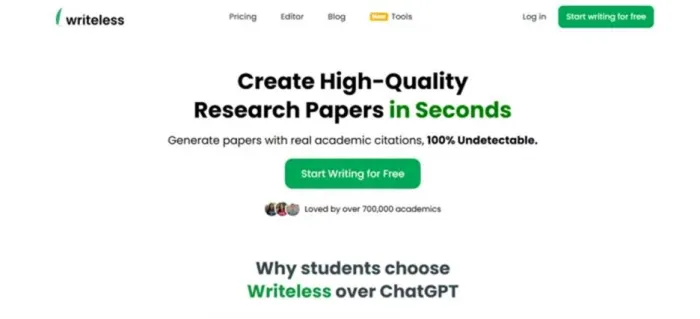
The homepage leads with speed, citations and undetectability. Only the first two are things the product can reliably deliver.
Where it sits in the market Picture three tools on a line. At one end, a citation manager that organises sources you found yourself. At the other, a general chatbot that writes anything from an open prompt. Writeless sits between them: it finds sources for you and writes to an academic brief, which makes it more useful than a chatbot for coursework and more dangerous, because the output looks submittable. |
How Writeless AI works
Under the surface the product has four layers, and understanding them explains both its strengths and its limits better than any feature list.
| Layer | What it does | What you control |
|---|---|---|
| 1. The brief | Collects your topic, paper type, writing style, length and citation rules through a guided form. You can attach a PDF or an image as source material. | Everything, in plain language, including custom paper types and custom tones |
| 2. Reference search | Looks for existing scholarly papers that match the topic before any writing happens. A progress bar labelled Searching for references runs first. | How many sources (0 to 20), which style (APA, MLA, Harvard, Chicago, Vancouver) and the oldest publication year allowed |
| 3. Generation | Writes the paper to the brief and places in-text citations that match the reference list. | Length presets from 500 to 10,000 words, with a ceiling of 20,000 on paid plans |
| 4. Editing and rewriting | Opens the draft in a full editor with Rewrite, Longer, Shorter, Add Cite and Personalize actions, plus a paid Humanize rewriter. | Section by section, without leaving the page |
The brief is where the product earns its keep
A general chatbot makes you do the prompt engineering. Writeless does it for you by asking the questions an instructor would ask: what kind of paper, in what voice, how long, with how many sources and how recent. A first-year student gets a better-shaped draft from Writeless than from a bare prompt, not because the writing is better, but because the brief is.
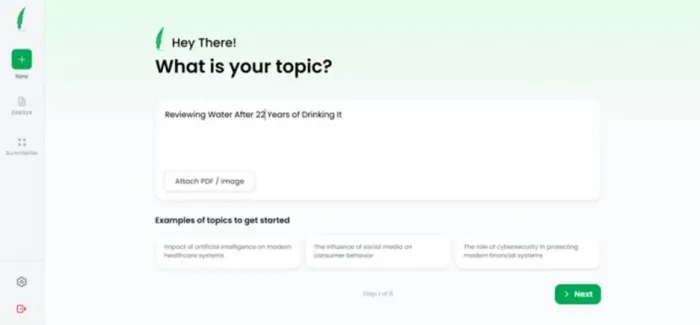
The first screen of the brief. Attaching your own PDF here is the difference between a generic draft and one grounded in your reading.
What "real citations" actually means
This is the technical distinction that matters most. When a chatbot writes a reference, it is predicting what a reference would look like. When Writeless writes one, it has retrieved a paper that exists and is formatting it. Independent testers, including my colleague, have looked up the references Writeless produced and found real, peer-reviewed papers with correctly matched in-text citations.
The limitation is not accuracy but spread. The generator leans hard on whatever it found. Ask for one source and that source appears in nearly every paragraph. Ask for ten and the draft still reads like it understood two of them well. Real references are a large step up from invented ones, but they are still a starting list for your own reading, not a completed bibliography.
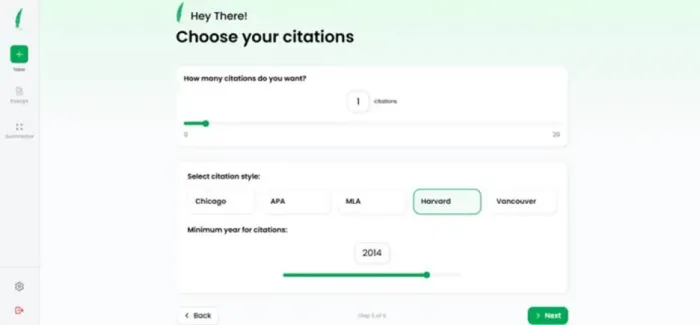
The reference search controls. A minimum publication year filter is rare among essay tools and useful for anyone doing real background reading.
What "Humanize" actually means
The paid Humanize feature is a rewriter. AI detectors look for statistical patterns in text, such as predictable word choice and uniform sentence rhythm, and a humanizer rewrites the draft to disturb those patterns. That is all it is. Two things follow from this. First, the rewritten text is still AI-generated, so the disclosure rules at your institution apply exactly as before. Second, the detectors are trained on paraphrased AI text too and are updated several times a year, which is why paying users have reported essays that passed at first and were flagged later. A rewriter can shift a score on a given day. It cannot change what the text is.
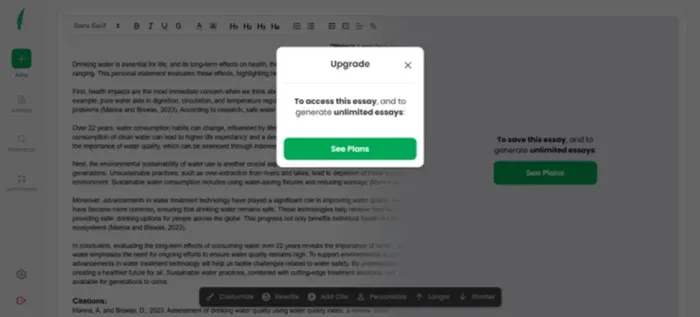
What you can make with it
Essays and research papers The core use. Standard, Academic or Argument styles, any length up to the plan limit, with the reference list built in. | Personal statements and literature reviews Both are presets. Expect a clean structure and a flattened voice, so these need the most rewriting of anything the tool produces. |
Custom formats A free-text paper type and a free-text tone field cover lab reports, reflective journals, policy briefs and anything else the presets skip. | Summaries of your own reading A separate Summarize tool condenses articles and PDFs. Useful for triage before deciding which papers deserve a full read. |
A working reference list The Research panel keeps the sources found for each paper in one place, which makes it a quick way to seed a real bibliography. | Not built for Marketing copy, fiction, emails or anything outside academic formats. The templates are academic and the tone controls assume it. |
Writeless AI pricing, explained properly
The public pricing page loads its figures inside the app, so third-party reviews disagree slightly with each other. The upgrade modal inside the editor is the reliable source: three plans, a $30 reference price crossed out on each, and a discount badge that grows with commitment. Every tier includes the same features. You are only paying for a different billing rhythm.
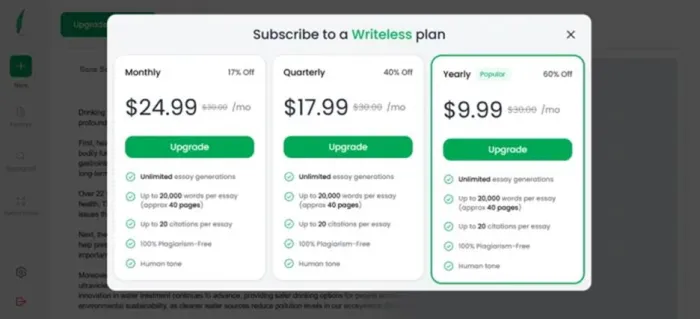
The in-app plan picker. Same features on every tier: unlimited generations, up to 20,000 words and 20 citations per paper, and the Humanize rewriter.
| Plan | Advertised | What leaves your account | Discount badge |
|---|---|---|---|
| Free | $0 | Nothing, no card required | None. One generation, preview only |
| Monthly | $24.99 a month | $24.99 every month | 17% off |
| Quarterly | $17.99 a month | About $54 every three months | 40% off |
| Yearly | $9.99 a month | About $120 once a year | 60% off, tagged Popular |
The free tier deserves one plain sentence. It lets you run the whole brief and generate a paper, but the Writeless AI free plan paywall arrives before you can save it, so treat it as a demo rather than a tier.
What it costs per paper
Subscription prices only mean something against how much you write. This is the maths I did before deciding whether the yearly plan made sense for a heavy term.
| Papers you generate each month | Yearly plan, per paper | Monthly plan, per paper |
|---|---|---|
| 1 | About $10 | $24.99 |
| 2 | About $5 | $12.50 |
| 4 | About $2.50 | $6.25 |
| 8 | About $1.25 | $3.12 |
Three things "unlimited" does not cover • Per-paper ceilings still apply. Unlimited generations, but each paper caps at 20,000 words and 20 references. • Rollover is not promised. At least one paying reviewer reports that unused allowance vanishes at the end of a billing period. • Refunds are not quick. The pricing page says cancel anytime and lists support@writeless.ai, but public reviews describe slow, circular support on refunds. Cancel before renewal and keep the email. |
Is Writeless AI worth it? It depends who is asking
The same $120 is a bargain for one person and a waste for another. Here is how I would call it by situation.
| If you are | My call | Why |
|---|---|---|
| An undergraduate with two or three papers a term | Skip the paid plans | The free plan shows you the product. At that volume the yearly price is $40 a paper |
| A graduate student or researcher writing constantly | Yearly plan, used carefully | The reference filter, the Summarize tool and the editor earn $10 a month if you rewrite every draft |
| Someone whose institution bans undisclosed AI | Skip, or use the free plan for structure only | Detection is beside the point. The policy is the issue, and no rewriter changes it |
| A writer outside academia | Skip | The templates and tone controls are academic. A general writing tool serves you better |
| Someone learning an unfamiliar paper format | Free plan | Seeing a literature review's shape is the point, and the preview shows you that |
Worth paying for when • You write several papers a month and can commit to the annual rate • You will verify every reference and rewrite every paragraph • You want a year filter on sources and a working reference list to start from • You already have your own PDFs to feed it | Not worth it when • The Humanize feature is the reason you are buying • You plan to submit output with light edits • Your topic depends on a personal angle a template will flatten • You would pay monthly, which is two and a half times the yearly rate |
How Writeless AI compares
The fair comparison is not against one rival but against the two ways people already get this work done.
| Area | Writeless AI | A general chatbot | Your own writing plus a citation manager |
|---|---|---|---|
| Setup | Guided brief with academic presets | Open prompt, you supply the structure | None, you supply everything |
| References | Retrieved from real papers, filtered by year and style | Vary by tool and mode; invented references remain a known risk | Only what you found and read |
| Editing | Built-in editor with rewrite and length controls | Copy out and edit elsewhere | Your word processor |
| Monthly cost | $9.99 to $24.99 depending on commitment | Free tiers exist; paid tiers around $20 | Usually free |
| Integrity risk | High if submitted as-is; marketed on undetectability | High if submitted as-is | None |
Using Writeless AI without getting burned
Everything above adds up to one honest use case: a scaffold you rebuild in your own words, with a reference list you verify yourself. This is how I would run it.
A working method • Feed it your reading first. Attach the PDFs you have already found so the draft is grounded in your sources rather than only in whatever it retrieves. • Set the year filter. Ask for recent sources and treat the reference list as a reading list, not a bibliography. • Keep the structure, replace the sentences. The outline is the valuable part. The prose is a template with your topic poured in. • Check each citation against the paper. Real references can still be cited for claims they do not make. • Leave Humanize alone. If the work needs to pass a detector, the problem is the work, not the detector. • Read your institution's AI policy. Many now require disclosure and some ban generation outright. The tool will not tell you which applies to you. |
On the detection point specifically, the landscape moves fast. Turnitin added detection aimed at AI bypasser tools in 2025 and has updated its model since, and the reviews from paying users track that timeline closely. The details, including the full Writeless AI review of what the undetectable claim looks like in practice, are in the hands-on piece.
What the reviews say, in one paragraph Trustpilot sits at 3.4 out of 5 across 54 reviews at the time of writing, split heavily between five-star and one-star ratings. The praise: references that exist, time saved, structure that beats the blank page. The complaints: generic prose, essays flagged despite the promise, refunds that go nowhere. Both sides describe the same product, which is why "is it worth it" depends on what you expected it to be. |
Final verdict after a week with Writeless AI
After a week of using it the way it is meant to be used, my read is this: Writeless AI is a good idea wrapped in a pitch that undermines it. The good idea is the reference search. Retrieving real papers before writing, filtering them by year and formatting them correctly is exactly what students struggle with and exactly what general chatbots get wrong. Add a brief that asks the right questions and an editor that is better than it needs to be, and you have a tool that can save an afternoon at the start of every paper. At $10 a month on the yearly plan, for someone writing constantly, that is a fair trade. The pitch is everything else. The free plan is a demo dressed as a tier. The prose is a template. And the loudest promise on the homepage is one no product can keep and no student should want kept. I did not pay for Humanize and would not tell anyone to, not because it might fail but because of what it is for. Use it to find your sources and shape your argument, then close it and write. Used that way, it is worth the annual price. Used any other way, you are paying for the wrong thing. Overall: 3 out of 5. Strong idea, weak pitch, and only worth it on the yearly plan. |