Text inside generated images stopped being a punchline in 2026. For three years, typography came out garbled and hands arrived with extra fingers, so designers treated image models as mood-board engines rather than production tools.
That has changed. GPT Image, Ideogram, and Google Imagen now render legible captions and short paragraphs reliably enough for real client work. The deprecation of DALL-E 3 from the OpenAI API in May 2026 marked how fast the field is consolidating around a smaller set of capable platforms.
The result is a market where the right choice depends less on raw output quality, which is broadly excellent across the leaders, and more on the surface that matters for a given job: photorealism, editing precision, commercial licensing, or sheer volume at low cost. This guide reviews eight of the strongest options and explains where each one earns its place.
How the Tools Were Evaluated
Every tool below was assessed against the Five-Surface Test, a fixed rubric applied identically to each platform so that scores stay comparable. Each surface reflects a job that buyers actually hire an image generator to do, and each is scored from one to ten.
•Prompt adherence: how closely the output matches a detailed written brief, including composition and the spatial relationships between a specified number of objects.
•Photorealism: the believability of lighting, skin, materials, and depth on realistic subjects.
•Text in image: accuracy of rendered words, logos, signage, and multi-line layouts.
•Editing control: inpainting, masking, reference consistency, and the ability to revise an image without regenerating from scratch.
•Commercial safety: clarity of usage rights, indemnification, training-data provenance, and content controls.
Pricing was verified against published plans in May 2026. Composite scores are the mean of the five surfaces. Aesthetic taste is deliberately excluded as a sixth axis, since preference for a house style is subjective and would distort a comparison meant to guide buying decisions.
Quick Comparison of the Leading Generators
The table below summarizes each tool's positioning alongside its standout surface and entry price. Detailed reviews follow.
| Tool | Best known for | Entry price (monthly) | Free tier |
|---|---|---|---|
| Google Gemini | All-round quality, text, infographics | From $21.99 (Google AI Plus) | Yes |
| ChatGPT (GPT Image) | Conversational editing, accuracy | $20 (Plus) | Limited |
| Adobe Firefly | Licensed, indemnified commercial use | $9.99 standalone | Yes |
| FLUX | Open-weight photorealism | Usage based (API) | Playground |
| Ideogram | Typography and poster layouts | About $8 | Yes |
| Leonardo AI | Character consistency, fine-tuning | $12 (Apprentice) | Yes (150/day) |
| Midjourney | Artistic and cinematic output | $10 (Basic) | No |
| SeaArt AI | Anime, volume, model variety | $5.99 | Yes |
The Eight Tools, Reviewed
Google Gemini (Nano Banana Pro)

Google folds image generation directly into the Gemini model family rather than bolting on a separate diffusion engine. Nano Banana Pro, built on Gemini 3 Pro Image, reasons about a scene before drawing it. That shows up as unusually accurate multilingual text and infographic layouts, with characters held consistent across edits. A faster Nano Banana 2 variant handles high-throughput work, and the dedicated Imagen 4 line remains available for batch generation.
Strengths: Best-in-class text rendering at up to 4K resolution. Strong world knowledge helps with diagrams and product mockups, and the model can blend many reference inputs into one composition. The free allowance through Google AI Studio is among the most generous available.
Limitations: Outputs carry a SynthID watermark, the model-name sprawl across Nano Banana, Nano Banana 2, Nano Banana Pro, and Imagen 4 confuses first-time buyers, and the most capable tier sits behind a paid Google AI subscription.
Pricing: Free tier in the Gemini app and AI Studio; Pro-grade generation bundles into Google AI Plus from roughly $21.99 per month, with API pricing billed per image.
Best for: Teams that need accurate text and infographics, plus reliable edits, inside a single reasoning model.
ChatGPT (GPT Image)
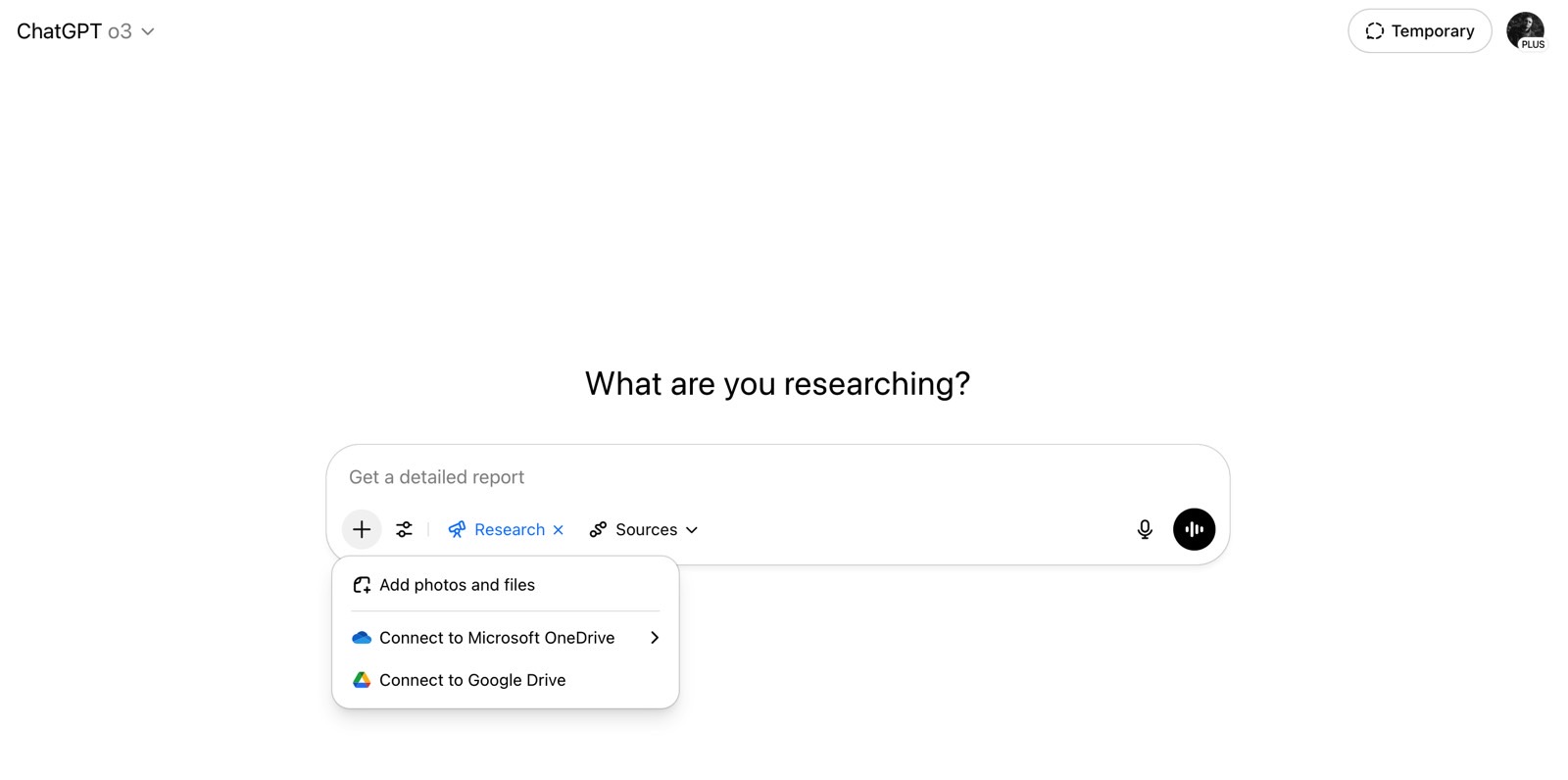
OpenAI replaced the older DALL-E pipeline with GPT Image, an autoregressive model woven into the same network that processes text. Generation happens through conversation, so refining a result is a matter of describing the change in plain language. GPT Image 2 is the current flagship through the API, while the ChatGPT app runs a closely related production model.
Strengths: Excellent prompt accuracy and clean typography, backed by dependable spatial reasoning, make it the strongest tool for logos and packaging mockups, and for any image that combines text with illustration. Iterative editing inside a chat thread is faster than mask-based tools for many tasks.
Limitations: Aesthetic output is competent rather than striking, and generation is slower than lightweight diffusion models. Rate limits on the Plus tier cap heavy sessions. DALL-E 3 and DALL-E 2 were removed from the API in May 2026, so legacy workflows had to migrate.
Pricing: Limited free access; ChatGPT Plus at $20 per month covers most individual use; Pro at $200 per month and per-image API billing serve higher volumes.
Best for: Creators who want precise, editable images and already work inside ChatGPT.
Adobe Firefly

Firefly is built around a single question that matters to brands: can the output be used commercially without legal exposure. Adobe trains the model on licensed and stock material and pairs it with commercial indemnification, then wires it into Photoshop, Illustrator, and Premiere through Generative Fill and Generative Expand.
Strengths: Clear, indemnified commercial rights and licensed training data remove the provenance worries that surround many rivals. Integration with Creative Cloud makes it the most natural choice for editing and compositing rather than pure generation, and content credentials travel with each file.
Limitations: Standalone generation quality trails the leaders, namely FLUX, Midjourney and Imagen, on photorealism and artistic range. The credit system on lower tiers runs out quickly, and the strongest value only appears for users already paying for Creative Cloud.
Pricing: Standalone Firefly from about $9.99 per month with limited credits; bundled into Creative Cloud plans that start near $54.99 per month.
Best for: Agencies and in-house teams that need airtight licensing and Photoshop-native editing.
FLUX (Black Forest Labs)
Founded by former Stable Diffusion researchers, Black Forest Labs ships FLUX as both open weights and a managed API. The FLUX.2 family released in late 2025 pushed the line toward photographic realism at up to four megapixels, with FLUX.2 max targeting maximum quality and FLUX.2 klein optimized for near-instant generation.
Strengths: Photorealistic portraits and product shots, with accurate text and a permissive deployment story for teams that want to self-host or fine-tune. The open-weight option supports full data sovereignty, which matters for regulated industries.
Limitations: The flagship 32-billion-parameter model demands heavy GPU memory to run locally, there is no polished consumer app comparable to Midjourney or Gemini, and quality varies across the many access points and partner platforms.
Pricing: Usage-based API credits, commonly around one cent to a few cents per image depending on model and resolution; open weights are free to run on owned hardware.
Best for: Developers and enterprises building image generation into their own products.
Ideogram
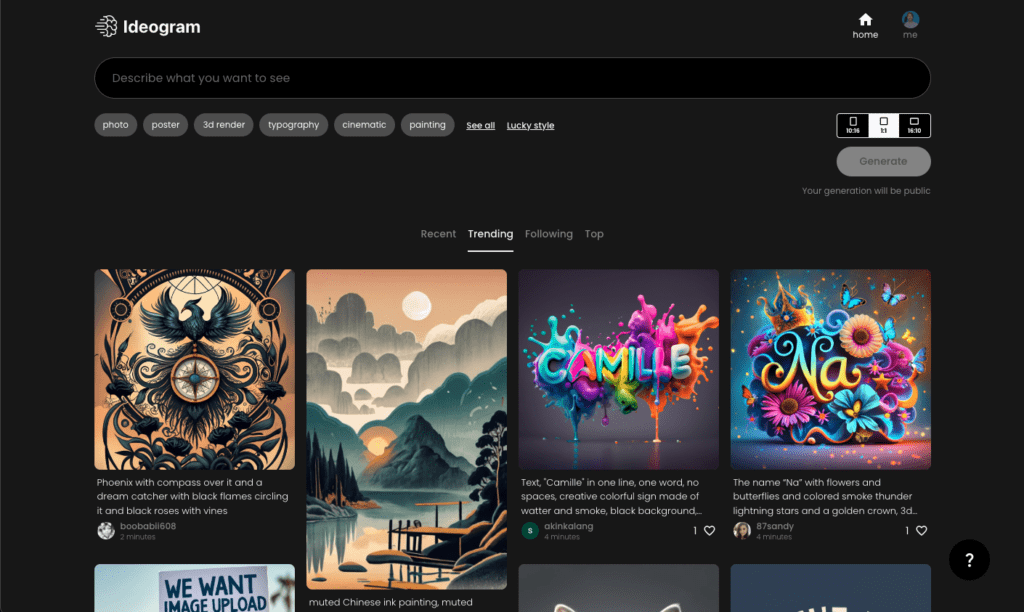
Ideogram made its name on the one task most models failed at, and it still leads there. Version 3.0 renders headlines and poster typography, dense packaging copy included, with accuracy that designers can hand to clients. The interface stays simple, tuned for rapid visual exploration.
Strengths: The strongest typography of any tool reviewed, plus fast iteration for concept work and a low barrier to entry for non-designers producing posters, ads, and social graphics.
Limitations: Editing tools are thinner than those in Firefly or the conversational models, photorealism is good rather than leading, and the platform is narrow by design, so it rarely serves as a single all-purpose generator.
Pricing: Free tier available; paid plans start around $8 per month with priority credits and canvas editing.
Best for: Marketers and designers whose images live or die on the words inside them.
Leonardo AI
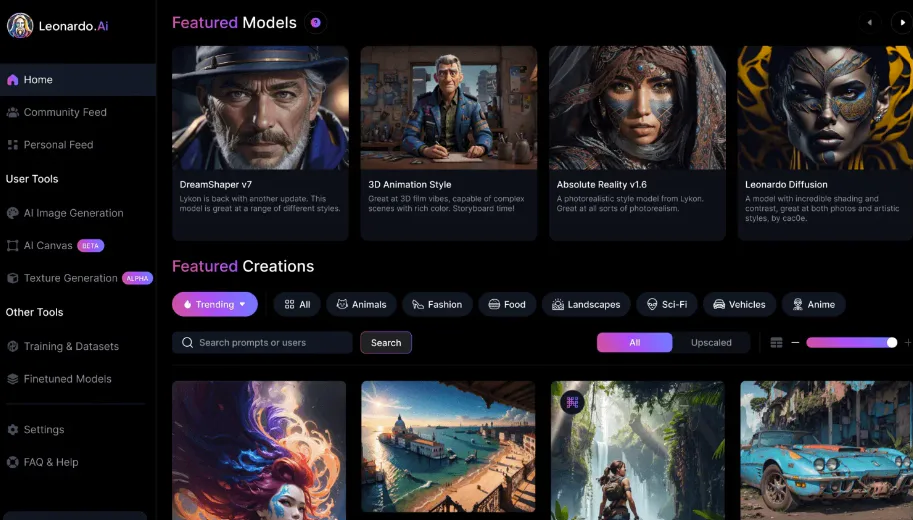
Leonardo targets creators who want control rather than a one-shot result. Its in-house Phoenix and Lucid Origin models sit alongside hosted FLUX, and a token economy lets users spend more on character consistency, LoRA training, or the AI Canvas when a project demands it.
Strengths: A consistent-character engine and custom model training give it an edge for game assets as well as comics and serialized brand work. The free tier grants 150 tokens daily, and feature depth per dollar beats most subscription rivals.
Limitations: Token costs vary by model and resolution, so two users on the same plan can produce sharply different volumes. Advanced models and the canvas sit behind higher tiers, as does private generation. Free-tier images are public by default.
Pricing: Free with 150 daily tokens; Apprentice $12 per month, Artisan $30, and Maestro $60, with roughly twenty percent off annual billing and custom Team pricing.
Best for: Creators producing consistent characters or training custom styles at scale.
Midjourney
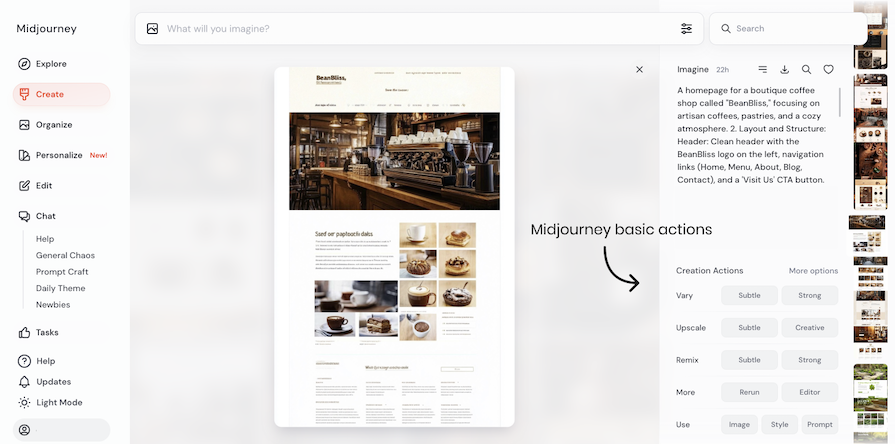
Midjourney remains the benchmark for aesthetic output. Independent of Google and OpenAI, it converts prompts into cinematic, atmospheric images with a coherence that competitors still chase. Version 7 is the default, with V8.1 the newest release, and the once Discord-only product now runs a mature web interface.
Strengths: Unmatched artistic quality and stylistic range, with lighting that competitors still chase, plus Omni Reference for character consistency. On editorial portraits, fantasy scenes, and brand campaign imagery, output tends to look intentional rather than accidental.
Limitations: Weak text rendering and editing controls that lag the conversational models drag down its composite score despite its visual strength. There is no permanent free tier, and private generation requires the Pro tier or higher.
Pricing: Basic $10, Standard $30, Pro $60, and Mega $120 per month, each twenty percent cheaper on annual billing; no free trial since 2023.
Best for: Artists and marketers who prioritize visual impact over text accuracy or editing.
SeaArt AI

SeaArt packs the widest feature set of any single platform here into a low-cost subscription. A library of more than 700,000 community models leans heavily toward anime and stylized art, supported by LoRA training from as few as twenty reference images, ControlNet, face swap, upscaling, and short video clips.
Strengths: Exceptional value and model variety. A ComfyUI-compatible workflow editor handles advanced control, and a low training barrier suits indie game and content production at volume.
Limitations: Output polish trails the leaders, text rendering is the weakest in this group, and tightened content moderation has frustrated some long-time users who relied on permissive generation. Commercial provenance is the least clear of the eight.
Pricing: Free tier with daily credits; paid plans from $5.99 per month, with credits consumed per image and per video clip.
Best for: Hobbyists and stylized-art creators who want maximum range at minimum cost.
Composite Capability Scores
Averaging the five surfaces produces a composite that rewards versatility. Google Gemini leads because it performs strongly everywhere, while Midjourney sits mid-pack despite its visual edge, held back by text and editing. The ranking should be read as a measure of all-round fitness, not of any single quality.
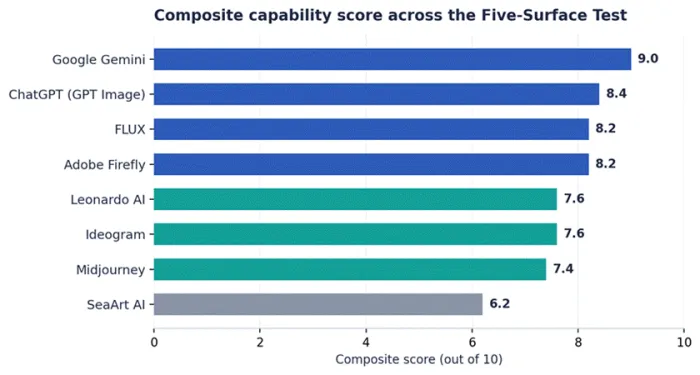
Figure 1. Composite scores, calculated as the mean of the five evaluation surfaces.
The detailed breakdown below shows why the order falls as it does. Reading across a row reveals a tool's range; reading down a column shows which platform owns a given task. Ideogram and Gemini top text rendering, FLUX and Midjourney top photorealism, and Adobe Firefly stands alone on commercial safety.
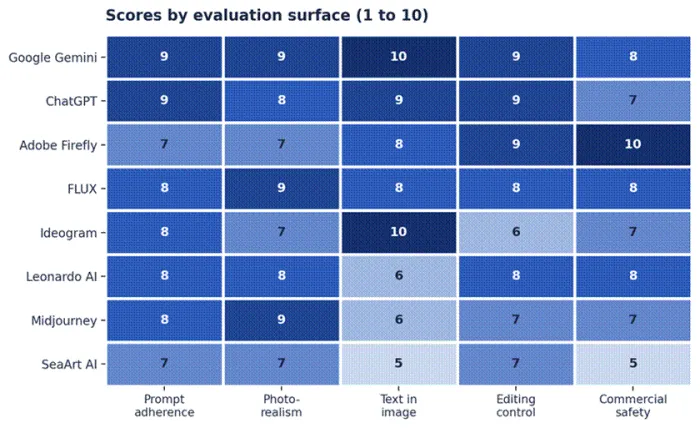
Figure 2. Surface-by-surface scores. Darker cells indicate higher performance.
Pricing at a Glance
Entry prices cluster tightly, but the value behind them differs sharply. SeaArt and Firefly anchor the low end, the conversational models cost more because image generation rides on a broader subscription, and FLUX is usage-based rather than fixed. Annual billing lowers most subscription costs by roughly a fifth.
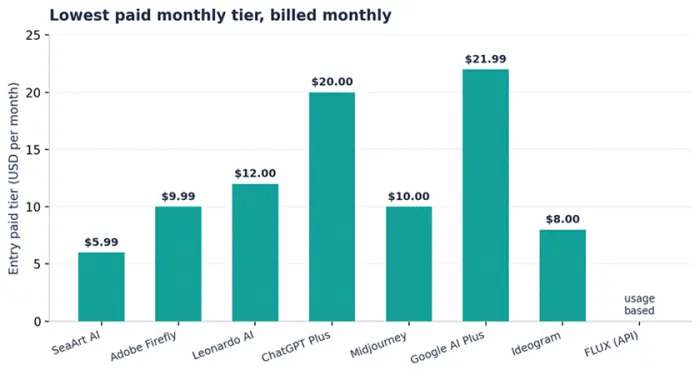
Figure 3. Lowest paid monthly tier, billed monthly, in US dollars.
| Tool | Entry paid plan | Notable higher tier | Billing model |
|---|---|---|---|
| SeaArt AI | $5.99 / mo | Pro credit packs | Credits per image |
| Ideogram | About $8 / mo | Plus and Pro | Priority credits |
| Adobe Firefly | $9.99 / mo | Creative Cloud from $54.99 | Monthly credits |
| Midjourney | $10 / mo (Basic) | Mega $120 / mo | Fast and Relax hours |
| Leonardo AI | $12 / mo (Apprentice) | Maestro $60 / mo | Monthly tokens |
| ChatGPT | $20 / mo (Plus) | Pro $200 / mo | Subscription plus API |
| Google Gemini | About $21.99 / mo | AI Pro and Ultra | Subscription plus API |
| FLUX | Usage based | Self-host open weights | Per-image credits |
Matching a Tool to the Job
No single generator wins every task, and the most efficient studios run two or three in combination. The table below maps common goals to the tool that fits best under the Five-Surface Test.
| Goal | Recommended tool | Reason |
|---|---|---|
| Posters and text-heavy graphics | Ideogram or Gemini | Highest text-rendering accuracy |
| Cinematic and editorial art | Midjourney | Strongest aesthetic coherence |
| Photorealistic product shots | FLUX or Gemini | Lifelike materials and lighting |
| Brand-safe commercial assets | Adobe Firefly | Licensed data and indemnification |
| Precise edits and revisions | ChatGPT or Gemini | Conversational, reference-aware editing |
| Consistent characters at scale | Leonardo AI | Character engine and LoRA training |
| High volume on a budget | SeaArt AI | Lowest cost and widest model library |
| Building into a product | FLUX | Open weights and managed API |
Where Image Generation Is Heading
Three shifts define the current cycle. First, generation is merging with reasoning: native multimodal models such as Gemini and GPT Image plan a composition before rendering it, which is why their text and layout accuracy jumped ahead of pure diffusion tools. Second, resolution and editing are becoming table stakes, with 4K output and reference-guided revision now common rather than premium. Third, provenance is moving to the center of buying decisions as watermarking through systems like SynthID and content credentials spread, and as licensing clarity separates tools suitable for commercial work from those that are not.
The practical consequence is that the gap between models on raw quality keeps narrowing. Differentiation increasingly comes from workflow fit and editing depth, and above all from legal certainty, rather than from which engine draws the prettiest single frame.
The Bottom Line
For an all-purpose choice that handles text and photorealism without trade-offs, and edits without fuss, Google Gemini through Nano Banana Pro is the strongest single platform in 2026. ChatGPT is the better pick for anyone who edits conversationally, Adobe Firefly is the safe answer when commercial licensing cannot be left to chance, and FLUX is the natural foundation for developers. Among specialists, Ideogram owns typography, Midjourney owns artistic impact, Leonardo owns character consistency, and SeaArt owns value and variety.
Pricing and model versions in this category change quickly, so plans should be confirmed on each provider's official page before committing.