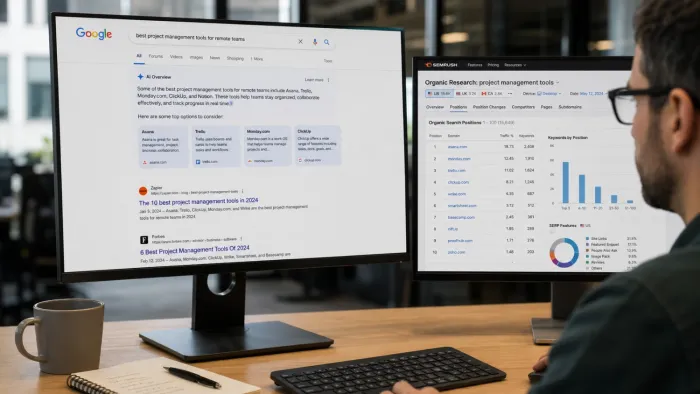
Google’s July search updates show a clear shift in how the company wants users to experience information, news, visuals and tasks inside Search.
Instead of treating AI as a side feature, Google is now building more AI-powered surfaces directly into the results page. The latest changes include a Top Stories carousel inside AI Overviews, image generation within search answers, app-based actions inside AI Mode, and new Search Console controls that help site owners measure and manage AI visibility.
The updates did not arrive as a broad ranking algorithm change. The bigger move is structural. Google is changing what the search results page can do before a user clicks anywhere else.
News Enters AI Overviews
The most important publisher update came on July 17, when Google confirmed that a Top Stories carousel is now fully live inside AI Overviews for mobile users in the United States.
The carousel shows timely news articles inside the AI answer box for some developing topics. It does not appear for every search, but when it does, it gives fresh reporting a dedicated route into AI Overviews instead of relying only on general citation logic.
For publishers, this matters because news visibility inside AI answers is becoming more organized. Google is also highlighting Preferred Sources inside AI Overviews and AI Mode, while “Highly Cited” badges are being used to point users toward influential original reporting.
The practical signal is clear. Publishers that want visibility in these surfaces need timely reporting, strong headlines, clean news markup, and original information that other outlets may cite. Rewritten summaries and late coverage are less likely to stand out when the feature is built around freshness and authority.
AI Images Move Into Search
Google also used the 25th anniversary of Google Images to announce a deeper AI image push. Its image-generation system is being added to AI Overviews, initially for desktop users in the United States using English.
Users will be able to ask Search to create visuals from scratch. For example, someone planning a room design could ask for a comparison image showing different wall colours or styles. AI Overviews can then generate a custom image at the top of the result, with regular Google Images results appearing below.
This is useful for users who want quick visual help, but it raises a real concern for creators and publishers. If Google can generate a visual answer directly inside Search, users may have less reason to click through to original photographs, design examples, or visual guides.
For websites that rely on original images ranking in Google Images, this is not a small change. AI-generated visuals may begin replacing some discovery moments where publishers previously earned visits.

AI Mode Starts Doing Tasks
On July 16, Google announced Connected Apps inside AI Mode, letting users connect services such as Instacart, YouTube Music and Canva.
The integrations move AI Mode beyond answering questions. Users can ask for a playlist based on a mood, generate a design template, or build a grocery cart from an event or saved plan. This builds on Google’s earlier move to connect AI features with its own apps, including Gmail, Drive and Photos.
The direction is clear. Search is becoming more action-based. Instead of searching for a recipe, opening a shopping list, choosing items and then checking out separately, a user may increasingly complete parts of that journey inside Google’s AI interface.
For businesses, this changes the meaning of search visibility. A transactional query may not always lead to a website visit. The task may begin and finish inside Search, with partner apps handling the final action.
Search Console Adds AI Controls
Google has also added more infrastructure for site owners. Search Console now includes generative AI performance reporting for AI Overviews, AI Mode and Discover’s AI features.
The reports show impressions, pages, countries, devices and dates. But they do not show clicks, click-through rate, average position or query-level detail. That limits how much publishers can understand from the data. A site owner may know that content appeared in an AI surface, but not whether that visibility drove meaningful traffic.
Alongside the reporting, Google has introduced a control that lets site owners block their content from appearing in AI Overviews, AI Mode and Discover’s AI features without harming normal search rankings.
The choice is not simple. Opting out protects content from being used in those AI search experiences, but it also removes the site from surfaces that now reach massive user audiences. Staying in preserves visibility, but it may also mean participating in answers that reduce clicks to the original page.
One important limitation is that the control does not cover every Google AI product. Content excluded from Search AI features may still appear in other AI experiences outside that setting.
What It Means for SEO
July’s updates show that SEO is no longer only about ranking traditional blue links. Site owners now have to manage visibility across AI Overviews, AI Mode, Discover, news carousels, generated images and task-based search experiences.
For publishers, freshness and original reporting now have a clearer path into AI answers. For visual creators, Google’s image generation creates a new competitive pressure. For brands and service businesses, AI Mode may absorb more of the user journey before a website visit happens.
The search results page is becoming less like a list of links and more like a working interface. For businesses that depend on organic traffic, the next challenge is not just being found. It is understanding where Google shows the content, how much control remains, and whether visibility still turns into visits.