Not every creator needs a complex studio, a paid subscription, or hours of setup to experiment with audio. PopPop.ai is built for exactly that mindset. It strips AI creativity down to its most practical form: quick access, browser-based tools, and results that appear within minutes, not workflows.
Instead of presenting itself as a professional audio suite, PopPop.ai functions more like a creative testing ground. Users can generate voiceovers, alter vocals, separate music tracks, or experiment with AI-driven sound effects without installs, tutorials, or technical friction. The platform’s appeal lies in its immediacy: you arrive with an idea, choose a tool, and start creating.
This emphasis on speed and experimentation gives PopPop.ai a distinct identity. It is not trying to replace advanced production software; it is designed to remove hesitation and make AI-powered audio feel approachable, playful, and accessible from the very first click.
What exactly is PopPop.ai?
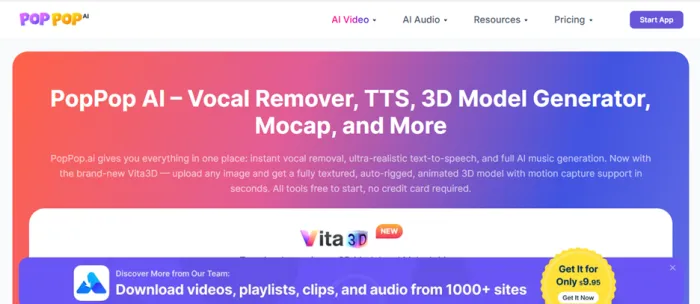
PopPop.ai is a web-based AI platform centered primarily on audio generation, manipulation, and enhancement. It brings together multiple standalone tools such as text-to-speech, voice changers, vocal separation, and AI song covers under a single, unified interface. The platform’s defining trait is its low barrier to entry. In many cases, users can access and test tools without creating an account, making the experience feel lightweight and inviting rather than transactional.
The website positions itself as a free and accessible AI creation hub, aimed at creators who want fast results rather than deep technical control. Instead of promising studio-level mastery, PopPop.ai emphasizes ease of use and instant output, appealing to users who value convenience over complexity.
PopPop.ai at a Glance
| What it is | Free, browser-based AI suite for audio creation (plus 3D via Vita3D) |
| Developer | Nabla Mind |
| Best for | Content creators, streamers, musicians, hobbyists, indie game devs |
| Core audio tools | Text-to-Speech, Voice Changer, Vocal Remover, AI Song Cover, Sound Effect Generator, Voice Cloning |
| 3D tools (Vita3D) | Image-to-3D, Scribble-to-3D, auto-texturing, auto-rigging, AI motion capture |
| Voices / languages | 200+ voices across 20+ languages (English US/UK/AU, Spanish, French, German, Chinese, Japanese, Korean, Arabic, and more) |
| Sign-up required? | No — many tools work without an account |
| Free tier | Yes, no credit card needed (daily/monthly limits apply) |
| Paid plans from | ~$9.95/month for audio; Vita3D roughly $10–$48/month (verify on the official pricing page) |
| Output formats | MP3 (audio), GLB (3D, Blender-compatible) |
| Platform | Web browser — no download or install |
The Platform Philosophy: Simplicity Over Sophistication
One of the most noticeable aspects of PopPop.ai is its design philosophy. The platform is built around tasks, not workflows. Users are not asked to understand timelines, layers, or advanced audio engineering concepts. Instead, they are presented with a straightforward question: What do you want to do today?
This task-first approach is particularly effective for beginners, casual creators, and hobbyists. Someone looking to remove vocals from a song or generate a quick voiceover can do so in minutes without reading documentation or watching tutorials. While this simplicity does limit fine-grained control, it aligns well with PopPop.ai’s target audience users who prioritize speed, experimentation, and accessibility.
Core Capabilities and Creative Possibilities
PopPop.ai’s strength lies in the breadth of its audio-focused tools rather than extreme depth in any single area. The text-to-speech functionality allows users to convert written content into natural-sounding voice outputs, making it suitable for quick narrations, short videos, or prototype voiceovers. The emphasis here is on immediacy rather than cinematic realism, but the results are more than adequate for casual and semi-professional use.
The AI voice changer and song cover features lean more toward creative experimentation. Users can upload audio files and apply different AI-generated voice styles, opening up possibilities for parody, remixing, and entertainment-driven content. These tools are particularly appealing to social media creators, streamers, and users who enjoy playful transformations rather than polished final productions.
Another practical highlight is the vocal remover and instrumental generator. By separating vocals from background music, PopPop.ai caters to musicians, remixers, and content creators who need quick instrumental tracks without navigating complex audio software. While the separation quality may vary depending on the source file, the tool delivers respectable results given its browser-based nature.
Every PopPop.ai Tool Explained
PopPop.ai bundles what would normally be several separate apps into one browser hub. Here's the full audio toolkit and what each tool does:
- AI Text-to-Speech (TTS) — Turns written text into natural-sounding speech with 200+ voices across 20+ languages. You can adjust speed and pitch, then download the result as an MP3. Ideal for voiceovers, narration, and prototype audio.
- AI Voice Changer — Transforms an uploaded or recorded voice into different styles, from realistic to robotic, anime, and character voices. Popular with gamers, streamers, and short-form video creators.
- AI Voice Cloning — Creates a custom voice profile from a sample (available in web and app form, with limits tied to your plan). Useful for consistent narration across a series of videos.
- AI Vocal Remover — Separates a song into isolated vocal and instrumental tracks using AI, then lets you download either stem. Perfect for karaoke, remixes, and backing tracks.
- AI Karaoke Maker — Strips the lead vocal from a track so you can sing along, built on the same separation engine as the vocal remover.
- AI Acapella Extractor — Does the opposite of the karaoke maker: isolates the vocal cleanly to create acapella tracks for sampling or remixing.
- AI Instrumental Maker / Remover — Produces a clean instrumental (or removes the instrumental to keep vocals), handy for practice tracks and covers.
- AI Song Cover Generator — Lets you upload a song, pick a vocal model or style, and generate a fresh AI cover. Great for parody, fan covers, and creative experimentation.
- AI Sound Effect (SFX) Generator — Generates custom sound effects from a short text description, so you don't have to dig through stock audio libraries.
Because these tools share one interface, you can move from generating a voiceover to pulling an instrumental to designing a sound effect without leaving the browser or switching accounts.
How PopPop.ai Works in Real-World Use
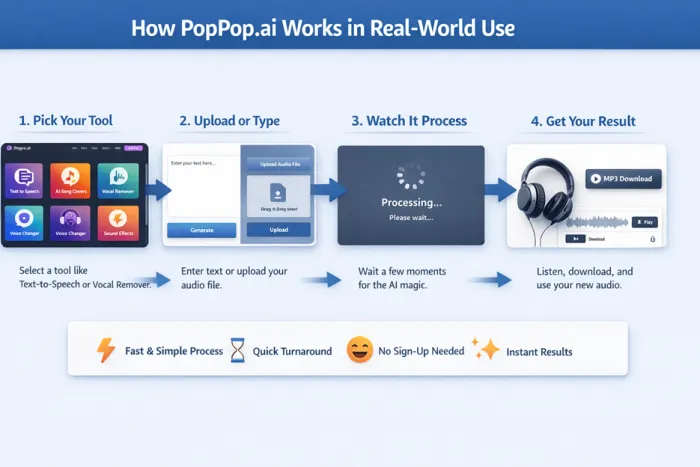
Using PopPop.ai is refreshingly straightforward. Upon visiting the website, users are greeted with a selection of tools rather than a marketing-heavy landing page. Choosing a tool leads directly to an input screen where users can either upload audio or enter text, depending on the function. Processing times are generally short, reinforcing the platform’s focus on rapid output.
The lack of forced sign-ups enhances the feeling of frictionless creativity. Users can test multiple tools in one session without interruption, making PopPop.ai particularly well-suited for exploration and trial-based usage. This ease, however, also signals that the platform is not designed for long, complex projects. It excels at quick tasks rather than extended production workflows.
User Experience and Interface Impressions
When you first land on PopPop.ai’s homepage, the simplicity of the layout immediately stands out. There’s no clutter, no overwhelming menus, and no lengthy signup process blocking access. Instead, users are greeted with direct entry points to tools like text-to-speech, voice changers, vocal removers, and other creative audio utilities all clearly labeled and accessible from a clean navigation panel. This transparency in the interface helps reduce friction right from the beginning and invites immediate experimentation without intimidation.
A Clean, Intuitive Interface That Reduces Cognitive Load
The overall design of PopPop.ai leans heavily toward user-focused simplicity, something rare in many AI platforms where technical jargon and complex dashboards can frustrate new users. Even those with zero prior experience in audio tools find the navigation intuitive: tools are arranged logically, and prompt labels are straightforward. Common actions like uploading a file, entering text, or selecting a voice require only a few clicks. This makes the platform feel less like a complex editor and more like a creative playground where ideas flow directly into results.
For users who appreciate accessible design, this ease of navigation is one of the platform’s most compelling strengths. You don’t need to hunt for a “Help” section just to figure out the basics; everything crucial is front and center.
Immediate Feedback and Results
PopPop.ai excels in delivering rapid output without unnecessary waiting. Tools such as text-to-speech and vocal removal generate results in just moments this immediacy reinforces user engagement. Unlike traditional audio editors where rendering and processing can take time, PopPop.ai’s browser-based outputs appear quickly, enhancing the sense of play and experimentation.
This speed also subtly educates users about cause and effect: when you adjust an input, the result changes quickly enough to feel responsive and intuitive. It fosters a sense of control even for complete beginners.
Real User Feedback: Mixed But Insightful
Community feedback highlights several important aspects of the user experience:
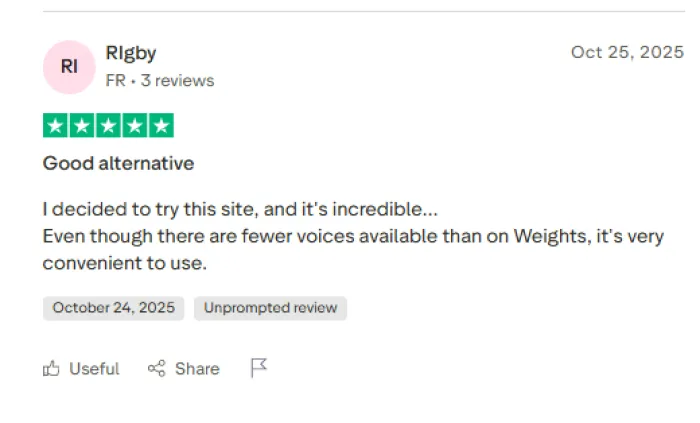
- Positive Impressions: Some users describe PopPop.ai as “very convenient to use” and appreciate how quickly they can experiment with different voice tools without barriers.
- Areas for Improvement: A segment of feedback points out occasional technical hiccups (like errors on uploads or credit deductions). These experiences indicate that while the UI is friendly, underlying stability and error messaging can sometimes lag behind the design simplicity.
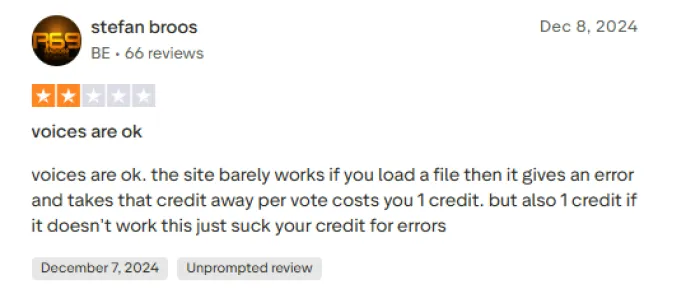
Overall, this feedback underscores that while the interface design is generally accessible and easy to grasp, there’s potential to improve robustness and error handling, a common challenge for fast-deployment tools.
Accessibility Across Devices
Although PopPop.ai is largely browser-centric, its responsive layout adapts reasonably well to different screen sizes. Mobile users can still navigate key functions without loss of clarity, and the layout scales to fit smaller screens. This responsiveness supports the platform’s accessibility ethos offering tools that work on the device you already have, without the need for a powerful computer or installed software.
What Sets the UI Apart
The interface’s strength lies in how direct and immediate the interaction feels:
- No forced tutorials or walkthroughs, users aren’t bombarded with guided tours; instead, they’re trusted to explore.
- Tool-first design PopPop.ai invites choices, not instruction menus, meaning users can pick a tool and start working without a preamble.
- Prompt clarity Labels and calls to action (e.g., “Separate Vocals” or “Generate Voice”) are easy to understand without prior experience.
This design choice reinforces confidence: users who might otherwise be intimidated by professional software can jump in and create.
Final Thoughts on UX & UI
PopPop.ai’s interface succeeds because it respects the user’s time and curiosity. Instead of being overwhelmed with technical options, it focuses on getting users to their creative result quickly. While there are mixed reviews about backend performance and occasional errors, the platform’s UI design itself is intuitively laid out, approachable for beginners, and streamlined for fast experimentation.
If your audience includes people who value ease of use, instant output, and minimal learning curves, this user experience narrative will resonate strongly in your article.
Pricing, Free Access, and Transparency
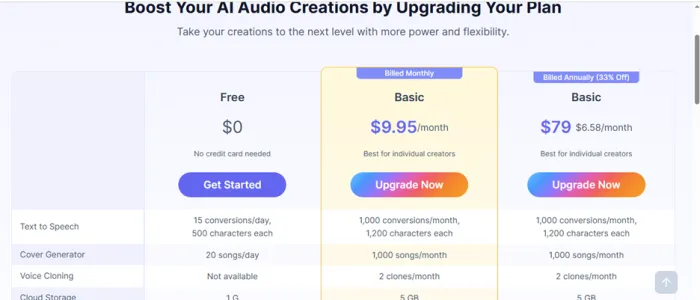
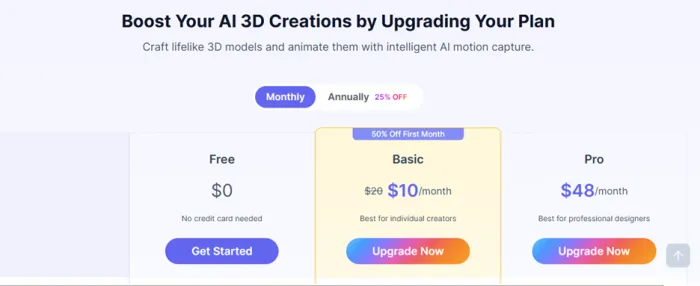
PopPop.ai adopts a pricing strategy that closely reflects its broader philosophy: let users experiment freely first, then decide whether they need more power. Rather than forcing early commitment, the platform separates its offerings into two clear categories audio tools and Vita3D each with its own pricing structure and free access pathway. This separation makes pricing easier to understand and prevents users from paying for features they may never use.
For audio tools, PopPop.ai offers a genuinely usable free tier. New users can access core features such as text-to-speech, AI song generation, vocal removal, and basic voice tools without entering payment details. While daily and monthly limits apply, the free tier is not merely a demo; it allows meaningful experimentation. This makes it particularly appealing for first-time users who want to evaluate output quality and usability before considering a paid plan. Usage limits are clearly indicated within the interface, reducing confusion about what is available and when restrictions will apply.
Paid audio plans are structured to scale usage rather than radically change functionality. As users move to higher tiers, they gain increased monthly quotas, larger character limits, faster processing priority, expanded storage, and access to features like limited voice cloning. Importantly, the platform does not aggressively upsell or obscure limitations behind vague language. Monthly quotas reset on a fixed cycle, and unused allowances do not roll over, a detail that is openly communicated on the pricing page. This level of clarity helps users plan their usage realistically instead of discovering restrictions after payment.
The Vita3D pricing model follows a similar principle but introduces a credit-based system more suited to computationally intensive 3D generation and animation tasks. Free users receive a modest number of credits each month, enough to test image-to-3D generation, basic rigging, and short animations. As creators move into paid Vita3D plans, they gain higher credit allocations, longer animation durations, faster queue priority, and greater asset retention. The distinction between tiers is clear, and credit consumption is tied directly to specific actions such as model generation, motion capture, or downloads, making it easier to understand where credits are being spent.
From a transparency standpoint, PopPop.ai performs better than many AI platforms in its category. Pricing pages clearly outline what each tier includes, and there is no ambiguity about whether free access requires a credit card—it does not. Cancellation instructions are available, and refund eligibility is explained rather than buried in fine print. While refunds are not unlimited, the platform provides a defined window for support requests in cases of accidental purchase or unresolved technical issues, which adds an extra layer of trust for cautious users.
Overall, PopPop.ai’s pricing feels intentionally restrained. It does not attempt to lock users into complex bundles or push enterprise plans aggressively. Instead, it allows creators to grow into paid tiers organically, based on real usage rather than speculation. For casual users, the free tier is sufficient to explore and learn. For regular creators, paid plans offer predictable scaling without sudden cost jumps. This balance between accessibility and clarity makes PopPop.ai’s pricing structure one of its quieter but more meaningful strengths.
Who Is PopPop.ai Best Suited For?
PopPop.ai is ideally suited for creators who need quick, accessible audio solutions without investing in professional software. Content creators producing short videos, streamers experimenting with voice effects, musicians testing remix ideas, and hobbyists curious about AI audio will find the platform particularly appealing.
On the other hand, professionals requiring precise control, consistent output quality, or advanced editing capabilities may find PopPop.ai too limited. The platform is not designed to replace full-fledged audio production tools but rather to complement them or serve as an entry point for those new to AI-driven creativity.
Strengths and Limitations in Practical Use
| Strengths | Limitations |
| Instant accessibility – Tools can be used directly in the browser, often without mandatory sign-ups, which removes friction for first-time users. | Limited advanced controls – Users looking for granular audio editing, fine tuning, or manual adjustments may find the options too basic. |
| Beginner-friendly interface – The layout is intuitive and task-oriented, making it easy for non-technical users to get started within minutes. | Inconsistent output quality – Results can vary depending on input audio quality and tool selection, especially for complex vocals or layered tracks. |
| Fast processing times – Most tools generate outputs quickly, reinforcing a smooth and responsive creative experience. | Not suited for long projects – The platform is optimized for quick tasks rather than extended workflows or multi-stage production. |
| Wide variety of creative audio tools – From text-to-speech and vocal removal to voice changing and AI covers, the platform supports diverse experimentation. | Feature depth is shallow – While the tool range is broad, individual tools lack the depth found in professional audio software. |
| No installation required – Entirely web-based, making it accessible on lower-end systems and shared devices. | Reliance on internet stability – Performance and uploads can be affected by slow or unstable connections. |
| Low commitment entry point – Free access encourages experimentation before considering any paid features. | Usage limits on free tier – Free users may encounter restrictions such as output caps, shorter durations, or limited processing credits. |
| Encourages creative exploration – The platform feels more like a sandbox than a rigid toolset, ideal for testing ideas quickly. | Not designed for professional mastering – Output is generally suitable for demos, content creation, or fun use, not final studio-grade delivery. |
| Clear, minimal UI – Reduces cognitive load and avoids overwhelming users with technical jargon. | Error handling can be unclear – When issues occur, feedback messages are sometimes limited or vague. |
Trust, Safety, and Responsible Use
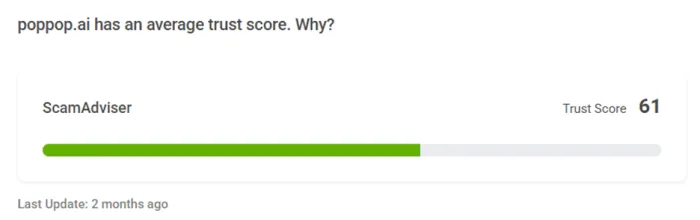
When evaluating AI-powered creative platforms, trust and responsible usage are just as important as features. PopPop.ai presents itself as a low-barrier, browser-based toolset, and this positioning strongly influences how users should approach safety and data handling.
One of the platform’s most trust-friendly aspects is its minimal onboarding. Several tools can be accessed without mandatory account creation, which reduces the immediate exposure of personal data such as email addresses or payment details. This design choice aligns well with PopPop.ai’s role as a casual experimentation platform rather than a long-term production or storage service.
That said, PopPop.ai still requires users to upload audio or text content for processing. Like most cloud-based AI tools, this means data is handled on external servers. While there is no public evidence of malicious behavior, the platform does not position itself as an enterprise-grade or compliance-focused service. Users should therefore treat it as a creative sandbox and avoid uploading sensitive, confidential, or proprietary materials.
Handling of Uploaded Content
PopPop.ai works best with non-sensitive inputs such as publicly available music, personal test recordings, demo narration, or creative experiments. The platform does not prominently disclose detailed data retention policies or model-training practices on its main pages, which is common among lightweight AI tools but still relevant from a safety standpoint.
Because of this, responsible use means assuming that uploaded files are processed externally and may be temporarily stored for functionality. Users working with commercial voice assets, unreleased music, or private conversations should rely on more secure, contract-based solutions instead.
Ethical Considerations Around AI Voice Tools
PopPop.ai includes voice-changing and AI cover tools that enable playful and creative audio manipulation. However, these features also raise ethical considerations common across voice-based AI platforms. Using AI-generated voices to impersonate real individuals, mislead audiences, or create deceptive content can lead to ethical and legal issues.
Responsible users should clearly disclose when audio has been AI-generated or modified and avoid imitating identifiable individuals without consent. When used transparently for entertainment, parody, or experimentation, these tools remain ethically appropriate.
Community Reputation and User Sentiment
Public user feedback provides additional insight into trustworthiness. Reviews of PopPop.ai tend to focus on usability, convenience, and creative potential rather than serious security concerns. Some users report occasional technical issues or limitations, but there are no widespread reports of data misuse or privacy violations.
This pattern reinforces the idea that PopPop.ai is viewed as a casual creative tool rather than a mission-critical service, a perception that aligns with its design and access model.
Best Practices for Responsible Use
To use PopPop.ai safely and responsibly:
- Avoid uploading sensitive, personal, or proprietary audio files
- Treat generated outputs as drafts or creative experiments
- Clearly label AI-generated or modified audio when sharing publicly
- Respect copyright laws and voice likeness rights
- Use the platform for testing, learning, and ideation not secure storage
These practices align with general recommendations for browser-based AI tools and help users minimize risk while enjoying creative flexibility.
Overall Trust Assessment
In summary, PopPop.ai offers a reasonable level of trust for its intended purpose: fast, accessible AI audio experimentation. It minimizes required personal data, enables quick creative output, and maintains a generally positive reputation among casual users. However, it is not designed to replace secure, professional, or compliance-heavy audio production environments.
Used thoughtfully and ethically, PopPop.ai can be considered a safe and low-risk platform for exploration, learning, and creative play provided users understand its scope and limitations.
PopPop.ai vs. Popular Alternatives
PopPop.ai's edge is breadth and zero friction — a free, no-download suite that covers many audio jobs plus 3D. Dedicated competitors usually go deeper on one job but cost more or require installs. Here's how it stacks up:
| Tool | Focus | Free tier | Standout strength | Trade-off vs. PopPop.ai |
|---|---|---|---|---|
| PopPop.ai | All-in-one audio + 3D | Yes, no card | Broad toolset, browser-based, no sign-up for many tools | Shallower depth per tool |
| ElevenLabs | Text-to-speech & voice cloning | Limited | Best-in-class voice realism, developer API | Subscription-focused, narrower scope |
| Voicemod | Real-time voice changer | Limited | Live voice changing for streaming/gaming | Desktop install, audio-only |
| LALAL.AI | Stem separation | Limited | Very clean vocal/instrumental splits, API | Paid credits, single-purpose |
| Moises | Musician practice suite | Yes | Chord/tempo tools, native mobile apps | Music-only, subscription for full features |
| Meshy / Tripo | AI 3D model generation | Yes (credits) | Deeper 3D control and output options | 3D-only, no audio side |
The short version: if you want one free browser tab that handles voiceovers, vocal removal, covers, sound effects, and 3D experiments, PopPop.ai is hard to beat on convenience. If you need the absolute cleanest stem separation (LALAL.AI), the most realistic cloned voices (ElevenLabs), or professional 3D depth (Meshy/Tripo), a specialist tool will serve better — often alongside PopPop.ai rather than instead of it.
Final Verdict: Is PopPop.ai Worth Exploring?
PopPop.ai succeeds by knowing exactly what it wants to be. It does not attempt to compete with professional audio workstations or enterprise AI platforms. Instead, it offers a frictionless entry point into AI-powered audio creativity, where users can test ideas, generate quick results, and enjoy the process without technical overhead.
For beginners, casual creators, and anyone curious about AI audio tools, PopPop.ai is absolutely worth exploring. It delivers on its promise of simplicity and accessibility, even if it occasionally sacrifices depth and refinement. As a creative sandbox rather than a polished studio, it earns its place in the evolving landscape of browser-based AI tools.
If your goal is fast experimentation and creative freedom without complexity, PopPop.ai is likely to leave a positive impression.