On paper, Remaker AI and D-ID look like cousins: both lean on generative models, both promise studio-grade results without a studio. Spend an afternoon with them and the resemblance falls apart. One is a face swap and photo workshop built for speed. The other is a talking-avatar engine built for business video.
This comparison comes from real jobs, not spec sheets: batch face swaps, product-photo cleanup, then a headshot turned into a multilingual presenter and wired into a chat agent. What follows is which tool earns its place for which task, backed by current pricing and verified ratings.
The short version, for anyone in a hurry:
● Pick Remaker AI for face swaps, batch photo edits, and headshots, paid for once with credits that never expire.
● Pick D-ID for talking-avatar videos, multilingual narration, interactive agents, and API video at scale.
● Use both when a project needs polished images on one side and a presenter that speaks on the other.
Remaker AI vs D-ID at a glance
The split is clearest side by side, before the section-by-section comparison that follows.
| Attribute | Remaker AI | D-ID |
|---|---|---|
| Core job | Face swap and AI photo editing | Talking-avatar and digital-human video |
| Best known for | One-click face swap (photo, video, GIF) | Photo-to-video presenters with lip-sync |
| Typical output | Edited images and short clips | Talking-head MP4 videos and live agents |
| Pricing model | One-time credits, no subscription | Monthly or annual subscription |
| Free option | 30 credits on signup, plus 5 daily | 14-day trial |
| Entry paid price | About $5.99 for 200 credits | $5.99 monthly, $4.70 annual (Lite) |
| Languages | Image-first, minimal speech | 120-plus languages for speech |
| API access | Limited | Full REST API (Advanced and up) |
| Headline rating | 4.3 on the App Store | 4.6 on G2 (116 reviews) |
| Best fit | Creators, social, ecommerce edits | Businesses, training, marketing, developers |
Remaker AI optimizes for cheap, fast image work; D-ID for polished, multilingual video and live agents. Nearly every other difference, from pricing model to output format to the ideal user, follows from those two starting points.
What each tool is actually built for
Remaker AI: a face swap and image studio
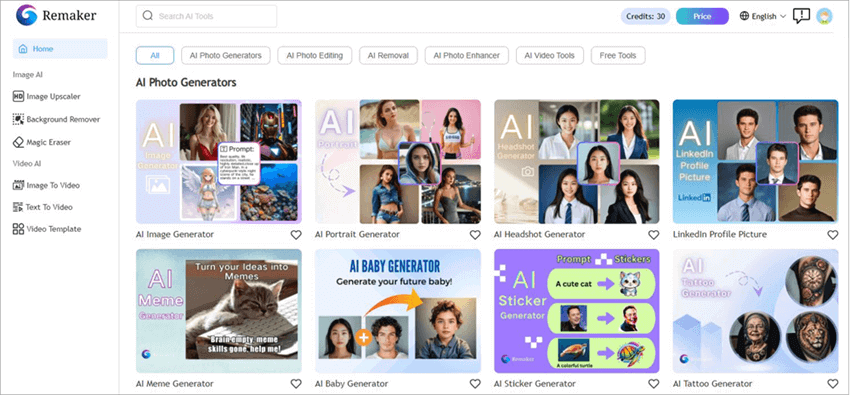
Remaker AI began as a face swap tool and grew into a full image studio. The swap engine handles single photos, group shots through a multi-face mode, and entire folders in one batch run, which kills the one-at-a-time grind that slows most consumer tools.
Around the swap sits a familiar kit: AI upscaling, background and watermark removal, an AI headshot generator, and ecommerce product-photo tools. Setup is light, since the web tools run with no install and casual swaps need no account, while a free account adds daily credits whose quality limits lift once credits are bought. Video swaps exist too, but they lean on credits heavily and are not the draw.
| What Remaker AI nails | Where it strains |
|---|---|
| Fast, accurate face swaps across photo, video, and GIF | Video output burns credits and can over-smooth |
| Batch processing for high-volume image work | Group shots and harsh lighting still trip the AI |
| A genuine all-in-one image kit, not one trick | Support and uptime have drawn repeated complaints |
| Usage-based credits that never expire | Web payments shifted to crypto and Telegram in 2026 |
D-ID: a talking-avatar and digital-human engine

D-ID works the same raw material, a face, from the opposite end. Its Creative Reality Studio turns a portrait plus a script or audio file into a lip-synced talking-head video, with speech in more than 120 languages and voice cloning from a short sample.
The platform reaches past single clips into real-time Visual AI Agents that hold live conversations, a Talking Head REST API that runs at scale, and integrations with Canva, PowerPoint, and Google Slides. The 2024 acquisition of explainer-video maker simpleshow widened it further, and security and compliance get real attention whenever a sensitive likeness is involved.
| What D-ID nails | Where it strains |
|---|---|
| Lifelike talking avatars with strong lip-sync | Avatars stay head-and-shoulders, little body motion |
| Speech in 120-plus languages from one script | A few non-English voices still sound robotic |
| A real REST API and live, interactive agents | Five-minute cap forces longer content to be split |
| Enterprise integrations, security, and compliance | Editing one line means re-rendering the whole video |
Plot those strengths on a single scale and the division of labor is hard to miss.
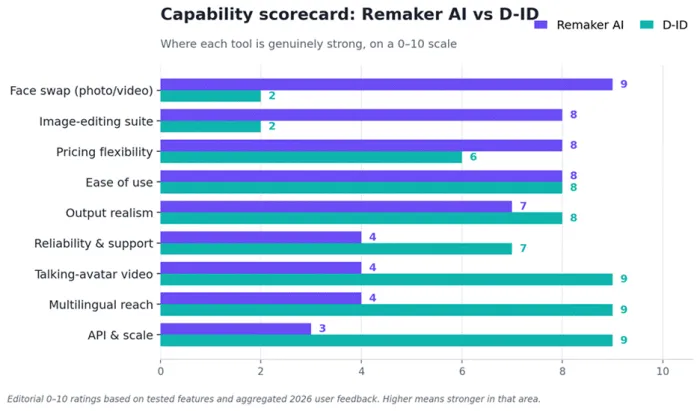
Capability scorecard. Scores reflect tested features and aggregated user feedback rather than vendor benchmarks.
Feature-by-feature comparison
This table goes deeper on the capabilities that usually decide a purchase.
| Feature | Remaker AI | D-ID |
|---|---|---|
| Face swap | Core strength: photo, video, GIF, batch | Not a face-swap tool |
| Talking-head video | Basic and credit-heavy | Core strength with lip-sync presenters |
| Voice and audio | Limited | Text-to-speech, voice cloning, pacing |
| Languages | Image-first, minimal speech | 120-plus languages |
| Interactive agents | None | Real-time Visual AI Agents with knowledge docs |
| Image tools | Upscale, background and watermark removal, headshots | Minimal |
| Max video length | Short clips | 5 minutes per video |
| Output resolution | Up to 4K on paid (images, some video) | Up to 1080p (premium presenters) |
| API and automation | Limited | Full REST API, streaming, batch |
| Integrations | Web app and mobile app | Canva, PowerPoint, Google Slides, simpleshow |
| Watermark | Removed on paid credits | Present on free trial and Lite plan |
| Commercial use | Allowed with paid credits | Gated to the Advanced plan and up |
The overlap is thinner than the matchup suggests: each tool is a tourist on the other's turf. Choosing on the strength column, not the long feature list, leads to a better decision, since a weak secondary feature rarely outweighs a strong primary one.
Free trial and free tier
Both let new users try before paying, but the free experience differs in kind, not just degree.
| Free access | Remaker AI | D-ID |
|---|---|---|
| Model | Free credits, ongoing | 14-day time-limited trial |
| Starting allowance | 30 credits on signup, plus 5 daily | Trial minutes across core features |
| Output limits | Quality capped until credits are bought | Watermark and standard presenters only |
| Card to start | Not needed for casual swaps | Trial available before any upgrade |
The shapes suit different habits. Remaker AI rewards casual, recurring use, since small daily credits keep the door open indefinitely while paid credits unlock full quality. D-ID front-loads access into two weeks, which fits a focused video evaluation more than occasional dabbling.
Pricing compared
Pricing is where the two philosophies split hardest. Remaker AI sells credits once and lets them sit; D-ID sells monthly access with minutes that reset. Neither is automatically cheaper, so the right answer depends on whether the work is image-heavy and occasional or video-heavy and ongoing.
Remaker AI pricing: one-time credits
| Plan or pack | Price | What it includes |
|---|---|---|
| Free | $0 | 30 credits on signup plus 5 daily; quality limits apply |
| Starter pack | About $5.99 | About 200 credits, no watermark, full resolution |
| Popular pack | About $49.99 | About 3,000 credits, suited to steady image work |
| Bulk pack | About $299 | About 20,000 credits for heavy or team use |
Credits never expire and nothing recurs. A face swap or photo edit runs about 2 to 8 credits while a short video clip burns 11 to 30, so image work stretches a pack far and video drains it fast. Web payments now route through crypto and Telegram rather than cards, a change worth checking first, and prices vary by region and over time, so treat the figures as a guide.
D-ID pricing: subscription tiers
| Plan | Monthly | Annual | Highlights |
|---|---|---|---|
| Free trial | $0 (14 days) | n/a | Core features, watermark, limited minutes |
| Lite | $5.99 | $4.70 | About 10 min monthly, standard presenters, watermark |
| Pro | $49.99 | $16 | About 15 min, premium presenters at 1080p, no watermark |
| Advanced | $299.99 | $108 | About 65 min, API access, commercial rights, plugins |
| Enterprise | Custom | Custom | Unlimited scale, agents, security, dedicated support |
Minutes do not roll over, so a quiet month is wasted spend. The features businesses actually need, no watermark, premium presenters, commercial rights, and API access, sit on the higher tiers, which is why the free trial can flatter the paid reality. API usage is billed separately, at a rate reported near $5.90 per minute.
A few things worth knowing before paying:
●Remaker AI keeps casual swaps free and account-free, but web payments now run through crypto and Telegram, and a multi-day outage in late 2025 dented its reliability record.
●D-ID does not roll minutes over, and editing a single line re-renders the whole clip, so scripts are best locked before generating.
●Commercial rights are gated on both, to D-ID's Advanced plan and to Remaker AI's paid credits, so check the terms before publishing client work.
Output quality and real-world performance
Specs only go so far. What matters is how the results hold up once they leave the screen, and the gap between a polished demo and a real deadline is where each tool's character shows.
Remaker AI is at its best on clean, well-lit, single-subject photos, where swaps blend naturally and edits land in seconds. Group shots, odd angles, and harsh lighting bring out the artificial look. Running a finished swap back through the built-in upscaler recovers some sharpness before anything goes public, while video enhancement stays the weak spot, over-smoothing detail for too many credits.
D-ID makes convincing talking heads: reviewers single out the lip-sync and expressions, and the output reads as professional for training, explainers, and marketing. The limits are motion and length, since avatars stay locked to the head and shoulders and the hard five-minute cap forces long scripts to be split. Editing even one line means re-rendering the whole clip, so scripts are best locked before generating, and a few non-English voices still trail on naturalness.
What users are saying
Marketing aside, the review record tells a more honest story, and the two tools land very differently depending on who is reviewing.
| Tool | Platform | Rating | Notes |
|---|---|---|---|
| D-ID | G2 | 4.6 / 5 | 116 reviews; praised for ease, realism, support |
| D-ID | Trustpilot | More critical | Smaller sample; billing and refund complaints |
| Remaker AI | Apple App Store | 4.3 / 5 | High volume; happy with quick, sharp results |
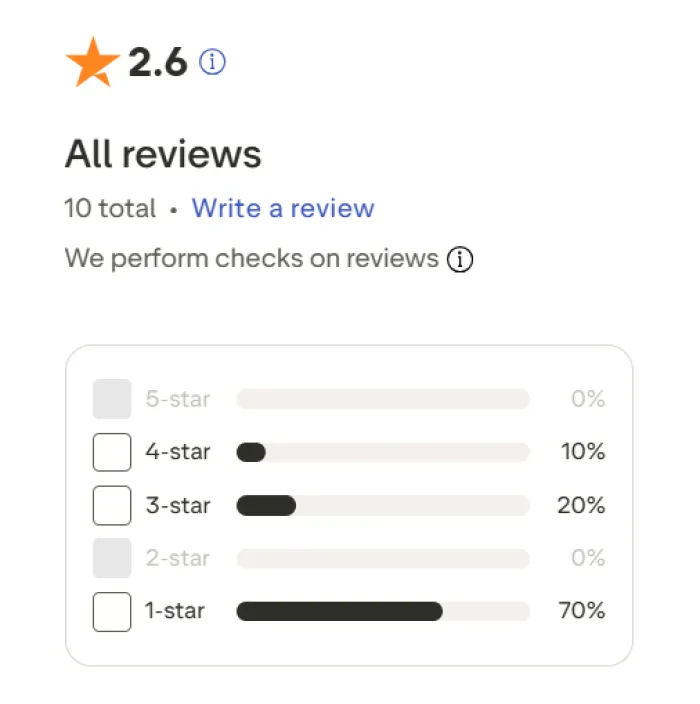
| Remaker AI | Trustpilot | 2.5 / 5 | About 6 reviews; downtime and support gripes |
| Remaker AI | ScamAdviser | Likely legitimate | Automated trust check across data sources |
D-ID holds a strong 4.6 on G2 across 116 business reviews, praised for ease of use, realistic avatars, and support. The recurring gripes are cost, limited avatar movement, and a credit model that charges a full re-render for a one-word change; consumer reviews on Trustpilot run cooler over billing and refunds, a reminder that business and consumer satisfaction are not the same thing.

Remaker AI shows the inverse shape: a healthy 4.3 on mobile for quick, sharp results, but a 2.6 on its small Trustpilot sample after a multi-day outage in late 2025, video failures, and slow support. Independent checks rate the site as likely legitimate and uploads are deleted within 48 hours, so it delivers on core image work yet stumbles on reliability when something breaks.
For context, avatar rivals like HeyGen and Synthesia carry thousands of G2 reviews to D-ID's hundred-plus, so D-ID is well regarded but not the most battle-tested name in its category.
A note on consent and responsible use
Both tools put a real person's likeness in play, so responsible use is not optional. Permission comes first, especially for anything public or commercial, and synthetic media should be labeled wherever viewers might assume a clip is real, which a growing number of platforms now require. Commercial rights matter too: D-ID gates them to its Advanced plan, and Remaker AI ties them to paid credits, while sharing someone's likeness without consent can carry legal as well as reputational risk.
The market behind the matchup
Zooming out explains why these tools feel like they are racing in different lanes. They are.
D-ID lives inside the AI avatar and digital-human market, sized near $9.7 billion in 2025 and projected to reach about $38 billion by 2030, growing near 31 percent a year. Both Market Research Future and Precedence Research list D-ID among the key players, alongside Synthesia, HeyGen, and Soul Machines, which is why it keeps pushing toward agents, API scale, and enterprise deals where contracts and switching costs run higher and protect margins.
Remaker AI rides a scrappier current: face swap and AI photo editing form a faster-churning, lower-priced niche where free alternatives are everywhere and switching costs are tiny. That keeps prices low, but it also means any single tool, Remaker AI included, can be undercut or outpaced quickly. The chart below shows the avatar wave D-ID is positioned to ride, with a note marking where Remaker AI sits in relation.
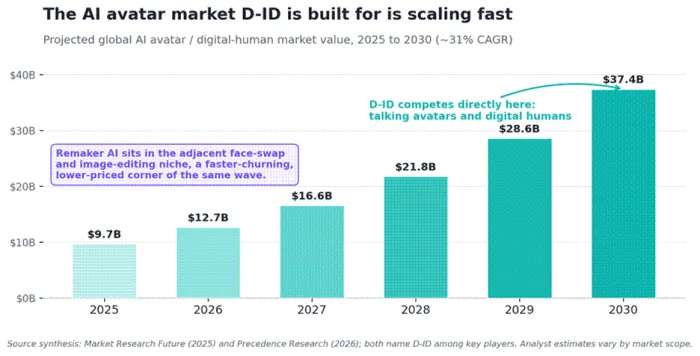
Projected AI avatar / digital-human market value. Figures synthesize Market Research Future (2025) and Precedence Research (2026); estimates vary by scope.
Which tool fits which job
Strip away the spec sheets and the choice comes down to the task at hand.
| Goal or task | Better pick | Why |
|---|---|---|
| Swapping a face in a photo, video, or meme | Remaker AI | Purpose-built, fast, cheap per swap |
| Editing product photos in bulk for a store | Remaker AI | Batch processing and a full image kit |
| Generating professional headshots quickly | Remaker AI | Dedicated headshot tool at low cost |
| Turning a script into a talking presenter | D-ID | Core strength with strong lip-sync |
| Localizing one video into many languages | D-ID | 120-plus languages from a single script |
| Building an interactive avatar or agent | D-ID | Real-time Visual AI Agents |
| Generating avatar videos at scale via code | D-ID | Full REST API and streaming |
| Avoiding subscriptions, paying only when active | Remaker AI | One-time credits that never expire |
| Producing commercial, watermark-free brand video | D-ID (Advanced) | Commercial rights and clean output |
Put simply, Remaker AI wins when the work is image-first, high in volume, and budget-conscious and a subscription feels like overkill, while D-ID wins the moment a face needs to speak, teach, sell, or hold a conversation and polish matters more than price. A fair number of teams will want both, reaching for Remaker AI on swaps, thumbnails, and cleanup, then D-ID when a face needs a voice. They solve adjacent problems, not the same one.
Final verdict
After enough real jobs, the verdict writes itself, and it is not a single winner.
Remaker AI is the tool to reach for when the work is visual, high-volume, and budget-conscious. Face swaps, batch edits, quick headshots, and cleanup all land fast, and the buy-once credit model suits anyone who refuses to babysit another subscription. The catch is reliability, so it earns trust for everyday creative tasks more than for mission-critical pipelines, where a backup plan is wise after the late-2025 outage.
D-ID is the clear pick the moment a face needs to talk, teach, sell, or hold a conversation. The avatars are convincing, the language coverage is rare, and the API makes it genuinely scalable, which is why it belongs in business, training, and developer hands. The price ladder is steep and the talking-head format has limits, but for professional video without a camera, little else in this matchup comes close, provided the budget can reach the higher tiers that drop the watermark and unlock the API.
The smartest move is to stop framing it as Remaker AI versus D-ID at all. One puts a new face on an image. The other gives a face a voice. Match the tool to the job, lean on the free credits and trial first, and the right choice stops being a debate.