ACTIVE The intern broke the build.
PASSIVE The build was broken by the intern.
Starting with an Example
Why I stopped hunting passives on sight
I edit blog drafts for a living, and for most of the past nine years the same scene has repeated on my screen. A writer runs a draft through a grammar checker, sees a wall of passive-voice flags, and dutifully rewrites every single one. The post comes back to me technically cleaner and noticeably worse. Sentences that used to flow now lurch, because the writer forced an actor into places where the actor did not matter.
Early in my career I did the same thing, enforcing “active good, passive bad” like a speed limit. What changed my mind was tracking which posts readers actually finished. The strongest performers were overwhelmingly active, yes, but every one of them contained deliberate passives, placed exactly where a passive does the job better.
So this is not another lecture telling you passive voice is evil. It covers what each voice actually is, five spots where active wins, six where passive earns its keep, what the style guides genuinely say past the famous one-liners, and the thresholds tools like Yoast and Hemingway apply to your draft.

Quick answer
Default to active, deploy passive on purpose Write roughly nine out of ten sentences in active voice, because active is shorter, easier to scan, and assigns clear responsibility. Switch to passive when the actor is unknown or irrelevant, when the receiver of the action is the real topic, when diplomacy matters, or when passive keeps a paragraph's focus steady. Neither voice is a grammar error, and Google's documentation never mentions passive voice as a ranking factor. |
What each voice actually is
Voice describes the relationship between the subject and the verb. In active voice, the subject performs the action. In passive voice, the subject receives it, the verb becomes a form of “to be” plus a past participle, and the doer either moves into a “by” phrase or disappears entirely.
Active: subject acts
PATTERN [The editor] [cut] [the paragraph]
One clause, one clear chain of responsibility. The reader knows who did what without backtracking.
Passive: subject receives
PATTERN [The paragraph] [was cut] [by the editor]
The receiver takes the spotlight. Drop the “by” phrase and the doer vanishes completely, which is sometimes the point and sometimes the problem.
The zombie test
Rebecca Johnson, a professor at Marine Corps University, shared a trick in 2012 that editors still use daily. Add the words “by zombies” after the verb. “The paragraph was cut” by zombies? Grammatical, so it is passive. “The editor cut” by zombies? Nonsense, so it is active.
Not everything with “was” is passive
“The post was long” is a linking verb with an adjective. “She was writing at midnight” is past progressive. Neither is passive voice. The confusion is so common that linguist Geoffrey Pullum caught famous style guides mislabeling ordinary sentences as passive.
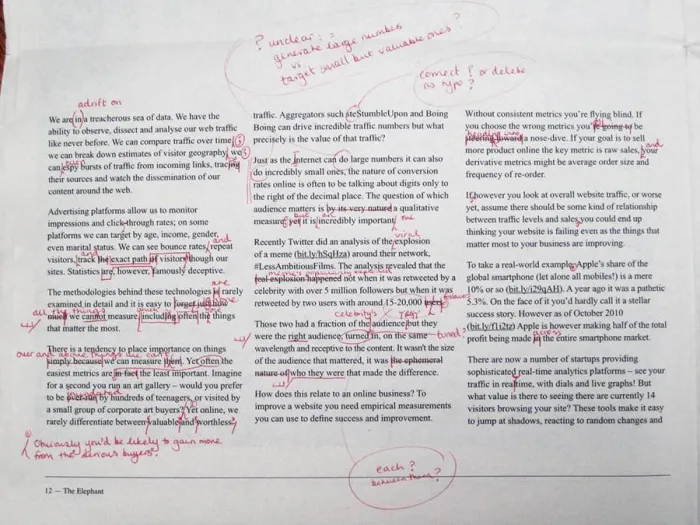
Active vs. passive at a glance
| DIMENSION | ACTIVE VOICE | PASSIVE VOICE |
|---|---|---|
| Length | Shorter, usually by two to four words per sentence | Longer, since “to be” and often a “by” phrase get added |
| Emphasis | On the doer and the action | On the receiver or the result |
| Accountability | Names who is responsible | Can hide or downplay the actor |
| Scanning | Fast, follows the natural subject-verb-object pattern | Slower, readers may pause to work out who acted |
| Typical blog use | Intros, tutorials, opinions, CTAs, storytelling | Incident reports, changelogs, methods, diplomatic recaps |
| Main risk | Can feel blunt in sensitive contexts | Reads evasive or bureaucratic when overused |
Five places where active voice wins in blogs
01 / Tutorials and how-to steps: instructions need a clear actor
Step-by-step content collapses without direct commands. Federal guidelines at plainlanguage.gov push active voice for exactly this reason: readers of instructions must know instantly who does what.
WEAK The Export button should be clicked before closing the tab.
STRONG Click Export before you close the tab.
02 / Intros and hooks: openers live or die on momentum
Your first hundred words decide whether anyone reads the rest. Active constructions front-load energy and keep the reader moving instead of decoding.
WEAK A lot of traffic is lost by blogs with slow intros.
STRONG Slow intros bleed traffic.
03 / Product and service pages: buyers want to know who does what
Commercial copy is a promise, and promises need a subject. “We migrate your data in 48 hours” lands harder than “your data will be migrated” because someone is visibly on the hook.
WEAK Refunds are processed within five days.
STRONG We process refunds within five days.
04 / Storytelling and case studies: characters have to act
Case studies work because a real person made decisions and got results. Passive dissolves the character into the scenery and drains the tension that keeps people scrolling.
WEAK A new pricing model was tested over six weeks.
STRONG Maria's team tested a new pricing model for six weeks.
05 / CTAs and microcopy: buttons and asks are verbs
Every call to action is an imperative, which is active by definition. The same goes for the sentence right before the button, where a passive lead-in kills the handoff.
WEAK The checklist can be downloaded below.
STRONG Grab the checklist below.

Six places where passive voice earns its keep
01 / The actor is unknown
Sometimes there is no actor to promote. Forcing one in produces vague filler like “someone” or “hackers,” which adds words without adding facts.
KEEP My site was hacked in March.
02 / The receiver is the story
Readers of a product update care about the feature, not which engineer touched it. Passive puts the thing they searched for in the subject slot, where their eyes land first.
KEEP Dark mode was removed in version 5.2.
03 / Topic flow between sentences
In The Sense of Style, Steven Pinker defends passive for keeping a paragraph's topic in the subject slot, so each sentence opens with what the reader already knows. “We launched a survey. It was completed by 2,000 readers” flows better than yanking the spotlight mid-thought.
04 / Tact and diplomacy
A retro post can say “two deadlines were missed” without publicly blaming a colleague. Use this power carefully: analyst William Schneider dubbed the notorious “mistakes were made” the past exonerative, and readers smell evasion when the hidden actor is obviously you.
05 / Methods and process notes
When you document a test, the procedure can matter more than the person. “Each landing page was shown to 500 visitors” keeps attention on the method. Ration these, though: journals like Nature now encourage active voice, and APA style makes active the default.
06 / Keyword-first headings
Jakob Nielsen's eyetracking work at Nielsen Norman Group showed that people scan the first words of headlines, and he argued back in 2007 that passive is legitimate there because it lets the key term lead. “Passive voice penalized by Google?” puts the query where scanners look.
What trusted sources actually say
The famous advice is more nuanced than the one-liners suggest, and the experts disagree more than most blog posts admit.
GEORGE ORWELL · POLITICS AND THE ENGLISH LANGUAGE, 1946
His fourth rule reads, “Never use the passive where you can use the active.” Worth knowing: Orwell admitted in the same essay that he had repeatedly broken his own rules within it, and his prose leans on passives throughout.
[Anti-passive, with caveats]
STRUNK & WHITE · THE ELEMENTS OF STYLE
The book's blunt heading tells writers to use the active voice, yet the very next lines concede that passive is frequently convenient and sometimes necessary, an admission most people quoting the rule skip.
[Pro-active default]
GEOFFREY PULLUM · CHRONICLE OF HIGHER EDUCATION, 2009
The linguist's essay marking the book's 50th anniversary argued its grammar advice was unreliable, noting that several of its own examples of passive voice are not passive at all, and that skilled writers use passives constantly.
[Defends passive]
STEVEN PINKER · THE SENSE OF STYLE, 2014
The Harvard psycholinguist treats passive as an attention-steering device. It exists in English, he argues, because writers sometimes need to keep the reader's gaze on the thing acted upon rather than the actor.
[Defends passive]
PURDUE OWL · ONLINE WRITING LAB
Purdue's widely cited guidance frames it as a choice, not a rule: pick passive to highlight the receiver of an action or when the actor is unimportant, and pick active for directness and concision everywhere else.
[Situational]
PLAINLANGUAGE.GOV · US FEDERAL GUIDELINES
The official plain language guidelines instruct government writers to prefer active voice so readers can immediately identify who is responsible for an action, calling passive one of the biggest obstacles to clear writing.
[Pro-active default]
What the tools measure, and what Google actually cares about
Most bloggers meet this debate through a colored dot in a plugin, so here are the real thresholds behind those dots.
| TOOL | HOW IT JUDGES PASSIVE VOICE | HOW TO TREAT IT |
|---|---|---|
| Yoast SEO | The readability check flags your post once more than 10 percent of sentences are passive | A useful smoke alarm. Audit the flagged sentences, keep the ones doing a real job |
| Hemingway Editor | Highlights passives and sets an allowance that scales with the length of the piece | Good for spotting clusters, blind to whether a given passive is justified |
| Grammarly | Marks passive constructions as clarity suggestions, explicitly not as errors | Read each suggestion against the six legitimate uses above before accepting |
| Google Search | No documented ranking signal counts passive sentences. Public guidance focuses on helpful, people-first content | Voice affects rankings only indirectly, through whether readers stay and finish |
The takeaway: no crawler docks you for a passive sentence. Overuse simply slows readers down, and reader behavior is what actually moves rankings. Write for the person scanning on a phone and the tools mostly turn green on their own.
How to spot weak passives and fix them in three moves
1. Find the pattern. Search the draft for was, were, is, are, been, and being, then check for a following past participle. Zombie-test anything ambiguous.
2. Ask whether the doer matters. If knowing who acted would change how the reader feels or what they do next, the actor belongs in the sentence. If not, the passive may be earning its place.
3. Promote the actor and reread. Rewrite as subject, verb, object, then read the paragraph aloud. If the fix broke the flow, that passive was structural, so put it back.

| DRAFT SENTENCE | VERDICT | AFTER THE EDIT PASS |
|---|---|---|
| A decision was made to sunset the free plan. | FIX | We decided to sunset the free plan. Owning the call builds more trust than hiding it. |
| Your invoice will be sent by our billing team on Friday. | FIX | Our billing team will send your invoice on Friday. Same facts, three fewer words. |
| The webinar was attended by over 400 marketers. | FIX | More than 400 marketers attended the webinar. The impressive number now leads. |
| It has been observed that shorter intros perform better. | FIX | Shorter intros perform better in our tests. Cut the throat-clearing entirely. |
| The login bug was fixed in release 5.2. | KEEP | Leave it alone. Readers searched for the bug, not the engineer, so the receiver belongs up front. |
Four myths worth retiring
| MYTH | REALITY |
|---|---|
| Passive voice is a grammar mistake | A fully grammatical construction English has used for centuries. The question is fit, not correctness |
| Every sentence with “was” or “were” is passive | Linking verbs and progressive tenses use the same helpers. Check for a past participle acting on the subject before flagging anything |
| Active voice is a direct SEO ranking factor | No search engine documents such a signal. Voice influences rankings only through readability and engagement |
| Passive is always wordier and weaker | Usually longer by a few words, yes, but when the actor is unknown or irrelevant, the passive version is often the tighter, clearer one |
The ratio I actually see in posts that perform
After nine years and more drafts than I can count, here is the honest pattern. The posts that hold readers to the end run around 90 percent active, and the remaining passives are never accidents. They sit in changelogs, in incident recaps, in the second sentence of a paragraph where switching subjects would break the thread. When I audit a struggling post, the problem is rarely that passive voice exists. It is that passive voice appears where nobody chose it.
So my working rule, the one I give every writer I onboard, has two halves. Draft in active voice without thinking about it, because momentum matters more than polish at that stage. Then, on the edit pass, interrogate every passive the checker finds with a single question: does the reader need the receiver up front here? If yes, keep it and move on with a clear conscience. If no, promote the actor and enjoy the two words you just saved.
Orwell gave us the rule, Pinker gave us the exceptions, and the tools give us the flags. The judgment in between is the actual craft, and it is the part no plugin will ever do for you. Choose your voice on purpose, sentence by sentence, and both of them will work for you.