Buying backlinks the slow way is a familiar grind for anyone who has done SEO for a while. Building a prospect list, digging out an editor's email, sending the pitch, waiting, following up, then negotiating over price and anchor text before anything goes live. It works, but it eats days.
SERPInsight sets out to remove that grind. It is a marketplace, so the pitch is simple: sign up, load a budget, and place orders instead of chasing publishers over email. This review is based on two weeks of hands-on use, running real guest posts and niche edits through it and watching them move from pending to live. What follows is the practical picture, covering how it works, what it costs, where it saves time, and the parts worth double-checking before spending money.
Quick verdict 4.2 / 5 ★★★★★ Best for fast, self-serve link buying without cold outreach | |
| Best for | Agencies, founders, and freelance SEOs who want placements without cold outreach |
| What it is | A self-serve marketplace for guest posts, niche edits, and footer links |
| Stands out | Escrow-protected payments and a 36-month link protection window |
| Watch-out | Publisher quality varies, so verify traffic yourself before you buy |
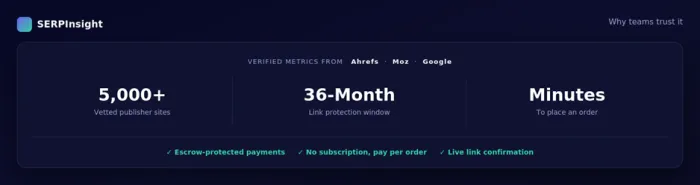
5,000+ Vetted publisher sites | 36-Month Link protection window | Pay-per-order No subscription fees | Ahrefs + Moz Verified site metrics |
What SERPInsight actually is
The short version before the detail.
SERPInsight is a backlink marketplace. Instead of hunting for sites and emailing owners, you browse a catalog of publishers, filter by the metrics that matter to you, and place an order in a few minutes. The publisher does the placement, and you track the whole thing from one dashboard. It is run by SERPInsight LTD, and it also gives away a set of free SEO tools on a separate subdomain.
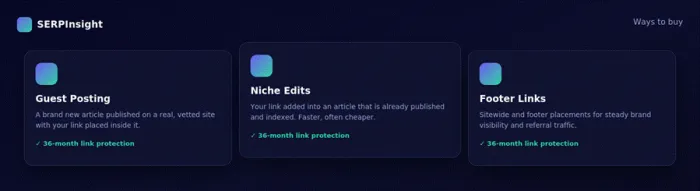
There are three products under the same roof, and they cover most of what off-page SEO campaigns need:
| SERVICE | WHAT YOU GET | BEST WHEN |
|---|---|---|
| Guest Posting | A brand new article published on a real site with your link inside it | You want fresh topical pages and a clean editorial link |
| Niche Edits | Your link added into an article that is already published and indexed | You need volume fast and do not want to write new content |
| Footer Links | Sitewide or footer placements from vetted publishers | You are after brand visibility and steady referral traffic |
Before a site shows up in the catalog, it goes through an automated check using Ahrefs and Moz data, and then a manual review by the team that looks at traffic, authority, content quality, and whether the site is a real property rather than a link farm. That two-layer screen is the reason the listings feel trustworthy at a glance, though it is still no substitute for independent checks, which the last section covers.
| Handy for agencies: because everything runs from one account, you can order and track links for multiple clients in the same dashboard, with order history kept clean enough to drop straight into a report. There is also a separate set of free SEO tools if you want to sanity-check a metric without leaving the ecosystem. |
How the ordering flow works
Four steps, and each one lives inside the dashboard.
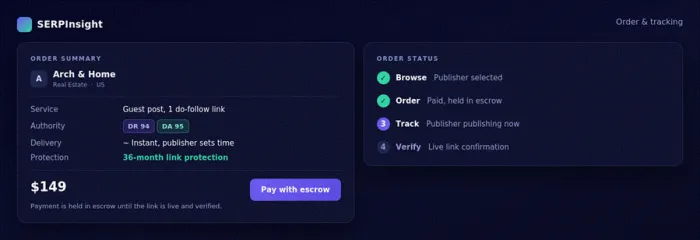
| 1 | Browse Filter the publisher list by Domain Rating, traffic, niche, country, language, and price until the shortlist fits your campaign. |
| 2 | Order Pick a publisher, upload your draft or send a brief with anchor text and target URL, then pay through escrow. |
| 3 | Track Watch the order move from pending to published in your dashboard, so you always know its status without chasing anyone. |
| 4 | Verify The live link gets confirmed after delivery, and the 36-month link protection window starts from day one. |
The filtering is what saves the most time. There are more than twenty filters, and because every listing shows its metrics up front, sorting by Domain Rating and traffic skips the back-and-forth about numbers that usually happens over email. In testing, most placements went live within a few hours, though delivery time is set by each publisher and shown before checkout.
What it costs
Pay per placement, and the price is on the listing before you commit.
There is no monthly plan. You sign up for free and pay only when you order, which is the right model for anyone who buys links in bursts rather than every week. Price scales with the publisher's authority and traffic, so a strong domain in a competitive niche costs more than a smaller blog.
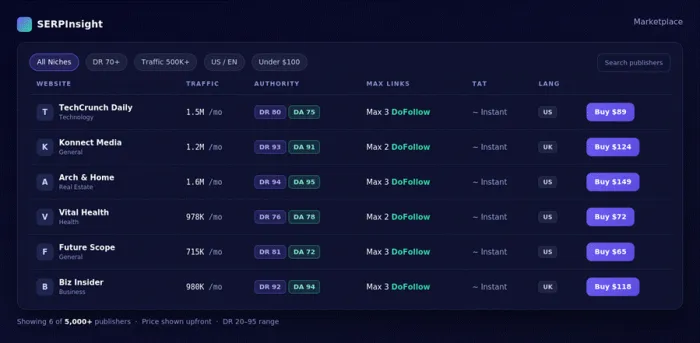
Here is a sample of publishers pulled straight from the marketplace, so you can see how price tracks with the metrics rather than guessing:
| PUBLISHER EXAMPLE | MONTHLY TRAFFIC | AUTHORITY | PRICE |
|---|---|---|---|
| Future Scope (General) | 715K | DR 81 / DA 72 | $65 |
| Vital Health (Health) | 978K | DR 76 / DA 78 | $72 |
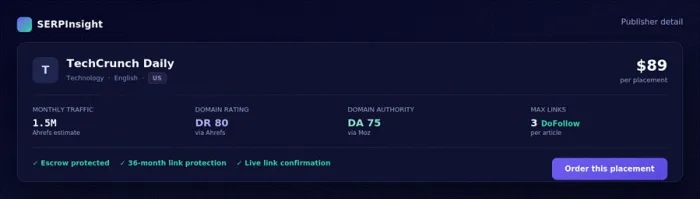
| TechCrunch Daily (Technology) | 1.5M | DR 80 / DA 75 | $89 |
| Biz Insider (Business) | 980K | DR 92 / DA 94 | $118 |
| Arch & Home (Real Estate) | 1.6M | DR 94 / DA 95 | $149 |
Example listings shown on SERPInsight, August 2026. The live catalog spans a Domain Rating range of roughly 20 to 95.
Because the catalog runs all the way down to lower Domain Rating sites, there are cheaper entries than the examples above if you are working on a tight budget. Payment is held in escrow until the link is live and confirmed, so you are not paying into thin air. If a publisher rejects the order or misses the delivery window, the balance goes back to your wallet to reorder. Most publishers accept your finished article or a brief, and content creation is available as an add-on if you would rather not write it yourself.
| On the pricing: for placements on sites reporting six-figure monthly traffic, the mid-range prices here undercut what direct outreach usually costs to negotiate. The escrow hold is the reassuring part, since the risk sits with the platform until the work is done rather than with the buyer at checkout. |
Pros and cons after real use
The honest ledger, not a feature list.
What works well ✓ Placements without a single outreach email, which turned a week of chasing into an afternoon of ordering. ✓ Metrics are shown up front, so filtering by Domain Rating and traffic is quick and honest. ✓ Escrow protection means your money is held until the link goes live and is verified. ✓ The 36-month protection window is longer than most marketplaces bother to offer. ✓ No subscription, so occasional buyers are not paying for months they do not use. | What to keep in mind ! Protection is a defined window, not a forever guarantee, so treat these as strong links rather than permanent ones. ! Quality across an open marketplace varies, and a high Domain Rating alone does not prove a site is a good fit. ! Content quality is on you unless you buy the writing add-on, and weak articles still read as weak. ! Results depend on your wider plan, since anchor text and target choices are yours to get right. ! It is a younger brand than the big SEO suites, so build trust with a small test order first. |
Who it fits, and who should skip it
| A GOOD FIT IF YOU ARE | LOOK ELSEWHERE IF YOU |
|---|---|
| An agency running links for several clients from one account | Only want links that are contractually permanent for life |
| A founder or small team without hours for outreach | Need deep backlink analysis and rank tracking in the same tool |
| A freelance SEO who buys placements in bursts, not monthly | Prefer building relationships with editors for repeat features |
| An affiliate or e-commerce brand wanting quick topical coverage | Have zero appetite to vet individual publisher sites yourself |
Four things to check before you spend
The due diligence worth doing on any marketplace, this one included.
| CHECK 01 | Confirm traffic yourself Run the publisher URL through your own Ahrefs or Semrush view. Marketplace numbers are a starting point, not the final word. |
| CHECK 02 | Match the niche, not just the DR A relevant site with modest authority often beats a high-DR general site that has nothing to do with your topic. |
| CHECK 03 | Read the policies Skim the refund, delivery, and link protection terms so you know exactly what the 36-month window covers before ordering. |
| CHECK 04 | Start with one order Place a single test placement, see how it delivers and reads, then scale up once the process has earned your trust. |
SERPInsight vs manual outreach
If you are weighing the marketplace against the traditional approach, the trade-off is speed and convenience against control and relationships.
| FACTOR | SERPINSIGHT | MANUAL OUTREACH |
|---|---|---|
| Time to first link | Hours | Days to weeks |
| Effort per placement | Low, one dashboard | High, email and follow-up |
| Price visibility | Shown upfront | Negotiated case by case |
| Payment safety | Escrow held until live | Depends on the publisher |
| Relationship building | Limited | Strong, repeatable |
The honest answer is that most serious campaigns use both. A marketplace like this covers volume and speed, while direct relationships stay valuable for the handful of flagship sites you want to appear on again and again.
The verdict after two weeksTwo weeks of hands-on use point to one clear strength: SERPInsight removes the part of link building most people dread, the outreach. Filtering publishers by real metrics, ordering in minutes, and letting escrow hold payment until each link goes live turns a campaign that would swallow a week into a handful of focused sessions. Placements can land on sites reporting strong traffic without a single cold email. It is not a replace-everything tool. The link protection is a defined window rather than a lifetime promise, quality across any open marketplace is uneven, and the content still has to be good for the link to be worth anything. None of that is hidden, and all of it is manageable by verifying traffic first and starting small. For agencies, founders, and freelancers who want dependable placements without the outreach slog, it earns its place, ideally alongside a few direct relationships for the flagship sites that matter most. Final score: 4.2 / 5 ★★★★★ |