Let me guess why you are here. Your feed has been a wall of AI announcements all year. New models, new features, new acronyms, and somewhere underneath all that noise is a version of you just trying to answer one question: which of these updates actually affect the way I write?
That is exactly what this guide is for. I went through the 2026 model releases, the market research reports, and the independent detector benchmarks, then stripped out everything that does not touch your day-to-day writing. What is left is a clear picture of the year so far: the numbers, the shifts, and the practical takeaways for students, marketers, bloggers, and fiction writers.
No hype. No vague predictions. Just data, tables, and honest context. Let's get into it.
Four Numbers That Summarize the Year
Market $115.8B Projected global value of the AI writing assistant software market in 2026, up from $91.3 billion in 2025, per Precedence Research. The firm expects nearly $988.5 billion by 2035, growing roughly 27% per year. | Adoption 97% Share of content marketers who plan to use AI writing tools in 2026, based on a statistics roundup published in April 2026. |
The web 74% Share of newly published web pages that now contain at least some AI generated content, according to the same 2026 data roundup. | Detection 2 to 8% Average detection rate for properly humanized AI text across major detectors in a 2026 leaderboard test. Yes, you read that correctly. More below. |
One honest caveat before we continue: different research firms define this market differently. A narrower estimate from Intel Market Research puts the 2026 figure at $1.95 billion, growing to $5.12 billion by 2034. The exact number depends on what counts as a "writing assistant," but every report agrees on the direction. Up, and fast.
The Big Model Updates of 2026
The engines behind almost every writing tool you touch got refreshed this year. Here is the scoreboard:
| Company | 2026 releases | Headline improvement | What it means for your writing |
|---|---|---|---|
| OpenAI | GPT-5.2, then GPT-5.5 in April | Better instruction persistence across long tasks, 256K context | Fewer mid-draft "personality resets" on long documents |
| Anthropic | Claude Opus 4.7, then Opus 4.8 | More careful handling of nuance, uncertainty, and edge cases | Reviewers consistently rank it highest for natural long-form prose |
| Gemini 3.1 Pro, then Gemini 3.5 Flash | 1 million token context window | Can hold an entire book manuscript in memory at once | |
| xAI | Grok 4.3 | Real-time research through X data | Strong for trend-driven and social content |
A few data points worth pinning to your wall:
• OpenAI reported that GPT-5.2 produced roughly 65% fewer hallucinations than the previous generation, which is a meaningful jump for anyone drafting research-heavy content.
• Claude Opus 4.8 sits at $5 per million input tokens and $25 per million output tokens on the API, keeping it in line with other frontier models rather than above them.
• Comparison reviewers throughout 2026 keep landing on the same split: GPT models for versatile everyday work, Claude for careful long-form prose, Gemini for anything that needs an enormous context window.
The market share shake-up nobody predicted One January 2026 analysis found ChatGPT's share of the AI assistant market fell from roughly 87% to about 68%, while Gemini surged past 18%. Real competition has arrived, and it is exactly why prices keep dropping and features keep shipping faster. For you, the user, this is the best possible news. |
What the Adoption Data Actually Says
Here are the most useful 2026 statistics from across the research landscape, gathered in one place:
| Metric | Figure | Source |
|---|---|---|
| Content marketers planning to use AI writing tools in 2026 | 97% | 2026 AI writing statistics roundup |
| Average reported productivity gain from AI-assisted writing | 44% | Same roundup |
| Increase in monthly content output for AI-assisted teams | 42% | Same roundup |
| Annual growth in generative AI spending through 2030 | 36% | Cited in a 2026 B2B tools review |
| Companies that abandoned most of their AI pilots in the past year | 42% | Same review |
| North America's share of the AI writing software market | ~42% | Precedence Research |
What this means for you Adoption is nearly universal, but that 42% pilot abandonment rate is the most honest number on this list. The pattern researchers keep finding is simple. Teams that get value from AI writing tools already have a working content process before they add AI to it. Teams that struggle are hoping the tool will invent a process for them. If you take exactly one strategic lesson from the 2026 data, make it that one. |
The Detection Arms Race Got Messy
If you write for school, clients, or publications, this is probably the section you scrolled here for. 2026 is the year the gap between what AI detectors claim and what they actually deliver became impossible to ignore.
Claimed Accuracy vs. Independent Testing
| Detector | Vendor claim | What independent tests found |
|---|---|---|
| Winston AI | 99.6% | Premium tools test well, but no independent benchmark replicates vendor numbers |
| Copyleaks | 99.1% | Results vary widely depending on content type |
| GPTZero | 99.3% | Around 83% real-world accuracy with an 11% false positive rate in one 2026 test, dropping to 68% on mixed human-and-AI text |
| Originality.ai | 96% | One 2026 analysis found it caught only 31.7% of GPT-5 content and just 7.3% of GPT-5-mini output |
| Turnitin | 87% | A March 2026 institutional benchmark measured 92% overall accuracy with a 3% false positive rate |
| Free detectors | Varies | 68 to 84% accuracy in 2026 testing |
The False Positive Problem Is Bigger Than the Accuracy Problem
61% In one widely cited study, detectors flagged 61% of genuine essays written by non-native English speakers as AI generated on average. Predictable grammar and simpler vocabulary look statistically similar to machine output, so real human writers pay the price. |
The fallout has been institutional. Vanderbilt, MIT, Yale, and the Toronto District School Board have all reportedly disabled or discontinued AI detection tools, citing false positive risk. GPTZero itself has publicly acknowledged that false positive rates rise sharply on submissions under 300 words, and a University of Chicago study found most detectors struggle badly on anything under 50 words.
The user-first takeaway A detector score is a probability estimate, not proof. Treat it that way whether you are a student defending your own work, a teacher grading someone else's, or an editor reviewing a freelancer's draft. |
Humanizers Went From Gimmick to Category
While detectors stumbled, the tools built to defeat them matured quickly. The 2026 numbers are stark:
| Detection rate: raw vs. humanized AI text | Result |
|---|---|
| Unmodified AI text caught by Turnitin | 9 of 10 |
| Humanized text caught, ten-detector average | 2 to 8% |
• A ten-tool detector leaderboard found humanized AI text was caught only 2 to 8% of the time.
• Even Originality.ai, the most aggressive detector in that test, caught just 7.8% of humanized samples.
• One Turnitin-focused test found only 3 out of 10 humanized samples scored above its 20% AI indicator threshold, while the same detector correctly caught 9 out of 10 unmodified AI texts.
• Academic research points the same direction. A study by Perkins and colleagues found six detectors averaging 39.5% accuracy on raw AI text dropped to just 17.4% once that text was lightly edited.
Vendor claims in this category are everywhere, so hands-on testing matters more here than anywhere else. Two humanizers have been through documented, real-world trials worth reading before you spend anything:
Hands-on test GPT Scrambler 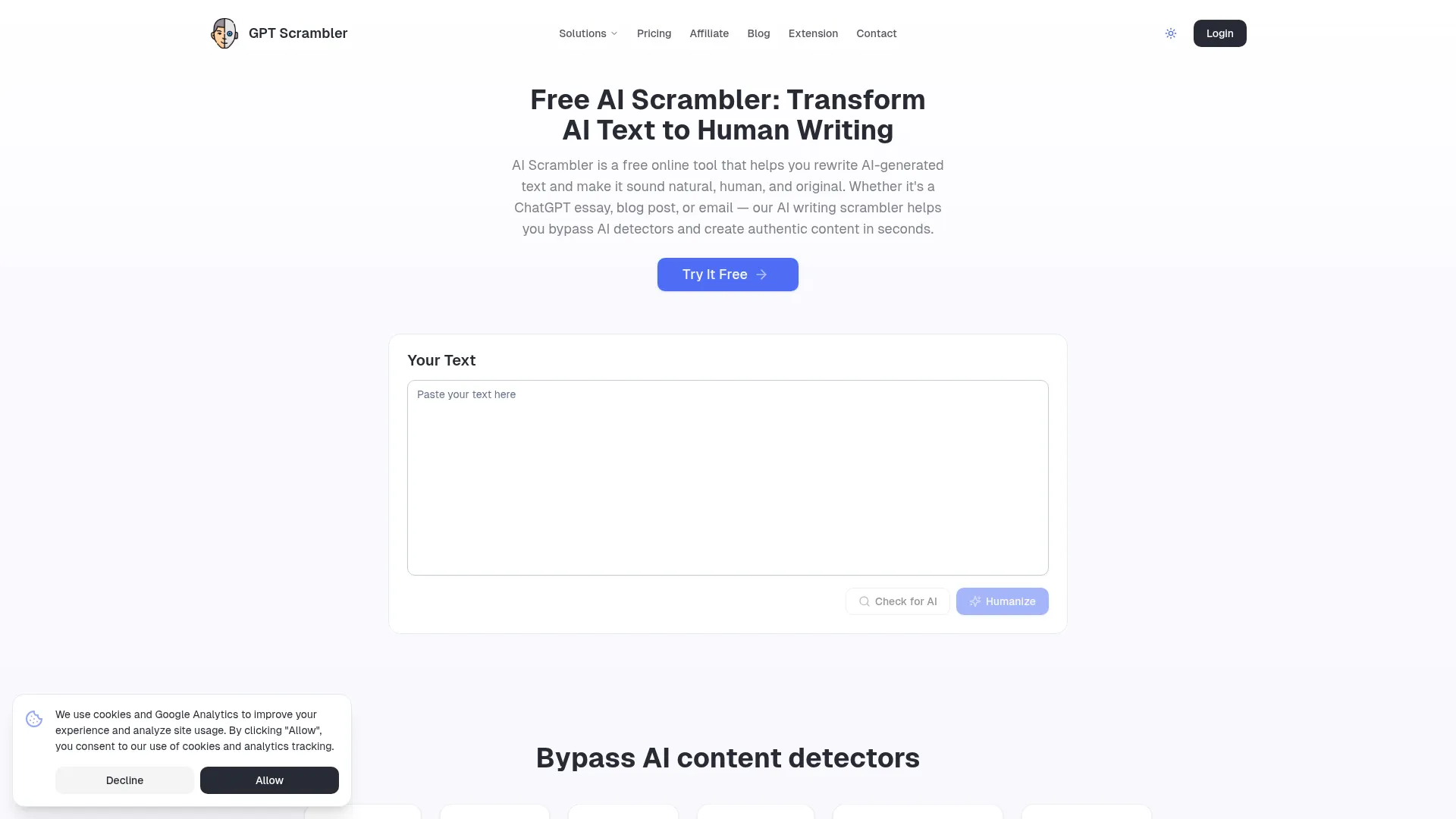 This humanizer was run head-to-head against three separate detectors in an independent review, with the results documented step by step. If you want to see how a humanizer performs against actual detection tools rather than homepage claims, the full GPT Scrambler test is here. |
Hands-on test GPTHuman AI 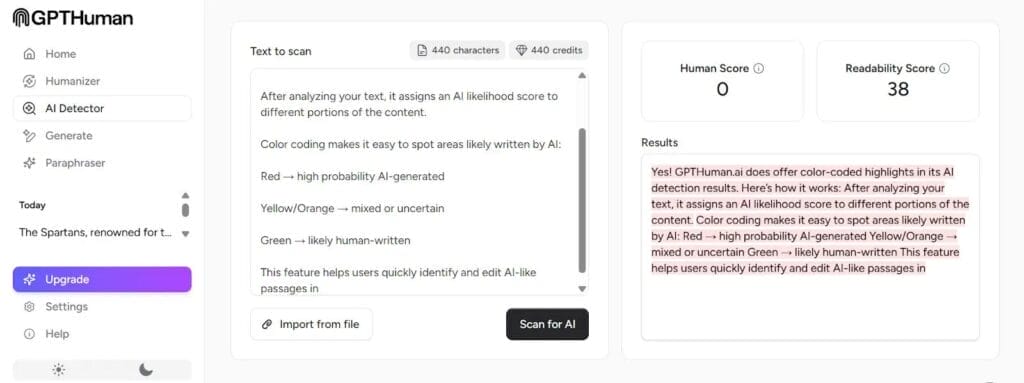 Another 2026-era humanizer, this one tested on genuine ChatGPT output rather than synthetic samples. That distinction matters, because detectors behave differently on real-world text than on lab-prepared passages. Read the full GPTHuman AI test here. |
A quick word on using these responsibly Humanizers are legitimate tools for smoothing robotic phrasing, protecting your genuinely human writing from false flags, and polishing AI-assisted drafts you are transparent about. They are not a workaround for honesty in academic or professional settings where AI use must be disclosed. Know your institution's rules before you rely on one. |
Creative Writing Tools Kept Their Own Lane
Not every 2026 update chased marketing budgets. Fiction-focused platforms kept evolving on their own track, prioritizing voice, continuity, and author control over SEO scores and brand guidelines.
Free trial test Novel AI  The long-running fiction platform remains one of the most distinctive tools in the category, built around story continuation, world-building memory features, and author-directed generation instead of generic chat. It runs on its own storytelling models rather than piggybacking on the big general-purpose ones, which gives it a noticeably different feel. If you are wondering whether that feel fits your writing style, this free trial test of Novel AI walks through the real experience before you commit a dollar. |
The broader 2026 trend in creative tools is specialization. General chatbots now write serviceable fiction, but dedicated platforms keep a clear edge in long-form consistency, character memory, and genre control. If storytelling is your job or your joy, the specialist route is still worth the detour.
Smaller 2026 Updates Worth Your Attention
| When | Update | Why it matters |
|---|---|---|
| Jan 2026 | OpenAI launched Prism, a collaborative workspace for scientific research and writing | Signals OpenAI's shift from chatbot to full writing environment |
| Jan 2026 | Claude added MCP Apps connecting to Canva, Asana, Slack, and Figma | Drafting, designing, and publishing now happen in one flow |
| Jan 2026 | ChatGPT rolled out automatic age prediction for accounts | Expect more safety-driven changes to how outputs behave |
| 2026 | Jasper shipped its brand memory system | Learns and enforces your brand voice and terminology across every piece |
| 2026 | SEO writing tools pivoted hard toward AEO | Conductor, Surfer, and Frase now optimize for AI Overviews and answer engines, not just blue links |
That last row deserves a spotlight. With AI Overviews and answer engines reshaping how people find content, the consistent 2026 message from SEO tool makers is this: your content now needs to be structured for machines that summarize, not just readers who scroll. Writing tools that ignore this are optimizing for a search landscape that no longer exists.
How to Choose in 2026, Based on What You Actually Do
| You are | Prioritize this | The data point that should guide you |
|---|---|---|
| A student | Your school's AI policy first, tools second | False positives hit non-native and formal writers hardest |
| A blogger or SEO writer | AEO-ready structure and genuine originality | 74% of new pages contain AI content, so sameness is your real enemy |
| A marketing team | Brand voice consistency and workflow fit | 42% of AI pilots fail when there is no process underneath |
| A fiction writer | Long-context memory and voice control | Specialized platforms beat general chatbots on continuity |
| Anyone publishing AI-assisted work | A humanizing and editing pass | Raw AI text gets caught at high rates; edited text rarely does |
Get Deliberate, Not Busy
Here is the one thing I hope you carry out of all this data: 2026 is not the year to chase every shiny update. It is the year to get deliberate.
The models are genuinely good now. All of them. The adoption numbers prove that everyone around you is using these tools, and the 42% pilot failure rate proves that a lot of them are using them badly. Your edge is no longer access. Your edge is process: knowing which tool actually fits your work, running your own tests instead of trusting vendor claims, and keeping your judgment in the loop at every step.
So pick one thing from this guide and act on it this week. Maybe that is finally testing a humanizer that has real documented results behind it. Maybe it is taking a fiction platform's free trial for a spin. Maybe it is simply restructuring your workflow around that pilot failure stat so you never become part of it.
Whatever you choose, start small, measure honestly, and let your own results decide what earns a permanent spot in your toolkit. That habit never goes out of date, no matter what ships next year.