Anyone who has pasted a clean, well argued draft into an AI detector and watched the meter swing toward red knows the quiet frustration that follows. The writing was fine. The ideas were real. Yet a classifier decided it looked too tidy, too even, too machine made. That single moment, repeated across classrooms, newsrooms, and marketing teams, is why AI humanizers exist at all.
Two names surface again and again in that search: GPT Scrambler and GPT Human AI. Both promise to take stiff, formulaic AI text and give it a pulse. Both claim to slip past the detectors that keep flagging honest work. The interesting question is not whether they rewrite text, since almost anything can shuffle a few synonyms. The real question is which one produces writing that reads like a person actually wrote it, and holds up when a reader, not just a detector, is paying attention.
What follows is a close, side by side comparison of how the two stack up on the things that decide whether a tool earns a place in a writer's routine.
The short answer GPT Human AI is the stronger all rounder for writers who want polished, human sounding output, real tone control, and a full suite of tools in one place. GPT Scrambler is the sharper pick for anyone who lives inside a browser and wants humanization built into Gmail, Google Docs, and Notion, or who needs clean developer access through an API and MCP server. Neither one is magic, and neither should be treated as a guaranteed way past every detector. |
What GPT Scrambler is
GPT Scrambler positions itself narrowly and does that one job with focus. It is an AI scrambler that rewrites machine generated text so it reads as natural, original, and human. Rather than acting as a general paraphraser, it targets the specific statistical fingerprints detectors look for and reworks sentence structure and word choice to soften them.
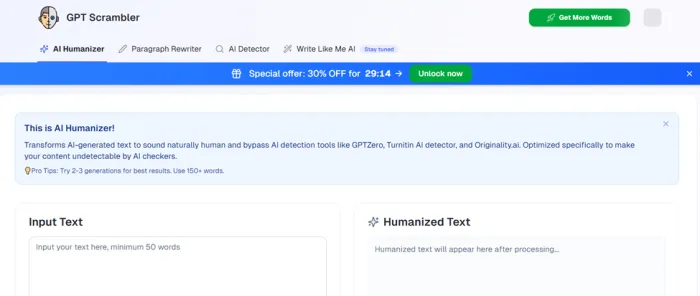
The tool comes in more than one shape. There is a standard web app for longer pieces, a Chrome extension that works directly inside Gmail, Google Docs, Notion, and LinkedIn, and a developer path through a REST API and an MCP server that plugs into tools such as Claude Desktop and Cursor. That spread of access is unusual for a humanizer and is one of its clearest advantages.
A free tier handles up to 200 words per rewrite with no signup barrier, which makes quick tests painless. The maker claims an 80 percent or higher success rate against detectors including GPTZero, Turnitin, ZeroGPT, Copyleaks, and OpenAI's own classifier, and it publishes an ethics policy that explicitly rejects academic fraud.
What GPT Human AI is
GPT Human AI, published as GPTHuman, casts a wider net. It is marketed as an industry leading humanizer, but the platform bundles several tools around that core: a humanizer, a from scratch content generator, a built in AI detector, and a paraphraser. The pitch is that a writer can draft, rewrite, check, and refine without ever leaving the app.
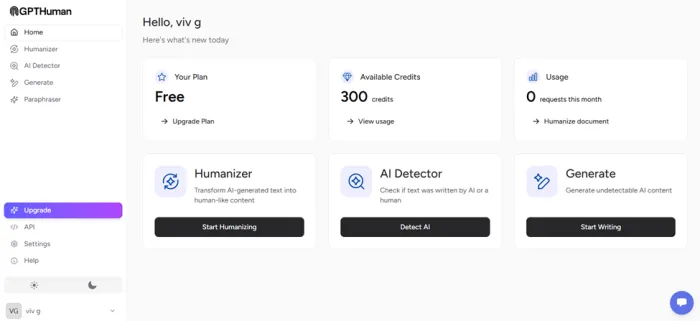
Control is the recurring theme. Output can be tuned by tone, with presets that run from Standard to College to PhD, and by mode, with a Balanced setting for everyday work and an Enhanced setting for heavier rewriting. A Shield Guard layer on paid plans adds extra masking, and the built in detector lets a writer verify a result and re humanize it until it reads clean.
The confidence shows in the marketing. GPTHuman advertises a 4.9 star rating, more than a million users, support for up to 80 languages, and a bypass guarantee: if content is flagged, the service rewrites it again at no cost. Those are vendor figures rather than independent measurements, a distinction worth holding onto when weighing the claims.
Feature and specs, side by side
Stripped of marketing language, the two line up cleanly. This table maps the specifications that tend to matter most when choosing between them.
| What to compare | GPT Scrambler | GPT Human AI |
|---|---|---|
| Core purpose | Focused AI humanizer and scrambler | Humanizer plus a full writing suite |
| Ways to access | Web app, Chrome extension, REST API, MCP server | Web app and developer API |
| Free tier | 200 words per rewrite, no card | 300 words of output, limited detector |
| Tone and mode control | Preserves tone; lighter control | Standard, College, PhD; Balanced or Enhanced |
| Extra built-in tools | Scrambling levels (Light, Moderate, Heavy) | Generator, paraphraser, detector, plagiarism check |
| Detectors targeted | GPTZero, Turnitin, ZeroGPT, Copyleaks, OpenAI | GPTZero, Turnitin, Originality, Copyleaks, Winston |
| Source models supported | ChatGPT, GPT-4, Claude, Gemini | ChatGPT, Claude, Gemini, LLaMA |
| Languages | Multiple (English, Spanish, German, more) | Up to 80 (50+ on every plan) |
| Vendor bypass claim | 80% or higher | 99.9%, free rewrite if flagged |
| Clearest edge | Browser workflow and developer access | All-in-one suite and tone precision |
How natural does the writing actually sound
Rewriting text is easy. Making it sound human is not. The gap between the two tools shows up less in whether they change words and more in how the finished paragraph reads out loud.
GPT Human AI tends to lead on raw naturalness, and the reason is structural. Its tone and mode controls let a rewrite match a target register, so a graduate level essay keeps its formality while a blog post loosens up. The Enhanced mode reworks rhythm and sentence length rather than swapping the odd synonym, which is exactly the signal that separates human cadence from machine flatness. Running a result back through the built in detector for a second and third pass gives another shot at anything that still reads stiff.
GPT Scrambler holds its own, especially on shorter pieces, and independent testing has been cautiously positive. One reviewer who spent weeks putting bypass tools through their paces described GPT Scrambler as imperfect but a genuine standout in a crowded field, singling out the pairing of a web app and a browser extension as a practical edge. On essays and articles its output flows well and needs little cleanup, though the lighter tone controls give a writer less say over the final voice.
What to keep in mind for both
• Very short snippets give either tool little to reshape, so results improve with a full paragraph or more of context.
• Technical or niche passages can drift slightly in meaning after aggressive rewriting, which makes a quick human read essential.
• The most natural results still come from a person lightly editing the output after the tool runs.
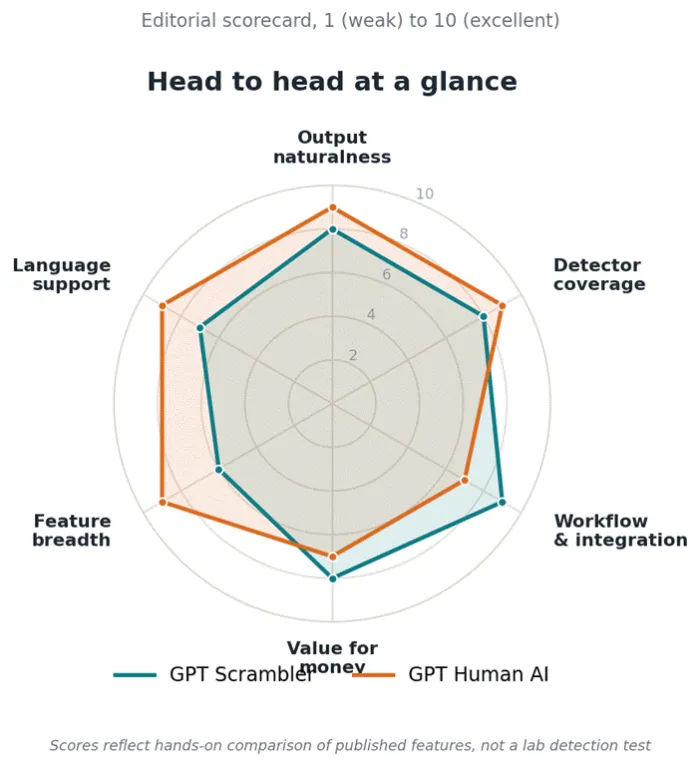
Editorial scorecard based on published features and hands-on comparison, not a lab detection test.
Detection bypass claims against reality
Both tools advertise bold numbers. GPT Scrambler cites 80 percent or better. GPT Human AI cites 99.9 percent. Those figures deserve context, because the wider evidence on AI detection is messy on every side.
Detectors themselves are far from reliable. A peer reviewed study published in the journal Patterns by Stanford researchers found that seven widely used GPT detectors wrongly flagged more than half of TOEFL essays written by non native English speakers as AI generated, with an average false positive rate above 61 percent. Nearly all of those human written essays tripped at least one detector. OpenAI quietly retired its own text classifier after it correctly identified only about a quarter of AI written text while still misflagging some genuine human writing.
The takeaway cuts two ways. Detectors punish plenty of real human writing, which is part of why defensive humanizing has become common even among people who wrote every word themselves. At the same time, no humanizer can promise a permanent pass, because detection models retrain constantly and the contest keeps shifting. A published success rate is a snapshot, not a warranty. The fair reading is that both tools can meaningfully lower the odds of a flag, and neither can erase them.
A note on honest use Used well, these tools polish and de-robotize a writer's own drafts and rescue clear writing that detectors unfairly flag. Used to disguise wholesale copying or to pass off unread AI work as original, they invite real academic and reputational risk. Both makers publish usage policies that discourage the second path. |
Pricing, plans, and value
The two price themselves on different logic, and that difference matters more than any single number.
GPT Human AI uses flat monthly or yearly tiers with set word allowances. GPT Scrambler leans toward pay-per-use, selling word packs alongside subscription options, which suits occasional jobs better than a recurring bill.
| Plan tier | GPT Scrambler | GPT Human AI |
|---|---|---|
| Free | 200 words per rewrite | 300 words output, limited detector |
| Entry paid | Word packs from 2,000 words, plus Advanced plan | Starter: $15/mo ($99/yr) · 25,000 words/mo |
| Mid tier | Advanced plan, monthly or yearly | Plus: $25/mo ($168/yr) · 60,000 words/mo |
| Top tier | Ultimate plan, unlimited words | Unlimited: $49/mo ($312/yr) · most popular |
| Developer | Dedicated API plan | API with 99.9% uptime, per use |
| Billing style | Pay-per-use packs and subscriptions | Fixed monthly or yearly, save up to 45% |
GPT Scrambler lists its exact pack and subscription prices on its own pricing page; the model itself leans pay-per-use, while GPT Human AI publishes fixed tiers.
The value logic follows from the model. For a writer producing steady volume, GPT Human AI's Unlimited tier at $49 a month is the simpler math. For someone who humanizes a handful of pieces now and then, buying a small word pack from GPT Scrambler avoids paying for a full month that goes unused. The free tiers sit close in spirit, with GPT Scrambler allowing 200 words per rewrite and GPT Human AI allowing 300 words of output plus limited detector access.
One market snapshot worth knowing
The rush toward humanizers is not a fringe habit. It has quietly become a standard step in how content gets published, and the numbers make the shift hard to ignore.
The market that created the demand, AI content detection, is growing fast. Analysts at MarketsandMarkets value the AI detector market at roughly $580 million in 2025 and project it to reach about $2.06 billion by 2030. Every gain in detection accuracy pushes more writers toward tools that soften the machine signature, which is why the humanizer segment keeps pace beside it.
Adoption tells the clearest story. According to SupWriter's 2026 analysis, humanizing has moved from a niche trick to routine practice among the people most likely to publish at scale.
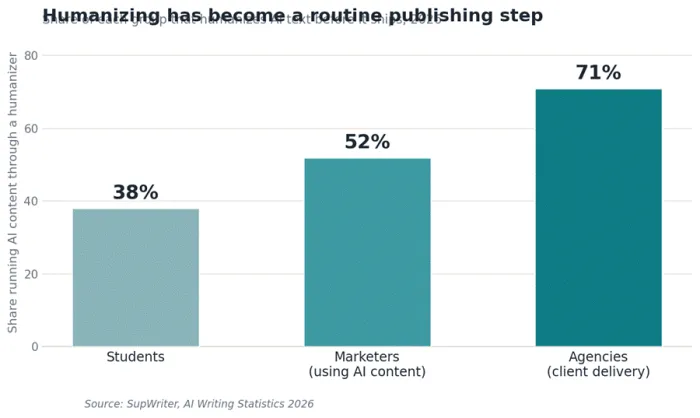
Figure: humanizing AI drafts before publishing, by user group, 2026.
When most agencies now run every AI draft through a humanizer before it reaches a client, the choice between tools like GPT Scrambler and GPT Human AI stops being academic and becomes part of the workflow itself.
Which tool fits which writer
The better tool depends less on a scoreboard and more on the shape of the work. This matrix matches common goals to the stronger option.
| If the goal is | Leaning toward |
|---|---|
| Editing AI text right inside Gmail, Docs, or Notion | GPT Scrambler |
| Producing large volumes of humanized content each month | GPT Human AI |
| Generating fresh content and humanizing in one place | GPT Human AI |
| Matching a strict academic register, College or PhD | GPT Human AI |
| Paying only for occasional, one-off jobs | GPT Scrambler |
| Wiring humanization into an app or an AI agent | Either (both ship APIs; Scrambler adds MCP) |
| Wanting a rewrite-if-flagged safety net | GPT Human AI |
Best for browser-native editing and developers GPT Scrambler. The Chrome extension turns humanizing into a single highlight and click, and the API plus MCP server make it easy to build into an app, agent, or automated pipeline. |
Best for all-in-one, high-volume, tone-precise work GPT Human AI. A single dashboard covers drafting, humanizing, detecting, and paraphrasing, with the tone and mode control that steady, register-sensitive writing needs. |
Strengths and trade-offs
GPT Scrambler Strengths. Browser extension for in-place editing, generous free rewrites, developer API and MCP access, and a focused, low friction design. Watch-outs. Lighter tone control, prices set per pack on the site, and a narrower feature set than a full suite. |
GPT Human AI Strengths. Polished, natural output, strong tone and mode control, an all-in-one suite, a rewrite-if-flagged guarantee, and up to 80 languages. Watch-outs. No browser extension, a free tier capped at 300 words, a headline bypass figure that is vendor supplied, and higher volume that needs a paid tier. |
Final verdict
After lining the two up feature by feature, the split is clear rather than close. GPT Human AI is the tool to reach for when the finished writing has to sound genuinely human and carry a specific voice. Its tone and mode controls, its draft then check then refine loop, and its all in one design make it the more complete writing companion, and its output tends to need the least cleanup afterward. For steady, higher volume work, it is the easier tool to build a habit around.
GPT Scrambler earns its place through fit rather than firepower. For anyone who drafts inside Gmail, Google Docs, or Notion, the browser extension turns humanizing into a single highlight and click, with none of the copy and paste shuffle. For developers wiring humanization into an app or an agent, the API and MCP server are a rare and welcome touch. And for light, occasional use, the free rewrites and pay-per-use packs sit gentler on a budget than a monthly plan.
The honest closing thought is the one that applies to every tool in this category. Both can make AI writing read more like a person wrote it, and both can lower the chance of a detector flag. Neither replaces the small, human act of reading the result and deciding whether it truly sounds right. That last pass, more than any scrambler or shield, is still what makes writing feel human.