It always happens late. The deadline is tomorrow, the document is blank, two tabs sit open. ChatGPT in one. Perplexity in the other.
Both have already taken the same $20 this month. Neither has produced a usable sentence yet. The choice between them stays academic right up until a draft is actually due. Then it stops being academic in a hurry.
Most comparisons end with some version of "they do different things, use both." Technically correct, practically useless. What follows is what side-by-side use across blog posts, marketing copy, and research briefs actually surfaced. The differences are not subtle, and they show up by the third paragraph every time.
Quick Take Pick ChatGPT when prose voice matters more than current data. Creative writing, blog drafts, marketing copy, persona work. Pick Perplexity when sources matter more than style. Research articles, fact-checked summaries, journalism, citations baked in. |
What Each Tool Is Built For
ChatGPT in 30 seconds
•Built by: OpenAI, launched late 2022.
•Default model: GPT-5.4 Thinking on Plus. GPT-5.4 Pro on the $100 tier.
•Signature move: Holds context across long chats and adjusts tone on command.
•Feels like: A co-writer at the next desk.
Perplexity in 30 seconds
•Built by: Perplexity AI, launched late 2022 as an answer engine.
•Default model: Multi-model. Route the same query through GPT-5.5, Claude Sonnet 4.6, Gemini 3.1 Pro, or Sonar.
•Signature move: Real-time citations attached to every claim, by default.
•Feels like: A research assistant who can also type.
Feature Comparison at a Glance
| Feature | ChatGPT | Perplexity |
|---|---|---|
| Primary purpose | Conversational AI and content generation | AI answer engine and research synthesis |
| Default paid model | GPT-5.4 Thinking | Multi-model: GPT-5.5, Claude Sonnet 4.6, Gemini 3.1 Pro, Sonar |
| Citations in output | Optional, must be requested | Built into every response |
| Real-time web data | Available, needs prompting | Default behavior |
| Image generation | Sora 2 (Plus), unlimited on Pro | Pro only via GPT Image, Nano Banana, Seedream 4.5 |
| Voice mode | Yes, Plus tier and up | Limited |
| Code execution | Codex sandbox, Agent Mode | Not available |
| Reusable templates | Custom GPTs marketplace | Spaces for shared context |
| Best-fit writing tasks | Creative, long-form, marketing copy, dialogue | Research briefs, sourced articles, fact-dense reports |
Writing Quality Across Real Tasks
Independent 2026 head-to-head tests from G2, Zapier, Cybernews, and Nexos converged on the same pattern. Each tool wins specific categories. Neither wins them all.
Creative storytelling and fiction
| Winner: ChatGPT, by the widest margin. |
•ChatGPT delivers: Focused, atmospheric prose. Holds character bibles and stylistic rules across long sessions.
•Perplexity delivers: Dreamlike but stretched output. Treats every query as a fresh search task.
•The numbers: 79% lexical diversity for ChatGPT versus 75% for Perplexity, per Cybernews 500-word sci-fi test.
•Best for: Novels, short stories, scripts, dialogue, brand narratives, anything that lives on voice.
Long-form blog posts and articles
| Winner: ChatGPT, with one catch. |
•ChatGPT delivers: Drafts that read more naturally and need less restructuring.
•The catch: Asserts outdated facts with the calm confidence of a TED speaker who has not read a paper in two years.
•Perplexity delivers: Structured briefings with every fact linked. Stiff transitions, but the sourcing is there.
•Best for: Evergreen blog posts, opinion pieces, listicles, marketing pillars where prose voice carries the read.
Research-driven articles and reports
| Winner: Perplexity, decisively. |
•Perplexity delivers: Responses with five to ten verifiable sources hanging off them. Deep Research runs multi-step web research across dozens of sources.
•ChatGPT struggles: Looser synthesis, less consistent source quality even with web search active.
•The deciding math: Perplexity Pro reportedly allows about 20 Deep Research runs per day. ChatGPT Plus caps the equivalent at 10 runs per month.
•Best for: Industry briefs, analyst notes, journalism, white papers, anything destined for a fact-checker.
Editing, rewriting, and tone control
| Winner: ChatGPT, no contest. |
•ChatGPT delivers: Handles iterative edits gracefully. The prompt "rewrite this in the voice of a skeptical investor" works on the first attempt.
•Perplexity delivers: Flatter, more templated outputs. The cake is the same. The icing has fewer colors.
•Best for: Tone shifts, voice rewrites, persona work, condensing long drafts, polishing imported text.
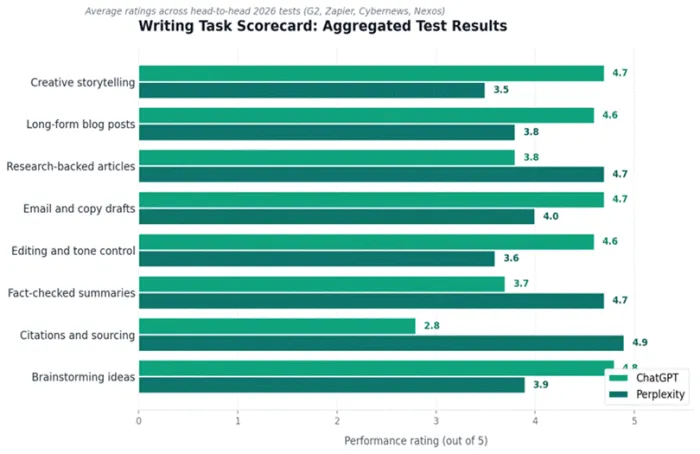
Aggregated writing-task ratings across 2026 head-to-head testing
Pricing Compared
Both platforms have been redrawing pricing all year. Numbers below are accurate through mid-2026. Verify the official pricing page before locking in an annual plan.
| Plan tier | ChatGPT | Perplexity |
|---|---|---|
| Free | GPT-5.3 with limits, ads in US market | Unlimited basic search, 5 Pro searches per 4 hours, citations included |
| $20/month | Plus: GPT-5.4 Thinking, Sora 2, voice mode, Codex, Custom GPTs, 10 Deep Research runs/month | Pro: multi-model access, ~20 Deep Research runs/day, file uploads, 50 Labs queries/month |
| Higher tier | Pro at $100/month: GPT-5.4 Pro reasoning, 5x to 20x usage, unlimited images | Max at $200/month: unlimited Labs, Sora 2 Pro video, Perplexity Computer with 10,000 agent credits |
| Top tier | Pro Max at $200/month | Enterprise Pro at $40/user/month for teams |
| Student deal | Promotional regional offers | Education Pro at $10/month, 50% off standard Pro |
| Bottom line: Same $20 buys broader tools at ChatGPT or sharper research at Perplexity. Students get the cleanest deal anywhere with Perplexity Education at $10. |
What $20 actually unlocks
•ChatGPT Plus: GPT-5.4 Thinking with stronger reasoning, Sora 2 for image generation, voice mode, Codex sandbox, Custom GPTs, 10 Deep Research runs per month, file uploads up to 512MB.
•Perplexity Pro: Multi-model routing across GPT-5.5, Claude Sonnet 4.6, and Gemini 3.1 Pro, around 20 Deep Research runs per day, 50 Labs queries per month, unlimited file uploads inside Spaces, Comet browser access.
•The trade-off: ChatGPT spreads $20 across more capabilities. Perplexity concentrates it on research depth and model variety. Heavy writers tend to feel the daily Pro Search cap on Perplexity Free within a week.
What Content Marketers Actually Trust in 2026
Pricing pages describe what tools can do. Trust surveys describe which ones professionals reach for when a paycheck depends on the result.
The 2026 Siege Media and Wynter survey of content marketers asked exactly that question.
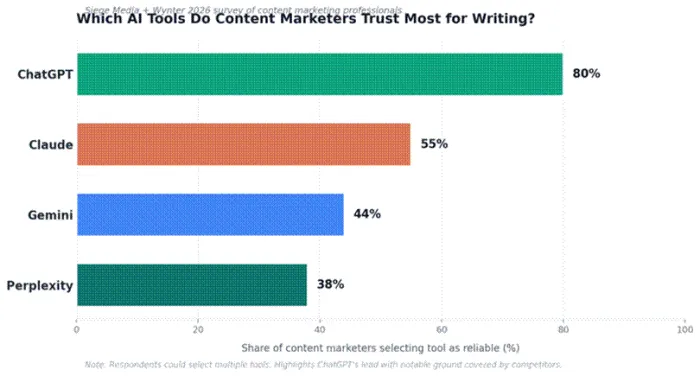
Source: Siege Media + Wynter 2026 survey of content marketing professionals
Three takeaways worth scanning:
•ChatGPT cleared 80%, a margin most categories never see in a survey of working professionals.
•The spread underneath matters more. Claude at 55%, Gemini at 44%, Perplexity at 38%. Three competitors crossed the 35% threshold, which means ChatGPT is no longer treated as the only acceptable choice.
•Trust splits by task. Perplexity’s 38% trust for writing masks its dominance in fact-checking, where separate research shows 45% of content creators using it for that exact job and 33% reaching for it three or more times a week.
Strengths and Weaknesses Side by Side
Reviews from G2, Zapier, Cybernews, and Nexos combined with user feedback through April 2026 line up around the trade-offs below.
| Aspect | ChatGPT | Perplexity |
|---|---|---|
| Prose quality | + Natural flow, varied sentences, holds tone − Can sound AI-polished without sharper prompting | + Direct, dense, scannable summaries − Mechanical rhythm, stiff transitions |
| Sources and citations | + Available when prompted with web search active − Quality varies, occasional hallucinated references | + Citations attached to every claim by default − Sometimes leans on one source per paragraph |
| Currency of information | + Strong with web search active − Confident outputs from older training data | + Real-time by default, fast on breaking topics − Less useful for evergreen creative work |
| Iteration and editing | + Strong follow-up edits, persona memory in chats − Plus tier caps advanced model usage | + Spaces support shared research workflows − Weaker multi-turn creative editing |
| Tone control | + Wide range, mimics specific voices reliably − Generic default without specific instructions | + Consistent for analytical and journalistic voice − Struggles with playful, satirical, narrative tone |
| Value at $20 | + Broader toolkit: writing, code, images, voice − Higher tiers jump steeply at $100 and $200 | + Multi-model access, $10 education tier − Some features capped per day, not per month |
Speed, UX, and the Daily Experience
Feature lists rarely capture what it feels like to use these tools every day. The differences below shape the actual writing session more than any pricing comparison.
Response speed
•Perplexity: Around 2 to 4 seconds for standard answers. Deep Research can run 30 seconds to a few minutes depending on query depth.
•ChatGPT: Around 3 to 8 seconds for GPT-5.4 Thinking outputs. Pro reasoning runs longer in exchange for sharper logic.
Interface and writing experience
•ChatGPT: Conversational layout. Chats persist in a sidebar, easy to revisit a draft from last week. Canvas mode opens a separate document panel for longer drafts.
•Perplexity: Search-engine layout with sources displayed to the right. Spaces let writers group queries by project. Less natural for long-form drafting, optimized for query-and-receive.
File handling and integrations
•ChatGPT: File uploads on Plus include PDFs, CSVs, images, and Word docs. Custom GPTs let teams build reusable templates. ChatGPT for Chrome extension brings it into any tab.
•Perplexity: Pro file uploads accept PDFs and docs for cross-referenced research. The Comet browser ships as a native answer-engine layer for paid users.
•Mobile: ChatGPT’s iOS and Android apps handle voice-to-draft well, useful for catching ideas on the move. Perplexity’s mobile flow is sharper for quick verification, less natural for sustained writing.
•Third-party plug-ins: ChatGPT pairs cleanly with Notion, Google Docs (via Workspace), and Slack. Perplexity offers Slack, browser, and the Comet plus partnerships with Conde Nast, CNN, Fortune, and Washington Post for premium content.
Real Writer Workflows in 2026
Four workflows writers have settled into over the past several months. Each routes specific tasks to specific platforms.
The blog post workflow
1.Research in Perplexity. Pull current data, grab three to five citations.
2.Draft in ChatGPT. Drop notes in with target length and audience attached.
3.Edit in the same chat. Two or three rounds is usually enough.
4.Fact-check back through Perplexity if anything still needs verification before publishing.
Time saved: 30 to 45 minutes per 1,200-word post versus sticking to one tool. Common mistake: asking Perplexity to write the post end-to-end. It summarizes search results, it does not compose original prose.
The white paper workflow
5.Run Deep Research on the subject in Perplexity Pro.
6.Export the structured summary with sources intact.
7.Draft long-form in ChatGPT with named sections and a defined audience.
8.Iterate on tone and structure until the prose lands.
Combined monthly cost: $40 covers what would otherwise need both a junior researcher and a draft writer. Common mistake: starting in ChatGPT. The whole point is to anchor the paper in sourced research first, prose second.
The newsletter workflow
9.Catch the week’s news in Perplexity with one query.
10.Convert in ChatGPT into the casual voice subscribers actually want to read.
What to avoid: pure Perplexity-drafted newsletters read like LinkedIn posts wearing a tie. Pure ChatGPT versions float free of what actually happened that week.
The social post workflow
11.Find a hook in Perplexity. A surprising statistic, a current event, a fresh data point.
12.Generate variations in ChatGPT. Ask for five drafts at different tones, pick the strongest.
Time saved: roughly 20 minutes per post across a five-post weekly cadence. Common mistake: skipping the hook research and asking ChatGPT to invent something interesting. That is how AI social posts end up sounding identical.
Which Writer Should Pick Which Tool
•Novelists, screenwriters, copywriters: ChatGPT Plus at $20. Voice and persona memory decide it. Pro at $100 only for heavy daily use.
•Journalists, analysts, researchers: Perplexity Pro at $20. Multi-model access replaces two separate subscriptions.
•Marketing leads at growing companies: Both. The $40 combined cost replaces a research assistant and a draft partner.
•Students on a budget: Perplexity Education Pro at $10. Strongest value in the category right now.
•Technical writers and documentation teams: ChatGPT for the writing, Perplexity as the second pane for verifying APIs and version numbers that change weekly.
•Academic researchers and PhD students: Perplexity Pro for source-heavy literature review. Pair with ChatGPT for prose polish on thesis chapters.
•Ecommerce and product copywriters: ChatGPT Plus runs A/B test variants and product descriptions at scale. Perplexity backs them up with competitor research and category benchmarks.
Sample Prompts That Actually Work
Prompt quality decides output quality. The patterns below come from writers running both tools daily, not from a prompt library.
For ChatGPT
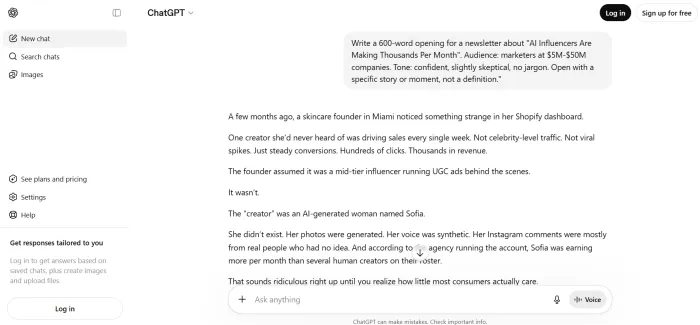
Creative draft: "Write a 600-word opening for a newsletter about [topic]. Audience: marketers at $5M-$50M companies. Tone: confident, slightly skeptical, no jargon. Open with a specific story or moment, not a definition." Voice rewrite: "Rewrite the paragraph below in the voice of [specific writer or publication]. Keep the meaning, change the rhythm. Aim for shorter sentences and a wry tone." |
For Perplexity
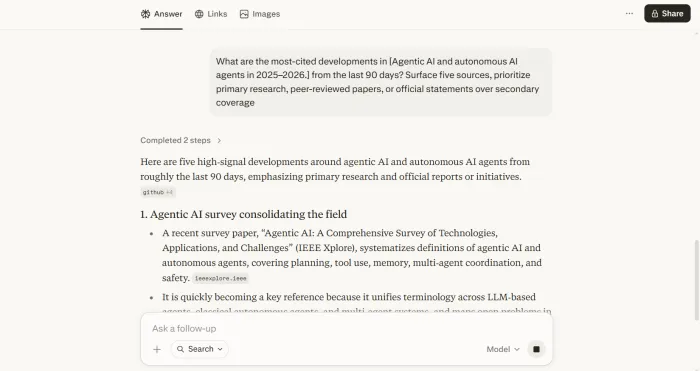
Research brief: "What are the most-cited developments in [topic] from the last 90 days? Surface five sources, prioritize primary research, peer-reviewed papers, or official statements over secondary coverage." Fact-check: "Verify each numeric claim in the text below against current sources. Flag any that are outdated, unsupported, or contradicted by newer data." |
What separates strong prompts from weak ones
•Specific audience: "Marketers at mid-market SaaS companies" beats "marketers."
•Specific length: "600 words" beats "a short piece."
•Specific tone: "Confident but skeptical" beats "professional."
•Specific format: "Open with a story, end with a question" beats “engaging.”
A Few Honest Things Worth Knowing
•ChatGPT’s free tier added ads in the US in early 2026. Small shift, worth flagging for free-plan users.
•Perplexity is not built for creative writing. It pulls from search results. A brand story comes back assembled, not composed.
•ChatGPT can still hallucinate. Even GPT-5.4 invents sources and statistics when pressed. Anything load-bearing needs a second check.
•Perplexity can cite incorrectly. The link is present, but occasionally the claim slightly misrepresents the source. Spot-check the important ones.
•Privacy defaults differ. Perplexity does not require an account for basic usage and does not train on queries by default.
•Mobile experience varies. ChatGPT’s mobile app is more polished for actual drafting. Perplexity’s mobile flow leans toward research bursts, not long sessions.
•Switching costs are real. Chats, custom GPTs, and saved spaces do not export cleanly between platforms. Picking primary versus secondary matters.
Final Verdict
After weeks of bouncing between these tools on real work, the answer is not that one wins. One tool owns most of the writing day. The other quietly solves the one stubborn problem the first cannot.
For writing that has to sound human, ChatGPT is the daily driver. Perplexity becomes the second monitor: verify a statistic, find a quote source, pull a fresh angle from this week’s news.
For writing where the facts come first, the order flips. Perplexity drafts the research-backed skeleton with citations intact. ChatGPT polishes the prose into something a real human might actually want to read.
The $20 question is no longer which one. It is which one first. That depends on whether the writing starts with a feeling or a fact. Two tools that started life as competitors have, almost without anyone noticing, become collaborators in the same workflow. The writers getting the most from either one figured that out months ago.