
Quick Verdict
| If you want this | Pick this |
|---|---|
| A polished, beginner-friendly generator that runs entirely in the browser | SeaArt |
| The largest model and LoRA library anywhere, with free downloads for local use | Civitai |
| Curated anime, manga, and stylized output with a higher quality floor | SeaArt |
| Maximum flexibility, raw parameter control, and offline workflows | Civitai |
| One workspace covering image, video, face swap, and LoRA training | SeaArt |
| A free tier that fully covers download-and-run users forever | Civitai |
The one-line take: Civitai is the warehouse where models are made and stored; SeaArt is the studio where images get generated and shipped. Plenty of serious creators keep an account on both.
Meet the Two Platforms
Before the comparison, a quick profile of each tool so the rest of the guide has context. Both are community-driven AI art platforms built on Stable Diffusion and related models, but they solve different problems.
SeaArt
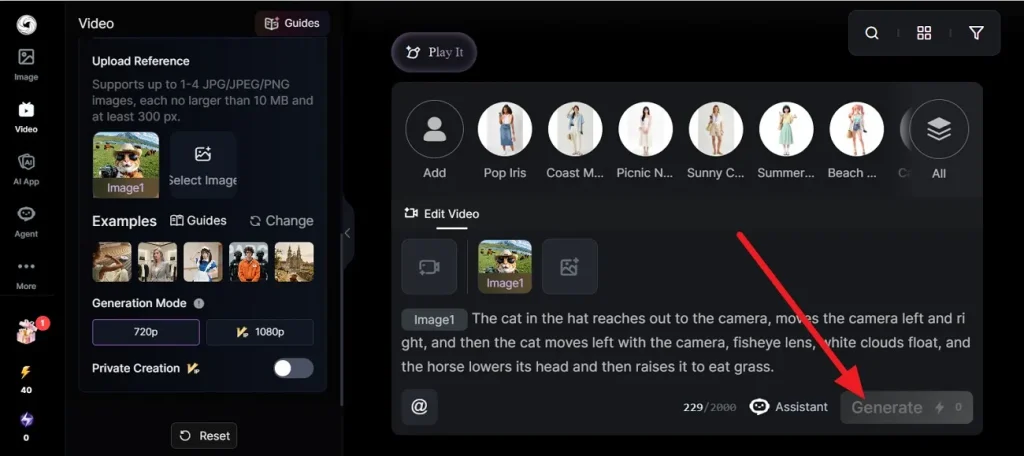
SeaArt is a cloud-based generation studio. Everything happens in the browser, with no local GPU required, and the interface is built around producing and editing images and video fast. It folds an enormous curated model library, LoRA training, video generation, face swap, background removal, and even AI character chat into a single workspace, which makes it a natural landing spot for beginners and high-volume content creators alike.
| SeaArt at a glance | |
|---|---|
| Type | Cloud AI generation studio (image, video, chat) |
| Launched | Freemium web app, scaled rapidly through 2024 to 2026 |
| Best for | Beginners, anime and stylized art, all-in-one workflows |
| Model library | Roughly 700,000 to 980,000 listed, curated and team-reviewed |
| Core models | FLUX, Stable Diffusion 3, SDXL, plus video engines |
| Standout tools | One-click inpaint/outpaint, img2img, video, LoRA training, ComfyUI |
| Pricing | Free tier (~130 daily Stamina) to Master at ~$149.99/mo |
| Trustpilot | About 4.4 / 5 across 800+ reviews |
| Main watch-out | Trial auto-renewal and annual billing surprises |
Civitai
Civitai is the open model hub of the Stable Diffusion world. Its core job is hosting, discovering, and distributing community models, LoRAs, checkpoints, and embeddings, with example generations and reviews attached to each. On-site generation and LoRA training exist, but the repository is the heart of it, and for downloadable weights to run locally, nothing matches its catalog.
| Civitai at a glance | |
|---|---|
| Type | Open model repository with on-site generation |
| Community | Around 5 million monthly active members |
| Best for | Power users, local-GPU creators, model authors |
| Model library | Roughly 500,000+, the broadest in the industry |
| Core architectures | SD 1.5, SDXL, FLUX, and most major bases |
| Standout tools | Massive LoRA hub, Buzz economy, Creator Program payouts |
| Pricing | Free forever for browse/download; Bronze ~$10/mo and up |
| Trustpilot | Small, mixed footprint (~34 reviews) |
| Main watch-out | Crypto-only Buzz on main site, model purges, UK access block |
Capability profile based on aggregated review consensus (0 to 10)
Platform Origins and Core Philosophy
The fastest way to understand these two is to look at how each was built. Civitai started as a repository, a place to store, organize, and hand out community models, with on-platform generation bolted on later. SeaArt went the opposite way: generation came first, and model sharing exists mainly to feed it.
That one difference shapes everything that follows, from where models live to how billing works to which art styles thrive. Match the platform to your workflow rather than its reputation, and most of the friction disappears.
| Dimension | Civitai | SeaArt |
|---|---|---|
| Founding model | Open model repository | Cloud generation studio |
| Primary action | Browse, download, host | Generate, edit, share |
| Model as | A file you own and run anywhere | An ingredient used inside the cloud |
| Gatekeeping | Minimal, open uploads | Curated, team-reviewed submissions |
| Active community | ~5M monthly members | Large, Japan-led, fast growing |
Head-to-Head Feature Comparison
The cheat sheet first; the detail follows in later sections. The Edge column names the stronger platform per row based on aggregated review consensus, not a single test.
| Feature | Civitai | SeaArt | Edge |
|---|---|---|---|
| Model library size | ~500K+ (broadest) | 700K to 980K listed | Civitai |
| Free model downloads | Yes, most models | Often author-restricted | Civitai |
| On-site generation UI | Functional, improving | Polished, guided | SeaArt |
| LoRA training | Yes | Yes (Pro tier+ priority) | Tie |
| Video generation | Limited | Yes (Veo, Kling, Flow) | SeaArt |
| Inpaint / outpaint / img2img | Basic | Built in, one click | SeaArt |
| ControlNet | Yes | Multiple, out of box | SeaArt |
| Beginner onboarding | Steeper curve | Very approachable | SeaArt |
| Style depth (niche) | Excellent long tail | Anime / stylized focus | Civitai |
| Local GPU required | Optional | Never, fully cloud | SeaArt |
| Creator monetization | Buzz banking + payouts | Less structured | Civitai |
Capability Profile at a Glance
The radar chart in section 1 sums up the trade cleanly. SeaArt pushes out toward generation experience, beginner friendliness, and video, while Civitai dominates on model breadth and creator payouts. Where they overlap, in curation and raw quality, the gap is narrow and depends heavily on the model you choose.
| Dimension (0-10) | SeaArt | Civitai |
|---|---|---|
| Model breadth | 7 | 10 |
| Generation UX | 9 | 6 |
| Beginner friendly | 9 | 5 |
| Video tools | 9 | 4 |
| Curation / quality | 8 | 6 |
| Creator payouts | 5 | 9 |
Model Libraries Compared
This is where reputations were made. Civitai is the default discovery hub for the Stable Diffusion ecosystem, and for downloadable LoRA weights nothing rivals its breadth. If a style, character, or pose exists as a model, it is probably here. The cost of that openness is noise: plenty of uploads are duplicative or thin, so discovery becomes a skill built on ratings, download counts, and sample galleries.
SeaArt trades breadth for curation. A moderation team reviews submissions, lifting the average quality and shortening the hunt, while gallery-driven signaling lets weak models sink before they waste your time. The tradeoff is fewer options at the experimental edge and a clear anime lean.
| Library trait | Civitai | SeaArt |
|---|---|---|
| Discovery model | Open marketplace | Curated + gallery signals |
| Quality control | Community ratings | Editorial team review |
| Baseline quality | Highly variable | Higher average |
| Niche / experimental | Strongest in class | Limited |
| Official tested models | Few | Yes, platform-validated |
| Discovery effort | Higher | Lower |
| Architectures | All major (SD1.5, SDXL, FLUX, +) | FLUX, SD3, SDXL |
A numbers caveat: reported SeaArt sizes swing from roughly 700,000 to nearly a million depending on the source, while Civitai estimates cluster near half a million. These counts are marketing-adjacent and tallied differently site to site, so read them as scale, not a scoreboard.
Pricing Breakdown
Pricing is the sharpest divide, and it is where Civitai has grown genuinely confusing. Under payment-processor pressure, Civitai split into two parallel sites and adopted a three-color Buzz currency, with subscriptions living on the curated side and the original site selling Buzz on its own. SeaArt keeps a more conventional ladder built around a daily Stamina pool. On both, a membership is a top-up, not an all-you-can-generate pass.
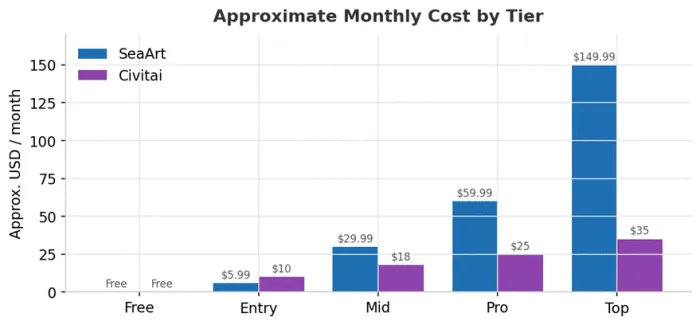
Approximate monthly cost by tier (Civitai mid and top tiers are illustrative estimates)
Civitai membership tiers
| Tier | Price/mo | Monthly Buzz | Buzz bonus | Private models | Vault |
|---|---|---|---|---|---|
| Free | $0 | Daily pool | None | Limited | Base |
| Bronze | $10 | 10,000 | 5% | 3 | 100 GB |
| Silver | Higher | 25,000 | 10% | 10 | 250 GB |
| Gold | Highest | 50,000 | Higher | More | More |
• Browsing, downloads, and basic generation stay free forever.
• Daily generation runs off a free pool around 200 Buzz, with complex jobs costing more Buzz than simple ones.
• Credit cards are blocked on the original site, so Buzz there is bought a la carte with crypto; memberships sit on the green (SFW) site.
• UK IP addresses are restricted under the Online Safety Act, so British users often need a VPN.
SeaArt plans
| Plan | Price (approx.) | Daily Stamina | Best for |
|---|---|---|---|
| Free | $0 | ~130/day | Testing and light hobby use (watermarked) |
| Beginner | ~$5.99/mo | Higher | Casual creators, occasional posting |
| Standard | ~$29.99/mo | Higher + concurrency | Regular creators feeding social or projects |
| Professional | ~$59.99/mo | ~4,000 | High-volume work, video, priority LoRA queue |
| Master | ~$149.99/mo | ~12,000 | Studios, plus unlimited on select premium models |
Read before you pay: SeaArt prices drift between sources and promotions, annual billing is often the default (one common charge is around $251.88 for a year billed upfront), and the 3-day trial can auto-renew. A single high-res video can burn more Stamina than dozens of basic images. Use a virtual card and confirm current numbers on the official site.
Generation Experience and Tools
If you intend to create on the platform rather than download and run models locally, this section likely decides it. SeaArt has clearly invested in usability: beginners get strong results fast, and the workspace folds image, video, face swap, background removal, and AI character chat into one place, with ComfyUI waiting for advanced node workflows. Civitai's generator keeps improving but still reads as a useful add-on to a repository, and it sits closer to raw Stable Diffusion parameters, which rewards tinkerers and slows everyone else.
| Aspect | SeaArt | Civitai Generator |
|---|---|---|
| Interface | Clean, guided, visual presets | Closer to raw SD parameters |
| Time to first image | Minutes, minimal setup | More manual configuration |
| Built-in editing | Inpaint, outpaint, img2img, video | Core generation, fewer extras |
| Output consistency | Varies a lot by model | Depends on chosen model |
| Flexibility ceiling | Within platform limits | Broader parameter space |
| Ideal user | Beginners to mid creators | Power users and tinkerers |
Community, Creators, and Monetization
Civitai's community is its crown jewel, large and technical, constantly sharing models, prompts, and feedback, though the technical bar can shut out newcomers. SeaArt's is smaller and lighter on deep technical talk, but the on-ramp is gentler. On money, Civitai runs a structured Buzz economy where creators earn and bank Buzz toward payouts, with caps tied to tier; SeaArt leans on protection instead, offering automatic model backups and a verification system so original authors can reclaim their work.
| Factor | Civitai | SeaArt |
|---|---|---|
| Community size | ~5M monthly, established | Large, growing, Japan-led |
| Tone | Technical, expert-led | Beginner-friendly, social |
| Earnings path | Buzz banking + payouts | Model/LoRA/character monetization |
| Creator protection | Standard | Backups + reclaim system |
| Best for selling | Established model creators | Newer creators, characters |
Content Policy and Platform Stability
This is the area driving much of the current migration chatter, and it deserves an honest look at both sides. Neither platform is risk-free; the pain points simply differ in kind.
| Concern | Civitai | SeaArt |
|---|---|---|
| Policy stability | Frequent changes, model purges | Tightening, less abrupt |
| Payment friction | Crypto, split sites, regional gaps | Auto-renew and trial traps |
| Uptime / speed | Queues, occasional slowdowns | Generally fast, cloud-based |
| Structural risk | Processor pressure, UK block | Aggregator: upstream APIs can vanish |
| Moderation gripes | Bots, spam, inconsistent enforcement | Strict flags; some content concerns |
Takeaway: Civitai's risks are structural and policy-driven, SeaArt's are billing and dependency-driven. Read the fine print before committing real workflow to either.
Trustpilot Ratings Compared
Trustpilot tells two very different stories, and the gap is mostly about sample size and who bothers to leave a review. SeaArt carries a strong headline score across a large base, while complaint-heavy threads cluster around billing. Civitai's Trustpilot presence is tiny and skews negative, which is common for tools whose happy users live on Reddit and Discord rather than review sites.
| Platform | Score | Reviews | Dominant themes |
|---|---|---|---|
| SeaArt | 4.4 / 5 | ~800+ | Praise for tools and free credits; heavy billing complaints |
| SeaArt (Google Play) | 3.3 / 5 | Mixed | App stability and moderation |
| SeaArt (App Store) | 4.1 / 5 | Mixed | Feature breadth vs glitches |
| Civitai | Low / mixed | ~34 | Billing dark patterns, moderation, regional access |
Reading the scores: a 4.4 next to a sea of one-star billing complaints is not a contradiction. Satisfied creators rate the product; frustrated ones rate the checkout. Treat the headline number as the experience and the complaint clusters as the warning label.
What Reddit and Review Sites Actually Say
Stripped of marketing, here is the recurring signal from Reddit threads, Trustpilot, and Product Hunt. The pattern is consistent enough to be useful.
SeaArt: the recurring verdict
“The app and website have so many options and ways to use AI to create, modify and edit clips, pictures, and chatbots. With a free account they give you a pretty generous amount of free tokens daily.”, Trustpilot reviewer
“I like the events, the interface, and how generous they are with the daily credits. However, lately SeaArt becomes more and more strict with their moderation, even for generated content.”, Trustpilot reviewer
“No warning, no email, no alert, just a silent charge of $28.68 to my credit card after the trial.”, Trustpilot reviewer (billing complaint)
Net read: the generation engine and free tier win people over, but billing practices around the 3-day trial and annual auto-renewal are the single biggest source of anger. On Reddit's alternative threads, SeaArt is consistently the top suggested replacement when people leave Civitai.
Civitai: the recurring verdict
“Best used as a model database for downloading models made by creators. Like the model, tip the creator directly.”, Product Hunt reviewer
“The platform uses classic dark patterns to hide affordable short-term options.”, Trustpilot reviewer (billing complaint)
Net read: reviewers overwhelmingly value Civitai as a model and LoRA database with a friendly, active community, while the on-site generator and the Buzz checkout draw steady criticism. Bots, upload spam, inconsistent moderation, and the UK access block round out the complaints. The community lives on Reddit and Discord, which is why its Trustpilot footprint understates real satisfaction.
| Sentiment | SeaArt | Civitai |
|---|---|---|
| Most praised | Free credits, all-in-one tools, anime models | Model/LoRA depth, community, tutorials |
| Most criticized | Trial billing, auto-renew, pop-ups | Buzz checkout, bots/spam, model purges |
| Where fans gather | Trustpilot, in-app events | Reddit, Discord |
| Biggest red flag | Unauthorized/early charges | Payment friction + regional blocks |
Performance and Traffic Snapshot
Public traffic estimates give a rough sense of scale and audience. These are third-party figures, so read them as directional. The pattern fits the philosophies: Civitai's higher pages-per-visit and lower bounce rate are the fingerprint of a repository people dig through, while SeaArt pulls more total visits and far more search traffic from a heavily Japan-led audience.
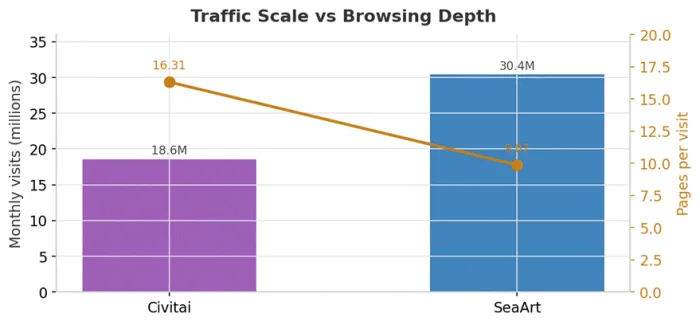
Monthly visits versus pages per visit (third-party estimates)
| Metric | Civitai | SeaArt |
|---|---|---|
| Monthly visits (est.) | ~18.6M | ~30.4M |
| Pages per visit | 16.31 | 9.87 |
| Bounce rate | 27.81% | 36.24% |
| Top country | United States (22%) | Japan (34%) |
| Search traffic share | 18.4% | 38.4% |
Which Platform Fits You
| Your profile | Recommended platform and why |
|---|---|
| Beginner / hobbyist | SeaArt: guided interface and generous free Stamina. |
| Anime / manga artist | SeaArt: curated stylized models and built-in editing. |
| Power user / tinkerer | Civitai: raw model access and parameter control. |
| Local-GPU creator | Civitai: the definitive source for downloadable weights. |
| Content creator at volume | SeaArt Standard or Pro: clean output plus video. |
| Niche / experimental styles | Civitai: far deeper at the long tail. |
| Model creator selling work | Civitai: structured Buzz payouts and audience. |
| Budget-conscious creator | Either free tier; SeaArt for predictable paid pricing. |
The honest recommendation: you do not have to choose. Use Civitai as your library to discover and download models, and SeaArt as your studio to generate, edit, and publish. The split that defines them is exactly why they pair so well, and it is why so many creators keep a foot in both camps.