
Somewhere around the third time a marketing director asked her team to “just throw it through Jasper, then clean it up in Grammarly, then run it past ChatGPT, then maybe Hemingway,” it became clear that the AI content stack had quietly turned into a small bureaucracy. Four tools, one blog post, one bewildered intern.
The harder question underneath is genuinely useful: when content teams say they need “AI for writing,” do they mean a tool that generates content from scratch, or one that polishes what humans already produced? These categories have different architectures, pricing logic, and risk profiles. Treating them as interchangeable is the most common reason AI investments fail to deliver returns, and it explains why some teams pay $300 per seat per month for tools they cannot defend in a quarterly business review.
This article maps the AI writing and AI editing tool categories as they exist in 2026, with sharp distinctions about what each tool genuinely does well and where each one quietly fails. The structure is intentional: the answer comes first, the reasoning follows.
The 30-Second Answer
Most readers will skim the rest of this article looking for this table. Here it is, surfaced upfront, with the reasoning that follows in the rest of the document.
Stack Recommendation by Team Profile
| Team profile | Writing tool | Editing tool | Cost / seat / month |
|---|---|---|---|
| High-volume marketing operation (20+ pieces/mo) | Jasper or Copy.ai | Grammarly Business + ProWritingAid for premium pieces | $80–150 |
| Regulated enterprise content team | Writer | Grammarly Business | Custom + $15 |
| Solo creator or team under 5 | ChatGPT Plus or Claude Pro | Grammarly Pro + Hemingway free | $32–35 |
| Long-form, fiction, or academic writer | Claude Pro for ideation | ProWritingAid Premium + Hemingway | $30 |
The single most important sequencing decision is editing tools first, writing tools second. Editing tools embed into existing workflows with low friction, surface immediate quality improvements, and create a baseline against which the value of writing-generation tools can be measured. Teams that buy generation tools first often produce more content of inconsistent quality, then scramble to add editing layers after the fact, which is also how content operations end up with $300 per seat per month tool stacks they cannot defend in a budget review.
Why Most Content Teams Get This Wrong
AI writing tools generate. They take a brief and produce drafts, optimized for output volume, brand voice modeling, and CMS workflow integration. They fail by hallucinating, drifting into generic phrasing, and losing the thread of long documents.
AI editing tools refine. They start with existing text and improve it, optimized for grammar accuracy, readability, and integration into the surfaces where people already write. They fail by overcorrecting, flattening creative voice, and missing structural problems they were never designed to see.
A team publishing 40 articles a month buys writing tools first. A team publishing 8 articles a month for executive and customer audiences gets more value from editing tools first. Most operations need both, but the buying sequence and the budget allocation differ, and getting it backwards is the expensive mistake.
The 2026 Numbers Behind the Shift
Salesforce’s State of Marketing 2026 puts generative AI use among marketers at 87 percent, up from 51 percent in 2024. HubSpot’s AI Trends 2026 shows content marketer adoption at 96 percent, the average marketer recovering 6.1 hours per week, and McKinsey pegging AI content drafting ROI at 3.2x. Teams that adopted AI content tools in 2024 now publish 4.1x more content per marketer per month than pre-adoption baselines.
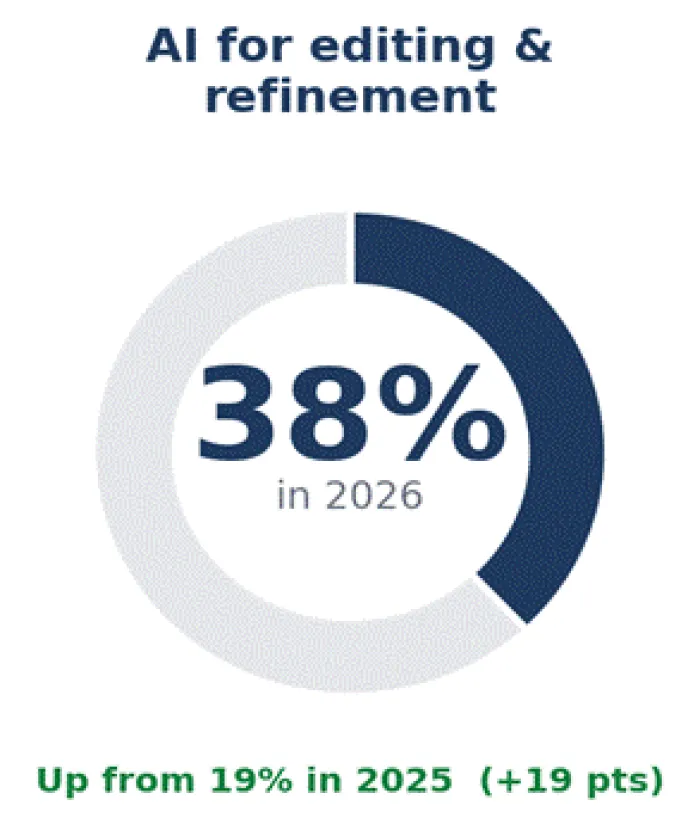
The structural shift sitting underneath those numbers is more interesting than the numbers themselves. Generation-tool adoption has plateaued. Editing-tool adoption among content marketers doubled in twelve months, from 19 percent in 2025 to 38 percent in 2026. The center of gravity has moved from “make AI write things for me” to “make AI fix what I wrote,” and the buying patterns that worked in 2023 are now actively wrong.
Market Sizing for AI Writing and Editing Software
| Segment | 2025 | 2026 | Long-Range CAGR |
|---|---|---|---|
| AI writing assistant software (narrow scope) | $1.23 B | $1.34 B | ~9.1% |
| AI writing assistant software (incl. embedded use) | $3.64 B | Projected $9.09 B by 2033 | ~12.1% |
| Global generative AI market (writing as a segment) | $63 B | $91.57 B | ~45% YoY |
Sources: Research and Markets; autofaceless.ai compilation, 2026.
The wide spread reflects scoping choices. The lower number tracks pure-play AI writing assistants. The higher number captures AI writing embedded inside Microsoft Copilot, Google Workspace, Notion AI, and other suite tools, which is the faster-growing slice and the one most market reports underestimate.
Generation Tools: Picking Your Drafter
The four options worth evaluating in 2026 sort cleanly by who owns the buying decision: marketing, sales, IT, or no one (because the team is small enough to skip procurement entirely).
Jasper AI — For Marketing-Led Teams

Jasper has the longest brand-voice training pedigree in the category and remains the default for marketing teams that produce a lot of content and care whether it sounds like them. The Brand Voice feature ingests existing samples and generates new pieces that hold tonal consistency across hundreds of outputs, which is the part competing tools usually claim and rarely deliver. The Surfer SEO integration is the genuine workflow innovation: real-time keyword scoring inside the editor compresses what was previously a separate research-and-optimization step.
Pricing starts at $39/mo on the annual Creator plan, $59/mo for Pro, with team and enterprise tiers running custom. There is no free plan; the trial is seven days, the shortest in the category. G2 rating sits at approximately 4.7/5 across 1,200+ reviews.
Pros and Cons (the operational ones, not the website ones)
| Pros | Cons |
|---|---|
| Brand Voice holds coherence past ~40 generations; competitors typically drift before 20 | No free tier, and a 7-day trial means evaluating a long-form tool in a sprint window |
| Surfer SEO integration is the only real-time SEO scoring built into the editor in this category | Output quality on technical B2B content lags consumer-marketing content noticeably |
| Workspace separation lets agencies serve distinct client brand voices without per-account billing | The 2023 pricing restructure raised effective costs roughly 300%; long-term price predictability is weak |
| Templates produce structurally varied output, so you don’t get five intros that all open with “In today’s fast-paced world” | Knowledge-grounding is shallow vs Writer; technical claims need human verification |
Where Jasper Earns Its Price Tag
| User type | What they actually use it for | Outcome to expect |
|---|---|---|
| Content marketing agency | Brand Voice trained per client; blog drafts then refined in Surfer | 3-4x content velocity; tone consistency surviving staff turnover |
| In-house mid-size SaaS marketing team | Monthly editorial calendar against keyword briefs | 50-60% reduction in first-draft time; SEO integration replaces a separate $89/mo Surfer seat |
| E-commerce content team | Product descriptions at scale, voice anchored to existing catalog | Consistent voice across thousands of SKUs; useful for catalog migrations |
| Solo blogger publishing 1-2 posts/month | Same workflow, $39/mo for two posts | Cost rarely justified; Claude Pro at $20 does similar work with more flexibility |
Copy.ai — For Sales-Led Teams
![Copy.ai vs. Copysmith: In-depth Comparison [2026]](https://driebipxfld1t.cloudfront.net/ai-tools-screenshots/copysmith-ui.jpg)
Copy.ai is a writing tool that went to a sales conference and never came back. Following its October 2025 acquisition by Fullcast, the product is now positioned as a go-to-market automation platform that includes writing rather than the other way around. For teams evaluating it as a content tool in 2026, that pivot matters: the writing roadmap is no longer the company’s primary roadmap, and that shows up in feature velocity.
Within its current scope, Copy.ai is genuinely strong at short-form copy. The 90+ template library exceeds Jasper’s, with depth in ad headlines, cold email sequences, LinkedIn outreach, and product descriptions. Multi-model access lets users switch between GPT, Claude, and Gemini outputs on a single brief. The free plan, which includes 2,000 words per month, 90+ templates, and unlimited chat with no credit card, is the most generous in the category. Paid plans start at $36/mo annually. G2 rating sits around 4.7/5.
Pros and Cons
| Pros | Cons |
|---|---|
| Free plan is the only genuinely useful one in paid AI writing; you can evaluate seriously without commitment | Long-form context collapses around 1,500 words; blog posts need stitched sections |
| Multi-model switching (GPT, Claude, Gemini) on one brief gives stylistic variety without multi-subscription | Brand Voice exists but drifts back to default tone within a long document |
| Native HubSpot/Salesforce connectors are deeper than any pure-writing tool | Post-Fullcast acquisition, writing features evolve more slowly than GTM features |
| 24 usable ad headline variations in under 8 minutes (independently tested in early 2026) | Center of gravity is moving away from writing teams; future-proofing is uncertain |
Where Copy.ai Actually Wins
| User type | What they use it for | Outcome to expect |
|---|---|---|
| Outbound sales team | Cold email sequences, LinkedIn outreach, follow-up cadences | Higher response rates from variation; 5-7 hours/week saved on outreach copy |
| Performance marketing team | Ad headline variants, A/B test variations for paid campaigns | Faster iteration; meaningful CTR improvements from headline volume |
| RevOps building automated pipelines | AI copy fed directly into CRM workflows via native connectors | One platform handles copy plus workflow; reduces tool sprawl |
| Long-form content team | Blog posts via stitched section generation | Editing overhead exceeds time saved; Jasper or Claude is the better fit |
Writer — For Governance-Led Enterprises
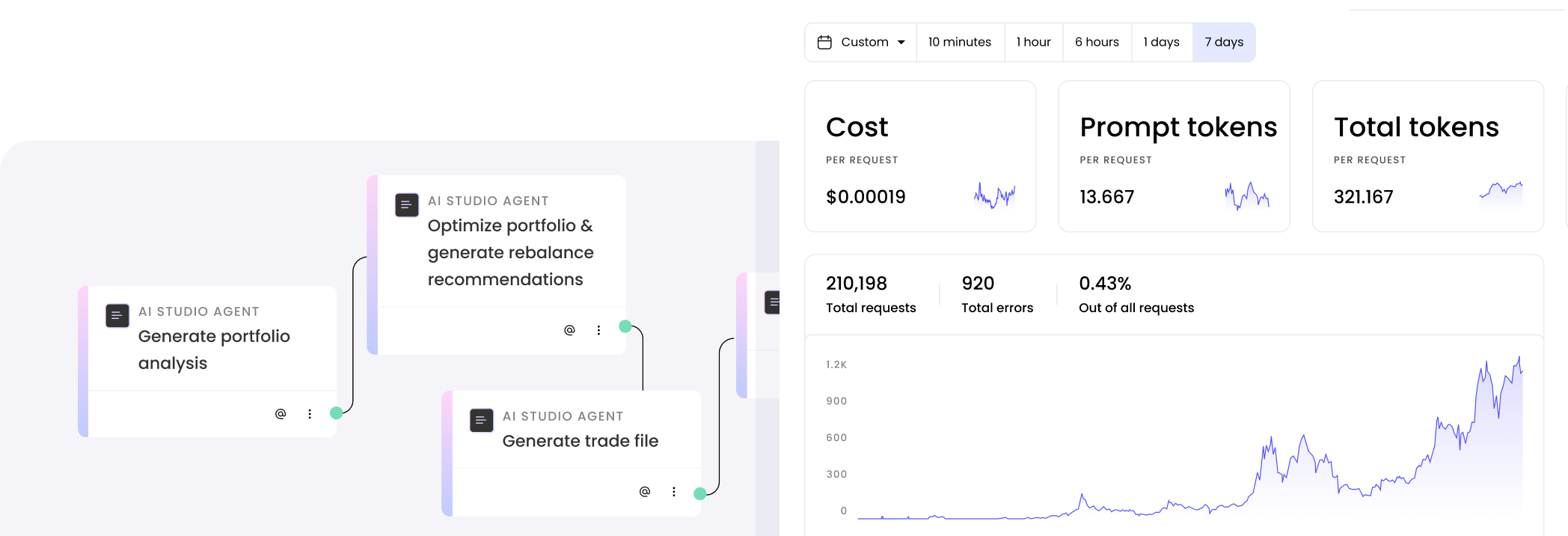
Writer is what happens when IT and InfoSec own the content tool procurement decision. The product is built around governance, knowledge-grounding, and policy enforcement, with brand voice modeling treated as a secondary capability. The architectural centerpiece is a knowledge graph that grounds outputs against organization-approved source documents. When a sales rep generates content, the model retrieves and references internal product specs and approved messaging instead of improvising from training data.
This matters where content accuracy is non-negotiable. Regulated industries (healthcare, financial services, pharmaceuticals) increasingly default to Writer because hallucination risk drops materially when the model is not free-associating. Audit logging, policy redaction, and content-approval workflows ship as first-class features. Pricing is custom enterprise, typically a five-figure annual minimum.
Pros and Cons
| Pros | Cons |
|---|---|
| Knowledge graph grounding eliminates the most common hallucination class: invented product specs, fabricated pricing, and made-up features | Pricing opacity; no self-service tier means even evaluating the product requires sales conversations |
| Audit logging and redaction ship as first-class features, not enterprise add-ons | Setup is a real project: knowledge base configuration takes weeks, not days |
| Replaces 2-3 separate tools (writing, governance, content review) in regulated industries | Brand voice depth is a generation behind Jasper; tone polish is competent, not exceptional |
| The procurement reality summed up by an industry retro: “Jasper is what marketing buys, Writer is what IT approves” | Overkill for marketing teams not subject to regulatory or InfoSec review cycles |
Where Writer Justifies the Procurement Cycle
| User type | What they use it for | Outcome to expect |
|---|---|---|
| Pharma marketing team | MLR-grounded content drafting against approved claims library | Materially reduced legal review cycles; compliance-traceable outputs |
| Financial services content team | Customer communications grounded against compliance-approved messaging | Lower regulatory risk; audit trail for every generated document |
| Enterprise product marketing | Launch content grounded against internal product specs | Eliminates the “AI invented a feature we don’t ship” failure mode |
| Mid-market marketing team | Evaluating Writer for general content generation | Disproportionate cost and complexity; Jasper fits better |
ChatGPT and Claude — For Solo and Small Teams

The honest reality of 2026 is that the largest share of professional writing happens in chat interfaces, not specialized platforms. ChatGPT runs 2.5 billion daily requests with 900 million weekly active users; among AI writing users surveyed, 80 percent reach for ChatGPT and 55 percent for Claude. Roughly 40 percent of work-related ChatGPT messages in mid-2025 were writing tasks.
The trade is straightforward: $20–30 per month buys flexibility and strong baseline writing quality, but skips brand voice training, SEO integration, content workflow features, and team governance. For solo creators with mature prompting practices, the chat interface is often sufficient. For content operations with structured workflows and brand standards across multiple writers, the absences become real costs rather than savings.
AI Writing Tools at a Glance
| Tool | Starting Price | Free Plan | Best Use Case | G2 Average |
|---|---|---|---|---|
| Jasper AI | $39/mo (annual) | No, 7-day trial | Long-form blogs, brand-consistent campaigns | ~4.7/5 |
| Copy.ai | $36/mo (annual) | Yes, generous | Short-form copy, sales workflows | ~4.7/5 |
| Writer | Custom enterprise | No | Regulated enterprise content | ~4.5/5 |
| ChatGPT Plus | $20/mo | Limited | General drafting, ideation | N/A (consumer) |
| Claude Pro | $20/mo | Limited | Long-form drafting, reasoning | N/A (consumer) |
Refinement Tools: Picking Your Editor
Editing tools sort by the problem they solve, not by the company that makes them. Four problems, four products, and almost no one needs all four.
Grammarly — For the Everywhere Problem
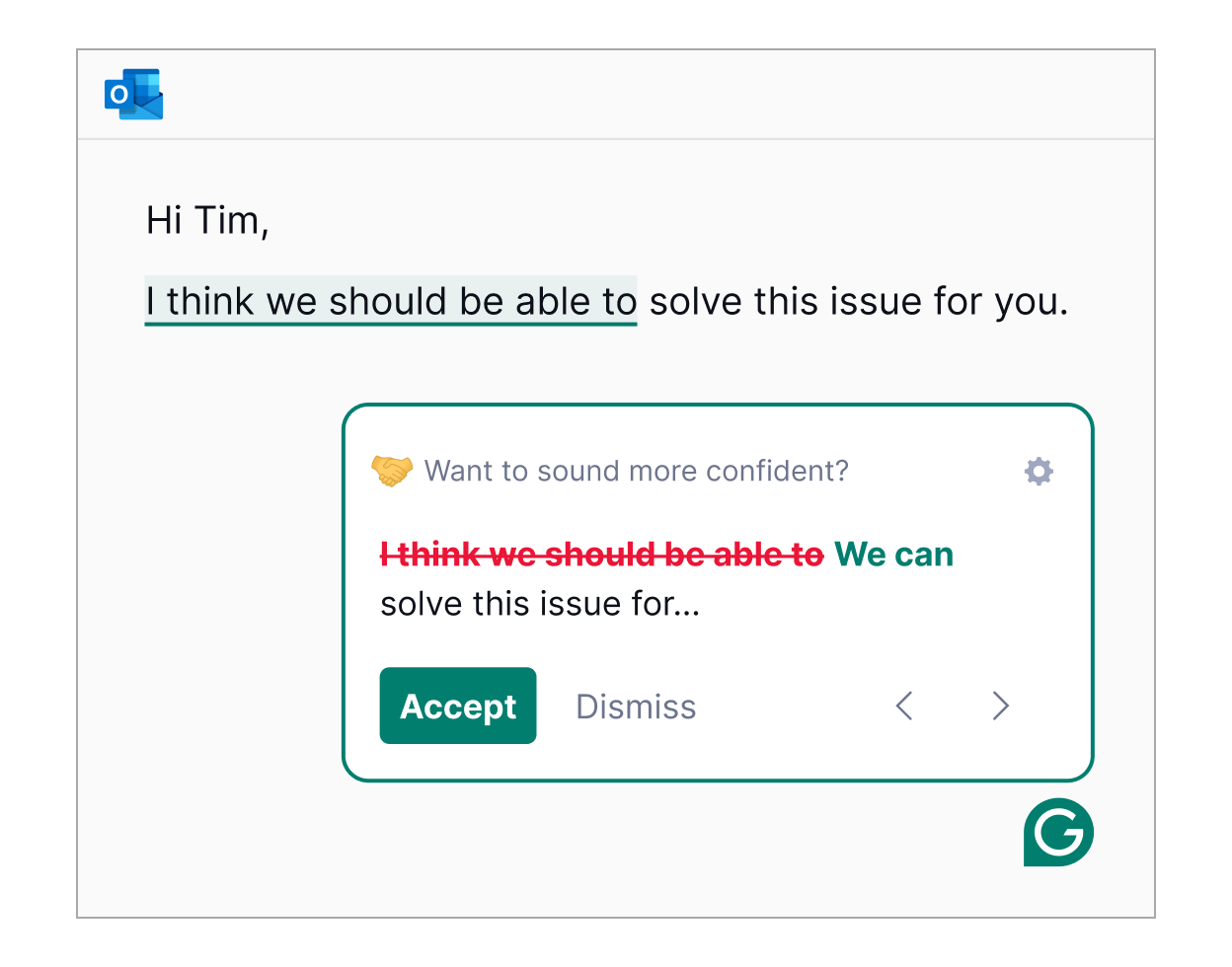
Grammarly’s actual moat is not grammar accuracy. It is that the tool sits inside 500,000+ apps and websites and disappears into the user’s existing workflow. With 30 million daily active users and 70,000+ organizational accounts, the product enforces a baseline of clarity without anyone having to open a separate editor. That ambient model is the quiet productivity story that explains the company’s scale, not GrammarlyGO, not the tone detector, not the plagiarism check.
Pricing runs $12/mo Pro (annual) and $15/user/mo Business. G2 ratings sit at 4.6–4.7/5. Trustpilot, where individual users leave more candid feedback, sits at 3.7/5. The gap is informative.
Pros and Cons
| Pros | Cons |
|---|---|
| Cross-platform integration (500K+ apps) is genuinely irreplaceable; no competitor is within reach | Mac desktop app stability has visibly degraded since 2024; Trustpilot complaints cluster here |
| Inline suggestion model means zero context switching, which is the real productivity moat | Treats fiction’s intentional fragments and stylistic punctuation as errors, requiring constant dismissal |
| Tone detection on emails catches passive-aggressive phrasing more reliably than most humans do | Pro AI generation limits (2,000 prompts/mo) hit faster than the marketing copy suggests |
| Free tier is meaningfully usable, not bait | A polisher, not a structural editor; will not tell you your argument is weak, only that it has commas |
Where Grammarly Earns Its Place
| User type | What they use it for | Outcome to expect |
|---|---|---|
| Distributed corporate team | Real-time editing across email, Slack, Google Docs, Notion | Standardized professional baseline; faster cross-functional review |
| Customer-facing professionals (sales, CS, HR) | Tone-checked external communication | Fewer accidentally curt emails; tone consistency at scale |
| Non-native English writers | Cross-platform grammar correction with tone modes | Confidence in professional written communication |
| Fiction writer drafting a novel | Real-time editing on a manuscript | Constant friction; ProWritingAid is the right tool |
ProWritingAid — For the Depth Problem
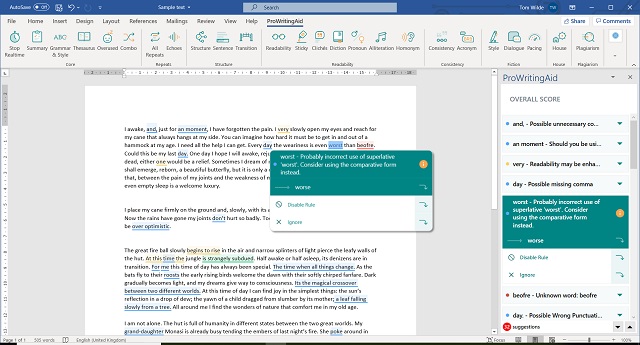
ProWritingAid is the only mainstream editing tool that treats writing as a craft to be coached rather than a series of errors to be corrected. The 20+ report types (pacing, sticky sentences, glue index, sentence-length variation, dialogue tags, cliché detection) surface patterns Grammarly literally cannot see, because Grammarly was built for sentence-level correction and ProWritingAid was built for document-level analysis. They are different tools for different jobs, and most reviewers comparing them as alternatives are missing this point.
The pricing math is its quiet competitive advantage. Premium runs $10/mo, but the lifetime license at $399 outperforms three years of Grammarly Premium ($432) and never re-bills. For anyone planning to use an editing tool past 18 months, the math is unusually favorable. G2 ratings sit at 4.2–4.5/5; Trustpilot at 4.3/5 across 625 reviews.
Pros and Cons
| Pros | Cons |
|---|---|
| 20+ reports surface patterns Grammarly cannot see (sentence variance, glue index, pacing rhythm) | Reports are diagnostic, not prescriptive; the tool surfaces problems but expects you to fix them |
| Lifetime license at $399 is the only sane long-term economics in the category | Plagiarism checks are pay-per-use unless you upgrade to Premium Pro |
| Privacy commitment (writing not used for training) is verified, not just claimed; matters for unpublished work | 40+ genre presets sound like marketing fluff but actually shift the analysis meaningfully |
| Scrivener integration is the deepest of any editing tool; novelists leave other tools for this alone | Mobile experience is essentially absent; no equivalent to Grammarly’s keyboard |
Where ProWritingAid Pays Off
| User type | What they use it for | Outcome to expect |
|---|---|---|
| Novelist drafting in Scrivener | Manuscript-level analysis with genre preset | Pacing improvements, overused-word reduction; closest software equivalent to a developmental editor |
| Academic writer | Long-document reports on style, clarity, and structure | Substantive structural feedback, not just typo fixes |
| Long-form content team | Editorial pass on premium pieces (1,500+ words) | Quality lift on flagship content; pairs well with Grammarly for daily writing |
| Social media marketer | Document analysis on a 200-word LinkedIn post | Overkill; the report suite is wasted on short copy |
Hemingway Editor — For the Clarity Problem

Hemingway has the rare honesty of doing one thing without trying to do six. It checks readability, flags long sentences, complex constructions, passive voice, and adverb use, then assigns a Flesch-Kincaid grade level. There is no real-time browser integration, no team features, no plagiarism checking, no AI co-author trying to ghostwrite the next paragraph. The visual highlighting (yellow for long sentences, red for very long, green for passive, blue for adverbs) communicates faster than any text-based suggestion list.
The free web version is the actual product for most users: no time limit, no word cap, no account required, which is increasingly rare in 2026. The desktop app is $19.99 one-time. Hemingway Plus, with AI rewrites, runs $9.99/mo on a 14-day trial.
Pros and Cons
| Pros | Cons |
|---|---|
| Free web version has no time limit, no word cap, no account; genuinely rare in 2026 | Misses real grammar errors that any other tool would catch; not a primary editor |
| Color-coded visual highlighting communicates faster than scrolling through suggestion lists | No browser integration means manual paste-in for every check |
| The constraint is the value; it forces brevity that other tools negotiate around | Plus tier ($9.99/mo) does not add enough beyond free version to justify the upsell |
| One-time $19.99 desktop purchase is among the only non-subscription editing tools left | Opinionated style philosophy works for journalism and marketing; fights with academic and technical writing |
Where Hemingway Belongs in the Stack
| User type | What they use it for | Outcome to expect |
|---|---|---|
| Content marketer/blogger | Final clarity pass before publishing | Tighter, more readable prose; works as the closing step in a multi-tool workflow |
| Technical writer | Grade-level check on customer-facing documentation | Documentation lands at appropriate reading levels for general audiences |
| Email writer fighting verbosity | Paste-in check before sending | Forces sentence-level discipline that nothing else does |
| Novelist | Fiction with intentional long, lyrical sentences | The tool will hate every sentence; ignore it |
Wordtune — For the Phrasing Problem
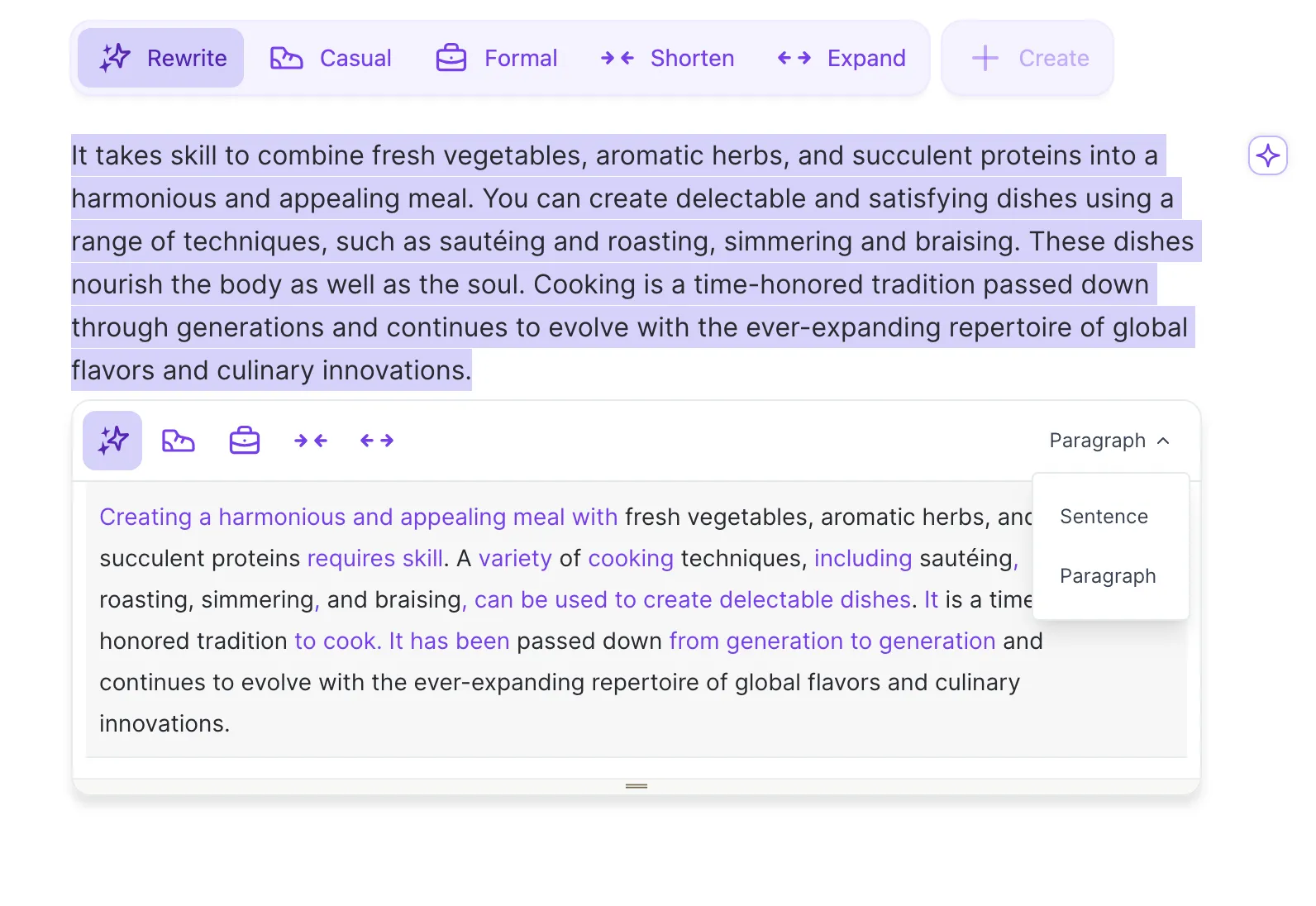
Wordtune is the rewriting niche made into a product. Where Grammarly corrects and ProWritingAid analyzes, Wordtune rephrases. The tool surfaces multiple alternative phrasings for any sentence, with controls for formality, length, and tone. The summarization feature, which compresses long articles, PDFs, and YouTube videos into key points, is unexpectedly useful and the most underrated capability in the editing category.
The $300 million Series D in early 2025 (with Google and Nvidia among investors) gives the company stability through the next product cycle. Premium runs about $9.99/mo. Free tier is limited to roughly 10 rewrites per day and 3 AI summaries per month, which is enough to demo, not enough to evaluate.
Pros and Cons
| Pros | Cons |
|---|---|
| Only mainstream tool surfacing multiple full-sentence rewrites simultaneously | Does not catch grammar errors; needs to be paired with Grammarly or ProWritingAid |
| Summarization of YouTube videos, PDFs, and articles is the underrated feature in the category | Free tier (10 rewrites/day) is more demo than evaluation |
| 30% student discount is the only verified educational pricing among major editing tools | Rewrites occasionally shift intended meaning, especially with technical phrasing |
| Strong investor backing ($300M Series D) suggests stability through the next cycle | Sentence-level focus means it ignores document-wide problems entirely |
Where Wordtune Genuinely Helps
| User type | What they use it for | Outcome to expect |
|---|---|---|
| Non-native English writer | Sentence rewrites with tone control across email and reports | Phrasing options that preserve meaning while sounding more natural |
| Professional adjusting tone across audiences | Rewrites for casual vs formal versions of the same source | Tone calibration without rewriting from scratch |
| Researcher consuming long-form content | YouTube/PDF summarization | Substantial time savings on background research |
| Writer needing comprehensive editing | Standalone use as a primary tool | Insufficient on its own; pair with Grammarly or ProWritingAid |
AI Editing Tools at a Glance
| Tool | Starting Price | Free Plan | Best Use Case | G2 / Trustpilot |
|---|---|---|---|---|
| Grammarly | $12/mo Pro (annual) | Yes | Daily cross-platform editing | 4.6–4.7 / 3.7 |
| ProWritingAid | $10/mo; $399 lifetime | Limited | Long-form structural editing | 4.2–4.5 / 4.3 |
| Hemingway | Free; $19.99 desktop | Yes | Readability/clarity passes | ~4.5 / N/A |
| Wordtune | ~$9.99/mo | Limited | Sentence rewriting, tone control | ~4.5 / 4.0 |
Cross-Platform Review Data
A note on industry context first. In January 2026, G2 acquired Capterra, Software Advice, and GetApp from Gartner Digital Markets. The consolidation means G2 now controls roughly 55-58 percent of global software review influence, and ratings on G2 and Capterra increasingly align (and probably will align further). Trustpilot remains independent, and it tends to skew lower than the B2B platforms because it captures individual consumer complaints alongside business reviews. The table below aggregates ratings from these three DR 80+ platforms, which together account for the majority of verified review signal in the B2B SaaS market.
User Ratings Across G2, Capterra, and Trustpilot (Q2 2026)
| Tool | G2 | Capterra | Trustpilot | What the spread reveals |
|---|---|---|---|---|
| Jasper AI | 4.7 / 5 (1,200+ reviews) | 4.7 / 5 | ~3.5 / 5 | Business buyers love it; individual users feel pricing pressure |
| Copy.ai | 4.7 / 5 | 4.4 / 5 | ~4.0 / 5 | Consistent across platforms; SMB and enterprise both satisfied |
| Writer | 4.5 / 5 | Mixed (legacy listing confusion) | N/A | Enterprise-only positioning means thin individual-user signal |
| Grammarly | 4.7 / 5 (7,200+ reviews) | 4.7 / 5 | 3.7 / 5 | Widest G2-to-Trustpilot gap in the category; informative |
| ProWritingAid | 4.4 / 5 | 4.5 / 5 | 4.3 / 5 (625 reviews) | Tightest range across platforms; consistent satisfaction |
| Hemingway Editor | 4.5 / 5 | 4.5 / 5 | Too few reviews to assess | Free tool means less commercial review pressure; ratings stable |
| Wordtune | ~4.5 / 5 | 4.0 / 5 (566 reviews) | ~4.0 / 5 | Slight Capterra/Trustpilot dip suggests free-tier users hit feature limits |
| ChatGPT (Plus/Team) | N/A (consumer) | N/A | ~4.0 / 5 | Massive usage volume does not translate to formal B2B review platforms |
| Claude (Pro/Team) | N/A (consumer) | N/A | ~4.5 / 5 | Strong satisfaction signal, but reviewer pool is small |
Sources: G2.com, Capterra.com, and Trustpilot.com aggregate ratings as of Q2 2026.
Three insights this table surfaces that the marketing pages will not:
The G2-to-Trustpilot gap is the loudest hidden signal. Grammarly’s 1.0+ point spread between B2B platforms and Trustpilot tells you that organizational buyers and individual end users are having materially different experiences. Jasper shows a similar pattern at smaller magnitude. Tools where the gap is narrow (ProWritingAid, Hemingway) tend to deliver consistent value regardless of who is paying.
Review volume changes how much a rating means. A 4.5 with 7,000 reviews is statistically robust. A 4.5 with 50 reviews can shift on a handful of outliers. Grammarly’s 7,200+ G2 reviews and ProWritingAid’s 625 Trustpilot reviews are the data points worth weighting heavily. Newer or enterprise-only tools with thin review pools deserve more scrutiny in evaluation.
N/A is a category signal, not a quality signal. ChatGPT and Claude have hundreds of millions of users but barely register on B2B review platforms because they are sold as consumer subscriptions and reviewed in different venues. The absence reflects distribution model, not product quality.
The Trend Reshaping This Category in 2026–2027
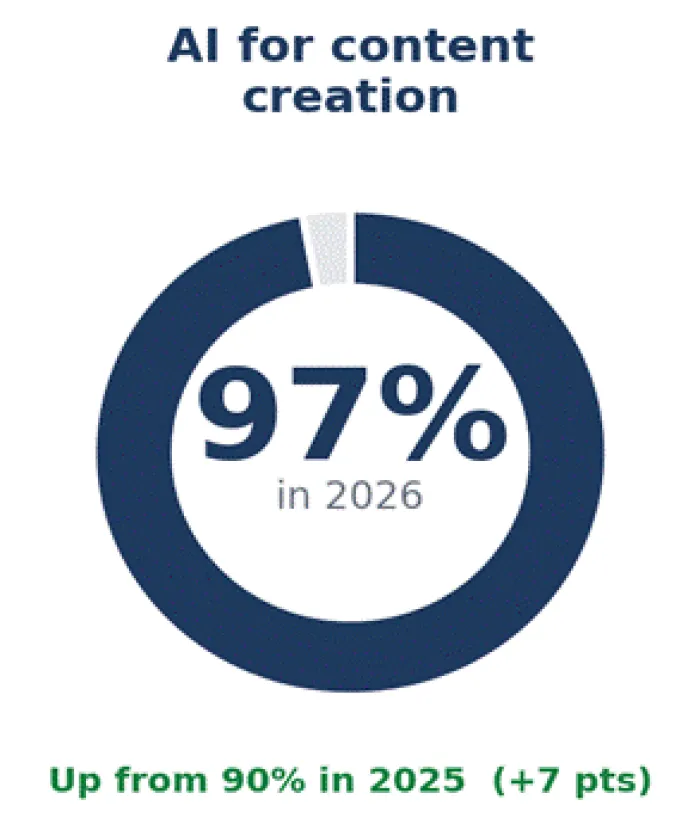
Generation has saturated. Editing is mid-curve. The three charts below summarize the divergence: how much of each AI use case content marketers have actually adopted, and how far they have moved in twelve months.
Adoption Among Content Marketers, 2026 vs 2025
 |  | |
Sources: Siege Media / Affinco / HubSpot 2026 State of Marketing.
The story the three charts tell together: the writing-generation use case is functionally tapped out. Almost every content marketer who is going to adopt AI for drafting already has. The editing use case is where the next surge of adoption is happening, and the SEO optimization use case is filling in steadily underneath. Tools positioned for editing are about to compete for a share of attention that, twelve months ago, was not yet there to win.
The next 18–24 months of competitive activity in AI content will concentrate on the editing layer, which is why ProWritingAid is leaning harder on lifetime pricing, Grammarly is bundling more AI generation into Pro, and Wordtune raised $300 million to extend its niche. Read the funding rounds, not the press releases.
Stack Patterns That Work in Practice
Three stack architectures account for roughly 80 percent of the content operations performing well in 2026. The pattern that fits depends on volume, audience, and who owns the procurement decision.
Three Working Patterns
| Pattern | Composition | When this fits |
|---|---|---|
| The Volume Stack | Jasper (Brand Voice + Surfer) + Grammarly Business + ProWritingAid for premium pieces | Marketing teams publishing 20+ pieces/month where consistent voice across writers is the binding constraint |
| The Governance Stack | Writer (knowledge-grounded) + Grammarly Business + internal compliance review | Regulated industries (pharma, financial services, healthcare) where invented facts create legal exposure |
| The Lean Stack | Claude Pro or ChatGPT Plus + Grammarly Pro + Hemingway free | Solo creators and small teams under 5; total tool spend stays under $35/seat/month |
Two patterns that look reasonable on paper but consistently fail in practice: (1) trying to make a single “all-in-one” tool cover both generation and editing, which produces mediocre output on both sides; and (2) running parallel writing tools for variety, which doubles cost without doubling quality, because the underlying language models are increasingly similar.
What to Buy in Q3 2026
The 2026 data settles the strategic question. Generation tool adoption among content marketers is at 96 to 97 percent, effectively saturated, while editing tool adoption has climbed from 19 to 38 percent in a year. Real productivity gains, in the range of 6 to 11 hours per marketer per week, only appear when both layers are in place.
Writing and editing tools are complementary, not competitors. The writing layer determines how much content a team can produce; the editing layer determines whether that content is publishable. Optimizing only the first produces volume nobody wants to read, while optimizing only the second produces excellence too slowly to matter.
For the next two quarters, the practical move is to anchor on editing infrastructure that fits your existing workflow, using Grammarly for breadth and ProWritingAid for depth where it makes sense. Then layer writing tools based on volume and brand needs: Jasper for marketing led operations, Writer for governance focused enterprises, Copy.ai for sales driven short form, general purpose chat models for solo or small teams, and specialist partners such as Writenexa when you need research heavy, SEO aligned long form content produced by humans with AI support. The teams that win the next phase will not be the ones with the most tools, but the ones that understood the difference between generating content and refining it and built their stack accordingly.