
Editorial pipelines do not fail because writers exhaust the universe of topics. They fail because their feeder systems (customer-conversation loops, refresh cadence, first-party data assets, second-order analysis) were never built, or quietly collapsed when the original owner moved on. Ahrefs' analysis of 14 billion URLs found 96.55% receive zero Google traffic. Content Marketing Institute's 2025 B2B survey of 980 marketers found 45% lack a scalable production model. This briefing maps where blog programs structurally break and how to rebuild ideation as a renewable system.
The Misdiagnosis Behind "Idea Drought"
When a blog stalls, the instinct is to blame creativity. The data points elsewhere. Andy Crestodina's 2025 Annual Blogger Survey (n=808) shows the average blog post still takes 3 hours 48 minutes to draft despite AI tool adoption rising from roughly 65% in 2023 to 95% in 2025. Industry estimates put active blogs above 600 million sites, with 7.5 million posts published daily. Only 5.7% of pages rank in Google's top 10 within a year (Ahrefs). Ideas are unbounded; distribution slots are not.
What teams describe as "running out of ideas" is almost always one of four operational conditions: the topical territory has been over-covered without depth differentiation, the editorial calendar has decoupled from sales conversations, the source pool has narrowed to competitor blogs and Google autocomplete, or the original subject-matter expert has run out of bandwidth. These are operational failures with operational fixes. They do not respond to longer brainstorming sessions, and they do not resolve themselves with a new AI subscription.
Five Structural Failure Modes
The topical ceiling
Niche depth is celebrated until it becomes a wall. A vendor selling payroll software for veterinary practices has perhaps 40 to 60 truly differentiated content angles before the territory is mapped, after which the team is paraphrasing itself in slightly different fonts. This is a market-sizing problem misdiagnosed as a creativity one because the visible symptom is identical. Animalz's editorial evolution illustrates the contrast: the team explicitly ignored keyword search volume and anchored topics in two private streams, problems surfaced from sales calls and second-order consequences of industry events. That structure expands topical surface area indefinitely because the inputs are not the public SERP. Teams that hit a ceiling typically built only one input layer and ran it until it ran out.
Editorial calendars decoupled from revenue conversations
CMI's 2025 Outlook found 65% of B2B marketers say their content does not align tightly with the buyer's journey, 39% struggle to map content to that journey at all, and only 35% report meaningful alignment between calendar and the actual buying process. When sales-call transcripts feed the calendar, ideation does not dry up: every objection, every "yes but," every multi-stakeholder negotiation surfaces a content gap with documented commercial intent. When transcripts do not feed the calendar, editors manufacture topics from search-volume tools alone. That source is the same source every competitor uses, which produces the same calendar everyone else publishes, which the algorithm has now learned to discount because it cannot tell which version of the same article should rank.
Solo-author bottlenecks and the 3-hour-48-minute tax
A solo blogger publishing weekly invests roughly 200 hours per year on drafting alone, before research, distribution, refresh, or editorial review. A single subject-matter-expert interview adds 60 to 90 minutes per piece for transcription and quote integration. Two adjacent findings tighten the diagnostic: only 9% of marketers publish posts longer than 2,000 words, but 39% of those who do report strong results against a 21% benchmark; marketers using AI as an editor report strong results at the same rate as those using human editors. The bottleneck is therefore not draft length, AI quality, or editorial review. It is institutional knowledge concentrated in one or two people. When that node saturates, the calendar contracts to whatever bandwidth remains, which is rarely the most strategic content the company could be producing.
Imitation cycles: when competitor audits replace original research
Animalz has labeled this the "copycat crisis," and any commercially valuable keyword's SERP confirms it: convergent titles, near-identical H2 patterns, recycled examples cited in slightly reordered sequences. Gap analysis against ranking competitors mathematically produces this outcome. The HubSpot case quantifies the structural risk: SEMrush data tracked HubSpot's organic traffic falling from 24.4 million monthly visits in March 2023 to 6.1 million by January 2025, a 75% drop coinciding with Google's December 2024 core update. Independent SEO analysis converged on a single diagnosis: HubSpot had built rankings on topically irrelevant pages including "shrug emoji" and "famous quotes." The traffic was real; the topical-authority signal it generated was wrong, and the algorithm eventually priced it in.
First-party signal starvation
Most blog programs do not systematically capture first-party signal. They have a Google Analytics login and perhaps Ahrefs or Semrush. They lack a structured pipeline that converts internal data into topic candidates: support tickets in Zendesk or Intercom, sales-call transcripts in Gong or Avoma, customer onboarding friction logs, churned-customer exit interviews, internal Slack threads where a customer-success representative rephrases an objection in plain language. Each is a renewable input. None go dry. Yet only 35% of B2B marketers say their content aligns with the buyer journey (CMI 2025), which is itself a proxy for whether first-party data is reaching the editorial function. The remaining 65% are running calendars off public inputs, which is the same starvation diet every competitor is on. The output looks similar because the inputs are identical.
Symptoms versus structural causes
Most editorial leaders treat the visible complaint as the actionable problem, which is why investments in "better brainstorming" or "a faster AI tool" frequently underperform. The table below maps surface-level symptoms to the structural condition that actually generated them.
| Visible Symptom | Common Misdiagnosis | Actual Structural Cause |
|---|---|---|
| "We have covered every topic in our niche" | Topical exhaustion | Source pool limited to competitor SERPs and keyword tools |
| "Posts feel repetitive" | Writer fatigue | No first-party signal reaching the calendar |
| "Calendar is empty next month" | Lack of creativity | Editorial cycle decoupled from revenue conversations |
| "Each post takes far too long" | Slow writers, weak tools | Single subject-matter expert is the program bottleneck |
| "Nobody reads what we publish" | SEO problem | Topical authority diluted by off-strategy and shallow posts |
| "AI is not saving us time" | Wrong AI tool | Bottleneck is institutional knowledge, not drafting speed |
Quantifying the pressure
Two datasets capture the operational and distribution-side pressure on editorial teams in 2025-2026. CMI's annual benchmarks reveal where production systems are failing internally. Ahrefs' AI Overview rollout study reveals where distribution is collapsing externally.
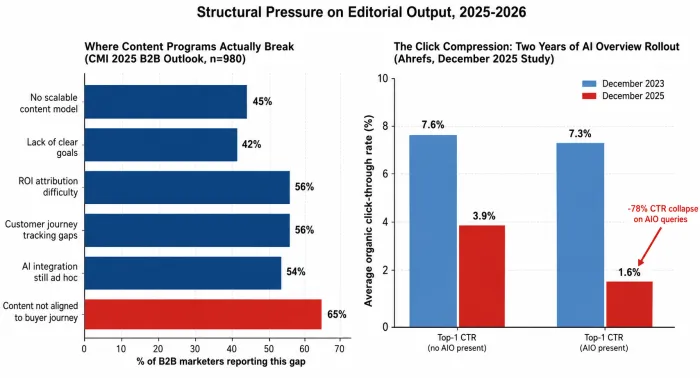
Figure 1. Editorial pressure points in 2025-2026. Sources: CMI 2025 B2B Outlook (n=980); Ahrefs December 2025 AI Overviews CTR study.
The Ahrefs December 2025 study compared top-1 click-through rates pre- and post-AI Overview rollout. Where AI Overviews appeared, average CTR fell from 7.3% to 1.6%, a 78% compression. Even on queries that did not trigger an AI Overview, CTR dropped roughly 49%. Pew Research's behavioral data corroborates: users click 8% of the time on AI Overview queries against 15% without. Topics easily summarized by an LLM are losing the distribution they once earned, which means ideation pipelines optimized for those topics are running into a ceiling no amount of brainstorming will lift.
Refilling the Pipeline: Five Operational Disciplines
A working ideation system has five repeatable inputs and one compound asset. None are creative exercises. All are operational disciplines that, once installed, run on schedule rather than on inspiration.
1. The customer-conversation loop
Grow and Convert's pain-point SEO methodology and Animalz's sales-marketing alignment converge on the same mechanic. Customer-facing teams log objections, edge cases, and confused questions in a shared spreadsheet or dedicated Slack channel. A weekly 30-minute review converts logs into topic candidates that compete on commercial intent, not search volume. Articles are evaluated against pipeline contribution and sales-cycle compression rather than pageviews. The pipeline scales nonlinearly because each customer interview surfaces three to seven discrete content angles, and the customer base grows over time. The ceiling is administrative, not topical: who owns the log, who reviews it weekly, who decides cadence. Most teams have never assigned those three roles, which is why the loop never closes.
2. Topic cluster architecture
Backlinko's analysis found pillar pages above 3,000 words attract 77.2% more backlinks than shorter pieces. Minuttia case studies have shown a single tight cluster ranking for over 1,000 keywords without external link building. The strategic value is editorial, not just SEO. A cluster forces the team to map every meaningful subtopic before publication starts, exposing gaps and overlaps while the calendar is still on a whiteboard. A typical B2B cluster pairs one 3,000-to-5,000-word pillar with 8 to 15 supporting articles, each linking back to the pillar and across to siblings. Idea drought is foreclosed structurally because the cluster is a calendar of ideas before it is a calendar of articles.
3. The refresh-first calendar
Every piece of content follows the same arc: spike, growth, plateau, decay. Orbit Media's 2025 survey found 71% of bloggers refresh older content, and refreshed pieces are 2.5 times more likely to report strong results than greenfield posts. The operational rule of thumb: reserve 30% to 40% of editorial slots for refresh work, prioritizing posts that have decayed but retain backlink equity (visible in Ahrefs, Search Console, or Semrush). QuickBooks reportedly deleted 2,000 blog posts to recover from organic decline, an aggressive subtraction strategy that doubled as topical-authority cleanup. Pruning, refreshing, and consolidating are ideation activities that produce calendar items the team would not otherwise have.
4. The second-order beat
When an industry event happens, most blogs cover the first-order consequences. That coverage is commodified within 48 hours and AI-summarized within a week. Animalz documents an explicit preference for second-order analysis: what does this mean two years out, what changes for hiring, what adjusts in pricing models, what becomes obsolete in workflow design. This beat is tractable because it cannot be auto-generated convincingly by current LLMs (it requires a position rather than a synthesis) and cannot be lifted from a competitor's homepage (the competitor is busy publishing the first-order take). Teams that develop a stable second-order beat build an inventory of analyses that age well, increasingly valuable in an environment where AI Overviews flatten first-order content into citation paste.
5. The first-party data asset
The highest-leverage single move in 2025-2026 ideation is publishing original data. Bain & Company's zero-click research, Orbit Media's blogger survey, and Ahrefs' SERP studies all illustrate the same dynamic: original data becomes citation infrastructure. It is referenced repeatedly across the web for years, generating durable backlink growth and increasingly appearing in AI Overview citations. Onely's 2025 analysis found brands cited in AI Overviews earn 35% more organic clicks and 91% more paid clicks than uncited competitors. Building such an asset requires a survey instrument, a sample of 200 to 1,000-plus respondents, and willingness to publish results that may not flatter the company's positioning. The teams that build it find the ideation problem inverts. They end up with more data than time to write up.
Adapting Ideation to the Zero-Click Environment
The recovery frameworks above assume a working distribution layer. That assumption is increasingly fragile. Semrush's 2025 zero-click study found 58.5% of US searches end without a click. Google AI Overviews appeared on 6.49% of queries in January 2025 and 13.14% by March, a 102% increase in two months. Bain & Company estimates organic traffic has been reduced 15% to 25% as a direct consequence.
Topics that produce easily summarizable answers (definitions, simple how-tos, listicle explainers) are losing distribution and will continue to lose it. Topics that resist summarization (proprietary frameworks, original data, expert perspective, second-order analysis) are gaining. A blog that wants to keep producing relevant ideas in this environment is implicitly being asked to publish content that an LLM with public data could not have written. The right ideation question is no longer "what should we write about this week." It is "what do we know that nobody else can plausibly publish."
Comparative Methodologies for Editorial Ideation
The methods below differ along four operational dimensions: the input data they require, the topical ceiling they encounter, their typical cycle time from concept to publication, and the audience or buying stage where each performs best. None is strictly superior. The strongest editorial systems combine three or four in deliberate proportion.
| Method | Primary Input | Topical Ceiling | Cycle Time | Best Use Case |
|---|---|---|---|---|
| Keyword gap analysis | Competitor SERP rankings | High (commodified) | 1 to 2 days | Early-stage blogs entering established niches |
| Customer call mining | Sales transcripts (Gong, Avoma), tickets | Effectively none | 3 to 5 days | B2B SaaS, complex products |
| Pain-point SEO | Customer interviews, objection logs | Low | 5 to 10 days | Bottom-of-funnel, conversion content |
| Topic cluster mapping | Pillar-cluster framework | Medium | 2 to 4 weeks (planning) | Topical authority and internal linking |
| Second-order analysis | Industry events, regulatory shifts | Low (perspective-driven) | 3 to 7 days | Thought leadership, executive audiences |
| Original data publishing | Surveys, product telemetry, panels | Effectively none | 4 to 8 weeks | Citation building, AI Overview presence |
| Refresh-first cadence | Decaying GA4 / GSC pages with backlink equity | Bounded by archive size | 1 to 3 days per piece | Mature blogs with backlink-rich archive |
Early-stage B2B blogs typically combine pain-point SEO with topic cluster mapping to establish authority, introduce customer-call mining once a meaningful sales pipeline exists, and commit to original data publishing only after the audience exists to amplify it. Mature programs invert the priority, leading with original data and second-order analysis while refresh cycles maintain the long tail. The persistent error at every stage is defaulting to keyword gap analysis as a primary method, because its topical ceiling is the lowest of the seven and the algorithm signal it generates is now actively penalized.
Strategic Synthesis
Editorial pipelines run dry for diagnosable, structural reasons. The diagnosis is rarely “we lost our creativity.” It is more often that one or several feeder systems were never operationalized, or were operationalized once and abandoned when the original owner left. The 2025-2026 search environment makes this fragility expensive in a way it was not five years ago. AI Overviews compress click distribution toward a smaller set of cited sources. Topical-authority audits punish breadth without depth, as HubSpot’s 75% decline made unmistakable. Shallow content accelerates its own decline.
The recovery hierarchy is operational and sequenced. First, install a customer-conversation-to-calendar loop with named owners and weekly cadence. Second, retire any post failing relevance and refresh any post that retains backlink equity but has lost ranking. Third, commit to one proprietary data asset annually. Fourth, develop a second-order beat that articulates positions rather than summaries. For AI-assisted SEO content teams, this is where platforms like WriteNexa, which focuses on human-like, SEO-structured blog writing, can support the workflow without replacing the editorial judgment that makes the system credible.
The output of those four moves is not a quarterly content calendar. It is a renewable ideation system that does not depend on individual creativity to refill, which is the only kind of editorial program that survives the next algorithm update.