Blog writing once meant fighting a blank page. In 2026, the fight is with a subscription stack of twelve AI tools, each insisting it writes better than the last, each with a free trial that expired yesterday. Somewhere between the breathless marketing copy and the Reddit takedowns, content teams still have to ship articles that rank, convert, and survive editorial review.
The good news: AI writing platforms have genuinely matured. The harder news: picking the right one now requires more judgment than it did when there were only three options. This analysis cuts through the noise with verified 2026 pricing, G2 sentiment, productivity benchmarks, and workflow comparisons.
The Rise of AI Writing Platforms
The Salesforce State of Marketing 2026 report shows 87 percent of marketers now use generative AI in at least one workflow, up from 51 percent in 2024. HubSpot places average weekly time saved at 6.1 hours, with senior practitioners reclaiming up to 10. AI-assisted teams publish 42 percent more content monthly, lifting the median from 12 to 17 articles.
Market expansion mirrors adoption. Research and Markets projects the AI writing assistant software segment to grow from $3.64 billion in 2025 to $9.09 billion by 2033, at a 12.1 percent compound annual rate. North America holds roughly 39 percent share, while Asia-Pacific is the fastest-growing region. The category has crossed from experiment to standard infrastructure.
Platform Comparison
The platforms below cover the four categories most relevant to blog planning: long-form generators, SEO optimizers, copy tools, and SERP-intelligence engines. Specifications were verified against 2026 vendor documentation, G2 listings, and reviews from Frase.io, NovaReviewHub, Toolsradar, and Demandsage.
| Platform | Category | Strongest Capability | Best Suited For | Limitation |
|---|---|---|---|---|
| Jasper | Long-form | Brand voice and campaign builder | Mid-size marketing teams | Premium pricing |
| Copy.ai | GTM workflows | Sales-aligned short-form copy | Sales–marketing alignment | Heavier edits on long-form |
| Writesonic | Volume engine | ArticleGPT and chatbot builder | High-volume teams on a budget | GEO gated to higher tiers |
| Surfer SEO | On-page SEO | SERP-driven scoring | Teams prioritizing rankings | Lighter AI generation |
| Frase | SEO + GEO | Dual SEO and AI search scoring | Hybrid SEO–GEO programs | No native plagiarism check |
| Clearscope | Premium optimizer | Best-in-class grading accuracy | Enterprises chasing quality | High cost per draft |
| ChatGPT Plus | General-purpose | Versatile drafting and ideation | Solo creators and lean teams | No SEO scoring layer |
| Scalenut | AI SEO suite | Cruise mode end-to-end workflow | SMBs scaling cost-efficiently | Editor polish below specialists |
Table 1. Capability and positioning of leading AI writing platforms, 2026.
Pricing Breakdown
Pricing has split into two tiers. Premium platforms targeting agencies and enterprises now sit between $99 and $399 per month for full feature access. Value-tier tools have settled at $20 to $49. Annual billing typically saves 17–25 percent.
| Platform | Entry (Monthly) | What Entry Includes | Annual Savings | Top Tier |
|---|---|---|---|---|
| Jasper Creator | $49 | Single brand voice, unlimited words | ~20% | Pro $69; Business custom |
| Copy.ai Starter | $49 | Multiple brand voices, 5 seats | ~17% | Advanced $249 |
| Writesonic Standard | $49 | ArticleGPT, SEO mode, ~33K words | ~25% | Professional $399 |
| Surfer Discovery | $89 | Content Editor, limited credits | ~20% | Scale $129 |
| Frase Starter | $49 | Full platform incl. GEO scoring | ~20% | Pro $115 |
| Clearscope Essentials | $189 | ~20 drafts, Google Docs add-on | Custom | Business $399 |
| ChatGPT Plus | $20 | GPT-4 class, custom GPTs, web tools | N/A | Team $25/seat |
| Scalenut Essential | $39 | Cruise mode, 100K AI words | ~20% | Pro $149 |
Table 2. Published 2026 pricing across leading AI writing platforms.
Watch the gating. Surfer charges roughly $99 extra monthly for AI Tracker. Writesonic locks GEO behind its $199 plan. Frase bundles GEO scoring into every paid tier, a meaningful inclusion given that AI Overviews now appear on 55 percent of Google searches and AI-referred traffic has grown 527 percent year-over-year.
User Reviews and Sentiment
Most platforms cluster between 4.5 and 4.9 on G2, which compresses real differences. Review volume and qualitative themes provide better signal than star ratings alone.
| Platform | G2 Rating | Reviews | Praised For | Common Criticism |
|---|---|---|---|---|
| Jasper | 4.7 / 5 | 1,250+ | Brand voice, campaign templates | Pricing depth at scale |
| Copy.ai | 4.7 / 5 | 1,000+ | Sales workflows, short-form variety | Long-form needs heavy editing |
| Writesonic | 4.7 / 5 | 1,950+ | Speed, ArticleGPT depth | UI density; credit confusion |
| Surfer SEO | 4.8 / 5 | 550+ | SERP analysis, real-time scoring | Score inflation risk |
| Frase | 4.8 / 5 | 298+ | Brief speed, SERP-driven outlines | Mobile experience limited |
| Clearscope | 4.9 / 5 | 180+ | Grading accuracy, polished UI | Highest-in-category pricing |
| ChatGPT | 4.7 / 5 | 900+ | Flexibility, accessibility | No SEO layer; drift on long drafts |
| Scalenut | 4.7 / 5 | 420+ | End-to-end workflow, cost efficiency | Editor polish below specialists |
Table 3. G2 ratings, review volume, and qualitative themes, sampled April 2026.
A useful nuance: Surfer SEO earns strong praise on formal review platforms while attracting sharper criticism in SEO practitioner forums, often around scoring methodology and over-optimization risk. Any single platform’s score should be read as directional, not as a publishing gate.
Productivity Gains by Task
AI writing platforms produce uneven returns. Repetitive, format-driven content sees the steepest time reductions, while long-form, expertise-heavy work shows more modest gains. Editorial review remains nearly unchanged, and intentionally so.
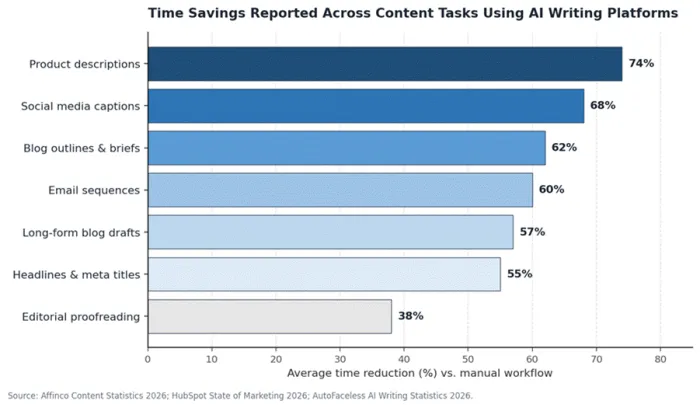
Figure 1. Time reduction across content tasks when assisted by AI writing platforms, 2026.
The Affinco 2026 content statistics report records 60 percent faster editing cycles and a 30 percent improvement in SEO rankings among teams using AI strategically. The lift comes from removing friction around the human contribution, not from AI outwriting humans.
Adoption Trends
The adoption curve has been steeper than most early forecasts. Three years after ChatGPT’s public launch, generative AI usage among content marketers is approaching universal penetration. Non-adoption is now the statistical outlier.
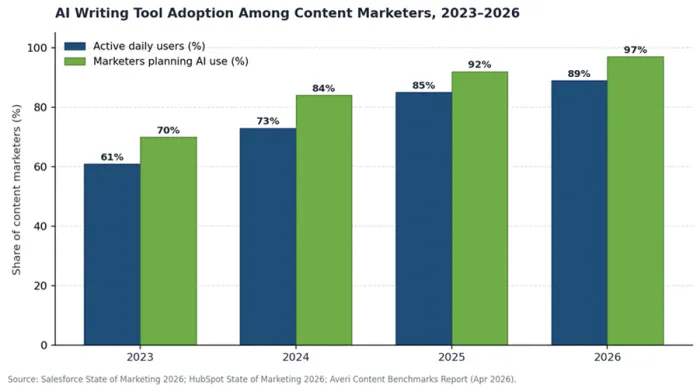
Figure 2. AI writing tool adoption among content marketers, 2023–2026.
Manual vs AI Workflow
A direct comparison clarifies where the hours actually move. The figures below cover a typical 2,000-word, SEO-targeted blog post, using blended internal labor rates near $50 per hour and current mid-tier platform pricing.
| Stage | Manual | AI-Augmented | Reduction | Risk Level |
|---|---|---|---|---|
| Topic and keyword research | 90–120 min | 20–30 min | 70–75% | Low |
| SERP analysis and brief | 60–90 min | 10–15 min | ~83% | Low |
| Outline development | 30–45 min | 5–10 min | ~80% | Low |
| First draft writing | 180–240 min | 60–90 min | ~60% | Medium |
| SEO optimization pass | 45–60 min | 15–20 min | ~67% | Low |
| Editorial review and fact-check | 60–90 min | 60–90 min | 0% (preserved) | High if skipped |
| Final proofread and polish | 30–45 min | 20–30 min | ~33% | Medium |
| Total per article | ~8.5 hours | ~3.2 hours | ≈ 62% reduction | Mixed |
Table 4. Stage-by-stage workflow comparison for a 2,000-word SEO-targeted blog post.
The non-negotiable principle: editorial review hours stay flat. The Harvard Business School controlled study, widely cited in 2026 productivity reports, found AI users completed tasks 25.1 percent faster and earned 40 percent higher quality ratings, but only when human editorial review remained intact. Skipping verification is where productivity programs collapse into quality crises.
ROI by Use Case
Productivity gains alone do not justify investment. Returns depend heavily on the use case applied. McKinsey’s Global AI Survey, referenced across 2026 marketing analyses, places content drafting and personalization at the top of the ROI ladder.
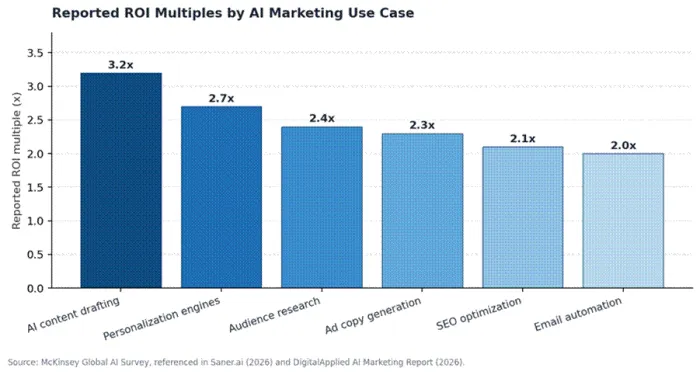
Figure 3. Reported ROI multiples by AI marketing use case.
A 3.2x return on AI content drafting reflects three compounding factors: faster production, lower cost per piece, and higher publish frequency that strengthens topical authority over time. DigitalApplied’s 2026 dataset shows 68 percent of businesses report increased content marketing ROI from AI-supported programs, with 65 percent reporting improved SEO performance.
SEO and Topical Authority
Algorithmic preference has shifted decisively toward content that demonstrates direct experience, verifiable expertise, and trustworthy sourcing. AI writing platforms support this by structuring topical maps, surfacing semantic gaps, and enforcing entity coverage. They do not manufacture experience.
Generative Engine Optimization, the discipline of ranking inside AI answer engines such as ChatGPT, Perplexity, Claude, Gemini, and Google AI Overviews, has emerged as a parallel layer. With AI Overviews now triggering on 55 percent of Google searches and AI-referred sessions growing more than fivefold year-over-year, editorial programs that ignore GEO are leaving compounding traffic unaddressed.
Limitations and Risks
AutoFaceless 2026 statistics indicate that 74 percent of new web pages now contain AI-generated content, while 44 percent of users regularly correct factual errors in AI output. Consumer trust signals are softening: 52 percent reduce engagement when they suspect AI authorship, particularly in YMYL categories such as health and finance.
•Hallucinated citations: Drafts continue to fabricate plausible but incorrect sources.
•Surface-level uniqueness: Outputs from similar SERP analyses converge into homogeneous structures.
•Score-chasing distortion: Optimizing strictly for content scores yields unnatural keyword density.
•EEAT erosion: AI cannot generate first-person experience or original primary research.
•Brand voice drift: Without enforced voice models, drafts gravitate toward a generic corporate tone.
Choosing the Right Platform
Tool selection should follow editorial strategy, not the reverse. The framework below reflects practices observed across high-performing 2026 content programs.
•Match platform to content category: Surfer or Clearscope for SEO-led publishing, Jasper for brand campaigns, Frase for SEO–GEO programs, Writesonic for high-volume budgets.
•Build a two-layer stack: Pair an SEO optimizer with a long-form generator rather than expecting one tool to do both well.
•Invest in prompt and brief libraries: Output quality correlates more with prompt quality than with model selection.
•Treat editorial review as fixed cost: Do not cut the verification stage to chase faster cycles.
•Layer GEO from day one: AI search visibility is now a primary traffic source.
Final Take
AI writing platforms have moved from experimental productivity boosters to core editorial infrastructure. The teams gaining durable advantage in 2026 aren’t the ones publishing the most AI‑assisted content, but the ones using AI as a research and scaffolding layer while preserving editorial judgment, original analysis, and verifiable expertise. As the category matures, expect tighter integration with search data, stronger brand‑voice enforcement, and more automation around briefs, drafts, and post‑publish performance, while pricing at the low end continues to compress.
Within that landscape, a specialist content hub like Writenexa sits in an interesting position. Instead of acting as a one‑click generator, it frames AI inside a larger editorial process: topic discovery grounded in real search demand, structured outlines tied to intent, and drafting that keeps a human editor firmly in the loop. Used this way, itbecomes a workspace where style guides, research, and revision history live alongside AI assistance, helping teams keep voice and factual standards consistent. The real moat in 2026 belongs to operators who treat AI as an accelerant for editorial standards, not a replacement, and who build their stack around systems that make that standard easy to repeat.