Most people do not choose a reading app so much as inherit one. A Kindle arrives as a gift, an iPhone ships with Apple Books on the home screen, or a friend swears by Kobo until it sticks. Yet that quiet default decides a great deal: which books sit within reach, what a reading habit costs each month, and whether a library survives the day a reader switches devices.
Before it is simply a place to keep eBooks, a reading app has three jobs: reading, tracking, and listening.
Three names own the conversation in 2026, and from a distance they look like the same product wearing different logos. Up close, after a stretch of switching between them on a commute and a couch, the personalities separate sharply. What follows is where each one earns its place, where each grates, and which reader each was built for.
Kindle vs Kobo vs Apple Books at a glance
Reduced to a sentence each: Kindle optimises for selection and convenience, Kobo for openness and reader ownership, Apple Books for design and effortless integration. Those instincts shape nearly every feature that follows, from the file formats each one accepts to how a borrowed library book behaves once the loan ends. The table below is the short version for anyone who wants the verdict before the reasoning that follows.
| At a glance | Amazon Kindle | Rakuten Kobo | Apple Books |
|---|---|---|---|
| Built for | Biggest catalogue, Audible listeners, casual buyers | EPUB freedom, library borrowing, leaving Amazon | iPhone and Mac owners who want zero setup |
| Reads on | iOS, Android, Windows, Mac, web, e-ink | iOS, Android, web, e-ink | iPhone, iPad, Mac only |
| Native EPUB | No, converts via Send to Kindle | Yes, directly | Yes, directly |
| Library loans | Libby and OverDrive, mainly US | OverDrive built in, very strong | None inside the app |
| Subscription | Kindle Unlimited, $11.99 a month | Kobo Plus, from $7.99 a month | None, books bought per title |
| Audiobooks | Audible, the largest catalogue | Kobo Audiobooks | Per title, plus AI narration |
| Standout | Whispersync and new AI reading tools | StoryGraph sync and reading stats | Smooth ebook to audiobook, design |
| Watch for | Locked to Amazon formats | Smaller store, slower app | No Android, no web, no loans |
The 2026 reading landscape in one chart
One number frames everything else. By the most recent industry estimates, roughly four out of five e-readers shipped worldwide are Kindles, with Kobo a distant second near one in ten, and every other brand, from Boox to PocketBook to reMarkable, splitting what remains. Trackers such as Mordor Intelligence place Amazon's hardware share somewhere between 70 and 80 percent, depending on the year and region surveyed.
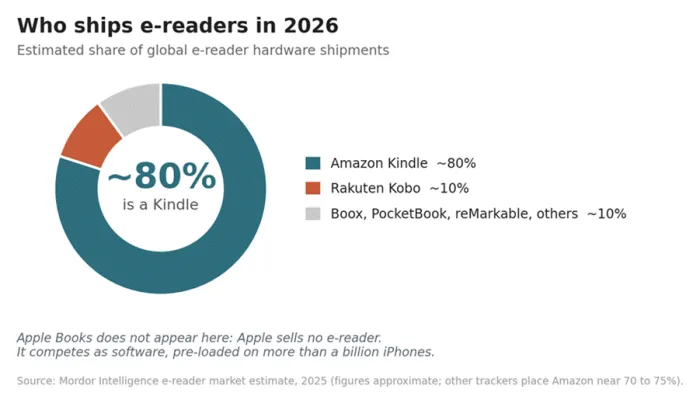
Global e-reader hardware shipments, 2025 estimate. Apple is absent because it builds no e-reader.
That lopsided picture explains why Kindle is the default and why leaving it can feel like work. Three points cut through the noise:
• Amazon owns the shelf: four in five e-readers sold are Kindles, so most readers start there by inheritance rather than choice.
• Apple plays a different game: it builds no e-reader at all, yet Apple Books rides on more than a billion iPhones, iPads, and Macs, and by installed reach may sit in more pockets than any Kindle.
• Hardware versus software: Kindle and Kobo pair devices with apps that reinforce each other, while Apple Books competes purely as software.
The right choice turns on a single question: does a reader want a device built for books, the freedom to read anywhere, or the most pleasant app already living on the phone?
The sections that follow unpack each app in turn, starting with the one almost everyone meets first.
Amazon Kindle: the default that is hard to leave
Kindle wins on sheer scale. The Kindle Store remains the largest commercial library in the business, and Kindle Unlimited alone now spans more than four million ebooks, around 700,000 audiobooks, and tens of thousands of comics and magazines. A 2026 deal with Kodansha folded in hundreds of manga series, joining existing DC and Marvel catalogues. For a reader who follows long indie fantasy or romance series, borrowing eight books in a row for one monthly fee so kindle said to be one of the best app to read Ebooks is a value almost nobody else matches.

The deeper advantage is Audible. Amazon owns the dominant audiobook store, and Whispersync lets a reader drift between the ebook and the narration without losing the spot. Add long-standing touches like X-Ray for characters and places, Word Wise for tricky vocabulary, tight Goodreads links, and newer on-device AI tools such as Ask This Book and Story So Far, and the experience feels considered.
Where it shines
• Catalogue: the broadest selection of ebooks, audiobooks, comics, and manga anywhere.
• Audible and Whispersync: the strongest audiobook story of the three, with seamless switching.
• Everywhere access: apps for iOS, Android, Windows, Mac, the web, plus Kindle and Fire hardware.
Where it grates
• Format lock-in: Kindle uses Amazon's own formats and does not read EPUB directly; outside files route through Send to Kindle, which converts them and can shuffle formatting.
• Library limits: Libby borrowing to a Kindle is largely a United States feature, leaving many readers abroad without it.
• The exit cost: a Kindle Unlimited library and Amazon-format purchases stay inside Amazon, so switching brands means starting over.
Rakuten Kobo: the open, reader-first option
Kobo built its identity as the friendly opposite of a walled garden. The app and Kobo devices open EPUB files directly, alongside PDF, MOBI, plain text, and comic formats like CBZ and CBR, which makes Kobo a natural home for sideloaded purchases and DRM-free collections. Adobe DRM means library books load cleanly, and Google Drive and Dropbox keep personal documents in sync.
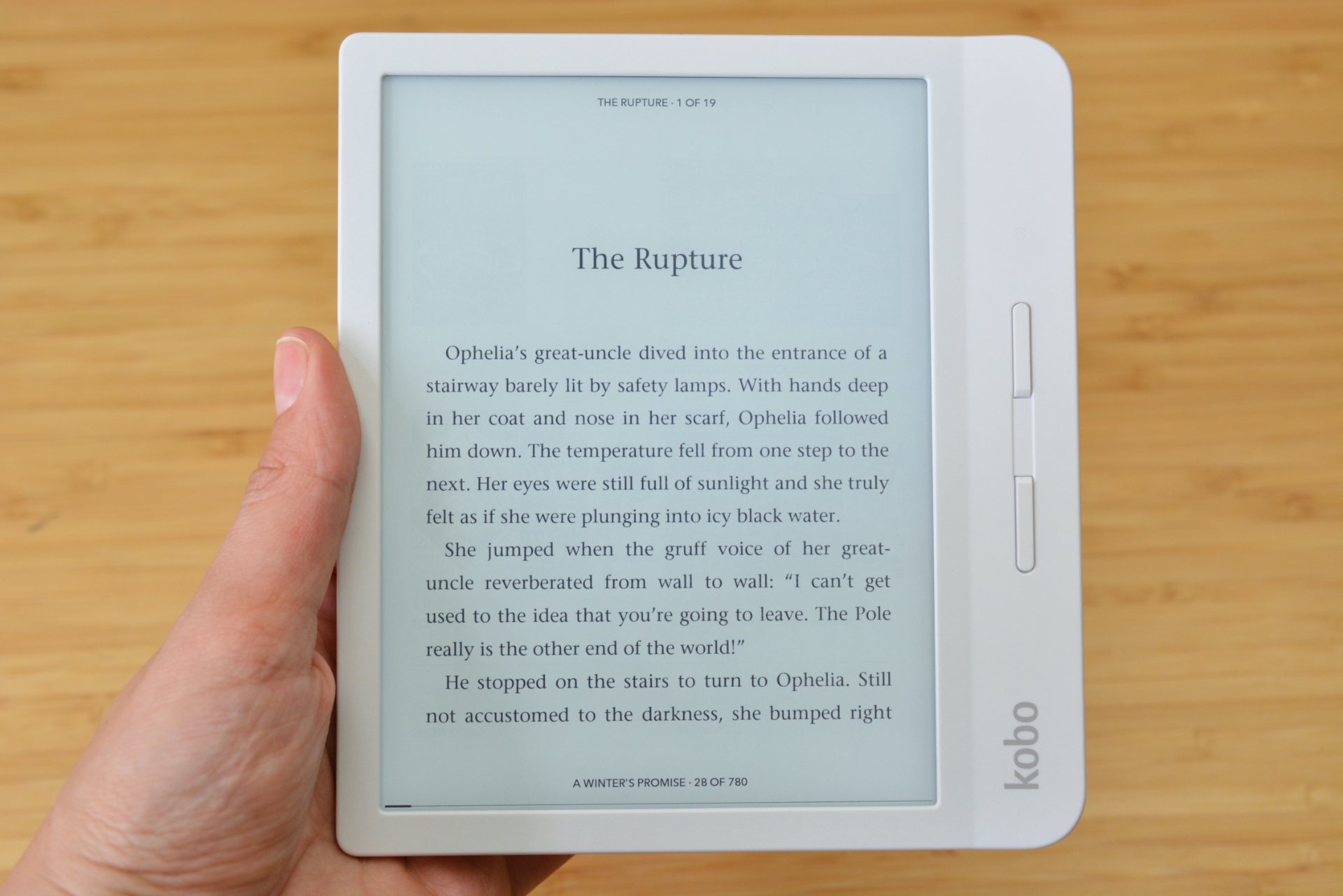
Borrowing is where Kobo pulls ahead. OverDrive is woven into the device itself in supported regions, so searching a local library and sending a loan to the reader happens without ever opening a second app. For anyone who treats the public library as a primary source of books, that integration alone can settle the decision.
Kobo has also courted readers tired of Amazon's grip on tracking. A native StoryGraph integration, rolled out across 2025 and 2026, syncs reading progress with the independent, recommendation-driven alternative to Goodreads. Built-in statistics, an Instapaper tie-in that replaced the retired Pocket service in 2025, and an iFixit repairability partnership round out a platform that treats the reader, not the store, as the centre of gravity.
Where it shines
• True EPUB freedom: reads the open standard and a long list of other formats without conversion.
• Best-in-class borrowing: OverDrive library loans built straight into the device.
• Reader-first extras: StoryGraph sync, detailed reading stats, repairable hardware, and recycled materials.
• Flexible value: Kobo Plus splits into reading-only, listening-only, or combined tiers, with no cap on how many titles sit on loan.
Where it grates
• Smaller shelves: the Kobo store and Kobo Plus carry fewer mainstream and brand-new releases than Amazon, leaning heavily on indie titles.
• Software polish: the app and device interface can feel slower and less refined than Kindle's.
• Audiobook gap: no Audible, and Kobo Plus audiobooks are locked to Kobo hardware and apps; availability also shifts by country.
Apple Books: elegant, effortless, and walled in
Apple Books asks for nothing. It is already installed on every iPhone, iPad, and Mac, signed in under an existing Apple Account, with the cleanest typography and the calmest interface of the three. There are no ads or upsells, and a reader can open a book seconds after buying it. For someone who lives inside Apple's ecosystem, that absence of setup is the whole appeal.
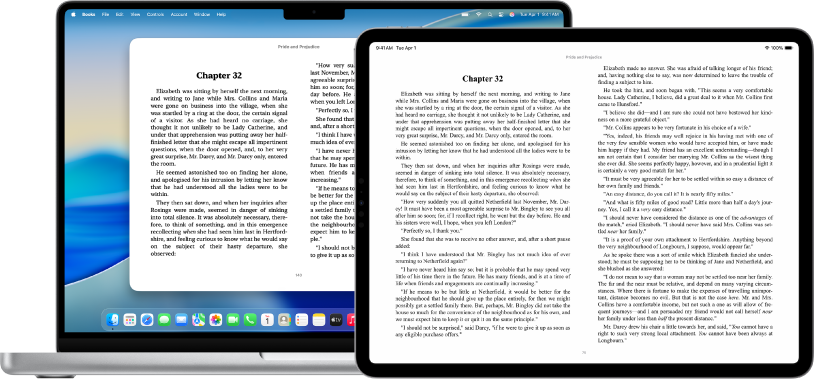
As an app, it is quietly capable. Apple Books reads EPUB and PDF natively, syncs files through iCloud, and accepts documents over AirDrop in a couple of taps, a tidy home for a reader's own collection. Reading Goals nudge a daily habit, and the design carries over to audiobooks, where a reader can switch between an ebook and its narration in one title.
Apple's most talked-about move is digital narration. Titles tagged Narrated by Apple Books use AI-generated voices to turn ebooks into audiobooks, a programme aimed at indie authors and small publishers who could never afford a studio. Listener reaction stays mixed, with some finding the voices natural and others hearing the seams, but the catalogue keeps growing. Notably, one rival, Audible, still refuses AI-narrated titles, which gives Apple an opening with independent creators.
Where it shines
• Zero friction: pre-installed, pre-signed-in, and ready the moment an iPhone is unlocked.
• Design and calm: the most refined typography and reading interface, with no advertising.
• Personal library: native EPUB and PDF, iCloud sync, and AirDrop make it ideal for a reader's own files.
Where it grates
• Apple only: no Android app, no Windows app, and no web reader, so the library never leaves Apple's devices.
• No subscription: every book is bought individually, which adds up fast for anyone reading several a month.
• No borrowing inside the app: library loans require the separate Libby app, since Apple Books offers no OverDrive link of its own.
Where each app travels, and what it opens
Two practical questions decide more day-to-day happiness than catalogue size: where a library can travel, and which files an app will open. On reach, the gap is wide:
• Kindle goes everywhere: iOS, Android, Windows, Mac, the web, and e-ink, so a library follows a reader from a work laptop to a phone to a bedside reader.
• Kobo travels widely: iOS, Android, a web reader, and its own hardware, though without dedicated Windows or Mac apps.
• Apple Books stays home: iPhone, iPad, and Mac only, with no Android app and no web reader.
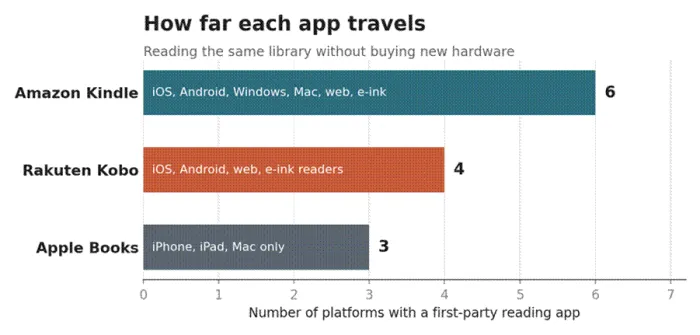
Surfaces with a first-party reading app. Kindle travels furthest; Apple Books stays on Apple hardware.
Formats tell a parallel story. Kobo accepts the open EPUB standard and a wide range of other files directly, which matters for sideloading, comics, and DRM-free books. Apple Books handles EPUB and PDF without fuss. Kindle, by contrast, converts EPUB through Send to Kindle and otherwise prefers Amazon's own formats. The full breakdown sits below.
| Files and reach | Amazon Kindle | Rakuten Kobo | Apple Books |
|---|---|---|---|
| Native formats | Kindle formats (AZW, KFX), PDF | EPUB, PDF, MOBI, CBZ, CBR, TXT | EPUB, PDF |
| Personal EPUB files | Via Send to Kindle, converted | Yes, opens directly | Yes, opens directly |
| Comics and manga files | Limited | CBZ and CBR supported | EPUB or PDF only |
| Library borrowing | Libby to Kindle (US) | OverDrive built in | Use Libby app separately |
| Read-it-later | None native | Instapaper | None native |
| Web reader | Yes (read.amazon.com) | Yes | No |
| File sync | Send to Kindle | Google Drive, Dropbox | iCloud, AirDrop |
What reading actually costs
Buy a single new release and the three stores land within pennies of each other, because publishers set those prices under agency terms that leave little room to discount. The real cost difference lives in subscriptions and loyalty perks. Kindle Unlimited runs $11.99 a month for the deepest borrowing catalogue. Kobo Plus is cheaper and more flexible, at $7.99 a month for reading or listening alone and $9.99 for both, with no limit on titles held at once. Apple Books offers no subscription at all, so a heavy reader pays full freight on every title.
Kobo sweetens ownership further with Super Points and a VIP tier that trims the price of bought books, plus frequent promotions. Amazon counters with Prime Day and seasonal Kindle deals. Apple leans on the comfort of a single Apple Account rather than discounts.
| Pricing | Amazon Kindle | Rakuten Kobo | Apple Books |
|---|---|---|---|
| Buy single ebook | Yes (Kindle Store) | Yes (Kobo Store) | Yes (Book Store) |
| Subscription | Kindle Unlimited | Kobo Plus | None |
| Monthly price | $11.99 | $7.99 single, $9.99 both | Not offered |
| In the subscription | 4M+ ebooks, 700k audiobooks | ~1.5M ebooks, ~150k audiobooks | Not offered |
| Borrow limit | 20 titles at a time | No limit | Not offered |
| Audiobook plan | Audible, $14.95 a month | Kobo Plus Listen | Bought per title |
| Free trial | 30 days | 30 days | Not offered |
| Loyalty perks | Prime and seasonal deals | Super Points and VIP | Single Apple Account |
The pattern is consistent, and it sorts neatly by reading habit:
• Heavy readers, three or more books a month: a subscription wins, with Kobo Plus the cheaper entry and Kindle Unlimited the deeper shelf.
• Audiobook devotees: Audible's catalogue is unmatched, while Kobo Plus Listen is the better value for lighter listening.
• Light or occasional readers: buying titles outright costs least, the lane where Apple Books fits without penalty.
Audiobooks and the new AI features
Listening has become a battleground of its own. Amazon holds the high ground through Audible, the largest audiobook store anywhere, with Whispersync stitching ebook and audio into one experience and Kindle Unlimited bundling hundreds of thousands of titles. Kobo answers with its own audiobook store and the Kobo Plus Listen tier, a smaller but steadily growing library. Apple keeps audiobooks à la carte and adds its AI-narrated catalogue on top.
The artificial-intelligence story splits along revealing lines:
• Kindle points AI at reading: tools that answer questions about a book and recap the story so far, without spoiling what lies ahead.
• Apple points AI at production: synthetic voices turn ebooks into audiobooks at scale, opening narration to authors who could never afford a studio.
• Kobo keeps it human: discovery runs through a StoryGraph partnership rather than generated content.
Even so, the audience stays modest. Industry researcher MIDiA puts monthly audiobook listening at about 11 percent of consumers, and only a fraction reach for Apple Books, a sign that the format, for all the investment, is still finding its readers.
The verdict: which reading app wins in 2026
After living with all three, the honest answer is that none of them wins outright, because they are not really chasing the same reader. The best app is the one that matches how a person already reads.
• Choose Kindle for the widest world of books. Anyone who listens through Audible, follows long series, reads across a laptop and a phone, or simply wants everything in one familiar place will be best served here. The catalogue and the audiobook integration are unmatched, and the lock-in only stings on the way out.
• Choose Kobo for ownership and the public library. Readers who borrow constantly, hoard EPUB and DRM-free files, want detailed stats and StoryGraph instead of Amazon's tracking, or feel uneasy handing Amazon another habit will find Kobo the more principled and more flexible home, as long as the smaller store and rougher app are acceptable trades.
• Choose Apple Books for the path of least resistance. The committed iPhone or Mac owner who buys a handful of books a year, keeps a personal shelf of EPUB and PDF files, and prizes a calm, beautiful, no-setup app will be perfectly happy, provided Android access, web reading, and in-app library loans are never needed.
The decision, in the end, is less about which app is objectively best and more about which compromise a reader can live with for years: Amazon's scale and its leash, Kobo's freedom and its smaller shelves, or Apple's polish and its walls. Settle that question first, and the right app stops being a debate and starts being obvious.